
The Cycle, and Where It Operates
Calvin and his co-workers worked out the whole pathway and showed that the pathway operated in a cyclic manner - the was regenerated. That is what makes it a cycle rather than a straight line: the acceptor is rebuilt at the end, so the next molecule has something to attach to.
Understand one thing very clearly at the outset. The Calvin pathway occurs in all photosynthetic plants. It does not matter whether they have or or any other pathway.
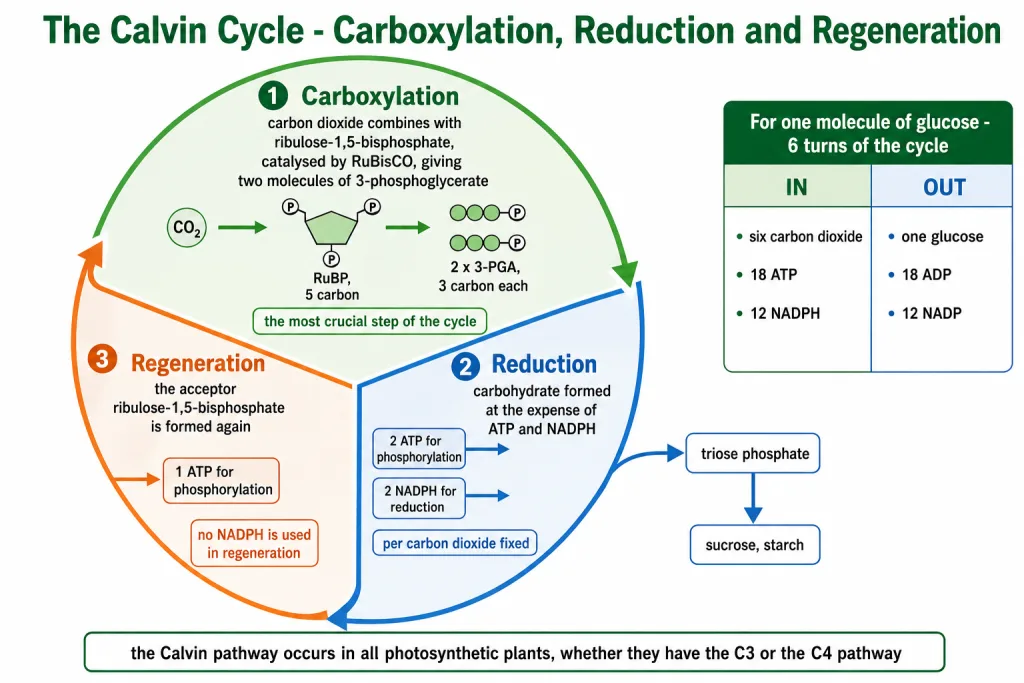
For ease of understanding, the Calvin cycle can be described under three stages:
- Carboxylation
- Reduction
- Regeneration
[NEET Important] The one statement that gets tested more than any other from this section is "the Calvin pathway occurs in all photosynthetic plants". A plant is not an alternative to the Calvin cycle - it is an extra pump in front of the same Calvin cycle. Any option that says plants do not run the Calvin cycle is wrong. Also fix the order of the three stages - carboxylation, then reduction, then regeneration - because scrambled-order options are standard.
Stage 1 - Carboxylation
Carboxylation is the fixation of into a stable organic intermediate.
Carboxylation is the most crucial step of the Calvin cycle, and it is where is utilised for the carboxylation of . This reaction is catalysed by the enzyme carboxylase, and it results in the formation of two molecules of 3-PGA.
Since this enzyme also has an oxygenation activity, it would be more correct to call it carboxylase-oxygenase, or RuBisCO.
| Point | Detail |
|---|---|
| What carboxylation is | The fixation of into a stable organic intermediate |
| Its rank in the cycle | The most crucial step |
| What accepts the | , a 5-carbon ketose sugar |
| The enzyme | carboxylase-oxygenase, RuBisCO |
| The product | Two molecules of 3-PGA |
[NEET Important] Two exact words earn the marks here. "Most crucial step" belongs to carboxylation, not to reduction. And the full name of the enzyme is carboxylase-oxygenase, because the enzyme also has an oxygenation activity - that second activity is the whole basis of photorespiration, which comes next in the chapter. Note also that two molecules of 3-PGA are formed, not one.
Stage 2 - Reduction, and Stage 3 - Regeneration
Reduction. These are a series of reactions that lead to the formation of glucose. The steps involve the utilisation of 2 molecules of ATP for phosphorylation and two of NADPH for reduction, per molecule fixed. The fixation of six molecules of and 6 turns of the cycle are required for the formation of one molecule of glucose from the pathway.
Regeneration. Regeneration of the acceptor molecule is crucial if the cycle is to continue uninterrupted. The regeneration steps require one ATP for phosphorylation to form .
| Stage | What happens in it | What it costs, per fixed |
|---|---|---|
| Carboxylation | is fixed onto by RuBisCO to give two 3-PGA | Nothing |
| Reduction | A series of reactions leading to the formation of glucose | 2 ATP for phosphorylation and 2 NADPH for reduction |
| Regeneration | The acceptor is formed again | 1 ATP for phosphorylation |
[NEET Important] Keep the two ATP costs apart, because that separation is the whole basis of the numbers in the next block. The 2 ATP belong to reduction, and the 1 ATP belongs to regeneration. NADPH is used only in reduction - regeneration uses no NADPH at all. A question asking "how much NADPH does regeneration need" is answered by none.
The Arithmetic You Will Be Asked
This is the most examined thing in the section, so set it out step by step.
Per one molecule of entering the Calvin cycle:
- Reduction uses 2 ATP and 2 NADPH.
- Regeneration uses 1 ATP.
- Hence for every molecule entering the Calvin cycle, 3 molecules of ATP and 2 of NADPH are required.
Notice that the two numbers are not equal - 3 ATP against 2 NADPH. It is probably to meet this difference in the number of ATP and NADPH used in the dark reaction that the cyclic phosphorylation takes place, since cyclic photophosphorylation makes ATP without making NADPH.
To make one molecule of glucose, 6 turns of the cycle are required. Multiply everything by six:
- = six
- ATP = 18 ATP
- NADPH = 12 NADPH
What goes in and what comes out of the Calvin cycle:
| In | Out |
|---|---|
| Six | One glucose |
| 18 ATP | 18 ADP |
| 12 NADPH | 12 NADP |
[NEET Important] Learn the ladder 3 ATP and 2 NADPH per , then 6 turns, then 18 ATP and 12 NADPH per glucose. The favourite wrong option is 12 ATP and 12 NADPH, produced by a student who forgot the one extra ATP spent in regeneration. And the reason the chapter gives for cyclic phosphorylation is exactly this mismatch between the ATP and the NADPH demand.
Quick Recap
- Calvin and his co-workers worked out the whole pathway and showed that it operated in a cyclic manner - the was regenerated.
- The Calvin pathway occurs in all photosynthetic plants; it does not matter whether they have or or any other pathway.
- Three stages, in order: carboxylation, reduction, regeneration.
- Carboxylation is the fixation of into a stable organic intermediate, and is the most crucial step of the Calvin cycle.
- is utilised for the carboxylation of , catalysed by carboxylase, resulting in the formation of two molecules of 3-PGA.
- Since the enzyme also has an oxygenation activity it is more correctly called carboxylase-oxygenase, or RuBisCO.
- Reduction is a series of reactions that lead to the formation of glucose.
- Reduction uses 2 molecules of ATP for phosphorylation and two of NADPH for reduction, per molecule fixed.
- The fixation of six molecules of and 6 turns of the cycle are required for the formation of one molecule of glucose.
- Regeneration of the acceptor molecule is crucial if the cycle is to continue uninterrupted, and the regeneration steps require one ATP for phosphorylation to form .
- For every molecule entering the Calvin cycle, 3 molecules of ATP and 2 of NADPH are required.
- It is probably to meet this difference in the number of ATP and NADPH used in the dark reaction that the cyclic phosphorylation takes place.
- In and out for one glucose: in - six , 18 ATP, 12 NADPH; out - one glucose, 18 ADP, 12 NADP.
Solved Examples
Question 1
Q. Why is the Calvin pathway called a cycle?
Answer. Because Calvin and his co-workers showed that the pathway operated in a cyclic manner - the was regenerated at the end. The acceptor comes back, so the pathway can run again on the next molecule without stopping.
Question 2
Q. In which plants does the Calvin pathway occur?
Answer. In all photosynthetic plants. It does not matter whether they have or or any other pathway. A plant still makes its sugar through the Calvin cycle.
Question 3
Q. Name the three stages of the Calvin cycle in order.
Answer. Carboxylation, then reduction, then regeneration.
Question 4
Q. Define carboxylation and say why it is important.
Answer. Carboxylation is the fixation of into a stable organic intermediate. It is the most crucial step of the Calvin cycle, because it is where is utilised for the carboxylation of - the point at which carbon actually enters the plant.
Question 5
Q. Which enzyme catalyses carboxylation, and what is formed?
Answer. carboxylase. The reaction results in the formation of two molecules of 3-PGA:
Question 6
Q. Why is the enzyme more correctly called RuBisCO?
Answer. Because it also has an oxygenation activity, besides its carboxylation activity. So the fuller and more correct name is carboxylase-oxygenase, shortened to RuBisCO.
Question 7
Q. What happens in the reduction stage?
Answer. It is a series of reactions that lead to the formation of glucose. The steps involve the utilisation of 2 molecules of ATP for phosphorylation and two of NADPH for reduction, per molecule fixed.
Question 8
Q. Why is regeneration crucial, and what does it cost?
Answer. Regeneration of the acceptor molecule is crucial if the cycle is to continue uninterrupted - without it there would be nothing left for the next to attach to. The regeneration steps require one ATP for phosphorylation to form .
Question 9
Q. How many ATP and NADPH molecules are required for every carbon dioxide molecule entering the Calvin cycle? Show where each comes from.
Answer. 3 molecules of ATP and 2 of NADPH. They break up as 2 ATP and 2 NADPH in the reduction stage, plus 1 ATP in the regeneration stage. Regeneration uses no NADPH.
Question 10
Q. How many turns of the cycle and how many carbon dioxide molecules are needed for one molecule of glucose?
Answer. 6 turns of the cycle, fixing six molecules of .
Question 11
Q. Work out how many ATP and NADPH molecules are required to make one molecule of glucose through the Calvin pathway.
Answer. 18 ATP and 12 NADPH.
Per the cycle needs 3 ATP and 2 NADPH. One glucose needs 6 turns, so multiply by six: ATP and NADPH.
Question 12
Q. Set out what goes in and what comes out of the Calvin cycle for one molecule of glucose.
Answer.
| In | Out |
|---|---|
| Six | One glucose |
| 18 ATP | 18 ADP |
| 12 NADPH | 12 NADP |
Question 13
Q. Why is cyclic phosphorylation thought to take place?
Answer. Because the Calvin cycle needs 3 ATP but only 2 NADPH for every fixed. It is probably to meet this difference in the number of ATP and NADPH used in the dark reaction that the cyclic phosphorylation takes place - cyclic photophosphorylation makes the extra ATP without making any NADPH.
Question 14
Q. A student writes that 12 ATP and 12 NADPH are needed for one glucose. Where has the student gone wrong?
Answer. The student has counted only the reduction stage, which uses 2 ATP and 2 NADPH per . The 1 ATP spent in regeneration has been left out. The correct cost per is 3 ATP and 2 NADPH, so for 6 turns it is 18 ATP and 12 NADPH.