
Where Photosynthesis Takes Place
Photosynthesis does take place in the green leaves of plants, but it does so also in other green parts of the plants.
The mesophyll cells in the leaves have a large number of chloroplasts. Usually the chloroplasts align themselves along the walls of the mesophyll cells, such that they get the optimum quantity of the incident light.
Within the chloroplast there is a membranous system consisting of the grana, the stroma lamellae, and the matrix stroma, and there is a clear division of labour within the chloroplast.
| Part of the chloroplast | What it does |
|---|---|
| The membrane system - grana and stroma lamellae | Trapping the light energy, and the synthesis of ATP and NADPH |
| The stroma | Enzymatic reactions synthesise sugar, which in turn forms starch |
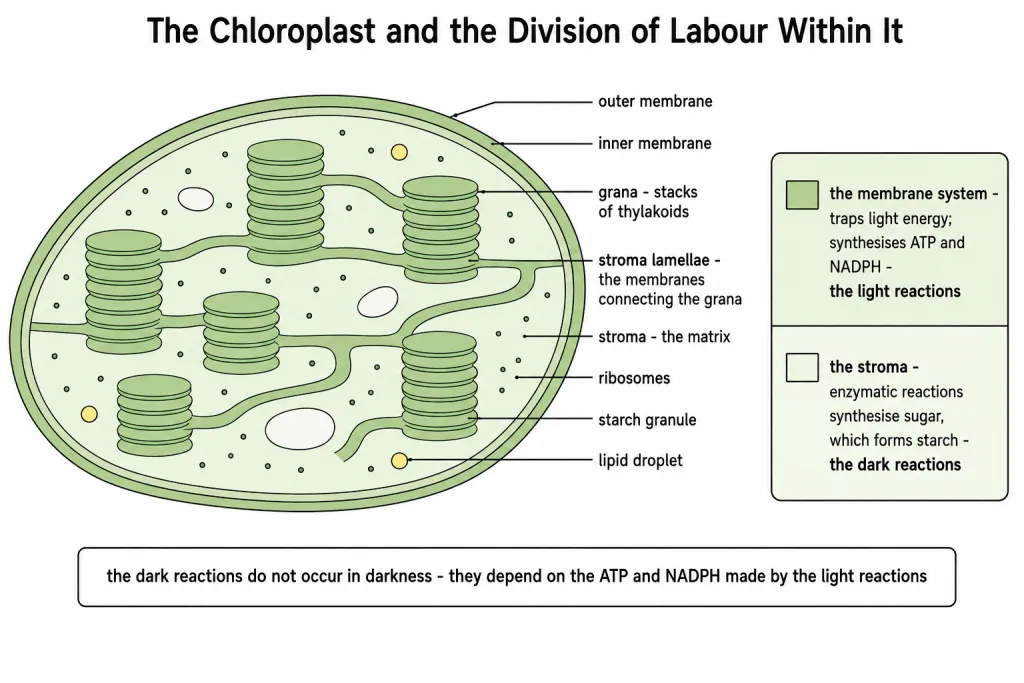
The two sets of reactions, and their names.
- The membrane reactions are directly light driven and are called light reactions, or photochemical reactions.
- The stroma reactions are not directly light driven but are dependent on the products of the light reactions - ATP and NADPH. To distinguish them they are called, by convention, dark reactions, or carbon reactions.
[NEET Important] The chapter itself warns you off the trap in the name: "this should not be construed to mean that they occur in darkness or that they are not light-dependent". The dark reactions do not need darkness and do stop when light stops, because their inputs come from the light reactions. Any option saying dark reactions happen at night, or happen without light, is wrong.
The Four Pigments
A chromatographic separation of the leaf pigments shows that the colour we see in leaves is not due to a single pigment but due to four pigments.
| Pigment | Colour in the chromatogram |
|---|---|
| Chlorophyll a | Bright or blue green |
| Chlorophyll b | Yellow green |
| Xanthophylls | Yellow |
| Carotenoids | Yellow to yellow-orange |
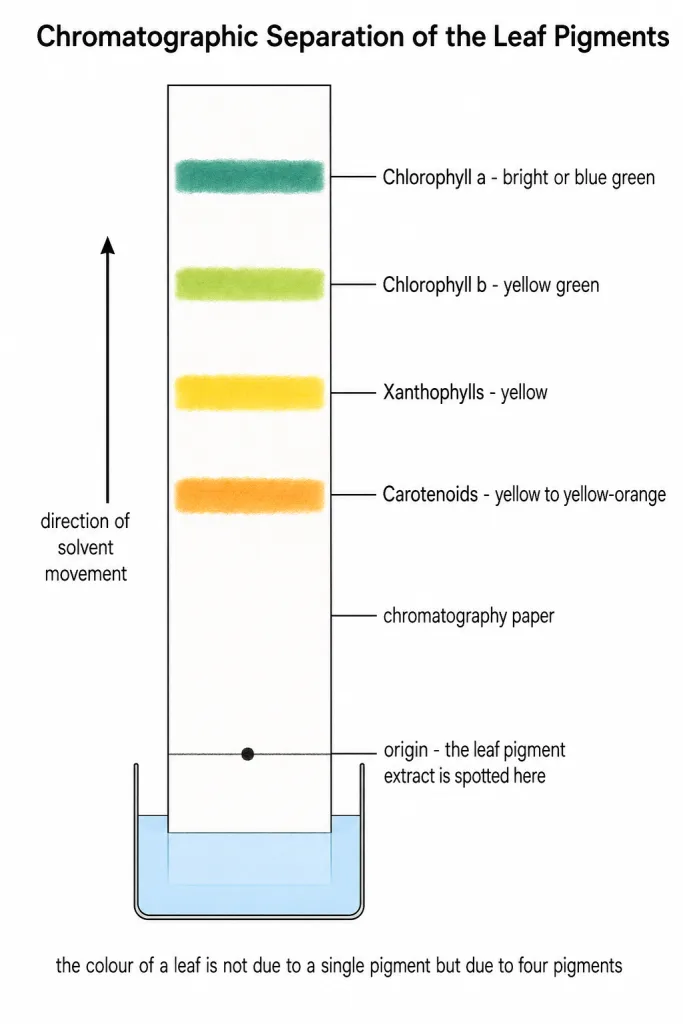
Pigments are substances that have an ability to absorb light, at specific wavelengths.
[NEET Important] The order of the four bands and their colours is asked directly, so learn the table as a block. Note that chlorophyll a is bright or blue green while chlorophyll b is yellow green - the two are constantly swapped in options.
Absorption Spectrum and Action Spectrum
Two different graphs, two different meanings, and telling them apart is most of what this section is examined on.
- An absorption spectrum plots how much light a pigment absorbs at each wavelength.
- An action spectrum plots the rate of photosynthesis at each wavelength.
Chlorophyll a shows maximum absorption in the blue and the red regions, and the wavelengths at which there is maximum absorption by chlorophyll a also show a higher rate of photosynthesis. Hence we can conclude that chlorophyll a is the chief pigment associated with photosynthesis.
But there is no complete one-to-one overlap between the absorption spectrum of chlorophyll a and the action spectrum of photosynthesis.
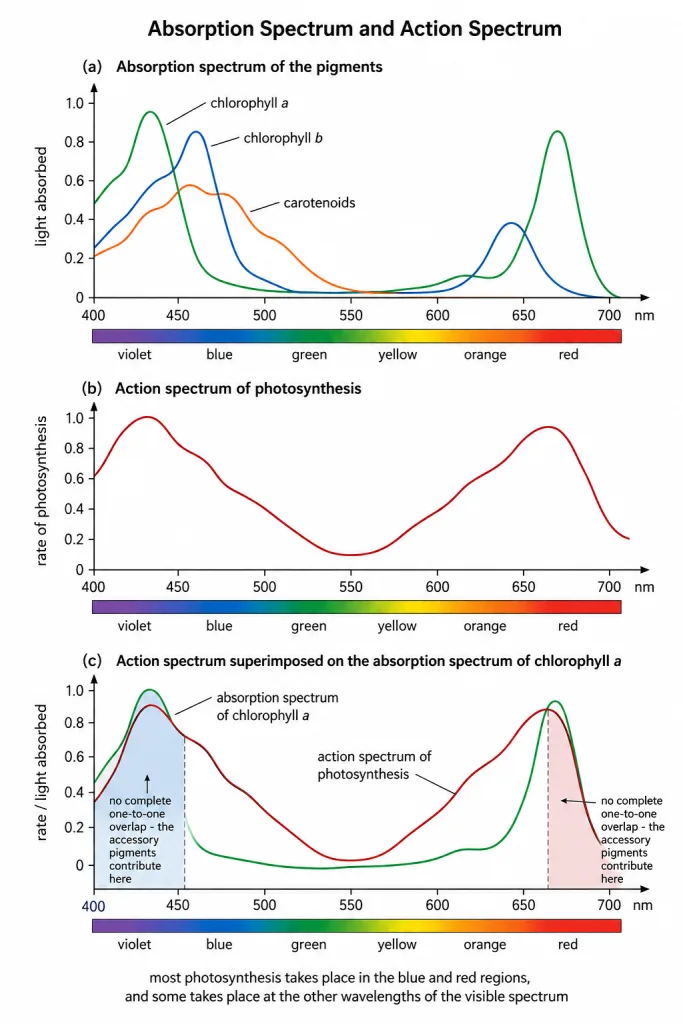
These graphs, together, show that most of the photosynthesis takes place in the blue and red regions of the spectrum, and that some photosynthesis does take place at the other wavelengths of the visible spectrum.
Why the gap exists. Though chlorophyll is the major pigment responsible for trapping light, other thylakoid pigments - chlorophyll b, xanthophylls and carotenoids - which are called accessory pigments, also absorb light and transfer the energy to chlorophyll a.
They do two jobs:
- They enable a wider range of wavelengths of incoming light to be utilised for photosynthesis.
- They protect chlorophyll a from photo-oxidation.
[NEET Important] The imperfect overlap is the point of the third graph, not a detail. It is the evidence that pigments other than chlorophyll a are contributing - which is exactly why the accessory pigments exist. A question asking "why do plants have chlorophyll b and other accessory pigments" wants both functions: wider wavelength range and protection of chlorophyll a from photo-oxidation.
Quick Recap
- Photosynthesis occurs in the green leaves and also in other green parts of the plant.
- Mesophyll cells have a large number of chloroplasts, which align along the walls to get the optimum quantity of incident light.
- The chloroplast membrane system is the grana, the stroma lamellae and the matrix stroma.
- Division of labour: the membrane system traps light energy and synthesises ATP and NADPH; the stroma runs the enzymatic reactions that synthesise sugar, which forms starch.
- Light reactions, or photochemical reactions - directly light driven. Dark reactions, or carbon reactions - not directly light driven, but dependent on ATP and NADPH from the light reactions. They do not occur in darkness and are not light-independent.
- Four leaf pigments: chlorophyll a (bright or blue green), chlorophyll b (yellow green), xanthophylls (yellow), carotenoids (yellow to yellow-orange).
- Pigments absorb light at specific wavelengths.
- Chlorophyll a absorbs maximally in the blue and red regions, and those regions also show the highest rate of photosynthesis - so chlorophyll a is the chief pigment associated with photosynthesis.
- There is no complete one-to-one overlap between the absorption spectrum of chlorophyll a and the action spectrum of photosynthesis.
- Accessory pigments - chlorophyll b, xanthophylls, carotenoids - absorb light and transfer the energy to chlorophyll a.
- Accessory pigments enable a wider range of wavelengths to be used, and protect chlorophyll a from photo-oxidation.
Solved Examples
Question 1
Q. Besides the green leaf, where else does photosynthesis occur?
Answer. In other green parts of the plants. Any part with chloroplasts can photosynthesise.
Question 2
Q. Why do chloroplasts align themselves along the walls of mesophyll cells?
Answer. So that they get the optimum quantity of the incident light.
Question 3
Q. Describe the division of labour within the chloroplast.
Answer. The membrane system - the grana and stroma lamellae - is responsible for trapping the light energy and also for the synthesis of ATP and NADPH. In the stroma, enzymatic reactions synthesise sugar, which in turn forms starch.
Question 4
Q. Why are the stroma reactions called dark reactions, and why is the name misleading?
Answer. They are called that only to distinguish them from the light reactions, since they are not directly light driven. The name is misleading because it does not mean they occur in darkness or that they are not light-dependent - they depend on ATP and NADPH, which the light reactions make, so they stop soon after the light stops.
Question 5
Q. Name the four pigments separated from a leaf by paper chromatography, with the colour of each.
Answer. Chlorophyll a - bright or blue green. Chlorophyll b - yellow green. Xanthophylls - yellow. Carotenoids - yellow to yellow-orange.
Question 6
Q. What is a pigment?
Answer. A substance that has an ability to absorb light at specific wavelengths.
Question 7
Q. Distinguish between an absorption spectrum and an action spectrum.
Answer. An absorption spectrum shows how much light a pigment absorbs at each wavelength. An action spectrum shows the rate of photosynthesis at each wavelength. One is about a molecule, the other about a process.
Question 8
Q. In which regions of the spectrum does chlorophyll a absorb most, and what happens to photosynthesis there?
Answer. In the blue and the red regions. The wavelengths at which there is maximum absorption by chlorophyll a also show a higher rate of photosynthesis, which is why chlorophyll a is the chief pigment associated with photosynthesis.
Question 9
Q. Is there a complete one-to-one overlap between the absorption spectrum of chlorophyll a and the action spectrum of photosynthesis?
Answer. No. Most of the photosynthesis takes place in the blue and red regions, but some photosynthesis does take place at the other wavelengths of the visible spectrum as well. The gap is evidence that other pigments are also contributing.
Question 10
Q. Name the accessory pigments and say what they do.
Answer. Chlorophyll b, xanthophylls and carotenoids. They absorb light and transfer the energy to chlorophyll a.
Question 11
Q. Suppose there were plants that had a high concentration of chlorophyll b but lacked chlorophyll a - would they carry out photosynthesis? Then why do plants have chlorophyll b and other accessory pigments? This is one of the chapter-end exercises.
Answer. No, they would not. Chlorophyll a is the chief pigment associated with photosynthesis, and it is the only pigment that forms the reaction centre of a photosystem. Every accessory pigment works by absorbing light and transferring the energy to chlorophyll a - so with no chlorophyll a there is nothing to hand the energy to, and the light reaction cannot begin. Chlorophyll b would absorb light and then have nowhere to send it.
So why keep the accessory pigments at all? For two reasons.
First, they widen the useful spectrum. Chlorophyll a absorbs mainly in the blue and red regions. The accessory pigments absorb at wavelengths chlorophyll a absorbs poorly and transfer that energy to chlorophyll a, so they enable a wider range of wavelengths of incoming light to be utilised for photosynthesis. This is exactly why the action spectrum of photosynthesis is broader than the absorption spectrum of chlorophyll a, and why there is no complete one-to-one overlap between the two.
Second, they protect chlorophyll a from photo-oxidation. In bright light chlorophyll a can be damaged by excess energy, and the accessory pigments absorb and dissipate some of it.
Question 12
Q. Why does a leaf kept in the dark frequently become yellow or pale green? Which pigment do you think is more stable? This is one of the chapter-end exercises.
Answer. Because chlorophyll breaks down in the dark and is not replaced.
Chlorophyll is continuously made and continuously broken down in a living leaf, and its synthesis needs light. Put the leaf in the dark and the breakdown continues while the synthesis stops, so the chlorophyll content falls.
The colour that is left behind is the answer to the second half. The leaf still contains its accessory pigments - the xanthophylls, which are yellow, and the carotenoids, which are yellow to yellow-orange. These were always there but were masked by the far more abundant green chlorophyll. As the chlorophyll goes, the yellow shows through.
Hence the carotenoids and xanthophylls are the more stable pigments, and chlorophyll is the less stable one. The same reasoning explains why leaves turn yellow in autumn and why a variegated leaf is pale where chlorophyll is absent.
Question 13
Q. Compare leaves on the shady side of a plant with leaves on the sunny side. Which are darker green, and why? This is one of the chapter-end exercises.
Answer. The leaves on the shady side are the darker green ones.
A shaded leaf receives less light, so it compensates by making more chlorophyll per unit area - more pigment means more of the little light available is captured. More chlorophyll means a deeper green.
A leaf in full sunlight does not need to. Light saturation occurs at about 10 per cent of full sunlight, so a sun leaf already has far more light than it can use, and holding extra chlorophyll would gain it nothing. Worse, an increase in incident light beyond a point causes the breakdown of chlorophyll, so sun leaves tend to be paler or more yellow-green.
The same comparison holds for a potted plant kept in sunlight against one kept in the shade - the shade plant has the darker leaves.
Question 14
Q. Why is chlorophyll a called the chief pigment of photosynthesis?
Answer. Because the wavelengths at which chlorophyll a absorbs most - the blue and the red - are also the wavelengths at which the rate of photosynthesis is highest. The two graphs line up, which is what identifies it as the pigment doing the main work.