
The Enzyme That Fixes Carbon, and the Flaw in It
Photorespiration is one more process that creates an important difference between and plants. To understand it we have to know a little more about the first step of the Calvin pathway - the first fixation step. This is the reaction where RuBP combines with to form 2 molecules of 3PGA, and it is catalysed by RuBisCO.
RuBisCO is the most abundant enzyme in the world. That single line is asked on its own.
The problem is in its active site. RuBisCO is characterised by the fact that its active site can bind to both and - hence the name, ribulose bisphosphate carboxylase-oxygenase. The enzyme is named after both jobs because it really does both.
Three points settle how the enzyme chooses:
- RuBisCO has a much greater affinity for when the to ratio is nearly equal. If this were not so, carbon fixation on this planet would barely work at all.
- This binding is competitive - the two gases compete for the same active site.
- It is the relative concentration of and that determines which of the two will bind to the enzyme.
[NEET Important] Read the third point carefully, because that is the one that is twisted in options. It is not the absolute amount of oxygen and not the amount of enzyme that decides - it is the relative concentration of the two gases. Every advantage in this section follows from that one sentence.
Photorespiration in C3 Plants
In plants some does bind to RuBisCO, and hence fixation is decreased.
Here the RuBP, instead of being converted to 2 molecules of PGA, binds with to form one molecule of phosphoglycerate and one molecule of phosphoglycolate, which is a 2-carbon compound. This pathway is called photorespiration.
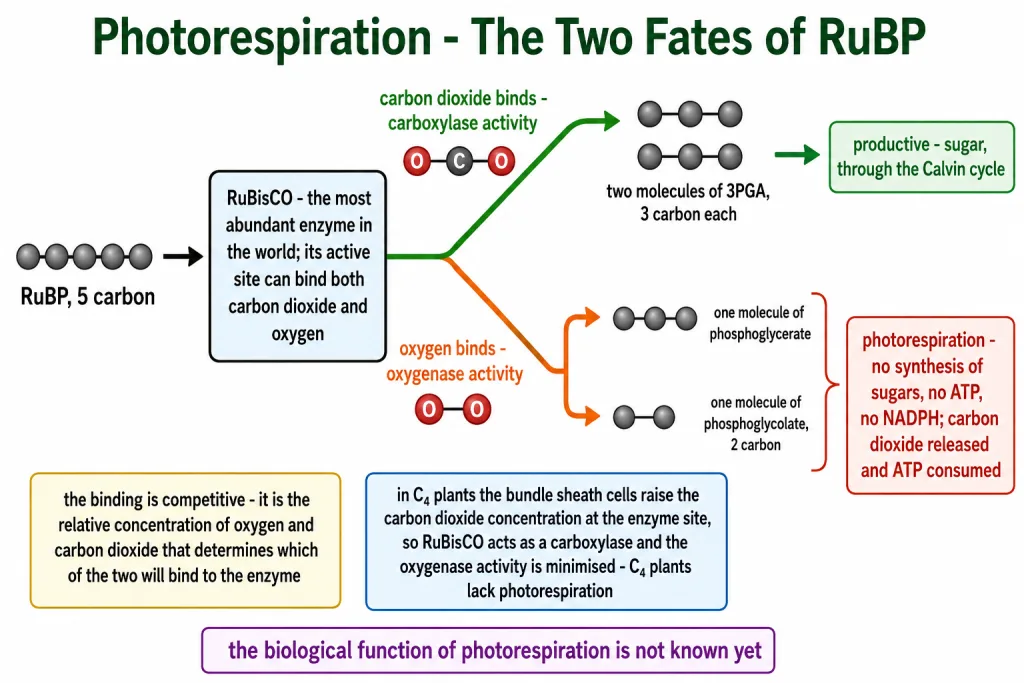
| Which gas binds RuBP | What RuBP gives | What the plant gets |
|---|---|---|
| binds - carboxylase activity | 2 molecules of 3PGA | Sugar, through the Calvin cycle |
| binds - oxygenase activity | One molecule of phosphoglycerate and one of phosphoglycolate (2 carbon) | Nothing useful - this is photorespiration |
What photorespiration costs the plant. Learn these four statements as they are written:
- In the photorespiratory pathway there is neither synthesis of sugars, nor of ATP.
- Rather, it results in the release of with the utilisation of ATP.
- In the photorespiratory pathway there is no synthesis of ATP or NADPH.
- The biological function of photorespiration is not known yet.
So the plant loses carbon it had already fixed and spends ATP doing it, and gains no sugar and no reducing power in return.
[NEET Important] The last of those four is a favourite one-liner: the biological function of photorespiration is not known yet. Any option that gives photorespiration a purpose - extra energy, protection, nitrogen fixation - is wrong at this level. The other trap is the product: it is one phosphoglycerate plus one phosphoglycolate, not two of either.
Why C4 Plants Escape It
In plants photorespiration does not occur.
This is because they have a mechanism that increases the concentration of at the enzyme site. The mechanism is the pathway itself:
- The acid from the mesophyll is broken down in the bundle sheath cells to release .
- This results in increasing the intracellular concentration of in exactly the cells where RuBisCO sits.
- In turn, this ensures that the RuBisCO functions as a carboxylase, minimising the oxygenase activity.
Because the relative concentration of the two gases decides which one binds, flooding the bundle sheath with effectively shuts oxygen out of the active site.
The consequences follow directly. Since plants lack photorespiration, productivity and yields are better in these plants. In addition, these plants show tolerance to higher temperatures.
[NEET Important] State the reason as a concentration effect at the enzyme site, not as a change in the enzyme. plants have the same RuBisCO - the bundle sheath cells are rich in RuBisCO but lack PEPcase. What differs is the gas mixture the enzyme is sitting in. An option saying plants have a different or modified RuBisCO is the standard distractor.
Quick Recap
- Photorespiration creates an important difference between and plants.
- First fixation step of the Calvin pathway: , catalysed by RuBisCO.
- RuBisCO is the most abundant enzyme in the world.
- Its active site can bind to both and - hence the name carboxylase-oxygenase.
- RuBisCO has a much greater affinity for when the to ratio is nearly equal.
- The binding is competitive, and the relative concentration of and determines which of the two will bind.
- In plants some does bind to RuBisCO, and hence fixation is decreased.
- RuBP then binds to form one molecule of phosphoglycerate and one of phosphoglycolate (2 carbon) - the pathway called photorespiration.
- In photorespiration there is neither synthesis of sugars nor of ATP.
- It results in the release of with the utilisation of ATP.
- There is no synthesis of ATP or NADPH in the photorespiratory pathway.
- The biological function of photorespiration is not known yet.
- In plants photorespiration does not occur, because they have a mechanism that increases the concentration of at the enzyme site.
- The acid from the mesophyll is broken down in the bundle sheath cells to release , increasing the intracellular concentration.
- This ensures that RuBisCO functions as a carboxylase, minimising the oxygenase activity.
- Productivity and yields are better in plants, and they show tolerance to higher temperatures.
Solved Examples
Question 1
Q. Write the first fixation reaction of the Calvin pathway and name its enzyme.
Answer. RuBP combines with to form 2 molecules of 3PGA, and the enzyme is RuBisCO.
Question 2
Q. Why is RuBisCO called a carboxylase-oxygenase?
Answer. Because its active site can bind to both and - hence the name. When it binds it acts as a carboxylase; when it binds it acts as an oxygenase.
Question 3
Q. What is special about RuBisCO in terms of how much of it exists?
Answer. It is the most abundant enzyme in the world.
Question 4
Q. When does RuBisCO have a much greater affinity for ?
Answer. When the to ratio is nearly equal. If that were not the case, oxygen would win the active site almost all the time and carbon fixation would collapse.
Question 5
Q. What decides whether or binds to RuBisCO?
Answer. The binding is competitive, so it is the relative concentration of and that determines which of the two will bind to the enzyme - not the absolute amount of either gas on its own.
Question 6
Q. What happens to fixation in a plant when oxygen binds RuBisCO?
Answer. fixation is decreased. Every RuBisCO molecule that has taken up is one that is not fixing carbon.
Question 7
Q. Name the two products formed when RuBP binds oxygen, and give the carbon count of the second one.
Answer. One molecule of phosphoglycerate and one molecule of phosphoglycolate. Phosphoglycolate has 2 carbons. Compare this with the normal reaction, which gives 2 molecules of PGA.
Question 8
Q. Is any sugar or ATP made in the photorespiratory pathway?
Answer. No. In the photorespiratory pathway there is neither synthesis of sugars, nor of ATP. There is no synthesis of ATP or NADPH either.
Question 9
Q. What does photorespiration actually do to the plant's carbon and energy balance?
Answer. It results in the release of with the utilisation of ATP. So the plant gives back carbon it had already fixed and spends ATP in the process, with no sugar, no ATP and no NADPH to show for it.
Question 10
Q. What is the biological function of photorespiration?
Answer. It is not known yet. That is the answer the chapter gives, and it is the answer to write.
Question 11
Q. Why does photorespiration not occur in plants?
Answer. Because they have a mechanism that increases the concentration of at the enzyme site. The acid from the mesophyll is broken down in the bundle sheath cells to release , which increases the intracellular concentration of , and this ensures that RuBisCO functions as a carboxylase, minimising the oxygenase activity.
Question 12
Q. RuBisCO is an enzyme that acts both as a carboxylase and oxygenase. Why do you think RuBisCO carries out more carboxylation in plants? This is one of the chapter-end exercises.
Answer. Because in a plant the RuBisCO is sitting in a much higher concentration than in a plant.
Start from how the enzyme behaves. Its active site can bind both and , the binding is competitive, and it is the relative concentration of and that determines which of the two will bind. So if you want more carboxylation, you do not need a better enzyme - you need more around the enzyme.
That is exactly what the pathway provides. In a plant, is first fixed in the mesophyll cells by PEPcase into the acid OAA, and the 4-carbon acids are transported into the bundle sheath cells. There the acid is broken down to release . The bundle sheath cells have thick walls impervious to gaseous exchange and no intercellular spaces, so the released cannot leak away. The intracellular concentration of therefore rises sharply, and RuBisCO, which is confined to these bundle sheath cells, is bathed in it.
With so far in excess of at the active site, wins the competition nearly every time. RuBisCO functions as a carboxylase, and the oxygenase activity is minimised.
Hence photorespiration does not occur in plants, and their productivity and yields are better. The enzyme is the same - only the gas mixture around it has changed.
Question 13
Q. In which cells of a plant is RuBisCO found, and which enzyme do those cells lack?
Answer. RuBisCO is in the bundle sheath cells. Those cells lack PEPcase. The reverse holds for the mesophyll cells, which have PEPcase but lack RuBisCO.
Question 14
Q. Give two advantages that plants gain from lacking photorespiration.
Answer. Productivity and yields are better in these plants, and they show tolerance to higher temperatures.
Question 15
Q. A student says plants avoid photorespiration because their RuBisCO cannot bind oxygen. Correct the statement.
Answer. That is wrong. plants have the same RuBisCO, and its active site can still bind oxygen. What they have is a mechanism that increases the concentration of at the enzyme site, so that out-competes for the active site. The difference is in the concentration of the gases, not in the enzyme.