
The Chemiosmotic Hypothesis
How is ATP actually made inside the chloroplast? The chemiosmotic hypothesis has been put forward to explain the mechanism.
Like in respiration, in photosynthesis too, ATP synthesis is linked to development of a proton gradient across a membrane. This time these are the membranes of the thylakoid.
There is one difference though. Here the proton accumulation is towards the inside of the membrane, that is, in the lumen. In respiration, protons accumulate in the intermembrane space of the mitochondria.
| Photosynthesis | Respiration | |
|---|---|---|
| Membrane involved | The thylakoid membrane | The inner mitochondrial membrane |
| Where protons accumulate | Towards the inside of the membrane, in the lumen | In the intermembrane space of the mitochondria |
So the principle is identical - build a proton gradient, then let it collapse through ATP synthase - and only the address changes.
[NEET Important] The one comparison asked here is lumen against intermembrane space. Say lumen of the thylakoid for photosynthesis and intermembrane space of the mitochondrion for respiration, and do not let an option talk you into the stroma - the stroma is where protons are being taken from, not where they gather.
The Three Causes of the Proton Gradient
Three separate things push protons into the lumen or pull them out of the stroma. They are asked as a set, so learn all three.
(a) Water splitting. Since splitting of the water molecule takes place on the inner side of the membrane, the protons or hydrogen ions that are produced by the splitting of water accumulate within the lumen of the thylakoids.
(b) Proton transport during electron movement. As electrons move through the photosystems, protons are transported across the membrane. This happens because the primary acceptor of electrons, which is located towards the outer side of the membrane, transfers its electron not to an electron carrier but to an H carrier. Hence this molecule removes a proton from the stroma while transporting an electron. When this molecule passes on its electron to the electron carrier on the inner side of the membrane, the proton is released into the lumen side of the membrane.
(c) NADP reductase. The NADP reductase enzyme is located on the stroma side of the membrane. Along with electrons that come from the acceptor of electrons of PS I, protons are necessary for the reduction of to . These protons are also removed from the stroma.
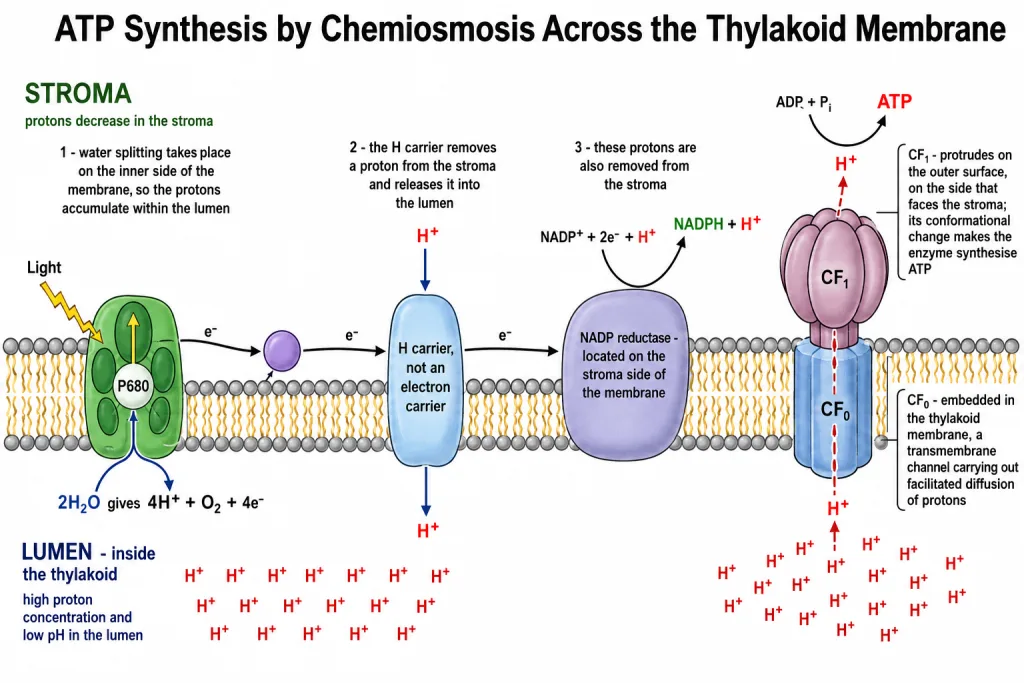
Add the three up. Within the chloroplast, protons in the stroma decrease in number, while in the lumen there is accumulation of protons. This creates a proton gradient across the thylakoid membrane as well as a measurable decrease in pH in the lumen.
Notice that (a) puts protons into the lumen, (b) moves them from the stroma into the lumen, and (c) only takes them out of the stroma. All three widen the same gradient.
[NEET Important] Cause (b) carries the detail that options are built from: the primary acceptor is on the outer side of the membrane, it hands its electron to an H carrier, not to an electron carrier, and that H carrier picks a proton up from the stroma and drops it into the lumen. And do not forget the consequence - a measurable decrease in pH in the lumen.
ATP Synthase and the Breakdown of the Gradient
Why are we so interested in the proton gradient? Because it is the breakdown of this gradient that leads to the synthesis of ATP. The gradient is not the product - collapsing it is what does the work.
The gradient is broken down due to the movement of protons across the membrane to the stroma through the transmembrane channel of the of the ATP synthase.
The ATP synthase enzyme consists of two parts:
| Part | Where it sits | What it does |
|---|---|---|
| Embedded in the thylakoid membrane | Forms a transmembrane channel that carries out facilitated diffusion of protons across the membrane | |
| Protrudes on the outer surface of the thylakoid membrane, on the side that faces the stroma | Undergoes the conformational change that makes the enzyme synthesise ATP |
The break down of the gradient provides enough energy to cause a conformational change in the particle of the ATP synthase, which makes the enzyme synthesise several molecules of ATP.
Chemiosmosis requires four things:
- A membrane
- A proton pump
- A proton gradient
- ATP synthase
Where the products go. Along with the NADPH produced by the movement of electrons, the ATP will be used immediately in the biosynthetic reaction taking place in the stroma, responsible for fixing and synthesis of sugars.
[NEET Important] is the channel in the membrane; is the knob on the stroma side. The two get swapped constantly, and the giveaway is the wording protrudes on the outer surface of the thylakoid membrane on the side that faces the stroma - that is . Also remember that the proton flow through is facilitated diffusion, that the flow is from the lumen back to the stroma, and the four requirements of chemiosmosis as a numbered set.
Quick Recap
- The chemiosmotic hypothesis has been put forward to explain how ATP is synthesised in the chloroplast.
- ATP synthesis is linked to development of a proton gradient across a membrane - here, the membranes of the thylakoid.
- The one difference from respiration: here the proton accumulation is towards the inside of the membrane, that is in the lumen, whereas in respiration protons accumulate in the intermembrane space of the mitochondria.
- Cause (a): splitting of the water molecule takes place on the inner side of the membrane, so the protons produced accumulate within the lumen of the thylakoids.
- Cause (b): as electrons move through the photosystems, protons are transported across the membrane - the primary acceptor of electrons, located towards the outer side of the membrane, transfers its electron to an H carrier, not to an electron carrier; that molecule removes a proton from the stroma while transporting an electron, and releases the proton into the lumen when it passes the electron to the electron carrier on the inner side.
- Cause (c): the NADP reductase enzyme is located on the stroma side of the membrane, and the protons needed for the reduction of to are also removed from the stroma.
- Protons in the stroma decrease in number while in the lumen there is accumulation of protons.
- This creates a proton gradient across the thylakoid membrane as well as a measurable decrease in pH in the lumen.
- It is the breakdown of this gradient that leads to the synthesis of ATP.
- The gradient is broken down due to the movement of protons across the membrane to the stroma through the transmembrane channel of the of the ATP synthase.
- is embedded in the thylakoid membrane and forms a transmembrane channel that carries out facilitated diffusion of protons.
- protrudes on the outer surface of the thylakoid membrane on the side that faces the stroma.
- The breakdown of the gradient provides enough energy to cause a conformational change in the particle, which makes the enzyme synthesise several molecules of ATP.
- Chemiosmosis requires a membrane, a proton pump, a proton gradient and ATP synthase.
- The ATP, along with the NADPH, is used immediately in the biosynthetic reaction taking place in the stroma, responsible for fixing and synthesis of sugars.
Solved Examples
Question 1
Q. What does the chemiosmotic hypothesis explain?
Answer. How ATP is synthesised in the chloroplast. It says that ATP synthesis is linked to development of a proton gradient across a membrane - here, the membranes of the thylakoid.
Question 2
Q. How does proton accumulation in photosynthesis differ from that in respiration?
Answer. In photosynthesis the proton accumulation is towards the inside of the membrane, that is in the lumen of the thylakoid. In respiration, protons accumulate in the intermembrane space of the mitochondria.
Question 3
Q. Give the first cause of the proton gradient across the thylakoid membrane.
Answer. Splitting of the water molecule takes place on the inner side of the membrane, so the protons or hydrogen ions produced by the splitting of water accumulate within the lumen of the thylakoids.
Question 4
Q. Explain how the movement of electrons through the photosystems transports protons across the membrane.
Answer. The primary acceptor of electrons is located towards the outer side of the membrane, and it transfers its electron not to an electron carrier but to an H carrier. Hence this molecule removes a proton from the stroma while transporting an electron. When this molecule passes on its electron to the electron carrier on the inner side of the membrane, the proton is released into the lumen side.
Question 5
Q. Where is NADP reductase located, and how does it add to the proton gradient?
Answer. On the stroma side of the membrane. Along with electrons that come from the acceptor of electrons of PS I, protons are necessary for the reduction of to , and these protons are also removed from the stroma.
Question 6
Q. List all three causes of the proton gradient in order.
Answer. (a) Splitting of water on the inner side of the membrane puts protons into the lumen. (b) As electrons move through the photosystems, an H carrier removes a proton from the stroma and releases it into the lumen. (c) NADP reductase, on the stroma side, removes protons from the stroma for the reduction of to .
Question 7
Q. What is the net effect of the three causes on the stroma and on the lumen?
Answer. Protons in the stroma decrease in number, while in the lumen there is accumulation of protons. This creates a proton gradient across the thylakoid membrane as well as a measurable decrease in pH in the lumen.
Question 8
Q. Why does the pH of the lumen fall?
Answer. Because protons accumulate there. More in a compartment means a lower pH, so the gradient shows up as a measurable decrease in pH in the lumen.
Question 9
Q. Which event actually leads to the synthesis of ATP - building the gradient or breaking it down?
Answer. Breaking it down. It is the breakdown of this gradient that leads to the synthesis of ATP. Building the gradient is only the storing of energy; releasing it is what powers the enzyme.
Question 10
Q. How is the proton gradient broken down?
Answer. Due to the movement of protons across the membrane to the stroma through the transmembrane channel of the of the ATP synthase. The direction is from the lumen back to the stroma.
Question 11
Q. Describe the two parts of the ATP synthase enzyme.
Answer. is embedded in the thylakoid membrane and forms a transmembrane channel that carries out facilitated diffusion of protons across the membrane. protrudes on the outer surface of the thylakoid membrane, on the side that faces the stroma.
Question 12
Q. What does the breakdown of the gradient do to the CF1 particle?
Answer. It provides enough energy to cause a conformational change in the particle of the ATP synthase, and this change makes the enzyme synthesise several molecules of ATP.
Question 13
Q. What four things does chemiosmosis require?
Answer. A membrane, a proton pump, a proton gradient and ATP synthase.
Question 14
Q. What happens to the ATP and NADPH made by the light reaction?
Answer. They are used immediately in the biosynthetic reaction taking place in the stroma, which is responsible for fixing and synthesis of sugars. Neither is stored - the light reaction and the stroma reactions run side by side.