
The Biosynthetic Phase
The products of the light reaction are ATP, NADPH and . Of these, the diffuses out of the chloroplast, while ATP and NADPH are used to drive the processes leading to the synthesis of food - more accurately, sugars. This is the biosynthetic phase of photosynthesis.
This process does not directly depend on the presence of light, but it is dependent on the products of the light reaction, that is ATP and NADPH, besides and .
You may wonder how this could be verified. It is simple. Immediately after light becomes unavailable, the biosynthetic process continues for some time, and then stops. If light is then made available, the synthesis starts again.
| What you do to the light | What the biosynthetic phase does |
|---|---|
| Light available | Runs, on the ATP and NADPH the light reaction supplies |
| Light just made unavailable | Continues for some time - the ATP and NADPH already made are still in the stroma |
| Light kept unavailable | Stops, because the supply of ATP and NADPH has run out |
| Light made available again | The synthesis starts again |
Read that experiment carefully, because it settles the naming. The biosynthetic phase does not need light itself, but it cannot keep running without what light produces. Hence calling the biosynthetic phase the "dark reaction" is arguably a misnomer - it neither requires darkness nor is it independent of light.
[NEET Important] The single most reliable question from this block is what happens the moment light is switched off. The answer is not "it stops at once" and not "it carries on indefinitely" - it continues for some time and then stops, because the stroma still holds the ATP and NADPH already made. That short lag is the whole proof that the biosynthetic phase runs on the products of the light reaction, not on light itself.
Melvin Calvin and the First Product of Carbon Fixation
We saw earlier that is combined with to produce sugars. What interested scientists was how this reaction proceeded - or rather, what the first product formed is when is taken into a reaction, or fixed.
Just after world war II, among the several efforts to put radioisotopes to beneficial use, the work of Melvin Calvin is exemplary. His use of radioactive in algal photosynthesis studies led to the discovery that the first fixation product was a 3-carbon organic acid. He also contributed to working out the complete biosynthetic pathway, and hence it was called the Calvin cycle after him.
The first product identified was 3-phosphoglyceric acid, or in short PGA. It has three carbon atoms.
| Feature of the work | Detail |
|---|---|
| When | Just after world war II |
| The tracer | Radioactive |
| The material | Algae |
| What was found | The first fixation product was a 3-carbon organic acid |
| Its name | 3-phosphoglyceric acid, or PGA |
| What the pathway is called | The Calvin cycle |
[NEET Important] Three details from this paragraph are asked as one-liners: the isotope is radioactive carbon-14, the material was algae, not a higher plant, and the first product is a 3-carbon organic acid, PGA. The common distractor sets carbon-14 against oxygen-18 - oxygen-18 belongs to the question of where the released comes from, not to the first product of fixation.
Two Types of Carbon Dioxide Assimilation
Scientists also tried to know whether all plants have PGA as the first product of fixation, or whether any other product was formed in other plants.
Experiments conducted over a wide range of plants led to the discovery of another group of plants, where the first stable product of fixation was again an organic acid, but one which had 4 carbon atoms in it. This acid was identified to be oxaloacetic acid, or OAA.
Since then, assimilation during photosynthesis was said to be of two main types.
| The type | The first product of fixation | Carbon atoms in it |
|---|---|---|
| The pathway | 3-phosphoglyceric acid (PGA), a acid | 3 |
| The pathway | Oxaloacetic acid (OAA), a acid | 4 |
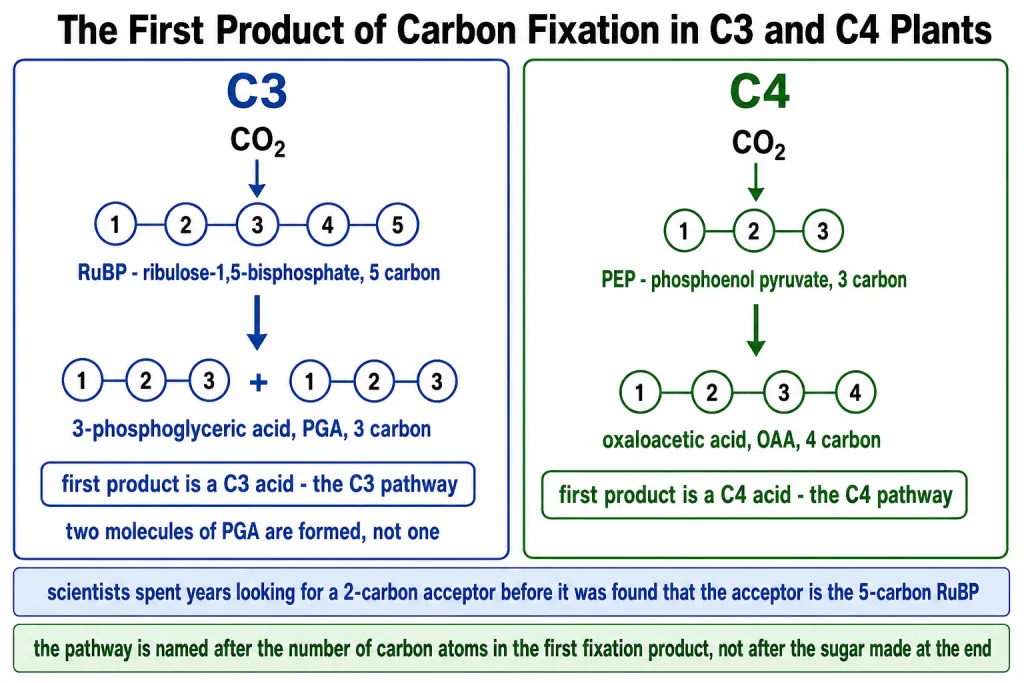
These two groups of plants showed other associated characteristics too, and those are taken up later in the chapter.
[NEET Important] The naming is the trap. The pathway is named after the number of carbon atoms in the FIRST fixation product, not after the sugar made at the end. Both types finish by making the same sugars, and as you will see, both run the Calvin cycle. So an option saying that plants do not use the Calvin cycle is wrong, even though their first product is a acid.
The Primary Acceptor of Carbon Dioxide
Now ask the question the scientists themselves asked while struggling to understand the so-called dark reaction: how many carbon atoms would a molecule have which, after accepting - that is, fixing - , would have the 3 carbons of PGA?
The obvious answer is two, and the obvious answer is wrong.
The studies very unexpectedly showed that the acceptor molecule was a 5-carbon ketose sugar - ribulose bisphosphate, .
Why it took so long. Since the first product was a acid, scientists believed that the primary acceptor would be a 2-carbon compound. They spent many years trying to identify a 2-carbon compound before they discovered the 5-carbon .
The arithmetic works because the fixation does not make one product molecule, it makes two. The 5 carbons of plus the 1 carbon of give 6 carbons, and those 6 carbons appear as two molecules of the 3-carbon PGA.
| The molecule | Carbon atoms | What it is |
|---|---|---|
| (ribulose bisphosphate) | 5 | The primary acceptor of , a ketose sugar |
| 1 | What gets fixed | |
| PGA (3-phosphoglyceric acid) | 3 | The first product, formed as two molecules |
[NEET Important] Remember two things and you cannot be caught. is a 5-carbon ketose sugar, not a 2-carbon compound and not an acid. And the 2-carbon compound is the historical wrong guess - questions love to offer it as an option precisely because it sounds logical.
Quick Recap
- The products of the light reaction are ATP, NADPH and .
- The diffuses out of the chloroplast; ATP and NADPH are used to drive the processes leading to the synthesis of food, more accurately sugars.
- This is the biosynthetic phase of photosynthesis.
- It does not directly depend on the presence of light, but depends on the products of the light reaction - ATP and NADPH - besides and .
- Verification: immediately after light becomes unavailable the biosynthetic process continues for some time and then stops; if light is made available, the synthesis starts again.
- Calling the biosynthetic phase the "dark reaction" is arguably a misnomer.
- Just after world war II, among efforts to put radioisotopes to beneficial use, Melvin Calvin used radioactive in algal photosynthesis studies.
- He discovered that the first fixation product was a 3-carbon organic acid, and worked out the complete biosynthetic pathway - hence the Calvin cycle.
- The first product identified was 3-phosphoglyceric acid, or PGA.
- Experiments over a wide range of plants found another group in which the first stable product of fixation was an organic acid with 4 carbon atoms - oxaloacetic acid, or OAA.
- Two main types of assimilation: the pathway, first product a acid (PGA), and the pathway, first product a acid (OAA).
- The primary acceptor of is a 5-carbon ketose sugar, ribulose bisphosphate ().
- Scientists believed the primary acceptor would be a 2-carbon compound and spent many years looking for one before discovering the 5-carbon .
Solved Examples
Question 1
Q. What are the three products of the light reaction, and what happens to each of them?
Answer. ATP, NADPH and . The diffuses out of the chloroplast. The ATP and NADPH are used to drive the processes leading to the synthesis of food, more accurately sugars.
Question 2
Q. What is the biosynthetic phase of photosynthesis?
Answer. It is the phase in which the ATP and NADPH made by the light reaction are used to make sugars from and . In plain words, the light reaction makes the energy currency and the biosynthetic phase spends it on building sugar.
Question 3
Q. Does the biosynthetic phase depend on light? Answer carefully.
Answer. It does not directly depend on the presence of light. But it is dependent on the products of the light reaction, that is ATP and NADPH, besides and . So it is light-dependent in an indirect way - remove the light and it stops once the ATP and NADPH run out.
Question 4
Q. How can you verify that the biosynthetic phase depends on the products of the light reaction?
Answer. Immediately after light becomes unavailable, the biosynthetic process continues for some time, and then stops. If light is then made available, the synthesis starts again. The short period of continued synthesis is the ATP and NADPH already present being used up, and the stop is those supplies running out.
Question 5
Q. Why is it said that calling the biosynthetic phase the "dark reaction" is a misnomer?
Answer. Because the name suggests two things that are both untrue. It does not need darkness - it runs perfectly well in the light. And it is not independent of light - it stops soon after light is withdrawn, because its ATP and NADPH come from the light reaction. The better names are the biosynthetic phase or the carbon reactions.
Question 6
Q. Which radioisotope did Melvin Calvin use, on what material, and when?
Answer. He used radioactive , in algal photosynthesis studies, just after world war II - among the several efforts to put radioisotopes to beneficial use.
Question 7
Q. What did Calvin's radioisotope work discover about the first product of carbon dioxide fixation?
Answer. That the first fixation product was a 3-carbon organic acid. It was identified as 3-phosphoglyceric acid, or PGA.
Question 8
Q. Why is the pathway called the Calvin cycle?
Answer. Because Melvin Calvin contributed to working out the complete biosynthetic pathway, so it was named the Calvin cycle after him. It is called a cycle because the acceptor molecule is regenerated at the end.
Question 9
Q. Name the first product of carbon dioxide fixation in the pathway and give its number of carbon atoms.
Answer. 3-phosphoglyceric acid, or PGA. It has three carbon atoms, which is exactly why the pathway is called the pathway.
Question 10
Q. In the second group of plants, what was the first stable product of carbon dioxide fixation, and how many carbon atoms does it have?
Answer. Oxaloacetic acid, or OAA, which has 4 carbon atoms. It was found when experiments were conducted over a wide range of plants, and it is why those plants are called plants.
Question 11
Q. Name the two main types of carbon dioxide assimilation and the first product of each.
Answer. The pathway, in which the first product is a acid, PGA, and the pathway, in which the first product is a acid, OAA.
Question 12
Q. What is the primary acceptor of carbon dioxide, what type of molecule is it, and how many carbon atoms does it have?
Answer. Ribulose bisphosphate, . It is a ketose sugar with 5 carbon atoms.
Question 13
Q. Scientists spent years looking for the wrong molecule as the primary acceptor. What were they looking for, and why?
Answer. They were looking for a 2-carbon compound. Since the first product was a acid, they believed the primary acceptor would have 2 carbons, so that 2 plus the 1 from would give 3. They spent many years on that search before they discovered the 5-carbon , which the studies showed very unexpectedly.
Question 14
Q. If has 5 carbons and adds only 1, how does a 3-carbon product come out of it?
Answer. Because two molecules of the product are formed, not one. 5 carbons plus 1 carbon gives 6, and those 6 carbons appear as two molecules of the 3-carbon PGA. The 2-carbon guess failed because it assumed a single product molecule.