
Phosphorylation and Photo-phosphorylation
Living organisms have the capability of extracting energy from oxidisable substances and store this in the form of bond energy. Special substances like ATP carry this energy in their chemical bonds.
Two definitions, and the second is built out of the first.
- Phosphorylation is the process through which ATP is synthesised by cells, in mitochondria and chloroplasts.
- Photo-phosphorylation is the synthesis of ATP from ADP and inorganic phosphate in the presence of light.
So the prefix photo is the only thing that separates them - the same reaction, ADP plus inorganic phosphate giving ATP, but driven by light.
[NEET Important] Learn the definition word for word: photo-phosphorylation is the synthesis of ATP from ADP and inorganic phosphate in the presence of light. The common distractor swaps in AMP for ADP, or says from ATP and phosphate, or leaves out in the presence of light and so describes ordinary phosphorylation instead.
Non-cyclic Photo-phosphorylation
When the two photosystems work in a series, first PS II and then the PS I, a process called non-cyclic photo-phosphorylation occurs.
The two photosystems are connected through an electron transport chain, as seen earlier - in the Z scheme.
This is exactly the pathway of the previous section, now given its energetic name. Follow the electron: it leaves PS II, runs down the electron transport chain, is re-excited at PS I, and ends on . It never comes back to where it started, and that is what the word non-cyclic means.
Because the electron leaves the system for good, PS II has to be topped up from outside - and water is the donor. So water splitting and oxygen release belong here.
Both ATP and are synthesised by this kind of electron flow.
[NEET Important] Non-cyclic flow is the only one of the two that gives both products. If a question mentions oxygen evolution, or NADPH, or both photosystems in series, the answer is non-cyclic photo-phosphorylation.
Cyclic Photo-phosphorylation
When only PS I is functional, the electron is circulated within the photosystem and the phosphorylation occurs due to cyclic flow of electrons.
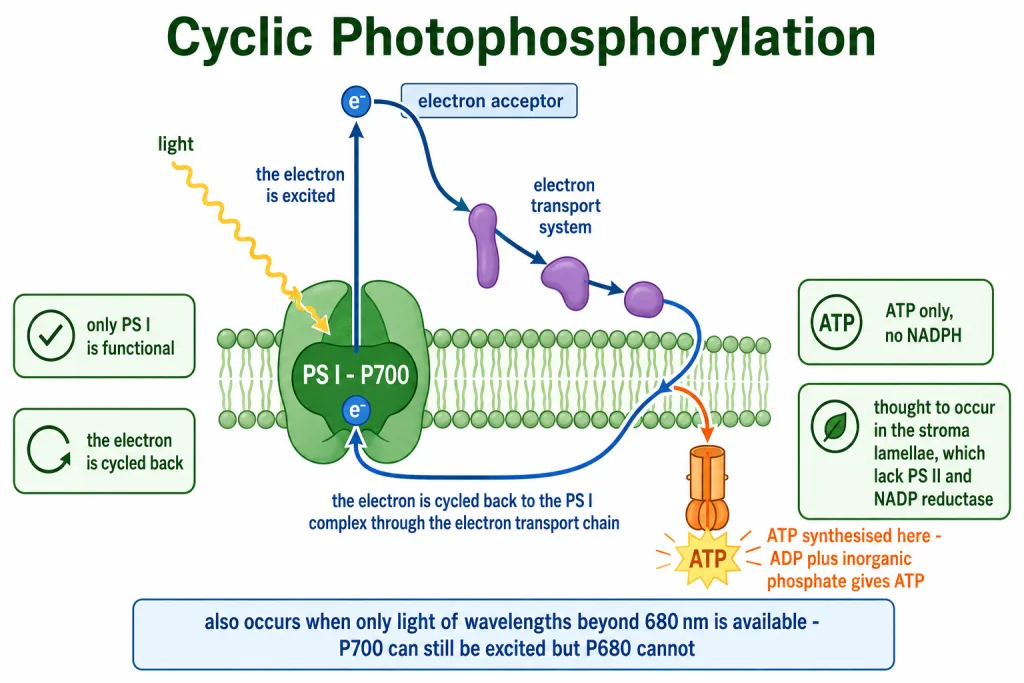
Where it happens. A possible location where this could be happening is in the stroma lamellae. The reason lies in what those membranes contain:
- The membrane or lamellae of the grana have both PS I and PS II.
- The stroma lamellae membranes lack PS II as well as the NADP reductase enzyme.
With no PS II there is no second photosystem to work in series with, and with no NADP reductase there is nothing to hand the electron on to . So the excited electron does not pass on to but is cycled back to the PS I complex through the electron transport chain.
The cyclic flow hence results only in the synthesis of ATP, but not of .
When else it happens. Cyclic photophosphorylation also occurs when only light of wavelengths beyond are available for excitation. That makes sense from the reaction centres: can still be excited by such light, but cannot, so PS II falls silent and only PS I keeps working.
[NEET Important] Two facts about the stroma lamellae are asked together: they lack PS II and they lack the NADP reductase enzyme. Options often name only one of the two. And the wavelength condition is beyond , not beyond - the point being that is the one left out.
Cyclic Against Non-cyclic - the Full Comparison
| Point of comparison | Cyclic photo-phosphorylation | Non-cyclic photo-phosphorylation |
|---|---|---|
| Photosystems involved | Only PS I is functional | Both PS II and PS I |
| Do they work in series? | No - a single photosystem acts alone | Yes - first PS II and then PS I, connected through an electron transport chain as in the Z scheme |
| Path of the electron | The electron is circulated within the photosystem and is cycled back to the PS I complex through the electron transport chain | The electron travels from PS II, down the electron transport chain, to PS I, and on to - it does not return |
| External electron donor | None needed - the same electron comes back | Water, which replaces the electrons removed from PS II |
| Splitting of water and release | Does not occur | Occurs, and is released |
| Products | ATP only - not | Both ATP and |
| Likely site | The stroma lamellae | The membrane or lamellae of the grana |
| What that membrane contains | Stroma lamellae lack PS II as well as the NADP reductase enzyme | Grana lamellae have both PS I and PS II |
| Wavelength condition | Also occurs when only light of wavelengths beyond is available for excitation | Needs both and to be excited, so light of as well as |
[NEET Important] If you memorise one row, memorise the products row - cyclic gives ATP only, non-cyclic gives ATP and . The second most-asked row is the site: stroma lamellae for cyclic, grana lamellae for non-cyclic, and the reason is that the stroma lamellae lack PS II and NADP reductase.
Quick Recap
- Living organisms extract energy from oxidisable substances and store it in the form of bond energy; special substances like ATP carry this energy in their chemical bonds.
- Phosphorylation is the process through which ATP is synthesised by cells, in mitochondria and chloroplasts.
- Photo-phosphorylation is the synthesis of ATP from ADP and inorganic phosphate in the presence of light.
- When the two photosystems work in a series, first PS II and then PS I, the process is called non-cyclic photo-phosphorylation.
- The two photosystems are connected through an electron transport chain, as in the Z scheme.
- Both ATP and are synthesised by non-cyclic electron flow.
- When only PS I is functional, the electron is circulated within the photosystem and the phosphorylation occurs due to cyclic flow of electrons.
- A possible location for cyclic flow is the stroma lamellae.
- The membrane or lamellae of the grana have both PS I and PS II; the stroma lamellae membranes lack PS II as well as the NADP reductase enzyme.
- The excited electron does not pass on to but is cycled back to the PS I complex through the electron transport chain.
- The cyclic flow hence results only in the synthesis of ATP, but not of .
- Cyclic photophosphorylation also occurs when only light of wavelengths beyond are available for excitation.
- Water splitting and oxygen release belong to non-cyclic flow only.
Solved Examples
Question 1
Q. Define phosphorylation.
Answer. The process through which ATP is synthesised by cells, in mitochondria and chloroplasts, is named phosphorylation.
Question 2
Q. Define photo-phosphorylation.
Answer. Photo-phosphorylation is the synthesis of ATP from ADP and inorganic phosphate in the presence of light.
Question 3
Q. How do living organisms store the energy they extract from oxidisable substances?
Answer. In the form of bond energy. Special substances like ATP carry this energy in their chemical bonds.
Question 4
Q. When is the process called non-cyclic photo-phosphorylation?
Answer. When the two photosystems work in a series, first PS II and then PS I. The two photosystems are connected through an electron transport chain, as in the Z scheme.
Question 5
Q. Which products are formed by non-cyclic electron flow?
Answer. Both ATP and . Oxygen is also released, because water is split at PS II to replace the lost electrons.
Question 6
Q. When does cyclic photo-phosphorylation occur?
Answer. When only PS I is functional. The electron is circulated within the photosystem and the phosphorylation occurs due to cyclic flow of electrons.
Question 7
Q. Where is cyclic photo-phosphorylation thought to happen, and why there?
Answer. In the stroma lamellae. Because the stroma lamellae membranes lack PS II as well as the NADP reductase enzyme, while the membrane or lamellae of the grana have both PS I and PS II. With no PS II and no NADP reductase, only PS I acting alone is possible.
Question 8
Q. In cyclic flow, where does the excited electron go?
Answer. It does not pass on to . Instead it is cycled back to the PS I complex through the electron transport chain.
Question 9
Q. What does cyclic flow produce, and what does it not produce?
Answer. The cyclic flow results only in the synthesis of ATP, but not of .
Question 10
Q. Under what light condition does cyclic photophosphorylation also occur?
Answer. When only light of wavelengths beyond are available for excitation. Such light can still excite in PS I but not in PS II, so PS I works alone.
Question 11
Q. Is water split during cyclic photo-phosphorylation?
Answer. No. Water splitting is associated with PS II, and PS II is not functional in cyclic flow. Since the same electron returns to PS I, there is no need for an outside donor, so no oxygen is released either.
Question 12
Q. Give comparison between cyclic and non-cyclic photophosphorylation. This is one of the chapter-end exercises.
Answer. Both are ways of making ATP in the light, but they differ in almost everything else.
| Point of comparison | Cyclic photo-phosphorylation | Non-cyclic photo-phosphorylation |
|---|---|---|
| Photosystems involved | Only PS I is functional | Both PS II and PS I |
| Do they work in series? | No, PS I acts alone | Yes - first PS II and then PS I |
| Connection between them | Not applicable | Connected through an electron transport chain, as in the Z scheme |
| Path of the electron | Circulated within the photosystem and cycled back to the PS I complex through the electron transport chain | Runs from PS II down the electron transport chain to PS I and then to , and never returns |
| External electron donor | None - the same electron is reused | Water, which supplies the electrons that replace those lost from PS II |
| Splitting of water | Does not occur | Occurs, at PS II |
| Oxygen release | No is released | is released |
| Products | ATP only, not | Both ATP and |
| Likely site | The stroma lamellae | The membrane or lamellae of the grana |
| Composition of that membrane | Stroma lamellae lack PS II as well as the NADP reductase enzyme | Grana lamellae have both PS I and PS II |
| Wavelength condition | Also occurs when only light of wavelengths beyond is available for excitation | Needs both reaction centres excited, so as well as light |
The one line that ties it together. In cyclic flow the electron comes home, so nothing is lost, nothing needs replacing, and nothing is left over to reduce - hence ATP only. In non-cyclic flow the electron is given away to , so water must be split to replace it - hence oxygen is released and both ATP and are made.
Question 13
Q. A chloroplast membrane fragment is found to contain PS I but neither PS II nor NADP reductase. Which membrane is it, and which type of photophosphorylation can it carry out?
Answer. It is a piece of the stroma lamellae, because the stroma lamellae membranes lack PS II as well as the NADP reductase enzyme. It can carry out cyclic photo-phosphorylation only, and so will make ATP but no and release no oxygen.
Question 14
Q. Why does non-cyclic photo-phosphorylation need water while cyclic photo-phosphorylation does not?
Answer. In non-cyclic flow the electron ends up on and does not come back, so PS II is left short and must be refilled - the electrons available due to splitting of water do that job. In cyclic flow the same electron is cycled back to the PS I complex, so nothing is ever missing and no external donor is required.