
What the Simple Experiments Already Showed
Before any of the machinery, two classroom experiments settle what photosynthesis needs.
The starch test. Take a variegated leaf, or a leaf that was partially covered with black paper, and expose it to light. On testing these leaves for the presence of starch it is clear that photosynthesis occurred only in the green parts of the leaves in the presence of light.
The experiment. Enclose part of a leaf in a test tube containing some -soaked cotton, which absorbs , while the other half is exposed to air, and place the setup in light. On testing for starch afterwards, the exposed part tests positive while the portion inside the tube tests negative. This showed that was required for photosynthesis.
Together they give the three requirements: chlorophyll, light and .
[NEET Important] Read the two experiments as controlled comparisons, because that is how they are asked. In each one only a single variable changes - green against non-green, light against dark, present against absorbed - and starch is the indicator in both.
The Early Experiments
Five names, five specific contributions. Every one of them is asked as a matching item.
Joseph Priestley (1733-1804), in 1770, performed a series of experiments that revealed the essential role of air in the growth of green plants. He discovered oxygen in 1774.
He observed that a candle burning in a closed space - a bell jar - soon gets extinguished, and that a mouse would soon suffocate in a closed space. He concluded that a burning candle or an animal that breathes the air both somehow damage the air. But when he placed a mint plant in the same bell jar, he found that the mouse stayed alive and the candle continued to burn.
His hypothesis: plants restore to the air whatever breathing animals and burning candles remove.
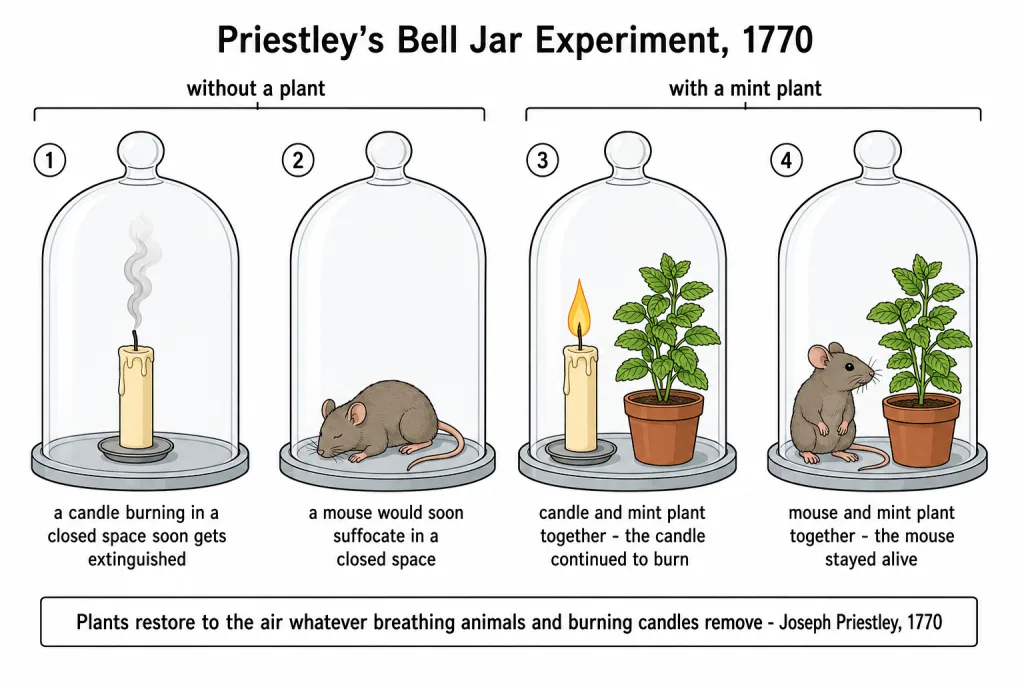
Jan Ingenhousz (1730-1799) used a similar setup to Priestley's, but placed it once in the dark and once in the sunlight, and so showed that sunlight is essential for the plant process that purifies the air fouled by burning candles or breathing animals.
In an elegant experiment with an aquatic plant he showed that in bright sunlight small bubbles were formed around the green parts, while in the dark they did not. He later identified these bubbles to be of oxygen, and so showed that it is only the green part of the plants that could release oxygen.
Julius von Sachs, in about 1854, provided evidence for the production of glucose when plants grow, and that glucose is usually stored as starch. His later studies showed that the green substance in plants - chlorophyll, as we now call it - is located in special bodies, later called chloroplasts, within plant cells. He found that the green parts in plants are where glucose is made.
T. W. Engelmann (1843-1909) used a prism to split light into its spectral components and then illuminated a green alga, Cladophora, placed in a suspension of aerobic bacteria. The bacteria were used to detect the sites of evolution, and he observed that they accumulated mainly in the region of blue and red light of the split spectrum. A first action spectrum of photosynthesis was thus described, and it resembles roughly the absorption spectra of chlorophyll a and b.
| Scientist | The one contribution |
|---|---|
| Joseph Priestley, 1770 | Plants restore to the air whatever breathing animals and burning candles remove; discovered oxygen in 1774 |
| Jan Ingenhousz | Sunlight is essential; only the green part releases oxygen |
| Julius von Sachs, about 1854 | Glucose is produced when plants grow and stored as starch; the green substance sits in special bodies, later called chloroplasts |
| T. W. Engelmann | The first action spectrum of photosynthesis, using a prism, Cladophora and aerobic bacteria |
| Cornelius van Niel | The released comes from water, not from |
[NEET Important] Two pairs get swapped constantly. Priestley showed that air is restored; Ingenhousz showed that sunlight is needed for it. And Engelmann gave the action spectrum, not the absorption spectrum - the absorption spectrum belongs to the pigment, the action spectrum to the process.
The Equations, and Where the Oxygen Comes From
By the middle of the nineteenth century the key features of plant photosynthesis were known - that plants could use light energy to make carbohydrates from and water. The empirical equation for oxygen-evolving organisms was written as:
where represented a carbohydrate, for example glucose, a six-carbon sugar.
Cornelius van Niel (1897-1985), a microbiologist, made a milestone contribution. Based on his studies of purple and green bacteria he demonstrated that photosynthesis is essentially a light-dependent reaction in which hydrogen from a suitable oxidisable compound reduces carbon dioxide to carbohydrates:
In green plants is the hydrogen donor and is oxidised to . Some organisms do not release during photosynthesis: when is instead the hydrogen donor, for purple and green sulphur bacteria, the oxidation product is sulphur or sulphate - depending on the organism - and not .
Hence he inferred that the evolved by the green plant comes from , not from carbon dioxide. This was later proved by using radioisotopic techniques.
The correct equation for the overall process is therefore:
where represents glucose.
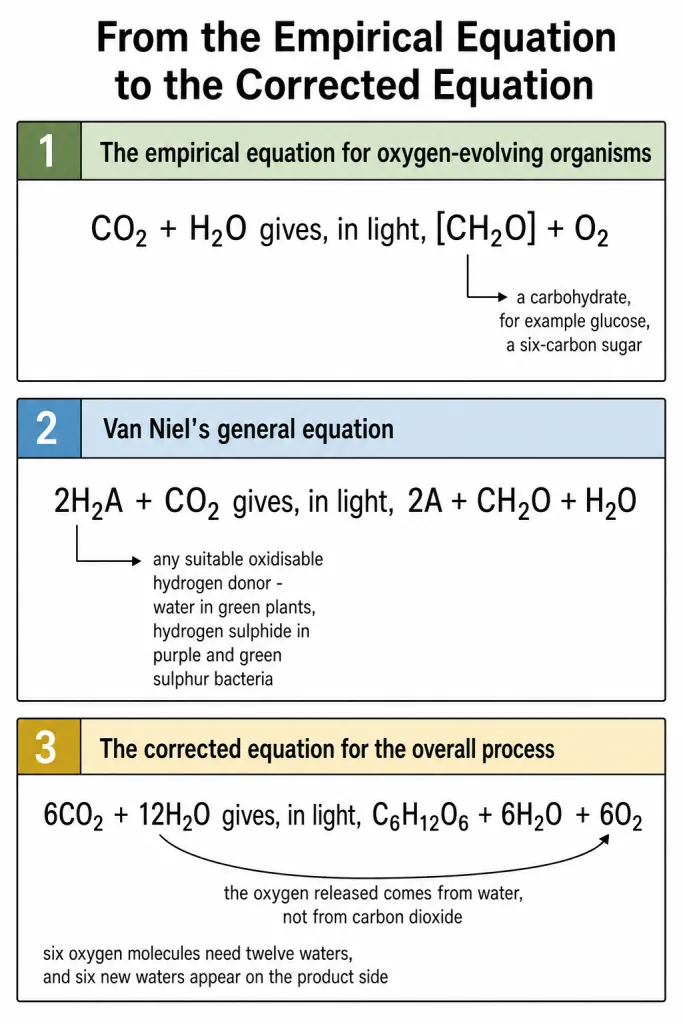
Note that this is not a single reaction but the description of a multistep process called photosynthesis.
[NEET Important] The question this block exists to answer is why twelve molecules of water. Because the oxygen released comes from water, not from - six molecules need twelve waters, and six new waters appear on the product side. A student who writes the old six-water equation has not understood van Niel's point, and that is exactly what the question is testing.
Quick Recap
- Chlorophyll, light and are required for photosynthesis.
- Variegated or partly covered leaf - starch forms only in the green parts, in the presence of light.
- -soaked cotton absorbs ; the enclosed half tests negative for starch, showing is required.
- Priestley, 1770 - a candle goes out and a mouse suffocates in a bell jar, but a mint plant keeps both going. Plants restore to the air whatever breathing animals and burning candles remove. He discovered oxygen in 1774.
- Ingenhousz - sunlight is essential; with an aquatic plant, bubbles form around the green parts in bright sunlight but not in the dark, and the bubbles are oxygen. Only the green part releases oxygen.
- Sachs, about 1854 - glucose is produced when plants grow and is usually stored as starch; the green substance is located in special bodies, later called chloroplasts.
- Engelmann - prism, Cladophora, aerobic bacteria; bacteria gathered in the blue and red regions; this gave the first action spectrum of photosynthesis, which roughly resembles the absorption spectra of chlorophyll a and b.
- Empirical equation: , with a carbohydrate.
- van Niel - photosynthesis is a light-dependent reaction in which hydrogen from a suitable oxidisable compound reduces carbon dioxide to carbohydrates; in green plants the donor is , in purple and green sulphur bacteria it is and the product is sulphur or sulphate, not .
- The comes from water, not from - proved by radioisotopic techniques.
- Correct equation: .
- Photosynthesis is a multistep process, not a single reaction.
Solved Examples
Question 1
Q. What three things do the simple starch experiments show are needed for photosynthesis?
Answer. Chlorophyll, light and . The variegated or partly covered leaf shows that photosynthesis occurred only in the green parts in the presence of light, and the experiment shows that was required.
Question 2
Q. In the experiment, why does the enclosed part of the leaf test negative for starch?
Answer. Because the -soaked cotton absorbs the inside the tube. That half of the leaf still has chlorophyll and light, so the only thing missing is - and no starch forms. The exposed half, with air available, tests positive.
Question 3
Q. What did Priestley observe with a candle and a mouse in a bell jar?
Answer. A candle burning in a closed space soon gets extinguished, and a mouse would soon suffocate. He concluded that a burning candle or an animal that breathes the air both somehow damage the air.
Question 4
Q. What happened when Priestley added a mint plant, and what did he conclude?
Answer. The mouse stayed alive and the candle continued to burn. He hypothesised that plants restore to the air whatever breathing animals and burning candles remove.
Question 5
Q. In which year did Priestley discover oxygen?
Answer. 1774. His bell-jar experiments were in 1770, four years earlier.
Question 6
Q. How did Ingenhousz improve on Priestley's setup, and what did he show?
Answer. He used a similar setup but placed it once in the dark and once in the sunlight. This showed that sunlight is essential for the plant process that purifies the fouled air.
Question 7
Q. Describe Ingenhousz's experiment with an aquatic plant.
Answer. In bright sunlight, small bubbles were formed around the green parts, while in the dark they did not. He later identified these bubbles to be of oxygen, showing that it is only the green part of the plants that could release oxygen.
Question 8
Q. What two things did Julius von Sachs establish?
Answer. First, that glucose is produced when plants grow, and is usually stored as starch. Second, that the green substance in plants is located in special bodies within plant cells - later called chloroplasts - and that the green parts are where glucose is made.
Question 9
Q. Describe Engelmann's experiment and what it produced.
Answer. He used a prism to split light into its spectral components and illuminated a green alga, Cladophora, placed in a suspension of aerobic bacteria. The bacteria were used to detect the sites of evolution, and they accumulated mainly in the region of blue and red light. This gave the first action spectrum of photosynthesis, which resembles roughly the absorption spectra of chlorophyll a and b.
Question 10
Q. Why were aerobic bacteria used in Engelmann's experiment?
Answer. Because they move towards oxygen, so wherever they gather is where is being released. They act as a living detector for the sites of evolution, which is how the wavelengths that drive photosynthesis were mapped.
Question 11
Q. Write the empirical equation for photosynthesis in oxygen-evolving organisms and say what stands for.
Answer. represents a carbohydrate, for example glucose, a six-carbon sugar.
Question 12
Q. State van Niel's generalisation about photosynthesis.
Answer. That photosynthesis is essentially a light-dependent reaction in which hydrogen from a suitable oxidisable compound reduces carbon dioxide to carbohydrates:
Question 13
Q. What is the hydrogen donor in green plants, and what is it in purple and green sulphur bacteria?
Answer. In green plants the donor is , which is oxidised to . In purple and green sulphur bacteria the donor is , and the oxidation product is sulphur or sulphate depending on the organism - not . That is why some organisms do not release during photosynthesis.
Question 14
Q. Where does the oxygen released in photosynthesis come from, and how do we know?
Answer. From water, not from carbon dioxide. van Niel inferred it from the bacteria that use and release sulphur instead of oxygen, and it was later proved by using radioisotopic techniques.
Question 15
Q. Why does the correct equation for photosynthesis use twelve molecules of water?
Answer. Because the oxygen released comes from water. Six molecules of need twelve molecules of water as the source of that oxygen, and six molecules of water reappear on the product side:
The older six-water form balances the atoms but hides where the oxygen came from, which is the whole point van Niel established.