
What Makes a Plant Special
Plants that are adapted to dry tropical regions have the pathway.
Here is the point that confuses students most, so settle it first. Though these plants have the oxaloacetic acid as the first fixation product, they use the pathway, or the Calvin cycle, as the main biosynthetic pathway. The route is not a replacement for the Calvin cycle - it is a step placed in front of it.
Then in what way are they different from plants? plants are special in five ways:
- They have a special type of leaf anatomy.
- They tolerate higher temperatures.
- They show a response to high light intensities.
- They lack a process called photorespiration.
- They have greater productivity of biomass.
[NEET Important] That list of five is asked as a straight "which of these is NOT a feature of plants" question, and the planted wrong option is almost always "they show photorespiration" - plants lack it. The second favourite is an option claiming that plants do not use the Calvin cycle. They do; the Calvin cycle is their main biosynthetic pathway.
Kranz Anatomy
Take vertical sections of two leaves, one of a plant and one of a plant, and the difference is visible at once around the vascular bundle.
The particularly large cells around the vascular bundles of the plants are called bundle sheath cells, and the leaves which have such anatomy are said to have Kranz anatomy. Kranz means wreath, and the name is a reflection of the arrangement of cells.
The bundle sheath cells may form several layers around the vascular bundles. They are characterised by:
- A large number of chloroplasts
- Thick walls impervious to gaseous exchange
- No intercellular spaces
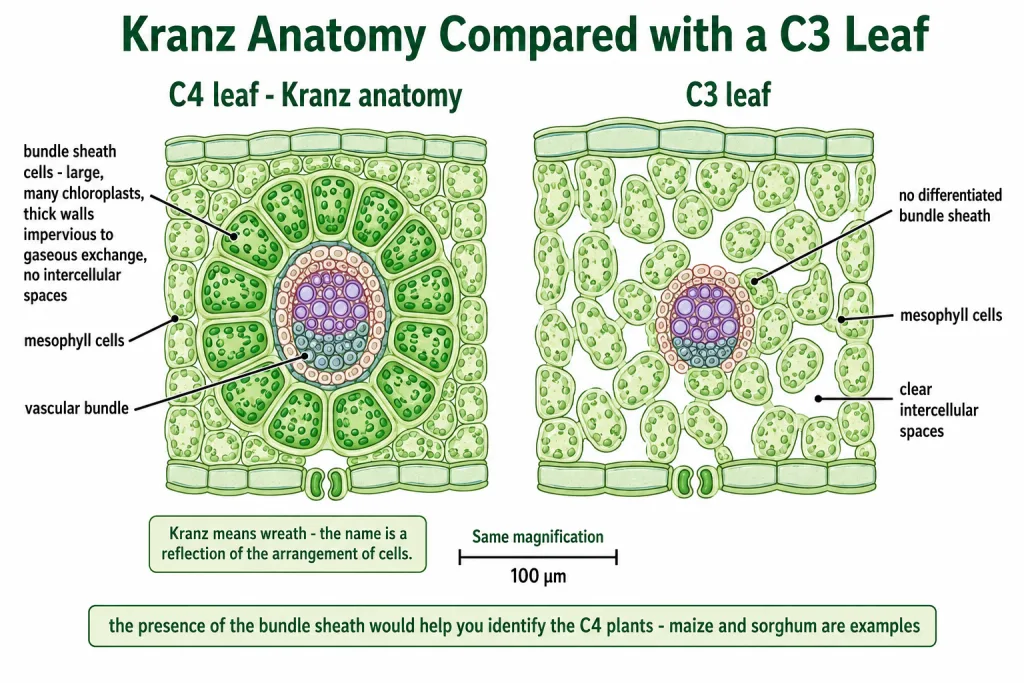
You may like to cut a section of the leaves of plants - maize or sorghum - to observe the Kranz anatomy and the distribution of mesophyll cells. If you collect leaves of diverse species of plants around you, cut vertical sections and observe them under the microscope, then look for the bundle sheath around the vascular bundles: the presence of the bundle sheath would help you identify the plants.
[NEET Important] All three characters of the bundle sheath cell are asked together, and each one has a purpose worth remembering. Many chloroplasts because this is the only place the Calvin cycle runs in a plant. Thick walls impervious to gaseous exchange and no intercellular spaces because the released inside must not leak back out. And the meaning of Kranz - wreath - is a one-mark question on its own.
The Hatch and Slack Pathway
This pathway has been named the Hatch and Slack pathway, and it is again a cyclic process. Take it step by step.
- The primary acceptor is a 3-carbon molecule, phosphoenol pyruvate (PEP), and it is present in the mesophyll cells.
- The enzyme responsible for this fixation is PEP carboxylase, or PEPcase. It is important to register that the mesophyll cells lack the RuBisCO enzyme.
- The acid OAA is formed in the mesophyll cells.
- It then forms other 4-carbon compounds like malic acid or aspartic acid in the mesophyll cells itself, and these are transported to the bundle sheath cells.
- In the bundle sheath cells these acids are broken down to release and a 3-carbon molecule.
- The 3-carbon molecule is transported back to the mesophyll, where it is converted to PEP again, thus completing the cycle.
- The released in the bundle sheath cells enters the or the Calvin pathway, a pathway common to all plants.
- The bundle sheath cells are rich in the enzyme ribulose bisphosphate carboxylase-oxygenase (RuBisCO), but lack PEPcase.
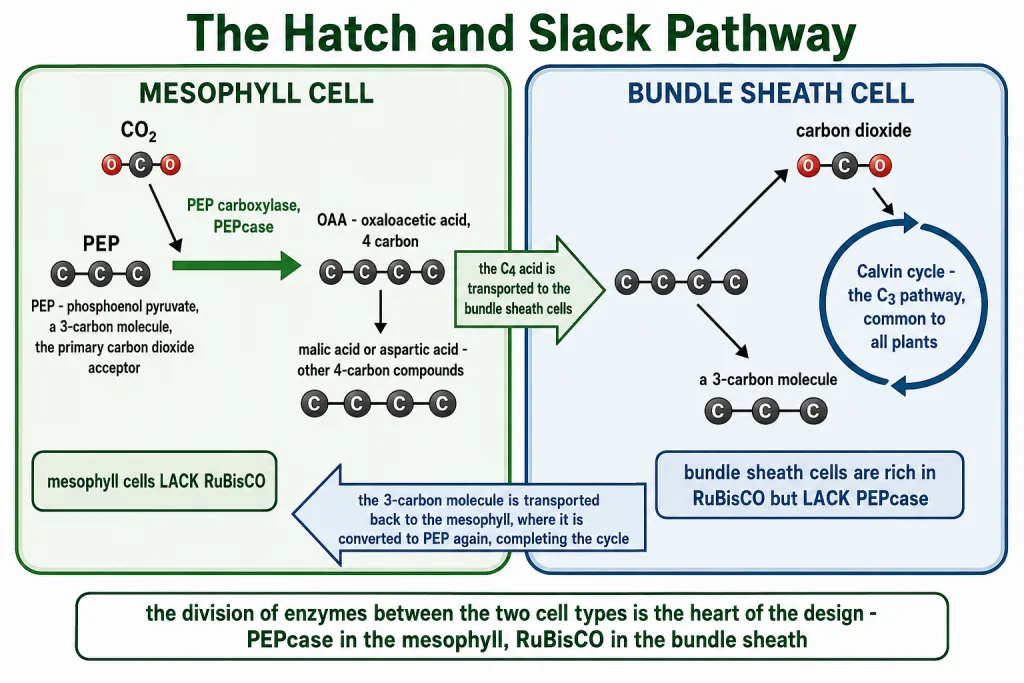
The division of enzymes between the two cell types is the heart of the whole design:
| Cell type | Enzyme it has | Enzyme it lacks | What happens there |
|---|---|---|---|
| Mesophyll cell | PEPcase | RuBisCO | PEP fixes to give OAA, then malic acid or aspartic acid |
| Bundle sheath cell | RuBisCO | PEPcase | acids broken down to release , which enters the Calvin cycle |
Thus the basic pathway that results in the formation of the sugars, the Calvin pathway, is common to the and plants.
[NEET Important] The enzyme-to-cell match is the highest-yield fact in this section. Mesophyll has PEPcase and lacks RuBisCO; bundle sheath has RuBisCO and lacks PEPcase. Swapping those two is the standard trap. Remember also that PEP is a 3-carbon molecule even though the pathway is called - the 4 refers to OAA, the first product, not to the acceptor.
Where the Calvin Pathway Actually Runs
Now put the two plant types side by side, because this comparison is asked directly.
The Calvin pathway occurs in all the mesophyll cells of the plants. In the plants it does not take place in the mesophyll cells, but does so only in the bundle sheath cells.
| Feature of the leaf | plant | plant |
|---|---|---|
| Kranz anatomy | Absent | Present |
| Bundle sheath cells | Not large or specialised in this way | Particularly large cells around the vascular bundles, often in several layers |
| Chloroplasts in the bundle sheath | Few or none | A large number |
| Walls of the bundle sheath | Not specialised | Thick and impervious to gaseous exchange |
| Intercellular spaces in the bundle sheath | Present in the mesophyll generally | No intercellular spaces |
| Enzyme in the mesophyll | RuBisCO | PEPcase, and RuBisCO is absent |
| Where the Calvin cycle runs | In all the mesophyll cells | Only in the bundle sheath cells |
| Examples | Wheat, rice | Maize, sorghum |
[NEET Important] Two sentences carry almost all the marks in this comparison. In plants the Calvin pathway occurs in all the mesophyll cells. In plants it does not take place in the mesophyll cells at all - only in the bundle sheath cells. And remember that both plant types use the Calvin pathway for making sugar.
Quick Recap
- Plants adapted to dry tropical regions have the pathway.
- plants have the oxaloacetic acid as the first fixation product, but use the pathway, or Calvin cycle, as the main biosynthetic pathway.
- plants are special: they have a special type of leaf anatomy, tolerate higher temperatures, show a response to high light intensities, lack a process called photorespiration and have greater productivity of biomass.
- The particularly large cells around the vascular bundles of plants are the bundle sheath cells, and such leaves are said to have Kranz anatomy. Kranz means wreath, a reflection of the arrangement of cells.
- Bundle sheath cells may form several layers around the vascular bundles.
- They have a large number of chloroplasts, thick walls impervious to gaseous exchange, and no intercellular spaces.
- Cut sections of maize or sorghum to observe Kranz anatomy; the presence of the bundle sheath helps you identify the plants.
- The Hatch and Slack pathway is a cyclic process.
- The primary acceptor is a 3-carbon molecule, phosphoenol pyruvate (PEP), present in the mesophyll cells, and the enzyme is PEP carboxylase, or PEPcase.
- The mesophyll cells lack RuBisCO.
- The acid OAA is formed in the mesophyll cells, then other 4-carbon compounds like malic acid or aspartic acid are formed in the mesophyll cells itself and transported to the bundle sheath cells.
- In the bundle sheath cells these acids are broken down to release and a 3-carbon molecule.
- The 3-carbon molecule is transported back to the mesophyll, where it is converted to PEP again, completing the cycle.
- The released in the bundle sheath cells enters the or Calvin pathway, a pathway common to all plants.
- The bundle sheath cells are rich in RuBisCO but lack PEPcase.
- The Calvin pathway occurs in all the mesophyll cells of plants; in plants it does not take place in the mesophyll cells but only in the bundle sheath cells.
Solved Examples
Question 1
Q. What kind of habitat are plants adapted to, and what is their first product of carbon fixation?
Answer. They are adapted to dry tropical regions. Their first fixation product is the acid oxaloacetic acid, OAA.
Question 2
Q. If OAA is the first product in a plant, which pathway makes its sugar?
Answer. The pathway, or Calvin cycle. Even in a plant, the Calvin cycle is the main biosynthetic pathway - the steps only deliver to it.
Question 3
Q. List the five ways in which plants are special.
Answer. They have a special type of leaf anatomy, they tolerate higher temperatures, they show a response to high light intensities, they lack a process called photorespiration, and they have greater productivity of biomass.
Question 4
Q. By looking at a plant externally, can you tell whether a plant is or ? Why and how? This is one of the chapter-end exercises.
Answer. No, not reliably. There is no external feature of a plant that tells you which pathway it uses, because the difference between a and a plant is an internal one - it lies in the leaf anatomy and in which enzyme sits in which cell, and neither of those is visible from outside. Two plants can look almost identical from the outside and still use different pathways.
What you can do from outside is guess, using indirect clues.
- Habitat. plants are the ones adapted to dry tropical regions. A plant thriving in a hot, dry, brightly lit place is more likely to be .
- Performance in heat and bright light. plants tolerate higher temperatures and show a response to high light intensities, so a plant that keeps growing well at midday in strong sun and high temperature, instead of slowing down, is behaving like a plant.
- Productivity. plants have greater productivity of biomass, so fast, heavy growth is a hint.
- Known examples. If you already recognise the plant, that settles it - maize and sorghum are plants.
But these are habitat and performance clues, not a test. They tell you where to look, not what the answer is. To actually decide, you must cut a vertical section of the leaf and look for the Kranz anatomy under the microscope.
Question 5
Q. By looking at which internal structure of a plant can you tell whether a plant is or ? Explain. This is one of the chapter-end exercises.
Answer. By looking at the leaf anatomy in a vertical section, specifically for the Kranz anatomy.
Cut a vertical section of the leaf and look at the cells around the vascular bundles. In a plant you will find particularly large cells around the vascular bundles, called bundle sheath cells, and a leaf with such an arrangement is said to have Kranz anatomy. Kranz means wreath, and the name is a reflection of the arrangement of cells - they sit in a ring around the bundle.
The bundle sheath cells are recognised by four things:
- They may form several layers around the vascular bundles.
- They have a large number of chloroplasts.
- They have thick walls impervious to gaseous exchange.
- They have no intercellular spaces.
A leaf has no such specialised sheath. So the presence of the bundle sheath is what identifies a plant. Maize and sorghum are good material to section for this.
Question 6
Q. Give a comparison between the anatomy of the leaf in and plants. This is one of the chapter-end exercises.
Answer.
| Feature | plant leaf | plant leaf |
|---|---|---|
| Kranz anatomy | Absent | Present |
| Cells around the vascular bundle | Not enlarged into a specialised sheath | Particularly large bundle sheath cells, often in several layers |
| Chloroplasts in those cells | Few or none | A large number |
| Their cell walls | Not specialised | Thick and impervious to gaseous exchange |
| Intercellular spaces there | Present as usual | No intercellular spaces |
| Enzyme in the mesophyll cells | RuBisCO | PEPcase; RuBisCO is absent |
| Enzyme in the bundle sheath cells | Not applicable | RuBisCO; PEPcase is absent |
| Site of the Calvin cycle | All the mesophyll cells | Only the bundle sheath cells |
| Examples | Wheat, rice | Maize, sorghum |
In one sentence: the leaf has Kranz anatomy and the leaf does not, and that single structural difference is what lets the plant split its photosynthesis between two kinds of cell.
Question 7
Q. What does Kranz mean, and why is the anatomy given that name?
Answer. Kranz means wreath. The name is a reflection of the arrangement of cells - the large bundle sheath cells form a ring, like a wreath, around the vascular bundle.
Question 8
Q. Name the three characteristics of bundle sheath cells.
Answer. A large number of chloroplasts, thick walls impervious to gaseous exchange, and no intercellular spaces. They may also form several layers around the vascular bundles.
Question 9
Q. What is the primary carbon dioxide acceptor in a plant, how many carbons does it have, and where is it found?
Answer. Phosphoenol pyruvate, PEP. It is a 3-carbon molecule, and it is present in the mesophyll cells.
Question 10
Q. Which enzyme fixes carbon dioxide in the mesophyll cells of a plant, and which enzyme is missing there?
Answer. PEP carboxylase, or PEPcase, does the fixing. The mesophyll cells lack the RuBisCO enzyme. That is the detail worth registering, because it is exactly the reverse in the bundle sheath cells.
Question 11
Q. Trace the Hatch and Slack pathway from PEP back to PEP.
Answer. PEP in the mesophyll cells accepts , using PEPcase, to form the acid OAA. OAA then forms other 4-carbon compounds like malic acid or aspartic acid in the mesophyll cells itself, and these are transported to the bundle sheath cells. There the acids are broken down to release and a 3-carbon molecule. The 3-carbon molecule is transported back to the mesophyll, where it is converted to PEP again, completing the cycle. The released in the bundle sheath cells enters the or Calvin pathway.
Question 12
Q. Which enzymes are present and absent in the bundle sheath cells?
Answer. The bundle sheath cells are rich in ribulose bisphosphate carboxylase-oxygenase, RuBisCO, but lack PEPcase.
Question 13
Q. Where does the Calvin pathway take place in a plant, and where in a plant?
Answer. In a plant it occurs in all the mesophyll cells. In a plant it does not take place in the mesophyll cells at all - it takes place only in the bundle sheath cells.
Question 14
Q. Even though a very few cells in a plant carry out the biosynthetic Calvin pathway, yet they are highly productive. Can you discuss why? This is one of the chapter-end exercises.
Answer. Because those few cells are kept working at close to their maximum rate all the time, while in a plant a far larger number of cells work well below theirs.
The mesophyll cells act as a pump for the bundle sheath. All the mesophyll cells of the leaf fix using PEPcase into the acids, which are then transported to the bundle sheath cells and broken down to release there. So the whole leaf collects carbon and delivers it into a small number of cells, and the concentration of inside those cells becomes very high.
The anatomy stops that concentrated from escaping. The bundle sheath cells have thick walls impervious to gaseous exchange and no intercellular spaces, so the released inside stays inside, and they have a large number of chloroplasts to use it.
The result is that RuBisCO in those cells is always supplied with plenty of . RuBisCO also has an oxygenation activity, and it is that activity, favoured when is scarce, which leads to photorespiration - a wasteful process. Because the bundle sheath is flooded with , the carboxylation activity wins, and plants lack photorespiration. Nothing that was fixed is thrown away again.
This is also why the other special features follow. The pump keeps working at high temperatures and at high light intensities, where a plant would be losing carbon to photorespiration. Put together - no losses, a saturating supply of , and full use of strong light and heat - the few bundle sheath cells give the plant greater productivity of biomass than a plant with many more photosynthesising cells.