
The Photochemical Phase
Light reactions, or the photochemical phase, include light absorption, water splitting, oxygen release, and the formation of high-energy chemical intermediates, ATP and NADPH.
That single sentence is the definition, and the four events in it are asked as a set:
- Light absorption
- Water splitting
- Oxygen release
- The formation of high-energy chemical intermediates, ATP and NADPH
Several protein complexes are involved in the process. This is not one enzyme doing one job. It is a row of complexes sitting in the thylakoid membrane, each handing energy or electrons to the next.
Notice what is not in the list. No is fixed here and no sugar is made here. The light reaction only builds the two energy currencies - ATP and NADPH - and releases as a by-product. The sugar comes later, in the stroma.
[NEET Important] The four events - light absorption, water splitting, oxygen release, formation of ATP and NADPH - are the whole of the light reaction. The standard distractor drops in fixation of or synthesis of sugar as a fifth item. Both belong to the biosynthetic phase in the stroma, not to the photochemical phase.
Two Photosystems, Named in the Order They Were Discovered
The pigments are organised into two discrete photochemical light harvesting complexes (LHC) within the Photosystem I (PS I) and Photosystem II (PS II).
Now the sentence that carries most of the marks in this section:
These are named in the sequence of their discovery, and not in the sequence in which they function during the light reaction.
Read that twice. PS I was discovered first, so it took the number one. But when the light reaction actually runs, PS II acts first and PS I acts second - the electrons begin at PS II, travel down an electron transport chain, and only then reach PS I.
| Photosystem | Why it carries that number | Where it comes in the light reaction |
|---|---|---|
| PS I | Discovered first | Second - it receives the electrons that PS II sent down the chain |
| PS II | Discovered second | First - it starts the electron flow and is the one linked to water splitting |
So the numbers are a historical label, not a running order. The name tells you when scientists found the complex, not when the plant uses it.
[NEET Important] This is a favourite question and it is asked in both directions. Either which photosystem functions first in the light reaction - the answer is PS II - or on what basis are the photosystems numbered - the answer is the sequence of their discovery, not the sequence in which they function. Any option saying PS I works first because it is numbered one is the trap the question was built around.
The Antennae and the Reaction Centre
The LHC are made up of hundreds of pigment molecules bound to proteins.
Inside one photosystem the pigments split into two very unequal jobs.
Each photosystem has all the pigments, except one molecule of chlorophyll a, forming a light harvesting system also called antennae. These pigments help to make photosynthesis more efficient by absorbing different wavelengths of light.
The single chlorophyll a molecule forms the reaction centre.
So it is hundreds of pigment molecules collecting, and exactly one chlorophyll a molecule acting. The antenna pigments catch photons across a wide range of wavelengths and funnel that energy inward; the reaction centre is where the energy is finally used to push an electron out.
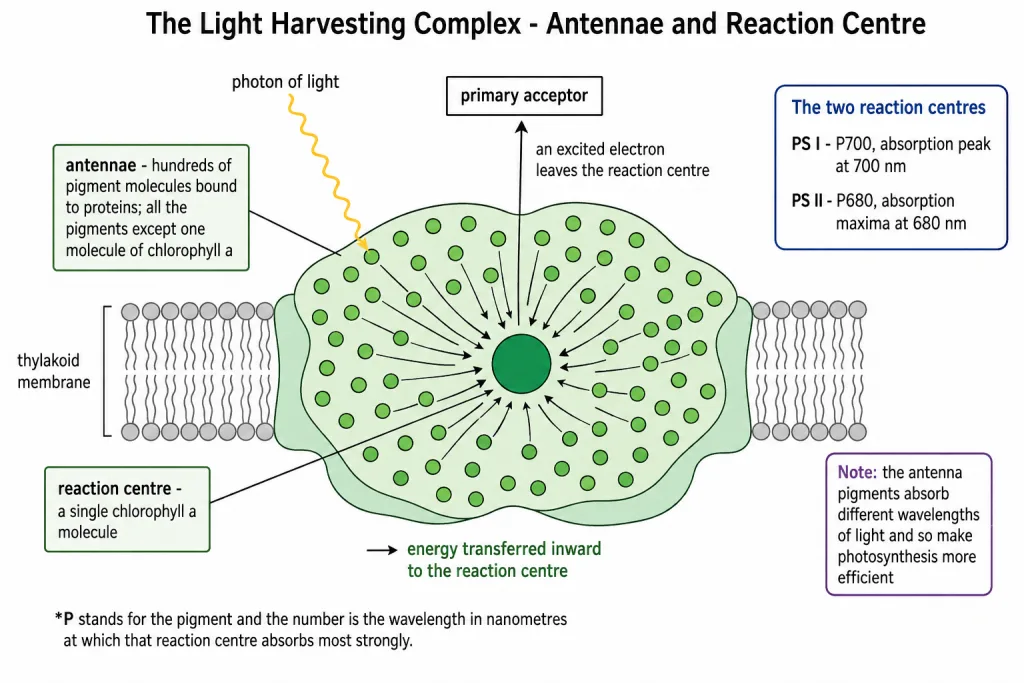
The reaction centre is different in both the photosystems.
| Photosystem | The reaction centre chlorophyll a | Its name |
|---|---|---|
| PS I | Absorption peak at | |
| PS II | Absorption maxima at |
The P stands for the pigment and the number is simply the wavelength in nanometres at which that reaction centre absorbs most strongly.
[NEET Important] Three separate one-mark facts live in this block. The antennae are all the pigments except one molecule of chlorophyll a. The reaction centre is that one chlorophyll a molecule. And goes with PS I while goes with PS II - the pairing that gets swapped in options more than any other in the chapter. Remember it by the discovery order: PS I, the one found first, has the larger number, .
Quick Recap
- Light reactions, or the photochemical phase, include light absorption, water splitting, oxygen release, and the formation of high-energy chemical intermediates, ATP and NADPH.
- Several protein complexes are involved in the process.
- The pigments are organised into two discrete photochemical light harvesting complexes (LHC) within Photosystem I (PS I) and Photosystem II (PS II).
- PS I and PS II are named in the sequence of their discovery, and not in the sequence in which they function during the light reaction.
- In the light reaction PS II functions first and PS I second.
- The LHC are made up of hundreds of pigment molecules bound to proteins.
- Each photosystem has all the pigments, except one molecule of chlorophyll a, forming a light harvesting system also called antennae.
- The antenna pigments help to make photosynthesis more efficient by absorbing different wavelengths of light.
- The single chlorophyll a molecule forms the reaction centre.
- The reaction centre is different in the two photosystems.
- In PS I the reaction centre chlorophyll a has an absorption peak at , hence is called .
- In PS II the reaction centre chlorophyll a has absorption maxima at , and is called .
Solved Examples
Question 1
Q. What is the other name for the light reaction, and what four events does it include?
Answer. The light reaction is also called the photochemical phase. It includes light absorption, water splitting, oxygen release, and the formation of high-energy chemical intermediates, ATP and NADPH.
Question 2
Q. Is sugar made during the light reaction?
Answer. No. The light reaction only makes ATP and NADPH and releases . Fixing and making sugar happen later, in the stroma, using those products.
Question 3
Q. How are the pigments organised in the thylakoid membrane?
Answer. They are organised into two discrete photochemical light harvesting complexes, the LHC, within Photosystem I (PS I) and Photosystem II (PS II). Several protein complexes are involved in the process.
Question 4
Q. On what basis were PS I and PS II given their numbers?
Answer. They are named in the sequence of their discovery, and not in the sequence in which they function during the light reaction. PS I was found first, so it took the number one.
Question 5
Q. Which photosystem actually acts first when the light reaction runs?
Answer. PS II. The electrons start at PS II, pass down an electron transport chain, and only then reach PS I. The numbering is a historical label, not the running order.
Question 6
Q. What are the LHC made of?
Answer. Hundreds of pigment molecules bound to proteins.
Question 7
Q. What is meant by the antennae of a photosystem?
Answer. All the pigments of a photosystem except one molecule of chlorophyll a form a light harvesting system, also called antennae. Their job is to absorb different wavelengths of light and pass the energy inward.
Question 8
Q. How do the antenna pigments make photosynthesis more efficient?
Answer. By absorbing different wavelengths of light. One pigment alone would capture only a narrow band; hundreds of different pigment molecules together capture across a much wider range and funnel all of it to a single point.
Question 9
Q. What forms the reaction centre of a photosystem?
Answer. A single molecule of chlorophyll a - the one molecule that the antennae leave out.
Question 10
Q. How many chlorophyll a molecules act as the reaction centre in one photosystem?
Answer. Exactly one. Everything else in the complex - the hundreds of pigment molecules - is antenna.
Question 11
Q. Name the reaction centre of PS I and give its absorption peak.
Answer. It is called , because in PS I the reaction centre chlorophyll a has an absorption peak at .
Question 12
Q. Name the reaction centre of PS II and give its absorption maximum.
Answer. It is called , because in PS II the reaction centre chlorophyll a has absorption maxima at .
Question 13
Q. A student writes that PS I is called Photosystem I because it works first in the light reaction. Correct the statement.
Answer. That is wrong. The photosystems are named in the sequence of their discovery, not in the sequence in which they function during the light reaction. PS I was discovered first, which is why it carries the number one, but during the light reaction PS II functions first and PS I functions second.