
The General Term: One Formula, Most of the Marks
The rationalised textbook chapter stops at full expansions; JEE asks for single terms — the 7th term, the coefficient of , the term free of . One formula answers them all:
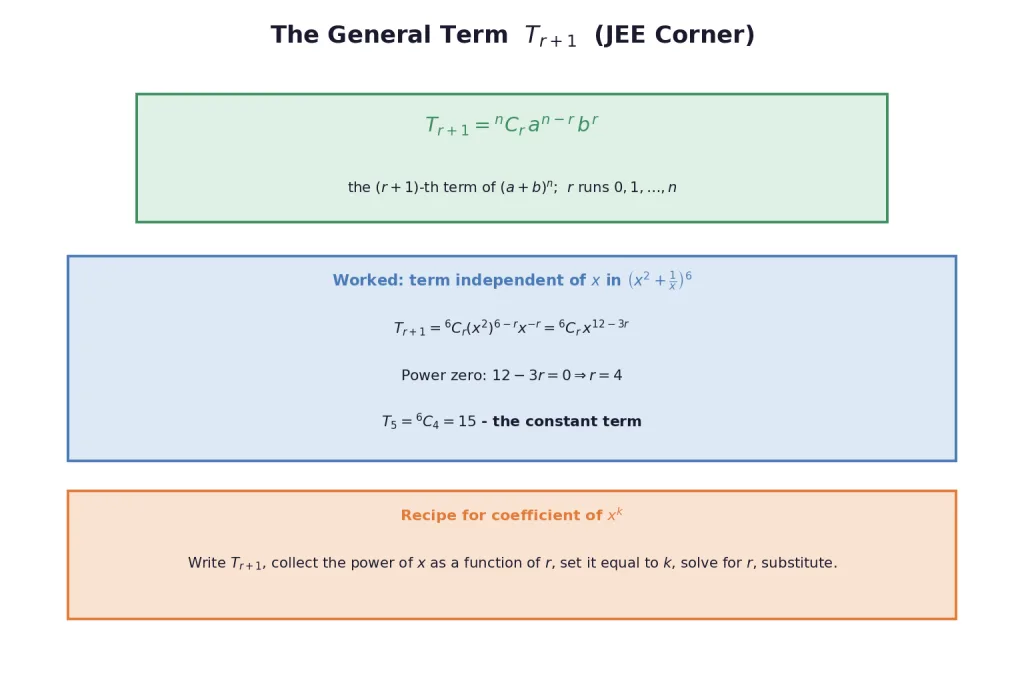
Key Point (General Term): In the expansion of ,
Note the offset: the term number is one more than — has , has .
The coefficient recipe: write , collect the power of as a function of , set it equal to the target power, solve for , substitute back. For the term independent of , set the power to zero.
Worked: in , ; zero power needs , giving .
[JEE Tip] If solving for gives a non-integer or , the requested term does not exist — that IS the answer (coefficient 0), and it is a favourite trap option.
Middle Terms and Coefficient Sums
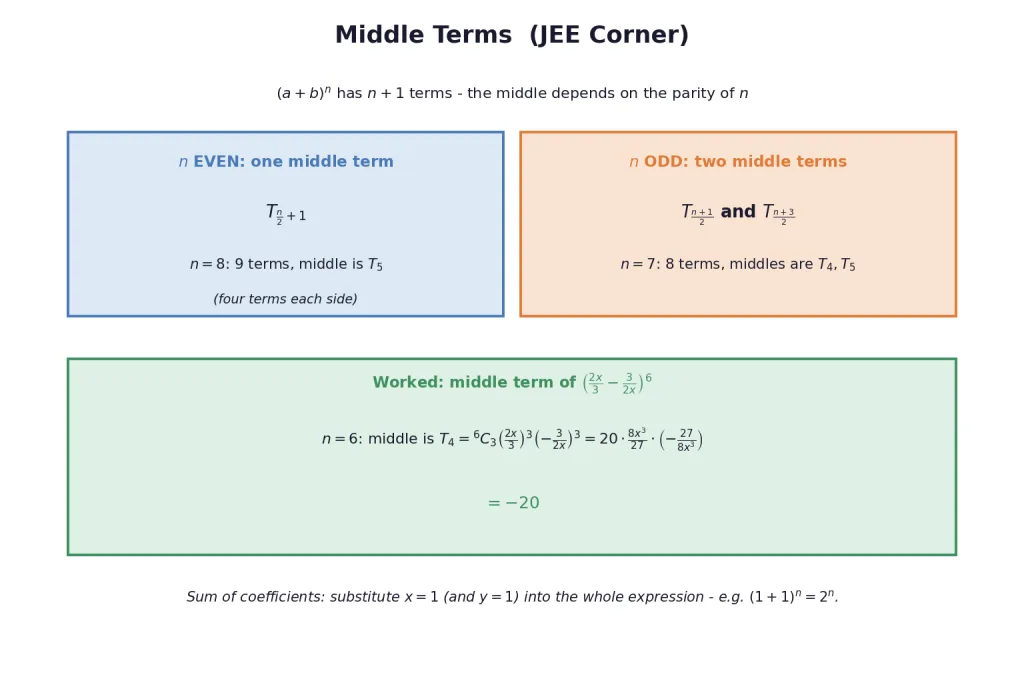
Key Point (Middle Terms): has terms. If is even, there is one middle term, . If is odd, there are two, and .
For the middle term is with the greatest coefficient of that row.
Sums of coefficients by substitution:
- All coefficients of a polynomial expansion : put . For : .
- Alternating sum: put .
- Binomial coefficients only: ; even- and odd-position sums are each.
Term from the end: the -th term from the end of is the -th from the beginning — or swap and and count from the front.
[JEE Tip] "Sum of coefficients" and "sum of binomial coefficients" differ: for the first is (put ), the second is . Read which one the question wants.
Solved Examples
Example 1: A specific term
Find the 4th term of .
Solution:
Step 1 — Convert term number to . means (the offset: ).
Step 2 — Write the term. .
Step 3 — Evaluate. .
Takeaway: The term number is always one more than — convert first, then substitute.
Example 2: A two-variable coefficient
Find the coefficient of in .
Solution:
Step 1 — Locate the term. needs : — and the -power matches ✓.
Step 2 — Evaluate. .
Takeaway: Match BOTH powers before evaluating — a mismatch means no such term.
Example 3: The 5th term with a coefficient base
Find the 5th term of .
Solution:
Step 1 — Convert. : .
Step 2 — Evaluate. : .
Takeaway: contributes — bracket the base before raising.
Example 4: Term independent of
Find the term independent of in .
Solution:
Step 1 — Write the general term and collapse the powers.
Step 2 — Set the power to zero. gives .
Step 3 — Substitute back. .
Takeaway: Independent term = solve (power of ) ; keep the numeric factors exact as fractions.
Example 5: Classic — the 13th term is constant
Show the 13th term of is independent of and find it.
Solution:
Step 1 — Convert and write the term. : .
Step 2 — Track the powers of . from the first factor; from the second: net ✓.
Step 3 — Evaluate. The even power kills the minus sign: .
Takeaway: cancels the denominator exactly — engineered bases like this are a JEE signature.
Example 6: Coefficient of a negative power
Find the coefficient of in .
Solution:
Step 1 — Collapse the powers. .
Step 2 — Solve. gives .
Step 3 — Evaluate. .
Takeaway: Negative target powers work exactly like positive ones — solve the same linear equation in .
Example 7: Single middle term ( even)
Find the middle term of .
Solution:
Step 1 — Locate the middle. (even): one middle term, , i.e. .
Step 2 — Write it. .
Step 3 — Simplify the powers. : .
Takeaway: Convert to a single power of 3 before multiplying — arithmetic stays small.
Example 8: Two middle terms ( odd)
Find the middle terms of .
Solution:
Step 1 — Locate. (odd): two middles, () and ().
Step 2 — Compute . .
Step 3 — Compute . .
Takeaway: Odd index → two middle terms with opposite signs here — the odd/even power of the negative part decides each sign.
Example 9: Middle term that collapses
Find the middle term of .
Solution:
Step 1 — Locate. : middle is , .
Step 2 — Write and simplify. .
Takeaway: Symmetric bases make the middle term the constant term — two questions, one answer.
Example 10: Sum of coefficients of a full expression
Find the sum of the coefficients of .
Solution:
Step 1 — Substitute . Sum of coefficients .
Step 2 — Evaluate. .
Takeaway: The substitution handles trinomials as easily as binomials.
Example 11: Two different "sums"
For , find (i) the sum of the coefficients (ii) the sum of the binomial coefficients.
Solution:
Step 1 — (i) All coefficients. Put : .
Step 2 — (ii) Binomial coefficients only. The alone: .
Step 3 — Contrast. The first includes the powers of 2 and 3 baked into each term; the second ignores them.
Takeaway: Read the question — "coefficients" and "binomial coefficients" differ whenever the base isn't .
Example 12: Equal coefficients locate (classic)
In , the coefficients of the -th and -th terms are equal. Find .
Solution:
Step 1 — Convert term numbers to coefficient indices. The -th term has coefficient : here and .
Step 2 — Apply the equality rule. Either (gives , rejected) or .
Step 3 — Solve. , so .
Takeaway: Always test both branches of — and reject the one that breaks the constraints.
Example 13: Coefficients in AP
The coefficients of the 2nd, 3rd and 4th terms of are in AP. Find .
Solution:
Step 1 — Write the AP condition. .
Step 2 — Expand and simplify. ; divide by and multiply by 6: .
Step 3 — Solve the quadratic. gives or .
Step 4 — Reject the impossible root. has no 4th term. .
Takeaway: Solve the algebra, then audit the roots against the term-count constraint.
Example 14: Term from the end
Find the 7th term from the end of .
Solution:
Step 1 — Convert to a front count. The -th term from the end is the -th from the start: .
Step 2 — Compute . : .
Step 3 — Evaluate. — here the 7th from either end coincide (13 terms, 7 is the middle).
Takeaway: End-counted terms convert by — or swap the two quantities and count from the front.
Example 15: Does the term exist?
Find the coefficient of in .
Solution:
Step 1 — Collapse the powers. .
Step 2 — Solve. gives , — not an integer.
Step 3 — Conclude. The power never occurs: coefficient .
Takeaway: A non-integer (or out-of-range) IS the answer — the term simply does not exist.