The Theorem
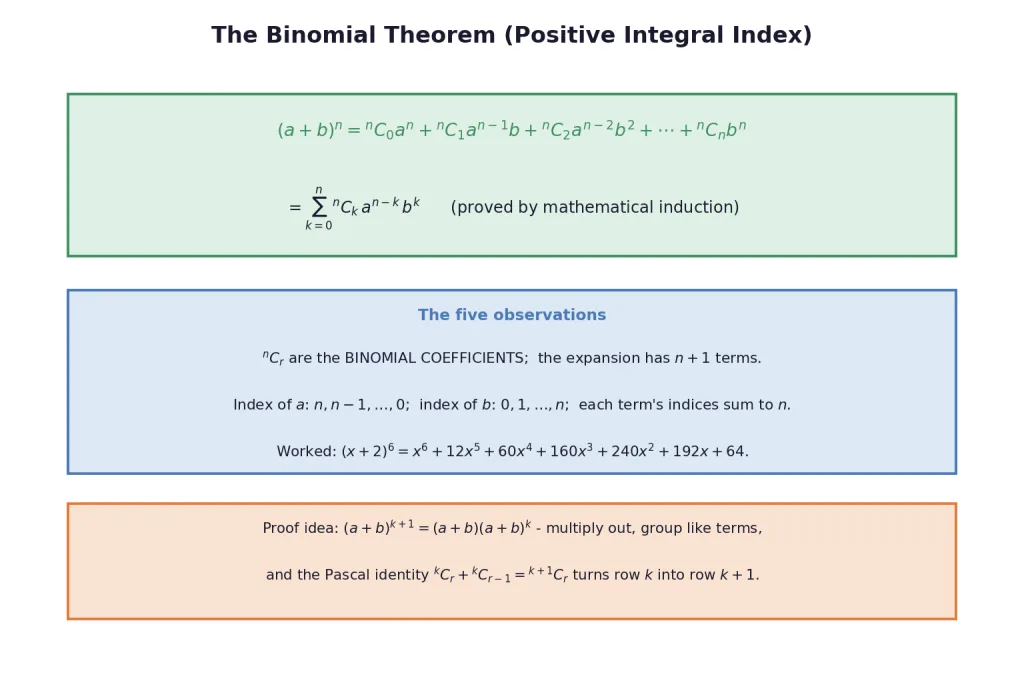
Key Point (Binomial Theorem): For any positive integer n,
(a+b)n=nC0an+nC1an−1b+nC2an−2b2+⋯+nCn−1abn−1+nCnbn=k=0∑nnCkan−kbk
The nCr are the binomial coefficients. The proof is by mathematical induction: P(1) is immediate, and multiplying the assumed expansion of (a+b)k by one more (a+b), then grouping like terms, produces exactly row k+1 — because the coefficients combine by the Pascal identity kCr+kCr−1=k+1Cr.
A worked illustration:
(x+2)6=x6+12x5+60x4+160x3+240x2+192x+64
where each coefficient is 6Cr⋅2r — e.g. the x3 term is 6C3x323=20⋅8x3=160x3.
[Board Tip] Bookkeeping wins marks: for index n expect exactly n+1 terms, powers of the first quantity falling n→0, powers of the second rising 0→n, and each term's indices adding to n. Count your terms before moving on.
Special Cases That Do the Real Work
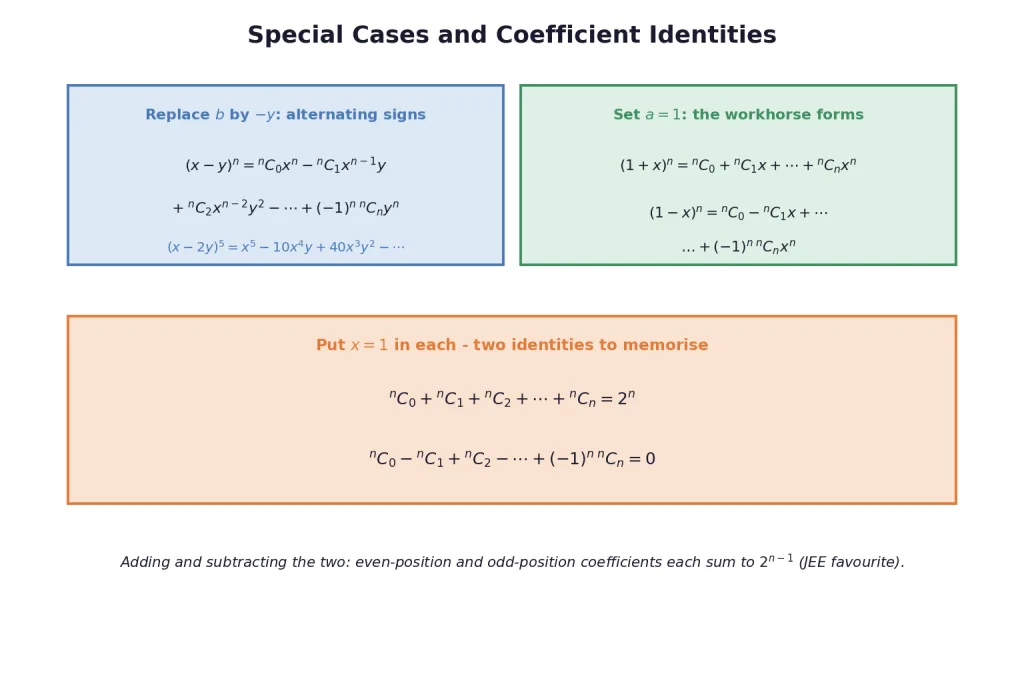
Replace b by −y — signs alternate, starting positive:
(x−y)n=nC0xn−nC1xn−1y+nC2xn−2y2−⋯+(−1)nnCnyn
For example: (x−2y)5=x5−10x4y+40x3y2−80x2y3+80xy4−32y5.
Set a=1 — the workhorse forms:
(1+x)n=nC0+nC1x+nC2x2+⋯+nCnxn
(1−x)n=nC0−nC1x+nC2x2−⋯+(−1)nnCnxn
Key Point (put x=1): nC0+nC1+⋯+nCn=2n and nC0−nC1+nC2−⋯+(−1)nnCn=0 — the two coefficient identities every exam quotes.
[JEE Tip] Adding and subtracting the two identities splits the coefficients: the even-position ones (nC0+nC2+⋯) and the odd-position ones (nC1+nC3+⋯) each sum to 2n−1.
Solved Examples
Example 1: Fractional second term
Expand (x2+x3)4, x=0.
Solution:
Step 1 — Set up the theorem. With a=x2, b=x3, n=4:
4C0(x2)4+4C1(x2)3x3+4C2(x2)2x29+4C3(x2)x327+4C4x481
Step 2 — Evaluate the coefficients. 1,4,6,4,1 times 30,31,32,33,34: 1,12,54,108,81.
Step 3 — Combine the powers of x. x8,x6⋅x−1=x5,x4⋅x−2=x2,x2⋅x−3=x−1,x−4:
=x8+12x5+54x2+x108+x481
Takeaway: Powers of x drop by 3 each term here — the exponent walk 8,5,2,−1,−4 is a quick self-check.
Example 2: Alternating signs
Expand (1−2x)5.
Solution:
Step 1 — Use the (1−x) pattern. Signs alternate starting positive:
(1−2x)5=5C0−5C1(2x)+5C2(2x)2−5C3(2x)3+5C4(2x)4−5C5(2x)5
Step 2 — Evaluate. Coefficients 5Cr2r: 1,10,40,80,80,32 with alternating signs:
=1−10x+40x2−80x3+80x4−32x5
Step 3 — Check. At x=1: 1−10+40−80+80−32=−1=(1−2)5 ✓.
Takeaway: (2x)r contributes 2r — and the x=1 substitution verifies the whole line at once.
Example 3: Both terms fractional
Expand (x2−2x)5, x=0.
Solution:
Step 1 — Identify the parts. a=x2, b=−2x; odd powers of b carry minus signs.
Step 2 — Write the five-row expansion.
x532−5⋅x416⋅2x+10⋅x38⋅4x2−10⋅x24⋅8x3+5⋅x2⋅16x4−32x5
Step 3 — Simplify term by term. x532, −x340, +x20, −5x, +85x3, −32x5:
=x532−x340+x20−5x+85x3−32x5
Takeaway: Powers of x climb by 2 each term (−5 to +5) — another exponent walk to check against.
Example 4: A sixth-power expansion
Expand (2x−3)6.
Solution:
Step 1 — Set up with alternating signs.
6C0(2x)6−6C1(2x)5(3)+6C2(2x)4(9)−6C3(2x)3(27)+6C4(2x)2(81)−6C5(2x)(243)+6C6(729)
Step 2 — Evaluate each coefficient. 64, 6⋅32⋅3=576, 15⋅16⋅9=2160, 20⋅8⋅27=4320, 15⋅4⋅81=4860, 6⋅2⋅243=2916, 729.
Step 3 — Assemble.
=64x6−576x5+2160x4−4320x3+4860x2−2916x+729
Step 4 — Check. At x=1: 64−576+2160−4320+4860−2916+729=1=(2−3)6 ✓.
Takeaway: Seven terms for index 6, signs strictly alternating — count both before simplifying.
Example 5: Fractional first term
Expand (3x+x1)5, x=0.
Solution:
Step 1 — Row 5 with a=3x, b=x1.
(3x)5+5(3x)4x1+10(3x)3x21+10(3x)2x31+5(3x)x41+x51
Step 2 — Simplify the powers of 3 and x.
=243x5+815x3+2710x+9x10+3x35+x51
Takeaway: Denominators run 35,34,… against rising powers of x1 — all signs positive since both terms are positive.
Example 6: A symmetric expansion
Expand (x+x1)6, x=0.
Solution:
Step 1 — Row 6 and the exponent walk. Coefficients 1,6,15,20,15,6,1; powers of x run 6,4,2,0,−2,−4,−6 (each step trades an x for an x−1).
Step 2 — Write it out.
x6+6x4+15x2+20+x215+x46+x61
Step 3 — Note the constant. The middle term 6C3x3x−3=20 is where the powers cancel exactly.
Takeaway: In (x+x1)n the exponents fall by 2 per term — the constant term exists only when n is even.
Example 7: (x−2y)5 line by line
Expand (x−2y)5.
Solution:
Step 1 — Row 5 with alternating signs.
x5−5x4(2y)+10x3(4y2)−10x2(8y3)+5x(16y4)−32y5
Step 2 — Simplify.
=x5−10x4y+40x3y2−80x2y3+80xy4−32y5
Step 3 — Check. At x=2,y=1: 32−160+320−320+160−32=0=(2−2)5 ✓.
Takeaway: (2y)r compounds to 2ryr; the signs alternate because the second quantity is negative.
Example 8: The sigma form, read off
Write ∑k=044Ck34−kxk as a power of a binomial.
Solution:
Step 1 — Pattern-match. The theorem reads ∑nCkan−kbk=(a+b)n.
Step 2 — Identify the parts. Here n=4, a=3 (falling powers), b=x (rising powers).
Step 3 — Conclude. The sum is (3+x)4.
Takeaway: Falling-power base is a, rising-power base is b — read sigma forms straight back into (a+b)n.
Example 9: Coefficient identities in action
Evaluate (i) 10C0+10C1+⋯+10C10 (ii) 10C0−10C1+⋯+10C10 (iii) 10C1+10C3+⋯+10C9.
Solution:
Step 1 — (i) Full sum. Put x=1 in (1+x)10: 210=1024.
Step 2 — (ii) Alternating sum. Put x=1 in (1−x)10: (1−1)10=0.
Step 3 — (iii) Odd positions. Subtracting (ii) from (i) doubles the odd-position sum: 21024−0=29=512.
Takeaway: Full sum 2n, alternating sum 0 — adding/subtracting splits even and odd positions into 2n−1 each.
Example 10: A disguised expansion
Prove that ∑r=0n3rnCr=4n.
Solution:
Step 1 — Start from the workhorse form. (1+x)n=∑rnCrxr for every real x.
Step 2 — Choose x=3. The right side becomes ∑nCr3r — exactly the given sum.
Step 3 — Evaluate the left side. (1+3)n=4n. ∎
Takeaway: Sums of the shape ∑nCrtr are (1+t)n in disguise — substitute, don't compute.
