A Pattern Worth Noticing
You already know these identities:
(a+b)0=1,(a+b)1=a+b,(a+b)2=a2+2ab+b2
(a+b)3=a3+3a2b+3ab2+b3,(a+b)4=a4+4a3b+6a2b2+4ab3+b4
Computing (a+b)4 by multiplying (a+b)3 by (a+b) works, but it hides a structure worth spelling out in three observations:
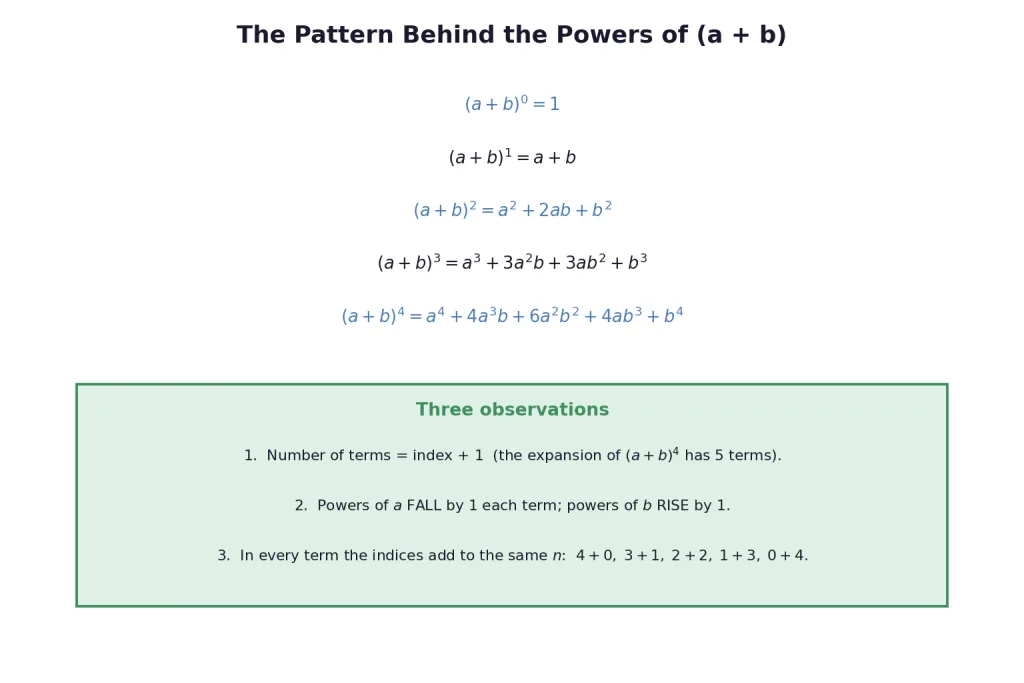
Key Point (the three observations): In the expansion of (a+b)n: (1) the number of terms is one more than the index — n+1 terms; (2) powers of a decrease by 1 term by term while powers of b increase by 1; (3) in every term the indices of a and b add to n.
So the only thing left to know is the coefficients — and they have a life of their own.
Pascal's Triangle
Arrange the coefficients by index:
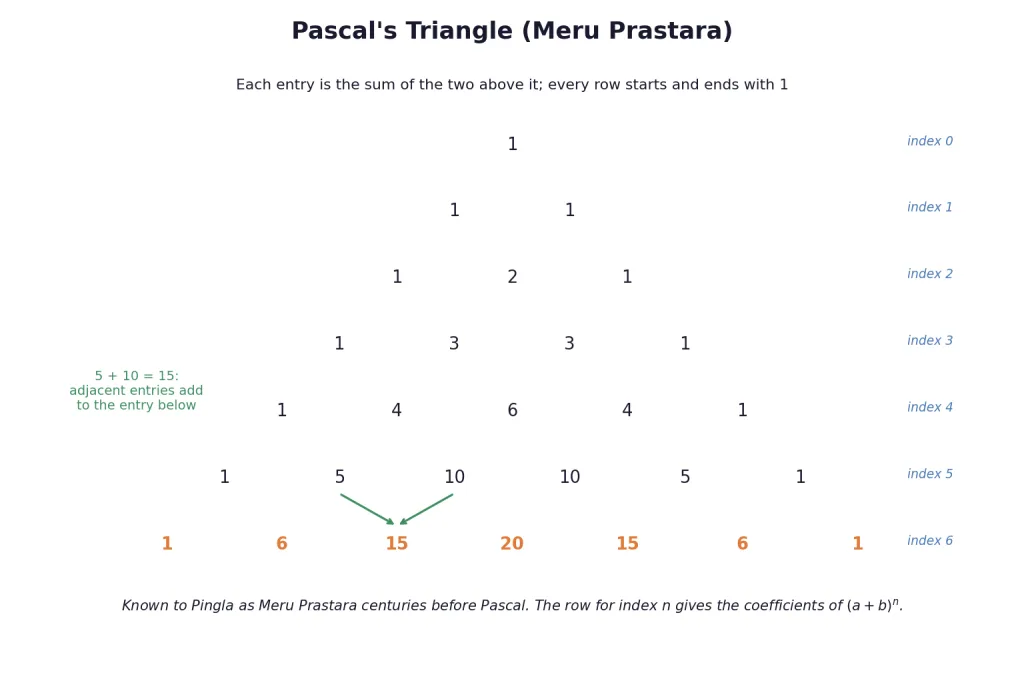
Every row begins and ends with 1, and each interior entry is the sum of the two entries above it — the 2 in row 2 comes from 1+1; the two 3's in row 3 from 1+2 and 2+1. This array is Pascal's triangle, known to the Indian scholar Pingla as Meru Prastara centuries before Pascal.
To expand a binomial, read off its row. The row for index 5 is 1,5,10,10,5,1, so
(2x+3y)5=(2x)5+5(2x)4(3y)+10(2x)3(3y)2+10(2x)2(3y)3+5(2x)(3y)4+(3y)5
=32x5+240x4y+720x3y2+1080x2y3+810xy4+243y5
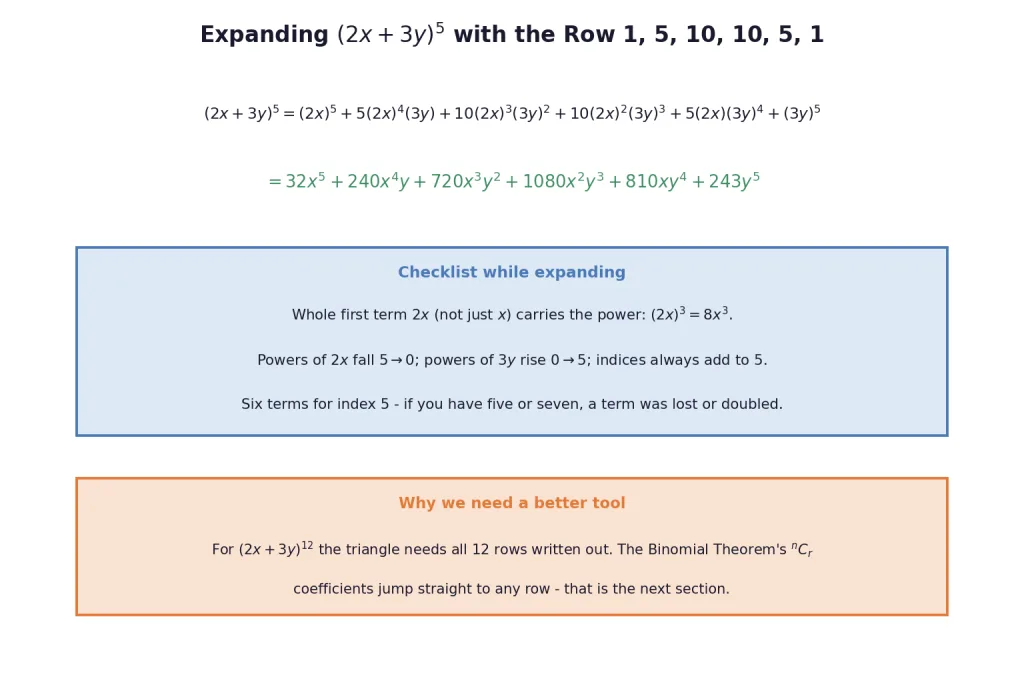
[Board Tip] The whole quantity 2x carries each power — (2x)3=8x3, not 2x3. Forgetting the coefficient's power is this section's classic lost mark.
From Triangle Rows to Combinations
Expanding (2x+3y)12 by triangle would need all twelve rows written out — workable, but slow, and hopeless for index 50. The escape: the entries of Pascal's triangle are the combinations of Chapter 6.
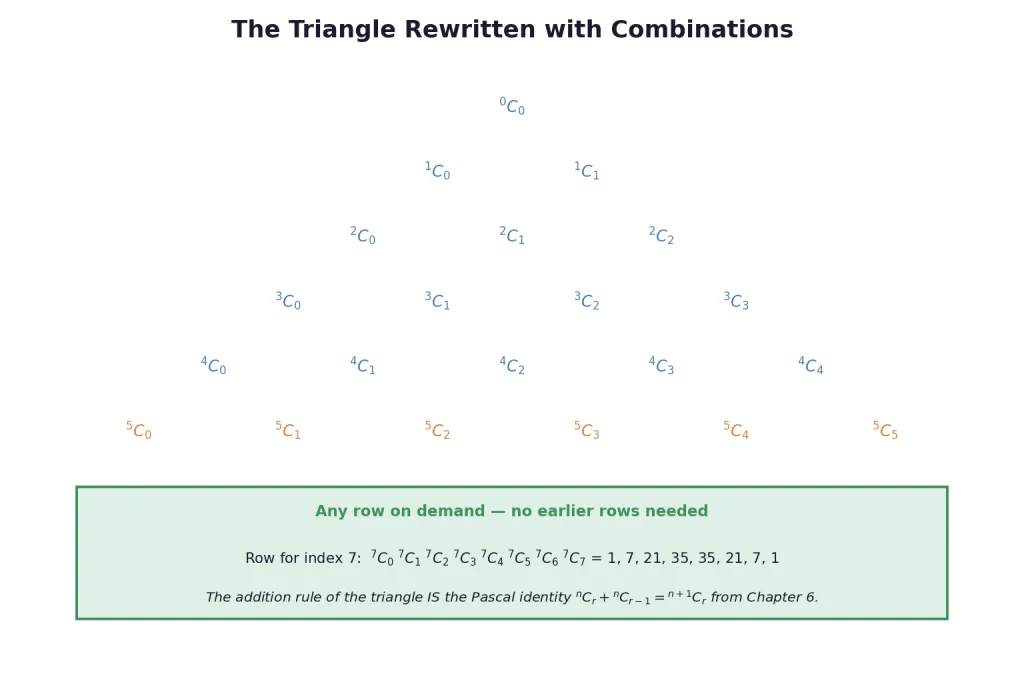
Row n reads nC0,nC1,…,nCn — so any row is available on demand. For index 7: 7C0,…,7C7=1,7,21,35,35,21,7,1, giving
(a+b)7=7C0a7+7C1a6b+7C2a5b2+⋯+7C7b7
Key Point: The triangle's addition rule is exactly the Pascal identity nCr+nCr−1=n+1Cr proved in Chapter 6 — the two chapters are one story.
[JEE Tip] Memorise rows up to index 6 (1,6,15,20,15,6,1) — most exam expansions live there, and recognising 1,5,10,10,5,1 on sight saves a minute per question.
Solved Examples
Example 1: Reading the observations
Without expanding, state for (p+q)9: (i) the number of terms (ii) the power of p in the 4th term (iii) the sum of indices in every term.
Solution:
Step 1 — (i) Count the terms. The expansion of (a+b)n has n+1 terms: 9+1=10.
Step 2 — (ii) Track the falling power. Powers of p run 9,8,7,6,… from the first term — the 4th term carries p6.
Step 3 — (iii) Index sum. In every term the indices of p and q add to the index: always 9.
Takeaway: The three observations answer structural questions with zero computation.
Example 2: Building a row
Given the row for index 6 is 1,6,15,20,15,6,1, write the row for index 7.
Solution:
Step 1 — Apply the addition rule. Each new interior entry is the sum of the two entries above: 1+6, 6+15, 15+20, 20+15, 15+6, 6+1.
Step 2 — Pad with the boundary 1's. Row 7: 1,7,21,35,35,21,7,1.
Step 3 — Check. These are 7C0,…,7C7, and the row sums to 27=128: 1+7+21+35+35+21+7+1=128 ✓.
Takeaway: Adjacent sums build the next row — and nCr values confirm it.
Example 3: A fifth-power expansion
Expand (2x+3y)5 using Pascal's triangle.
Solution:
Step 1 — Fetch the row. Index 5: 1,5,10,10,5,1.
Step 2 — Attach falling and rising powers. (2x)5+5(2x)4(3y)+10(2x)3(3y)2+10(2x)2(3y)3+5(2x)(3y)4+(3y)5.
Step 3 — Evaluate each term. (2x)5=32x5; 5⋅16⋅3=240; 10⋅8⋅9=720; 10⋅4⋅27=1080; 5⋅2⋅81=810; 35=243.
=32x5+240x4y+720x3y2+1080x2y3+810xy4+243y5
Step 4 — Check. At x=y=1: 32+240+720+1080+810+243=3125=55=(2+3)5 ✓.
Takeaway: The whole quantity 2x carries each power — and the x=y=1 substitution is a free full-expansion check.
Example 4: A quick cube
Expand (x+2y)3 by triangle row.
Solution:
Step 1 — Row 3. 1,3,3,1.
Step 2 — Expand. x3+3x2(2y)+3x(2y)2+(2y)3=x3+6x2y+12xy2+8y3.
Step 3 — Check. At x=y=1: 1+6+12+8=27=33 ✓.
Takeaway: (2y)2=4y2 and (2y)3=8y3 — the inner coefficient compounds.
Example 5: Spot the error
A student writes (3a+b)4=3a4+4⋅3a3b+6⋅3a2b2+4⋅3ab3+b4. Correct the mistake.
Solution:
Step 1 — Identify the error. The student treated (3a)k as 3ak; the base 3a must carry each power: (3a)4=81a4, (3a)3=27a3, (3a)2=9a2.
Step 2 — Rebuild. 81a4+4(27a3)b+6(9a2)b2+4(3a)b3+b4.
Step 3 — Simplify. 81a4+108a3b+54a2b2+12ab3+b4.
Step 4 — Check. At a=b=1: 81+108+54+12+1=256=44=(3+1)4 ✓.
Takeaway: Whenever the binomial's letters have coefficients, bracket them before raising.
