Big Powers by Hand
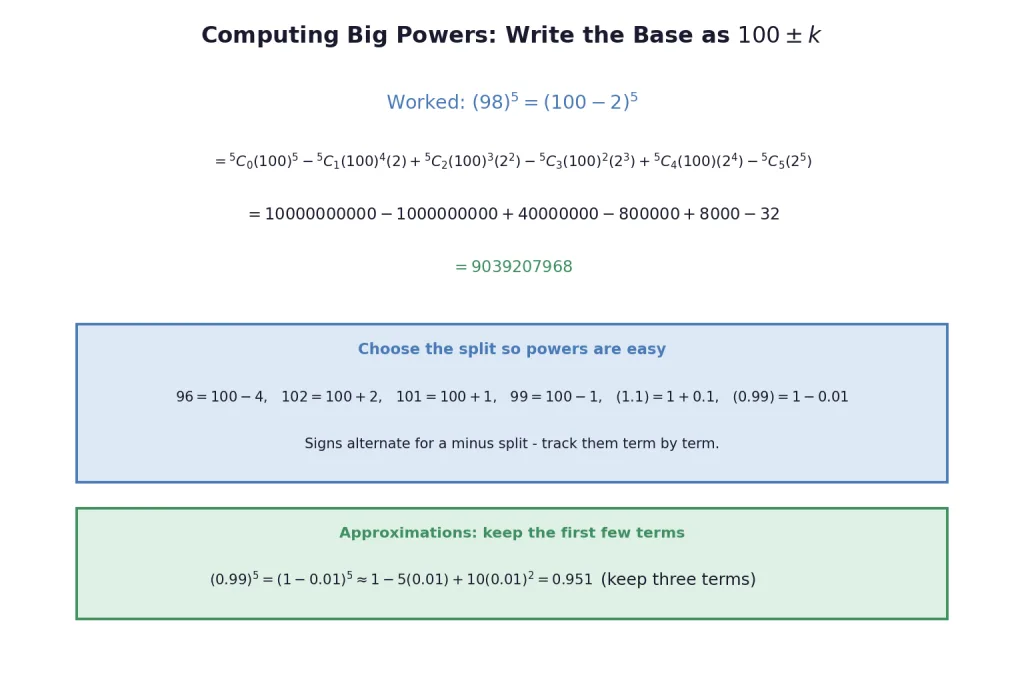
The theorem computes ( 98 ) 5 (98)^5 ( 98 ) 5 write the base as a sum or difference of numbers with easy powers , then expand.
For example, 98 = 100 − 2 98 = 100 - 2 98 = 100 − 2
( 98 ) 5 = 5 C 0 ( 100 ) 5 − 5 C 1 ( 100 ) 4 ( 2 ) + 5 C 2 ( 100 ) 3 ( 2 2 ) − 5 C 3 ( 100 ) 2 ( 2 3 ) + 5 C 4 ( 100 ) ( 2 4 ) − 5 C 5 ( 2 5 ) (98)^5 = {^5C_0}(100)^5 - {^5C_1}(100)^4(2) + {^5C_2}(100)^3(2^2) - {^5C_3}(100)^2(2^3) + {^5C_4}(100)(2^4) - {^5C_5}(2^5) ( 98 ) 5 = 5 C 0 ( 100 ) 5 − 5 C 1 ( 100 ) 4 ( 2 ) + 5 C 2 ( 100 ) 3 ( 2 2 ) − 5 C 3 ( 100 ) 2 ( 2 3 ) + 5 C 4 ( 100 ) ( 2 4 ) − 5 C 5 ( 2 5 )
= 10000000000 − 1000000000 + 40000000 − 800000 + 8000 − 32 = 9039207968 = 10000000000 - 1000000000 + 40000000 - 800000 + 8000 - 32 = 9039207968 = 10000000000 − 1000000000 + 40000000 − 800000 + 8000 − 32 = 9039207968
Same recipe: 96 = 100 − 4 96 = 100 - 4 96 = 100 − 4 102 = 100 + 2 102 = 100 + 2 102 = 100 + 2 101 = 100 + 1 101 = 100 + 1 101 = 100 + 1 99 = 100 − 1 99 = 100 - 1 99 = 100 − 1 ( 1.1 ) = 1 + 0.1 (1.1) = 1 + 0.1 ( 1.1 ) = 1 + 0.1 ( 0.99 ) = 1 − 0.01 (0.99) = 1 - 0.01 ( 0.99 ) = 1 − 0.01
Key Point: For a minus split the signs alternate — track them term by term. Powers of 100 shift the decimal, powers of the small number stay tiny; the terms are easy to add.
[Board Tip] For an approximation , keep only the first few terms: ( 0.99 ) 5 = ( 1 − 0.01 ) 5 ≈ 1 − 5 ( 0.01 ) + 10 ( 0.01 ) 2 = 0.951 (0.99)^5 = (1 - 0.01)^5 \approx 1 - 5(0.01) + 10(0.01)^2 = 0.951 ( 0.99 ) 5 = ( 1 − 0.01 ) 5 ≈ 1 − 5 ( 0.01 ) + 10 ( 0.01 ) 2 = 0.951 10 − 6 10^{-6} 1 0 − 6
Comparisons and Divisibility
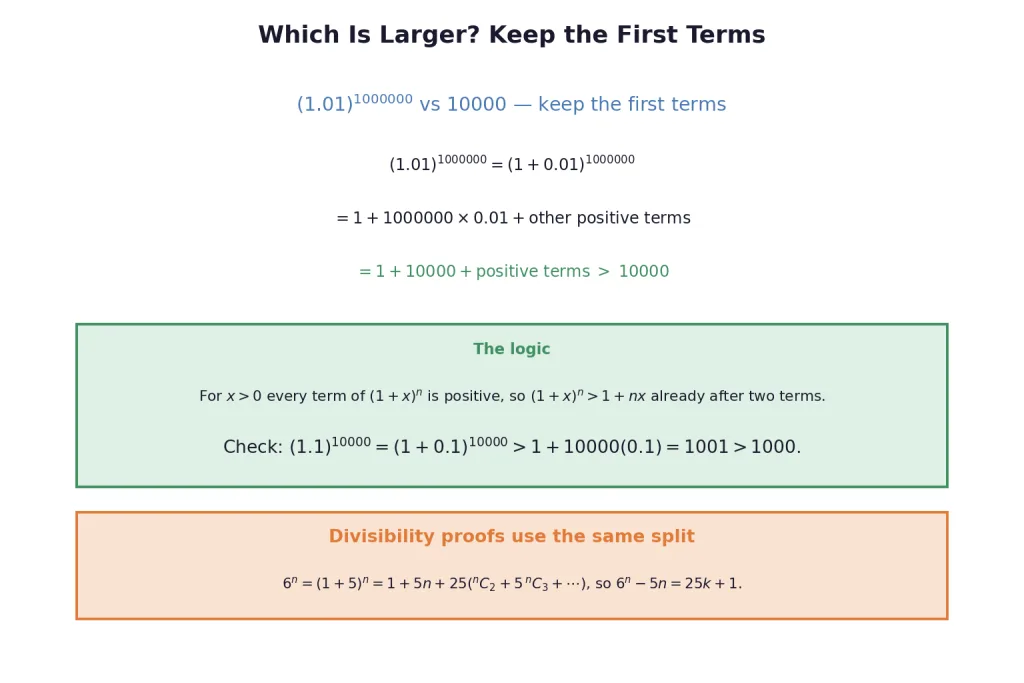
Which is larger? Expand the bigger-looking side and keep just enough terms:
For example: ( 1.01 ) 1000000 = ( 1 + 0.01 ) 1000000 = 1 + 1000000 ( 0.01 ) + positive terms = 1 + 10000 + ⋯ > 10000 (1.01)^{1000000} = (1 + 0.01)^{1000000} = 1 + 1000000(0.01) + \text{positive terms} = 1 + 10000 + \cdots > 10000 ( 1.01 ) 1000000 = ( 1 + 0.01 ) 1000000 = 1 + 1000000 ( 0.01 ) + positive terms = 1 + 10000 + ⋯ > 10000
Key Point: For x > 0 x > 0 x > 0 ( 1 + x ) n (1+x)^n ( 1 + x ) n ( 1 + x ) n > 1 + n x (1+x)^n > 1 + nx ( 1 + x ) n > 1 + n x
Divisibility and remainders come from splitting the base and pulling out the modulus:
6 n = ( 1 + 5 ) n = 1 + 5 n + 5 2 n C 2 + 5 3 n C 3 + ⋯ = 1 + 5 n + 25 ( n C 2 + 5 n C 3 + ⋯ ) 6^n = (1+5)^n = 1 + 5n + 5^2\,{^nC_2} + 5^3\,{^nC_3} + \cdots = 1 + 5n + 25\left({^nC_2} + 5\,{^nC_3} + \cdots\right) 6 n = ( 1 + 5 ) n = 1 + 5 n + 5 2 n C 2 + 5 3 n C 3 + ⋯ = 1 + 5 n + 25 ( n C 2 + 5 n C 3 + ⋯ )
so 6 n − 5 n = 25 k + 1 6^n - 5n = 25k + 1 6 n − 5 n = 25 k + 1 6 n − 5 n 6^n - 5n 6 n − 5 n 9 n + 1 = ( 1 + 8 ) n + 1 = 1 + 8 ( n + 1 ) + 64 ( n + 1 C 2 + ⋯ ) 9^{n+1} = (1+8)^{n+1} = 1 + 8(n+1) + 64\left({^{n+1}C_2} + \cdots\right) 9 n + 1 = ( 1 + 8 ) n + 1 = 1 + 8 ( n + 1 ) + 64 ( n + 1 C 2 + ⋯ ) 9 n + 1 − 8 n − 9 9^{n+1} - 8n - 9 9 n + 1 − 8 n − 9
[JEE Tip] Choose the split so the modulus appears squared in the third term: to work mod 25 split off 5's; mod 64 split off 8's; mod 49 split off 7's. The first two terms then carry all the remainder information.
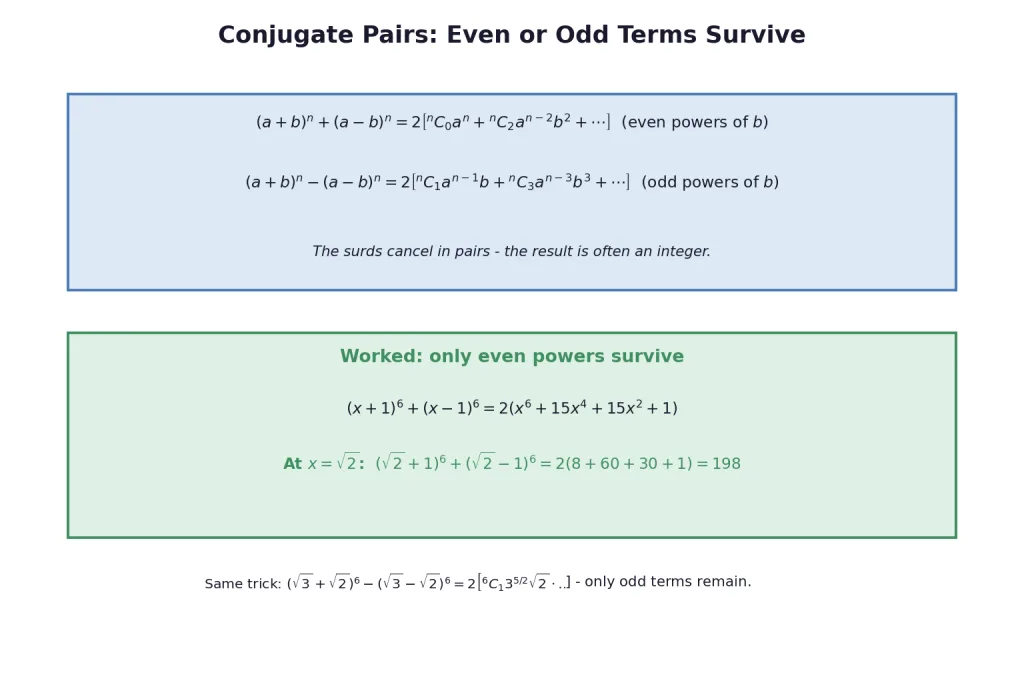
Adding or subtracting the expansions of ( a + b ) n (a+b)^n ( a + b ) n ( a − b ) n (a-b)^n ( a − b ) n
( a + b ) n + ( a − b ) n = 2 [ n C 0 a n + n C 2 a n − 2 b 2 + ⋯ ] (even powers of b ) (a+b)^n + (a-b)^n = 2\left[{^nC_0}a^n + {^nC_2}a^{n-2}b^2 + \cdots\right] \quad \text{(even powers of } b\text{)} ( a + b ) n + ( a − b ) n = 2 [ n C 0 a n + n C 2 a n − 2 b 2 + ⋯ ] (even powers of b )
( a + b ) n − ( a − b ) n = 2 [ n C 1 a n − 1 b + n C 3 a n − 3 b 3 + ⋯ ] (odd powers of b ) (a+b)^n - (a-b)^n = 2\left[{^nC_1}a^{n-1}b + {^nC_3}a^{n-3}b^3 + \cdots\right] \quad \text{(odd powers of } b\text{)} ( a + b ) n − ( a − b ) n = 2 [ n C 1 a n − 1 b + n C 3 a n − 3 b 3 + ⋯ ] (odd powers of b )
With surd values of b b b even , so the surds vanish and the result is often an integer. For example: ( x + 1 ) 6 + ( x − 1 ) 6 = 2 ( x 6 + 15 x 4 + 15 x 2 + 1 ) (x+1)^6 + (x-1)^6 = 2(x^6 + 15x^4 + 15x^2 + 1) ( x + 1 ) 6 + ( x − 1 ) 6 = 2 ( x 6 + 15 x 4 + 15 x 2 + 1 ) x = 2 x = \sqrt{2} x = 2 2 ( 8 + 60 + 30 + 1 ) = 198 2(8 + 60 + 30 + 1) = 198 2 ( 8 + 60 + 30 + 1 ) = 198
[Board Tip] Work symbolically first — find the polynomial identity in x x x
Solved Examples
Example 1: ( 98 ) 5 (98)^5 ( 98 ) 5
Compute ( 98 ) 5 (98)^5 ( 98 ) 5
Solution:
Step 1 — Split the base. 98 = 100 − 2 98 = 100 - 2 98 = 100 − 2 ( 100 − 2 ) 5 (100-2)^5 ( 100 − 2 ) 5
Step 2 — Write the six terms. 10 10 − 5 ( 10 8 ) ( 2 ) + 10 ( 10 6 ) ( 4 ) − 10 ( 10 4 ) ( 8 ) + 5 ( 100 ) ( 16 ) − 32 10^{10} - 5(10^8)(2) + 10(10^6)(4) - 10(10^4)(8) + 5(100)(16) - 32 1 0 10 − 5 ( 1 0 8 ) ( 2 ) + 10 ( 1 0 6 ) ( 4 ) − 10 ( 1 0 4 ) ( 8 ) + 5 ( 100 ) ( 16 ) − 32
Step 3 — Evaluate. 10000000000 − 1000000000 + 40000000 − 800000 + 8000 − 32 10000000000 - 1000000000 + 40000000 - 800000 + 8000 - 32 10000000000 − 1000000000 + 40000000 − 800000 + 8000 − 32
Step 4 — Add. = 9039207968 = 9039207968 = 9039207968
Takeaway: Powers of 100 shift the decimal; powers of 2 stay tiny — six easy terms beat four long multiplications.
Example 2: ( 96 ) 3 (96)^3 ( 96 ) 3
Evaluate ( 96 ) 3 (96)^3 ( 96 ) 3
Solution:
Step 1 — Split. 96 = 100 − 4 96 = 100 - 4 96 = 100 − 4 ( 100 − 4 ) 3 = 10 6 − 3 ( 10 4 ) ( 4 ) + 3 ( 100 ) ( 16 ) − 64 (100-4)^3 = 10^6 - 3(10^4)(4) + 3(100)(16) - 64 ( 100 − 4 ) 3 = 1 0 6 − 3 ( 1 0 4 ) ( 4 ) + 3 ( 100 ) ( 16 ) − 64
Step 2 — Evaluate. 1000000 − 120000 + 4800 − 64 1000000 - 120000 + 4800 - 64 1000000 − 120000 + 4800 − 64
Step 3 — Add. = 884736 = 884736 = 884736
Takeaway: Row 3 (1 , 3 , 3 , 1 1, 3, 3, 1 1 , 3 , 3 , 1
Example 3: ( 102 ) 5 (102)^5 ( 102 ) 5
Evaluate ( 102 ) 5 (102)^5 ( 102 ) 5
Solution:
Step 1 — Split. 102 = 100 + 2 102 = 100 + 2 102 = 100 + 2
Step 2 — Write the terms. 10 10 + 5 ( 10 8 ) ( 2 ) + 10 ( 10 6 ) ( 4 ) + 10 ( 10 4 ) ( 8 ) + 5 ( 100 ) ( 16 ) + 32 10^{10} + 5(10^8)(2) + 10(10^6)(4) + 10(10^4)(8) + 5(100)(16) + 32 1 0 10 + 5 ( 1 0 8 ) ( 2 ) + 10 ( 1 0 6 ) ( 4 ) + 10 ( 1 0 4 ) ( 8 ) + 5 ( 100 ) ( 16 ) + 32
Step 3 — Add. 10000000000 + 1000000000 + 40000000 + 800000 + 8000 + 32 = 11040808032 10000000000 + 1000000000 + 40000000 + 800000 + 8000 + 32 = 11040808032 10000000000 + 1000000000 + 40000000 + 800000 + 8000 + 32 = 11040808032
Takeaway: Same skeleton as ( 98 ) 5 (98)^5 ( 98 ) 5 100 − 2 100-2 100 − 2 100 + 2 100+2 100 + 2
Example 4: ( 101 ) 4 (101)^4 ( 101 ) 4
Evaluate ( 101 ) 4 (101)^4 ( 101 ) 4
Solution:
Step 1 — Split. ( 100 + 1 ) 4 (100+1)^4 ( 100 + 1 ) 4
Step 2 — Write the terms. 10 8 + 4 ( 10 6 ) + 6 ( 10 4 ) + 4 ( 100 ) + 1 10^8 + 4(10^6) + 6(10^4) + 4(100) + 1 1 0 8 + 4 ( 1 0 6 ) + 6 ( 1 0 4 ) + 4 ( 100 ) + 1
Step 3 — Add. 100000000 + 4000000 + 60000 + 400 + 1 = 104060401 100000000 + 4000000 + 60000 + 400 + 1 = 104060401 100000000 + 4000000 + 60000 + 400 + 1 = 104060401
Takeaway: The digits of row 4 — 1 , 4 , 6 , 4 , 1 1, 4, 6, 4, 1 1 , 4 , 6 , 4 , 1
Example 5: ( 99 ) 5 (99)^5 ( 99 ) 5
Evaluate ( 99 ) 5 (99)^5 ( 99 ) 5
Solution:
Step 1 — Split. ( 100 − 1 ) 5 (100-1)^5 ( 100 − 1 ) 5
Step 2 — Write the terms. 10 10 − 5 ( 10 8 ) + 10 ( 10 6 ) − 10 ( 10 4 ) + 5 ( 100 ) − 1 10^{10} - 5(10^8) + 10(10^6) - 10(10^4) + 5(100) - 1 1 0 10 − 5 ( 1 0 8 ) + 10 ( 1 0 6 ) − 10 ( 1 0 4 ) + 5 ( 100 ) − 1
Step 3 — Add. 10000000000 − 500000000 + 10000000 − 100000 + 500 − 1 = 9509900499 10000000000 - 500000000 + 10000000 - 100000 + 500 - 1 = 9509900499 10000000000 − 500000000 + 10000000 − 100000 + 500 − 1 = 9509900499
Takeaway: A ± 1 \pm 1 ± 1
Example 6: The million-power comparison
Which is larger: ( 1.01 ) 1000000 (1.01)^{1000000} ( 1.01 ) 1000000 10000 10000 10000
Solution:
Step 1 — Split the base. ( 1.01 ) 1000000 = ( 1 + 0.01 ) 1000000 (1.01)^{1000000} = (1 + 0.01)^{1000000} ( 1.01 ) 1000000 = ( 1 + 0.01 ) 1000000
Step 2 — Keep the first two terms. = 1 + 1000000 ( 0.01 ) + other positive terms = 1 + 10000 + ⋯ = 1 + 1000000(0.01) + \text{other positive terms} = 1 + 10000 + \cdots = 1 + 1000000 ( 0.01 ) + other positive terms = 1 + 10000 + ⋯
Step 3 — Compare. 1 + 10000 + positive terms > 10000 1 + 10000 + \text{positive terms} > 10000 1 + 10000 + positive terms > 10000 ( 1.01 ) 1000000 (1.01)^{1000000} ( 1.01 ) 1000000
Takeaway: For x > 0 x > 0 x > 0 ( 1 + x ) n > 1 + n x (1+x)^n > 1 + nx ( 1 + x ) n > 1 + n x
Example 7: A second comparison
Which is larger: ( 1.1 ) 10000 (1.1)^{10000} ( 1.1 ) 10000 1000 1000 1000
Solution:
Step 1 — Two-term bound. ( 1 + 0.1 ) 10000 > 1 + 10000 ( 0.1 ) = 1001 (1 + 0.1)^{10000} > 1 + 10000(0.1) = 1001 ( 1 + 0.1 ) 10000 > 1 + 10000 ( 0.1 ) = 1001
Step 2 — Compare. 1001 > 1000 1001 > 1000 1001 > 1000 ( 1.1 ) 10000 (1.1)^{10000} ( 1.1 ) 10000
Takeaway: The same inequality works whenever the truncated value already beats the target.
Example 8: Approximation
Find an approximation of ( 0.99 ) 5 (0.99)^5 ( 0.99 ) 5
Solution:
Step 1 — Split. ( 0.99 ) 5 = ( 1 − 0.01 ) 5 (0.99)^5 = (1 - 0.01)^5 ( 0.99 ) 5 = ( 1 − 0.01 ) 5
Step 2 — Keep three terms. 1 − 5 ( 0.01 ) + 10 ( 0.01 ) 2 = 1 − 0.05 + 0.001 1 - 5(0.01) + 10(0.01)^2 = 1 - 0.05 + 0.001 1 − 5 ( 0.01 ) + 10 ( 0.01 ) 2 = 1 − 0.05 + 0.001
Step 3 — Evaluate. ≈ 0.951 \approx 0.951 ≈ 0.951 10 ( 0.01 ) 3 = 10 − 5 10(0.01)^3 = 10^{-5} 10 ( 0.01 ) 3 = 1 0 − 5
Takeaway: Approximations keep the first few terms and estimate the size of the first dropped one.
Example 9: Remainder mod 25
Prove that 6 n − 5 n 6^n - 5n 6 n − 5 n
Solution:
Step 1 — Split the base. 6 n = ( 1 + 5 ) n = 1 + 5 n + 5 2 n C 2 + 5 3 n C 3 + ⋯ + 5 n 6^n = (1+5)^n = 1 + 5n + 5^2\,{^nC_2} + 5^3\,{^nC_3} + \cdots + 5^n 6 n = ( 1 + 5 ) n = 1 + 5 n + 5 2 n C 2 + 5 3 n C 3 + ⋯ + 5 n
Step 2 — Group the 25's. From the third term onward every term has factor 5 2 = 25 5^2 = 25 5 2 = 25
6 n − 5 n = 1 + 25 ( n C 2 + 5 n C 3 + ⋯ + 5 n − 2 ) = 25 k + 1 6^n - 5n = 1 + 25\left({^nC_2} + 5\,{^nC_3} + \cdots + 5^{n-2}\right) = 25k + 1 6 n − 5 n = 1 + 25 ( n C 2 + 5 n C 3 + ⋯ + 5 n − 2 ) = 25 k + 1
Step 3 — Conclude. The remainder on division by 25 is always 1. ∎
Takeaway: Split so the modulus appears squared in the third term — the first two terms carry the remainder.
Example 10: Divisible by 64
Show that 9 n + 1 − 8 n − 9 9^{n+1} - 8n - 9 9 n + 1 − 8 n − 9 n n n
Solution:
Step 1 — Split. 9 n + 1 = ( 1 + 8 ) n + 1 = 1 + 8 ( n + 1 ) + 8 2 n + 1 C 2 + 8 3 n + 1 C 3 + ⋯ 9^{n+1} = (1+8)^{n+1} = 1 + 8(n+1) + 8^2\,{^{n+1}C_2} + 8^3\,{^{n+1}C_3} + \cdots 9 n + 1 = ( 1 + 8 ) n + 1 = 1 + 8 ( n + 1 ) + 8 2 n + 1 C 2 + 8 3 n + 1 C 3 + ⋯
Step 2 — Subtract the linear part. 1 + 8 ( n + 1 ) = 8 n + 9 1 + 8(n+1) = 8n + 9 1 + 8 ( n + 1 ) = 8 n + 9
9 n + 1 − 8 n − 9 = 64 ( n + 1 C 2 + 8 n + 1 C 3 + ⋯ ) 9^{n+1} - 8n - 9 = 64\left({^{n+1}C_2} + 8\,{^{n+1}C_3} + \cdots\right) 9 n + 1 − 8 n − 9 = 64 ( n + 1 C 2 + 8 n + 1 C 3 + ⋯ )
Step 3 — Conclude. The bracket is an integer, so the expression is a multiple of 64. ∎
Takeaway: Same recipe as mod 25 — this time the 8's supply 8 2 = 64 8^2 = 64 8 2 = 64
Example 11: A conjugate difference
Find ( a + b ) 4 − ( a − b ) 4 (a+b)^4 - (a-b)^4 ( a + b ) 4 − ( a − b ) 4 ( 3 + 2 ) 4 − ( 3 − 2 ) 4 (\sqrt{3} + \sqrt{2})^4 - (\sqrt{3} - \sqrt{2})^4 ( 3 + 2 ) 4 − ( 3 − 2 ) 4
Solution:
Step 1 — Subtract the twin expansions. Even powers of b b b
( a + b ) 4 − ( a − b ) 4 = 2 [ 4 C 1 a 3 b + 4 C 3 a b 3 ] = 2 [ 4 a 3 b + 4 a b 3 ] = 8 a b ( a 2 + b 2 ) (a+b)^4 - (a-b)^4 = 2\left[{^4C_1}a^3b + {^4C_3}ab^3\right] = 2\left[4a^3b + 4ab^3\right] = 8ab(a^2 + b^2) ( a + b ) 4 − ( a − b ) 4 = 2 [ 4 C 1 a 3 b + 4 C 3 a b 3 ] = 2 [ 4 a 3 b + 4 a b 3 ] = 8 ab ( a 2 + b 2 )
Step 2 — Substitute the surds. a = 3 , b = 2 a = \sqrt{3}, b = \sqrt{2} a = 3 , b = 2 a b = 6 ab = \sqrt{6} ab = 6 a 2 + b 2 = 3 + 2 = 5 a^2 + b^2 = 3 + 2 = 5 a 2 + b 2 = 3 + 2 = 5
Step 3 — Evaluate. 8 6 × 5 = 40 6 8\sqrt{6} \times 5 = 40\sqrt{6} 8 6 × 5 = 40 6
Takeaway: Find the polynomial identity first; substitute surds last.
Example 12: A conjugate sum
Find ( x + 1 ) 6 + ( x − 1 ) 6 (x+1)^6 + (x-1)^6 ( x + 1 ) 6 + ( x − 1 ) 6 ( 2 + 1 ) 6 + ( 2 − 1 ) 6 (\sqrt{2}+1)^6 + (\sqrt{2}-1)^6 ( 2 + 1 ) 6 + ( 2 − 1 ) 6
Solution:
Step 1 — Add the twin expansions. Odd powers cancel; even powers double:
( x + 1 ) 6 + ( x − 1 ) 6 = 2 [ x 6 + 15 x 4 + 15 x 2 + 1 ] (x+1)^6 + (x-1)^6 = 2\left[x^6 + 15x^4 + 15x^2 + 1\right] ( x + 1 ) 6 + ( x − 1 ) 6 = 2 [ x 6 + 15 x 4 + 15 x 2 + 1 ]
Step 2 — Substitute x = 2 x = \sqrt{2} x = 2 x 2 = 2 x^2 = 2 x 2 = 2 x 4 = 4 x^4 = 4 x 4 = 4 x 6 = 8 x^6 = 8 x 6 = 8 2 ( 8 + 60 + 30 + 1 ) 2(8 + 60 + 30 + 1) 2 ( 8 + 60 + 30 + 1 )
Step 3 — Evaluate. 2 × 99 = 198 2 \times 99 = 198 2 × 99 = 198
Takeaway: Conjugate sums keep even powers, where ( 2 ) even (\sqrt{2})^{\text{even}} ( 2 ) even
Example 13: A factor theorem via expansion
If a a a b b b a − b a - b a − b a n − b n a^n - b^n a n − b n
Solution:
Step 1 — Rewrite the base. a = ( a − b ) + b a = (a - b) + b a = ( a − b ) + b a n = [ ( a − b ) + b ] n a^n = \left[(a-b) + b\right]^n a n = [ ( a − b ) + b ] n
Step 2 — Expand with first quantity ( a − b ) (a-b) ( a − b )
a n = ( a − b ) n + n C 1 ( a − b ) n − 1 b + ⋯ + n C n − 1 ( a − b ) b n − 1 + b n a^n = (a-b)^n + {^nC_1}(a-b)^{n-1}b + \cdots + {^nC_{n-1}}(a-b)b^{n-1} + b^n a n = ( a − b ) n + n C 1 ( a − b ) n − 1 b + ⋯ + n C n − 1 ( a − b ) b n − 1 + b n
Step 3 — Subtract b n b^n b n Every remaining term contains ( a − b ) (a-b) ( a − b )
a n − b n = ( a − b ) [ ( a − b ) n − 1 + n C 1 ( a − b ) n − 2 b + ⋯ + n C n − 1 b n − 1 ] a^n - b^n = (a-b)\left[(a-b)^{n-1} + {^nC_1}(a-b)^{n-2}b + \cdots + {^nC_{n-1}}b^{n-1}\right] a n − b n = ( a − b ) [ ( a − b ) n − 1 + n C 1 ( a − b ) n − 2 b + ⋯ + n C n − 1 b n − 1 ]
The bracket is an integer, so ( a − b ) ∣ a n − b n (a-b) \mid a^n - b^n ( a − b ) ∣ a n − b n
Takeaway: Adding-and-subtracting inside the base (a = ( a − b ) + b a = (a-b) + b a = ( a − b ) + b