How to Use This Section
Thirty fully worked examples sweep the whole chapter — Pascal-row expansions, alternating signs, fractional terms, coefficient extraction by inspection, numerical evaluations and approximations, comparisons, divisibility proofs, conjugate-pair simplifications, coefficient-identity drills, and full trinomial expansions solved by grouping.
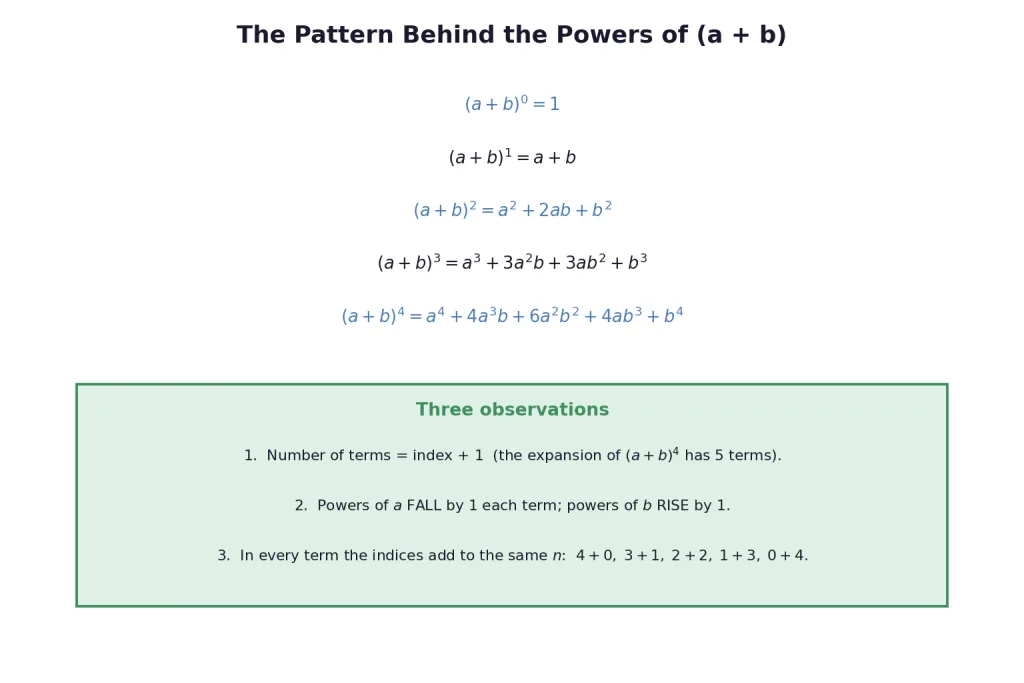
[Board Tip] Two sanity checks after every expansion: the term count must be n + 1 n + 1 n + 1 x = 1 x = 1 x = 1 x = 1 x = 1 x = 1
Expansions
Example 1: A clean quartic
Expand ( 2 x + 3 ) 4 (2x + 3)^4 ( 2 x + 3 ) 4
Solution:
Step 1 — Fetch row 4. 1 , 4 , 6 , 4 , 1 1, 4, 6, 4, 1 1 , 4 , 6 , 4 , 1
Step 2 — Attach the powers. ( 2 x ) 4 + 4 ( 2 x ) 3 ( 3 ) + 6 ( 2 x ) 2 ( 9 ) + 4 ( 2 x ) ( 27 ) + 81 (2x)^4 + 4(2x)^3(3) + 6(2x)^2(9) + 4(2x)(27) + 81 ( 2 x ) 4 + 4 ( 2 x ) 3 ( 3 ) + 6 ( 2 x ) 2 ( 9 ) + 4 ( 2 x ) ( 27 ) + 81
Step 3 — Evaluate. 16 x 4 + 96 x 3 + 216 x 2 + 216 x + 81 16x^4 + 96x^3 + 216x^2 + 216x + 81 16 x 4 + 96 x 3 + 216 x 2 + 216 x + 81
Step 4 — Check. At x = 1 x = 1 x = 1 16 + 96 + 216 + 216 + 81 = 625 = 5 4 = ( 2 + 3 ) 4 16 + 96 + 216 + 216 + 81 = 625 = 5^4 = (2+3)^4 16 + 96 + 216 + 216 + 81 = 625 = 5 4 = ( 2 + 3 ) 4
Takeaway: Five terms for index 4, and the x = 1 x=1 x = 1
Example 2: Alternating signs, constant first
Expand ( 3 − 2 x ) 5 (3 - 2x)^5 ( 3 − 2 x ) 5
Solution:
Step 1 — Row 5 with alternating signs. 3 5 − 5 ( 3 4 ) ( 2 x ) + 10 ( 3 3 ) ( 2 x ) 2 − 10 ( 3 2 ) ( 2 x ) 3 + 5 ( 3 ) ( 2 x ) 4 − ( 2 x ) 5 3^5 - 5(3^4)(2x) + 10(3^3)(2x)^2 - 10(3^2)(2x)^3 + 5(3)(2x)^4 - (2x)^5 3 5 − 5 ( 3 4 ) ( 2 x ) + 10 ( 3 3 ) ( 2 x ) 2 − 10 ( 3 2 ) ( 2 x ) 3 + 5 ( 3 ) ( 2 x ) 4 − ( 2 x ) 5
Step 2 — Evaluate each coefficient. 243 , 5 ⋅ 81 ⋅ 2 = 810 , 10 ⋅ 27 ⋅ 4 = 1080 , 10 ⋅ 9 ⋅ 8 = 720 , 5 ⋅ 3 ⋅ 16 = 240 , 32 243, \ 5 \cdot 81 \cdot 2 = 810, \ 10 \cdot 27 \cdot 4 = 1080, \ 10 \cdot 9 \cdot 8 = 720, \ 5 \cdot 3 \cdot 16 = 240, \ 32 243 , 5 ⋅ 81 ⋅ 2 = 810 , 10 ⋅ 27 ⋅ 4 = 1080 , 10 ⋅ 9 ⋅ 8 = 720 , 5 ⋅ 3 ⋅ 16 = 240 , 32
Step 3 — Assemble. 243 − 810 x + 1080 x 2 − 720 x 3 + 240 x 4 − 32 x 5 243 - 810x + 1080x^2 - 720x^3 + 240x^4 - 32x^5 243 − 810 x + 1080 x 2 − 720 x 3 + 240 x 4 − 32 x 5
Step 4 — Check. At x = 1 x = 1 x = 1 243 − 810 + 1080 − 720 + 240 − 32 = 1 = ( 3 − 2 ) 5 243 - 810 + 1080 - 720 + 240 - 32 = 1 = (3-2)^5 243 − 810 + 1080 − 720 + 240 − 32 = 1 = ( 3 − 2 ) 5
Takeaway: The constant leads when the variable sits second — the signs still alternate off the minus.
Example 3: Two variables with a coefficient
Expand ( 2 a − 3 b ) 4 (2a - 3b)^4 ( 2 a − 3 b ) 4
Solution:
Step 1 — Row 4 with alternating signs. ( 2 a ) 4 − 4 ( 2 a ) 3 ( 3 b ) + 6 ( 2 a ) 2 ( 9 b 2 ) − 4 ( 2 a ) ( 27 b 3 ) + 81 b 4 (2a)^4 - 4(2a)^3(3b) + 6(2a)^2(9b^2) - 4(2a)(27b^3) + 81b^4 ( 2 a ) 4 − 4 ( 2 a ) 3 ( 3 b ) + 6 ( 2 a ) 2 ( 9 b 2 ) − 4 ( 2 a ) ( 27 b 3 ) + 81 b 4
Step 2 — Evaluate. 16 a 4 − 96 a 3 b + 216 a 2 b 2 − 216 a b 3 + 81 b 4 16a^4 - 96a^3b + 216a^2b^2 - 216ab^3 + 81b^4 16 a 4 − 96 a 3 b + 216 a 2 b 2 − 216 a b 3 + 81 b 4
Step 3 — Check. At a = b = 1 a = b = 1 a = b = 1 16 − 96 + 216 − 216 + 81 = 1 = ( 2 − 3 ) 4 16 - 96 + 216 - 216 + 81 = 1 = (2-3)^4 16 − 96 + 216 − 216 + 81 = 1 = ( 2 − 3 ) 4
Takeaway: Both quantities carry coefficients — bracket each before raising.
Example 4: Coefficient by inspection
Find the coefficient of x 6 y 3 x^6y^3 x 6 y 3 ( x 2 − y ) 6 (x^2 - y)^6 ( x 2 − y ) 6
Solution:
Step 1 — Locate the term. y 3 y^3 y 3 r = 3 r = 3 r = 3 6 C 3 ( x 2 ) 3 ( − y ) 3 ^6C_3(x^2)^3(-y)^3 6 C 3 ( x 2 ) 3 ( − y ) 3
Step 2 — Confirm the x x x ( x 2 ) 3 = x 6 (x^2)^3 = x^6 ( x 2 ) 3 = x 6 x 6 y 3 x^6y^3 x 6 y 3
Step 3 — Evaluate the sign and number. 20 ⋅ x 6 ⋅ ( − y 3 ) 20 \cdot x^6 \cdot (-y^3) 20 ⋅ x 6 ⋅ ( − y 3 ) − 20 -20 − 20
Takeaway: Write one general term, match the powers, then evaluate — no full expansion needed.
Example 5: Coefficient of a 2 b 3 a^2b^3 a 2 b 3
Find the coefficient of a 2 b 3 a^2b^3 a 2 b 3 ( a + 2 b ) 5 (a + 2b)^5 ( a + 2 b ) 5
Solution:
Step 1 — Locate. The b 3 b^3 b 3 5 C 3 a 2 ( 2 b ) 3 ^5C_3\,a^2(2b)^3 5 C 3 a 2 ( 2 b ) 3
Step 2 — Evaluate. 10 × 8 = 80 10 \times 8 = 80 10 × 8 = 80
Takeaway: The inner coefficient 2 contributes 2 3 = 8 2^3 = 8 2 3 = 8
Example 6: Powers of x x x
Find the coefficient of x x x ( x 2 + 2 x ) 5 \left(x^2 + \frac{2}{x}\right)^5 ( x 2 + x 2 ) 5
Solution:
Step 1 — Write the general term. 5 C r ( x 2 ) 5 − r ( 2 x ) r = 5 C r 2 r x 10 − 3 r ^5C_r(x^2)^{5-r}\left(\frac{2}{x}\right)^r = {^5C_r}\,2^r\,x^{10-3r} 5 C r ( x 2 ) 5 − r ( x 2 ) r = 5 C r 2 r x 10 − 3 r
Step 2 — Solve for the power. 10 − 3 r = 1 10 - 3r = 1 10 − 3 r = 1 r = 3 r = 3 r = 3
Step 3 — Evaluate. 5 C 3 2 3 = 10 × 8 = 80 ^5C_3\,2^3 = 10 \times 8 = 80 5 C 3 2 3 = 10 × 8 = 80
Takeaway: Collapse the powers of x x x r r r
Example 7: A trinomial by grouping
Expand ( 1 + x 2 − 2 x ) 4 \left(1 + \frac{x}{2} - \frac{2}{x}\right)^4 ( 1 + 2 x − x 2 ) 4 x ≠ 0 x \ne 0 x = 0
Solution:
Step 1 — Group into a binomial. Let u = x 2 − 2 x u = \frac{x}{2} - \frac{2}{x} u = 2 x − x 2 ( 1 + u ) 4 = 1 + 4 u + 6 u 2 + 4 u 3 + u 4 (1 + u)^4 = 1 + 4u + 6u^2 + 4u^3 + u^4 ( 1 + u ) 4 = 1 + 4 u + 6 u 2 + 4 u 3 + u 4
Step 2 — Expand the powers of u u u u 2 = x 2 4 − 2 + 4 x 2 u^2 = \frac{x^2}{4} - 2 + \frac{4}{x^2} u 2 = 4 x 2 − 2 + x 2 4 u 3 = x 3 8 − 3 x 2 + 6 x − 8 x 3 u^3 = \frac{x^3}{8} - \frac{3x}{2} + \frac{6}{x} - \frac{8}{x^3} u 3 = 8 x 3 − 2 3 x + x 6 − x 3 8 u 4 = x 4 16 − x 2 + 6 − 16 x 2 + 16 x 4 u^4 = \frac{x^4}{16} - x^2 + 6 - \frac{16}{x^2} + \frac{16}{x^4} u 4 = 16 x 4 − x 2 + 6 − x 2 16 + x 4 16
Step 3 — Substitute and collect like powers.
x 4 16 + x 3 2 + x 2 2 − 4 x − 5 + 16 x + 8 x 2 − 32 x 3 + 16 x 4 \frac{x^4}{16} + \frac{x^3}{2} + \frac{x^2}{2} - 4x - 5 + \frac{16}{x} + \frac{8}{x^2} - \frac{32}{x^3} + \frac{16}{x^4} 16 x 4 + 2 x 3 + 2 x 2 − 4 x − 5 + x 16 + x 2 8 − x 3 32 + x 4 16
Step 4 — Check the constant. 1 + 6 ( − 2 ) + 6 = − 5 1 + 6(-2) + 6 = -5 1 + 6 ( − 2 ) + 6 = − 5 1 , 6 u 2 , u 4 1, 6u^2, u^4 1 , 6 u 2 , u 4
Takeaway: Trinomials fold into binomials by grouping — then it is bookkeeping, done power by power.
Example 8: A squared-trinomial cube
Expand ( 3 x 2 − 2 a x + 3 a 2 ) 3 (3x^2 - 2ax + 3a^2)^3 ( 3 x 2 − 2 a x + 3 a 2 ) 3
Solution:
Step 1 — Group. [ ( 3 x 2 − 2 a x ) + 3 a 2 ] 3 = A 3 + 3 A 2 ( 3 a 2 ) + 3 A ( 9 a 4 ) + 27 a 6 \left[(3x^2 - 2ax) + 3a^2\right]^3 = A^3 + 3A^2(3a^2) + 3A(9a^4) + 27a^6 [ ( 3 x 2 − 2 a x ) + 3 a 2 ] 3 = A 3 + 3 A 2 ( 3 a 2 ) + 3 A ( 9 a 4 ) + 27 a 6 A = 3 x 2 − 2 a x A = 3x^2 - 2ax A = 3 x 2 − 2 a x
Step 2 — Expand the powers of A A A A 2 = 9 x 4 − 12 a x 3 + 4 a 2 x 2 A^2 = 9x^4 - 12ax^3 + 4a^2x^2 A 2 = 9 x 4 − 12 a x 3 + 4 a 2 x 2 A 3 = 27 x 6 − 54 a x 5 + 36 a 2 x 4 − 8 a 3 x 3 A^3 = 27x^6 - 54ax^5 + 36a^2x^4 - 8a^3x^3 A 3 = 27 x 6 − 54 a x 5 + 36 a 2 x 4 − 8 a 3 x 3
Step 3 — Collect.
27 x 6 − 54 a x 5 + 117 a 2 x 4 − 116 a 3 x 3 + 117 a 4 x 2 − 54 a 5 x + 27 a 6 27x^6 - 54ax^5 + 117a^2x^4 - 116a^3x^3 + 117a^4x^2 - 54a^5x + 27a^6 27 x 6 − 54 a x 5 + 117 a 2 x 4 − 116 a 3 x 3 + 117 a 4 x 2 − 54 a 5 x + 27 a 6
Step 4 — Check. At x = a = 1 x = a = 1 x = a = 1 27 − 54 + 117 − 116 + 117 − 54 + 27 = 64 = ( 3 − 2 + 3 ) 3 27 - 54 + 117 - 116 + 117 - 54 + 27 = 64 = (3 - 2 + 3)^3 27 − 54 + 117 − 116 + 117 − 54 + 27 = 64 = ( 3 − 2 + 3 ) 3
Takeaway: The coefficients read the same forwards and backwards — the trinomial is symmetric in x x x a a a
Numerical Evaluations and Comparisons
Example 9: A fourth power near 100
Evaluate ( 99 ) 4 (99)^4 ( 99 ) 4
Solution:
Step 1 — Split. ( 100 − 1 ) 4 (100 - 1)^4 ( 100 − 1 ) 4 1 , 4 , 6 , 4 , 1 1, 4, 6, 4, 1 1 , 4 , 6 , 4 , 1
Step 2 — Write the terms. 10 8 − 4 ( 10 6 ) + 6 ( 10 4 ) − 4 ( 100 ) + 1 10^8 - 4(10^6) + 6(10^4) - 4(100) + 1 1 0 8 − 4 ( 1 0 6 ) + 6 ( 1 0 4 ) − 4 ( 100 ) + 1
Step 3 — Add. 100000000 − 4000000 + 60000 − 400 + 1 = 96059601 100000000 - 4000000 + 60000 - 400 + 1 = 96059601 100000000 − 4000000 + 60000 − 400 + 1 = 96059601
Takeaway: A ± 1 \pm 1 ± 1
Example 10: Decimal base
Approximate ( 1.02 ) 8 (1.02)^8 ( 1.02 ) 8
Solution:
Step 1 — Split and truncate. ( 1 + 0.02 ) 8 ≈ 1 + 8 ( 0.02 ) + 8 C 2 ( 0.02 ) 2 (1 + 0.02)^8 \approx 1 + 8(0.02) + {^8C_2}(0.02)^2 ( 1 + 0.02 ) 8 ≈ 1 + 8 ( 0.02 ) + 8 C 2 ( 0.02 ) 2
Step 2 — Evaluate. 1 + 0.16 + 28 ( 0.0004 ) = 1 + 0.16 + 0.0112 = 1.1712 1 + 0.16 + 28(0.0004) = 1 + 0.16 + 0.0112 = 1.1712 1 + 0.16 + 28 ( 0.0004 ) = 1 + 0.16 + 0.0112 = 1.1712
Step 3 — Estimate the error. Next term 8 C 3 ( 0.02 ) 3 = 56 × 8 × 10 − 6 ≈ 0.0004 ^8C_3(0.02)^3 = 56 \times 8 \times 10^{-6} \approx 0.0004 8 C 3 ( 0.02 ) 3 = 56 × 8 × 1 0 − 6 ≈ 0.0004 1.1717 … 1.1717\ldots 1.1717 …
Takeaway: Three terms of a small-x x x 10 − 3 10^{-3} 1 0 − 3
Example 11: Three-term comparison
Which is larger: ( 1.2 ) 10 (1.2)^{10} ( 1.2 ) 10 4 4 4
Solution:
Step 1 — Try two terms. 1 + 10 ( 0.2 ) = 3 1 + 10(0.2) = 3 1 + 10 ( 0.2 ) = 3
Step 2 — Add the third term. 10 C 2 ( 0.2 ) 2 = 45 × 0.04 = 1.8 ^{10}C_2(0.2)^2 = 45 \times 0.04 = 1.8 10 C 2 ( 0.2 ) 2 = 45 × 0.04 = 1.8 1 + 2 + 1.8 = 4.8 1 + 2 + 1.8 = 4.8 1 + 2 + 1.8 = 4.8
Step 3 — Conclude. ( 1.2 ) 10 > 4.8 > 4 (1.2)^{10} > 4.8 > 4 ( 1.2 ) 10 > 4.8 > 4
Takeaway: If two terms don't settle a comparison, keep adding positive terms until they do.
Example 12: A power of 1.1, quickly
Approximate ( 1.1 ) 5 (1.1)^5 ( 1.1 ) 5
Solution:
Step 1 — Truncate. 1 + 5 ( 0.1 ) + 10 ( 0.01 ) = 1 + 0.5 + 0.1 = 1.6 1 + 5(0.1) + 10(0.01) = 1 + 0.5 + 0.1 = 1.6 1 + 5 ( 0.1 ) + 10 ( 0.01 ) = 1 + 0.5 + 0.1 = 1.6
Step 2 — Gauge the error. Next term 10 ( 0.1 ) 3 = 0.01 10(0.1)^3 = 0.01 10 ( 0.1 ) 3 = 0.01 1.61051 1.61051 1.61051
Takeaway: The first dropped term estimates the error — quote it to justify the cut.
Example 13: Divisibility by 49
Prove that 2 3 n − 7 n − 1 2^{3n} - 7n - 1 2 3 n − 7 n − 1 n n n
Solution:
Step 1 — Rewrite the power. 2 3 n = 8 n = ( 1 + 7 ) n 2^{3n} = 8^n = (1 + 7)^n 2 3 n = 8 n = ( 1 + 7 ) n
Step 2 — Expand and group. ( 1 + 7 ) n = 1 + 7 n + 49 n C 2 + 343 n C 3 + ⋯ (1+7)^n = 1 + 7n + 49\,{^nC_2} + 343\,{^nC_3} + \cdots ( 1 + 7 ) n = 1 + 7 n + 49 n C 2 + 343 n C 3 + ⋯
Step 3 — Subtract. 2 3 n − 7 n − 1 = 49 ( n C 2 + 7 n C 3 + ⋯ ) 2^{3n} - 7n - 1 = 49\left({^nC_2} + 7\,{^nC_3} + \cdots\right) 2 3 n − 7 n − 1 = 49 ( n C 2 + 7 n C 3 + ⋯ )
Takeaway: Recognise 2 3 n 2^{3n} 2 3 n 8 n 8^n 8 n 1 + 7 1 + 7 1 + 7
Example 14: Divisibility by 9
Show 4 n − 3 n − 1 4^n - 3n - 1 4 n − 3 n − 1 n n n
Solution:
Step 1 — Split. 4 n = ( 1 + 3 ) n = 1 + 3 n + 9 n C 2 + 27 n C 3 + ⋯ 4^n = (1+3)^n = 1 + 3n + 9\,{^nC_2} + 27\,{^nC_3} + \cdots 4 n = ( 1 + 3 ) n = 1 + 3 n + 9 n C 2 + 27 n C 3 + ⋯
Step 2 — Subtract. 4 n − 3 n − 1 = 9 ( n C 2 + 3 n C 3 + ⋯ ) 4^n - 3n - 1 = 9\left({^nC_2} + 3\,{^nC_3} + \cdots\right) 4 n − 3 n − 1 = 9 ( n C 2 + 3 n C 3 + ⋯ )
Takeaway: The modulus 9 is 3 2 3^2 3 2
Example 15: Remainder, then subtraction
What is the remainder when 6 n − 5 n − 1 6^n - 5n - 1 6 n − 5 n − 1
Solution:
Step 1 — Start from the mod-25 result. 6 n − 5 n = 25 k + 1 6^n - 5n = 25k + 1 6 n − 5 n = 25 k + 1 6 = 1 + 5 6 = 1 + 5 6 = 1 + 5
Step 2 — Subtract 1. 6 n − 5 n − 1 = 25 k 6^n - 5n - 1 = 25k 6 n − 5 n − 1 = 25 k
Step 3 — Conclude. Remainder 0 0 0
Takeaway: Once the remainder identity is proved, nearby questions are one-line corollaries.
Conjugate Pairs and Surds
Example 16: A sixth-power conjugate difference
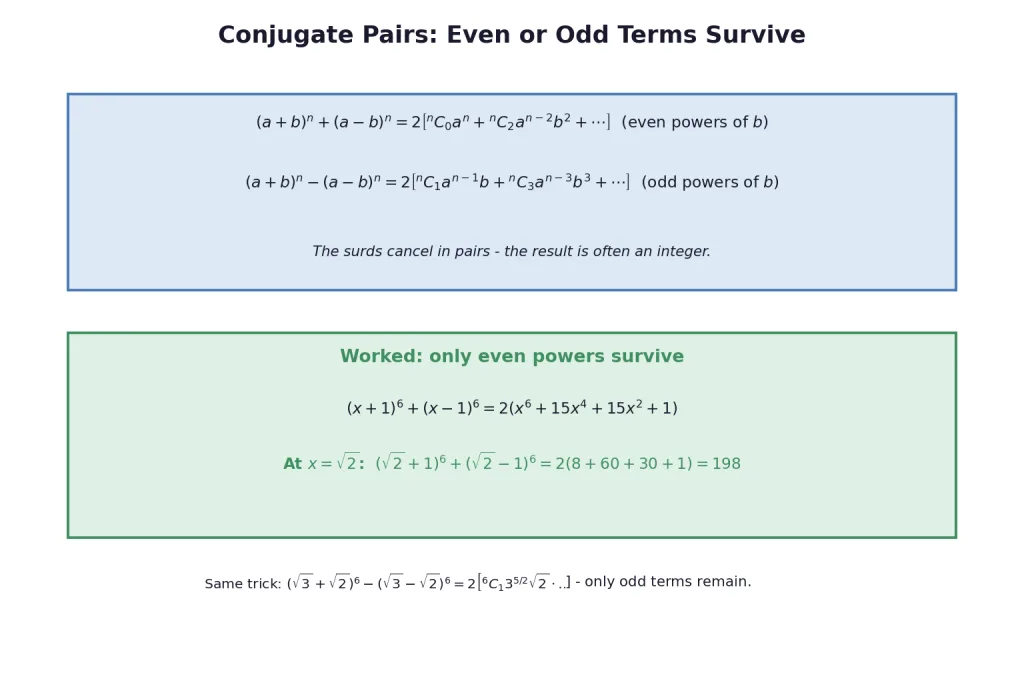
Evaluate ( 3 + 2 ) 6 − ( 3 − 2 ) 6 (\sqrt{3} + \sqrt{2})^6 - (\sqrt{3} - \sqrt{2})^6 ( 3 + 2 ) 6 − ( 3 − 2 ) 6
Solution:
Step 1 — Keep the odd-power terms, doubled. With a = 3 , b = 2 a = \sqrt{3}, b = \sqrt{2} a = 3 , b = 2
2 [ 6 C 1 a 5 b + 6 C 3 a 3 b 3 + 6 C 5 a b 5 ] 2\left[{^6C_1}a^5b + {^6C_3}a^3b^3 + {^6C_5}ab^5\right] 2 [ 6 C 1 a 5 b + 6 C 3 a 3 b 3 + 6 C 5 a b 5 ]
Step 2 — Evaluate the surd powers. a 5 = 9 3 a^5 = 9\sqrt{3} a 5 = 9 3 a 3 = 3 3 a^3 = 3\sqrt{3} a 3 = 3 3 b 3 = 2 2 b^3 = 2\sqrt{2} b 3 = 2 2 b 5 = 4 2 b^5 = 4\sqrt{2} b 5 = 4 2
Step 3 — Compute each term. 6 ⋅ 9 3 ⋅ 2 = 54 6 6 \cdot 9\sqrt{3} \cdot \sqrt{2} = 54\sqrt{6} 6 ⋅ 9 3 ⋅ 2 = 54 6 20 ⋅ 3 3 ⋅ 2 2 = 120 6 20 \cdot 3\sqrt{3} \cdot 2\sqrt{2} = 120\sqrt{6} 20 ⋅ 3 3 ⋅ 2 2 = 120 6 6 ⋅ 3 ⋅ 4 2 = 24 6 6 \cdot \sqrt{3} \cdot 4\sqrt{2} = 24\sqrt{6} 6 ⋅ 3 ⋅ 4 2 = 24 6
Step 4 — Add and double. 2 ( 54 + 120 + 24 ) 6 = 396 6 2(54 + 120 + 24)\sqrt{6} = 396\sqrt{6} 2 ( 54 + 120 + 24 ) 6 = 396 6
Takeaway: Every surviving term carries 3 2 = 6 \sqrt{3}\sqrt{2} = \sqrt{6} 3 2 = 6 6 \sqrt{6} 6
Example 17: A parametric conjugate sum
Find the value of ( a 2 + a 2 − 1 ) 4 + ( a 2 − a 2 − 1 ) 4 \left(a^2 + \sqrt{a^2 - 1}\right)^4 + \left(a^2 - \sqrt{a^2 - 1}\right)^4 ( a 2 + a 2 − 1 ) 4 + ( a 2 − a 2 − 1 ) 4
Solution:
Step 1 — Conjugate sum keeps even powers. With A = a 2 A = a^2 A = a 2 B = a 2 − 1 B = \sqrt{a^2-1} B = a 2 − 1
2 [ A 4 + 4 C 2 A 2 B 2 + B 4 ] = 2 [ A 4 + 6 A 2 B 2 + B 4 ] 2\left[A^4 + {^4C_2}A^2B^2 + B^4\right] = 2\left[A^4 + 6A^2B^2 + B^4\right] 2 [ A 4 + 4 C 2 A 2 B 2 + B 4 ] = 2 [ A 4 + 6 A 2 B 2 + B 4 ]
Step 2 — Substitute B 2 = a 2 − 1 B^2 = a^2 - 1 B 2 = a 2 − 1 2 [ a 8 + 6 a 4 ( a 2 − 1 ) + ( a 2 − 1 ) 2 ] 2\left[a^8 + 6a^4(a^2-1) + (a^2-1)^2\right] 2 [ a 8 + 6 a 4 ( a 2 − 1 ) + ( a 2 − 1 ) 2 ]
Step 3 — Expand and collect. 2 [ a 8 + 6 a 6 − 6 a 4 + a 4 − 2 a 2 + 1 ] = 2 a 8 + 12 a 6 − 10 a 4 − 4 a 2 + 2 2\left[a^8 + 6a^6 - 6a^4 + a^4 - 2a^2 + 1\right] = 2a^8 + 12a^6 - 10a^4 - 4a^2 + 2 2 [ a 8 + 6 a 6 − 6 a 4 + a 4 − 2 a 2 + 1 ] = 2 a 8 + 12 a 6 − 10 a 4 − 4 a 2 + 2
Takeaway: Even powers of B B B a a a
Example 18: A fifth-power conjugate sum
Evaluate ( 2 + 1 ) 5 + ( 2 − 1 ) 5 (\sqrt{2} + 1)^5 + (\sqrt{2} - 1)^5 ( 2 + 1 ) 5 + ( 2 − 1 ) 5
Solution:
Step 1 — Keep even powers of b = 1 b = 1 b = 1 2 [ 5 C 0 a 5 + 5 C 2 a 3 + 5 C 4 a ] 2\left[{^5C_0}a^5 + {^5C_2}a^3 + {^5C_4}a\right] 2 [ 5 C 0 a 5 + 5 C 2 a 3 + 5 C 4 a ] a = 2 a = \sqrt{2} a = 2
Step 2 — Evaluate the surd powers. a 5 = 4 2 a^5 = 4\sqrt{2} a 5 = 4 2 a 3 = 2 2 a^3 = 2\sqrt{2} a 3 = 2 2 = 4 2 + 10 ⋅ 2 2 + 5 2 = 29 2 = 4\sqrt{2} + 10 \cdot 2\sqrt{2} + 5\sqrt{2} = 29\sqrt{2} = 4 2 + 10 ⋅ 2 2 + 5 2 = 29 2
Step 3 — Double. 2 × 29 2 = 58 2 2 \times 29\sqrt{2} = 58\sqrt{2} 2 × 29 2 = 58 2
Takeaway: With an ODD index the even-power terms hold odd powers of a a a
Example 19: Fourth-power conjugate sum
Evaluate ( 3 + 1 ) 4 + ( 3 − 1 ) 4 (\sqrt{3} + 1)^4 + (\sqrt{3} - 1)^4 ( 3 + 1 ) 4 + ( 3 − 1 ) 4
Solution:
Step 1 — Even powers, doubled. 2 [ 4 C 0 a 4 + 4 C 2 a 2 + 4 C 4 ] 2\left[{^4C_0}a^4 + {^4C_2}a^2 + {^4C_4}\right] 2 [ 4 C 0 a 4 + 4 C 2 a 2 + 4 C 4 ] a = 3 a = \sqrt{3} a = 3
Step 2 — Evaluate. a 4 = 9 a^4 = 9 a 4 = 9 a 2 = 3 a^2 = 3 a 2 = 3 2 [ 9 + 18 + 1 ] 2\left[9 + 18 + 1\right] 2 [ 9 + 18 + 1 ]
Step 3 — Compute. 2 × 28 = 56 2 \times 28 = 56 2 × 28 = 56
Takeaway: Even index + conjugate sum = an integer every time — the surd appears only in even powers.
Example 20: Is it an integer?
Show that ( 2 + 3 ) 4 + ( 2 − 3 ) 4 (2 + \sqrt{3})^4 + (2 - \sqrt{3})^4 ( 2 + 3 ) 4 + ( 2 − 3 ) 4
Solution:
Step 1 — Conjugate sum. 2 [ 2 4 + 4 C 2 ⋅ 2 2 ⋅ 3 + 3 2 ] 2\left[2^4 + {^4C_2} \cdot 2^2 \cdot 3 + 3^2\right] 2 [ 2 4 + 4 C 2 ⋅ 2 2 ⋅ 3 + 3 2 ] 3 \sqrt{3} 3
Step 2 — Evaluate. 2 [ 16 + 72 + 9 ] = 2 × 97 = 194 2\left[16 + 72 + 9\right] = 2 \times 97 = 194 2 [ 16 + 72 + 9 ] = 2 × 97 = 194
Takeaway: Conjugate surd pairs always sum to integers — the odd (irrational) terms cancel by construction.
Coefficient Identities and Structure
Example 21: Sum of all coefficients
Find the sum of the coefficients in the expansion of ( 1 + 2 x ) 4 (1 + 2x)^4 ( 1 + 2 x ) 4
Solution:
Step 1 — Substitute x = 1 x = 1 x = 1 Every term becomes its bare coefficient: ( 1 + 2 ) 4 = 81 (1 + 2)^4 = 81 ( 1 + 2 ) 4 = 81
Step 2 — Verify against the expansion. 1 + 8 x + 24 x 2 + 32 x 3 + 16 x 4 1 + 8x + 24x^2 + 32x^3 + 16x^4 1 + 8 x + 24 x 2 + 32 x 3 + 16 x 4 1 + 8 + 24 + 32 + 16 = 81 1 + 8 + 24 + 32 + 16 = 81 1 + 8 + 24 + 32 + 16 = 81
Takeaway: "Sum of coefficients" always means: substitute 1 for every variable.
Example 22: A sum that collapses to − 1 -1 − 1
Find the sum of the coefficients of ( 2 x − 3 y ) 9 (2x - 3y)^9 ( 2 x − 3 y ) 9
Solution:
Step 1 — Substitute x = y = 1 x = y = 1 x = y = 1 ( 2 − 3 ) 9 = ( − 1 ) 9 (2 - 3)^9 = (-1)^9 ( 2 − 3 ) 9 = ( − 1 ) 9
Step 2 — Evaluate. − 1 -1 − 1
Takeaway: The substitution works for any number of variables, even when the base goes negative.
Example 23: Identifying n n n
If the sum of all binomial coefficients of ( 1 + x ) n (1 + x)^n ( 1 + x ) n n n n
Solution:
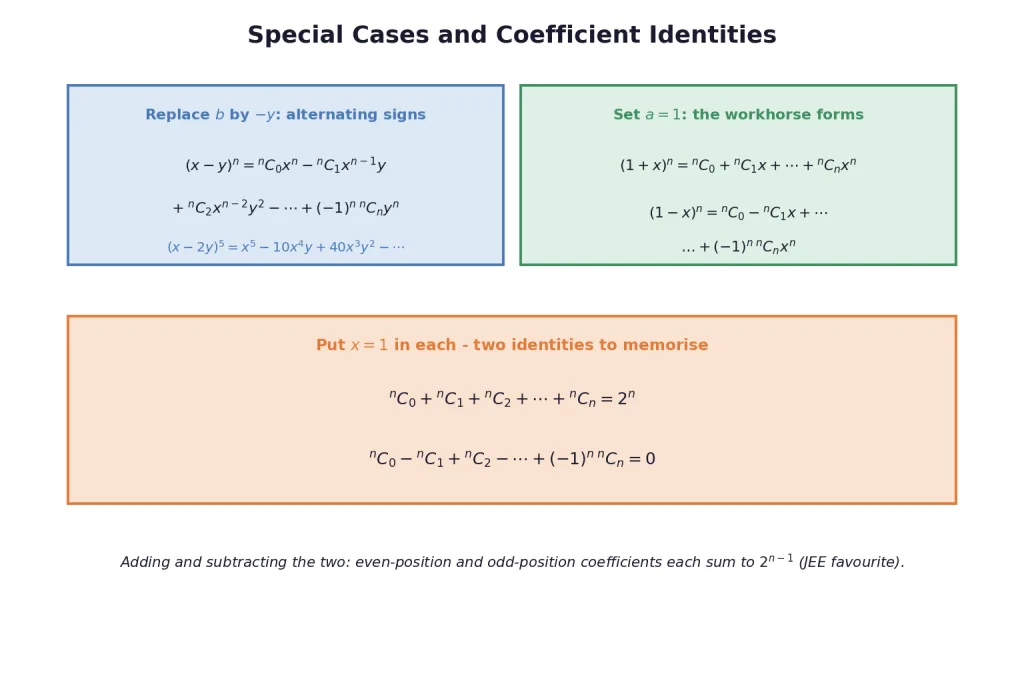
Step 1 — Use the identity. ∑ n C r = 2 n = 512 \sum {^nC_r} = 2^n = 512 ∑ n C r = 2 n = 512
Step 2 — Solve. 512 = 2 9 512 = 2^9 512 = 2 9 n = 9 n = 9 n = 9
Takeaway: Coefficient-sum data converts directly to a power of 2.
Example 24: Even-position sum
Prove n C 0 + n C 2 + n C 4 + ⋯ = 2 n − 1 ^nC_0 + {^nC_2} + {^nC_4} + \cdots = 2^{n-1} n C 0 + n C 2 + n C 4 + ⋯ = 2 n − 1
Solution:
Step 1 — Write the two identities. At x = 1 x = 1 x = 1 ∑ n C r = 2 n \sum {^nC_r} = 2^n ∑ n C r = 2 n x = − 1 x = -1 x = − 1 ∑ ( − 1 ) r n C r = 0 \sum (-1)^r\,{^nC_r} = 0 ∑ ( − 1 ) r n C r = 0
Step 2 — Add them. Odd-position terms cancel; even ones double: 2 ( n C 0 + n C 2 + ⋯ ) = 2 n 2\left({^nC_0} + {^nC_2} + \cdots\right) = 2^n 2 ( n C 0 + n C 2 + ⋯ ) = 2 n
Step 3 — Divide. Even-position sum = 2 n − 1 = 2^{n-1} = 2 n − 1 2 n − 1 2^{n-1} 2 n − 1
Takeaway: Add the identities for the even split, subtract for the odd one.
Example 25: Equal coefficients locate n n n
In ( 1 + x ) n (1 + x)^n ( 1 + x ) n x 7 x^7 x 7 x 8 x^8 x 8 n n n
Solution:
Step 1 — Set up. n C 7 = n C 8 ^nC_7 = {^nC_8} n C 7 = n C 8
Step 2 — Apply the equality rule. 7 ≠ 8 7 \ne 8 7 = 8 n = 7 + 8 = 15 n = 7 + 8 = 15 n = 7 + 8 = 15
Step 3 — Check. 15 C 7 = 15 C 8 = 6435 ^{15}C_7 = {^{15}C_8} = 6435 15 C 7 = 15 C 8 = 6435
Takeaway: Equal binomial coefficients with different lower indices always mean the indices add to n n n
Example 26: Term count
The expansion of ( a + b ) n (a + b)^n ( a + b ) n n n n
Solution:
Step 1 — Term count. n + 1 = 12 n + 1 = 12 n + 1 = 12 n = 11 n = 11 n = 11
Step 2 — Locate the peak. For odd n n n 11 C 5 = 11 C 6 ^{11}C_5 = {^{11}C_6} 11 C 5 = 11 C 6
Step 3 — Evaluate. 11 C 5 = 462 ^{11}C_5 = 462 11 C 5 = 462
Takeaway: Odd index → twin peaks; even index → single central peak.
Example 27: The largest coefficient in an even-index row
Which coefficient of ( 1 + x ) 8 (1 + x)^8 ( 1 + x ) 8
Solution:
Step 1 — Peak of an even row. Row 8 climbs to its centre entry 8 C 4 ^8C_4 8 C 4
Step 2 — Evaluate. 8 C 4 = 70 ^8C_4 = 70 8 C 4 = 70 x 4 x^4 x 4
Takeaway: Binomial rows increase to the middle and mirror back down.
Example 28: A parameter from equal coefficients
If the coefficients of x 2 x^2 x 2 x 3 x^3 x 3 ( 3 + a x ) 9 (3 + ax)^9 ( 3 + a x ) 9 a a a
Solution:
Step 1 — Write both coefficients. Of x 2 x^2 x 2 9 C 2 3 7 a 2 = 36 ⋅ 3 7 a 2 ^9C_2\,3^7a^2 = 36 \cdot 3^7 a^2 9 C 2 3 7 a 2 = 36 ⋅ 3 7 a 2 x 3 x^3 x 3 9 C 3 3 6 a 3 = 84 ⋅ 3 6 a 3 ^9C_3\,3^6a^3 = 84 \cdot 3^6 a^3 9 C 3 3 6 a 3 = 84 ⋅ 3 6 a 3
Step 2 — Equate and cancel. 36 ⋅ 3 7 a 2 = 84 ⋅ 3 6 a 3 36 \cdot 3^7 a^2 = 84 \cdot 3^6 a^3 36 ⋅ 3 7 a 2 = 84 ⋅ 3 6 a 3 3 6 a 2 3^6 a^2 3 6 a 2 36 × 3 = 84 a 36 \times 3 = 84a 36 × 3 = 84 a
Step 3 — Solve. a = 108 84 = 9 7 a = \frac{108}{84} = \frac{9}{7} a = 84 108 = 7 9
Takeaway: Cancel the common powers before solving — the equation collapses to one line.
Example 29: Reading a sigma sum
Evaluate ∑ r = 0 8 8 C r 2 r \sum_{r=0}^{8} {^8C_r}\,2^r ∑ r = 0 8 8 C r 2 r
Solution:
Step 1 — Pattern-match. ∑ n C r t r = ( 1 + t ) n \sum {^nC_r}t^r = (1+t)^n ∑ n C r t r = ( 1 + t ) n t = 2 t = 2 t = 2 n = 8 n = 8 n = 8
Step 2 — Evaluate. ( 1 + 2 ) 8 = 3 8 = 6561 (1 + 2)^8 = 3^8 = 6561 ( 1 + 2 ) 8 = 3 8 = 6561
Takeaway: Weighted coefficient sums are expansions read backwards.
Example 30: An alternating weighted sum
Evaluate ∑ r = 0 6 ( − 1 ) r 6 C r 2 6 − r \sum_{r=0}^{6} (-1)^r\,{^6C_r}\,2^{6-r} ∑ r = 0 6 ( − 1 ) r 6 C r 2 6 − r
Solution:
Step 1 — Pattern-match. ∑ 6 C r 2 6 − r ( − 1 ) r = ( 2 + ( − 1 ) ) 6 \sum {^6C_r}\,2^{6-r}(-1)^r = (2 + (-1))^6 ∑ 6 C r 2 6 − r ( − 1 ) r = ( 2 + ( − 1 ) ) 6
Step 2 — Evaluate. ( 2 − 1 ) 6 = 1 (2-1)^6 = 1 ( 2 − 1 ) 6 = 1
Takeaway: Falling powers of 2 and alternating signs are just ( a + b ) n (a+b)^n ( a + b ) n a = 2 a = 2 a = 2 b = − 1 b = -1 b = − 1