
An Event Is a Subset
You already know random experiments and sample spaces. This chapter adds the last layer: events, and a set of axioms that turn 'chance' into computable mathematics.
Toss a coin twice: . Interested in 'exactly one head'? The outcomes that deliver it are and , so the happening is captured by the set — a subset of .
Definition. Any subset of a sample space is called an event.
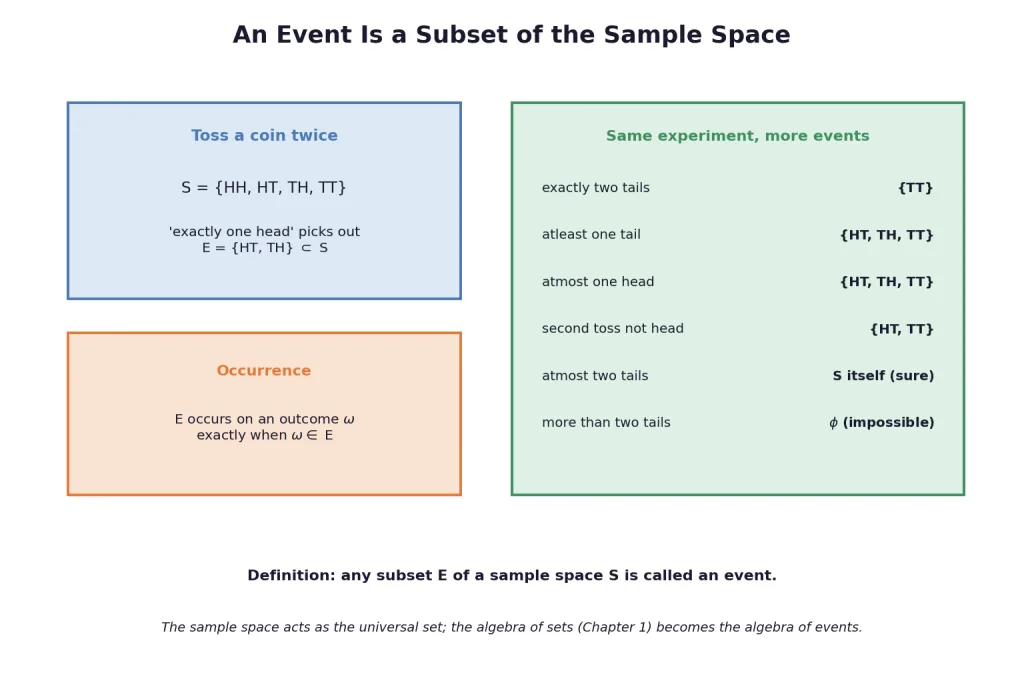
Every description of a happening corresponds to a subset, and every subset describes an event:
| Description | Subset of |
|---|---|
| number of tails is exactly 2 | |
| number of tails is atleast one | |
| number of heads is atmost one | |
| second toss is not head | |
| number of tails is atmost two | itself |
| number of tails is more than two |
Occurrence. The event occurs on a run of the experiment if the outcome satisfies ; if , the event has not occurred. Roll a die and let = 'a number less than 4 appears': outcomes 1, 2 or 3 make occur; outcomes 4, 5, 6 do not.
Types of Events
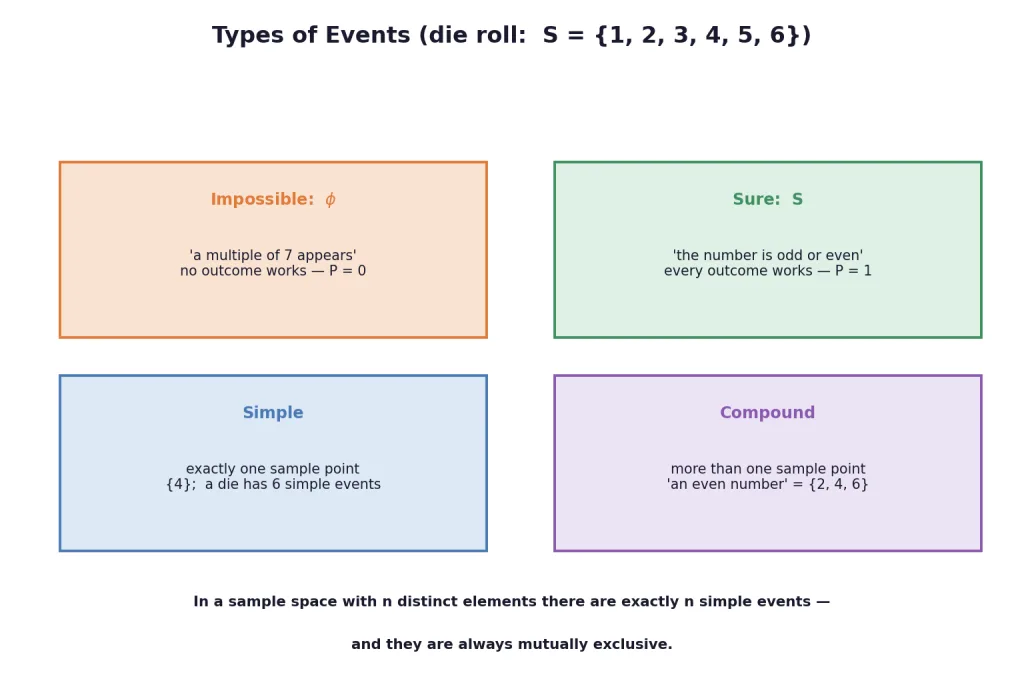
Impossible and sure events. For a die roll, . The event 'a multiple of 7 appears' contains no outcome at all: it is the empty set , the impossible event. The event 'the number is odd or even' is all of : the sure event.
Simple (elementary) event. An event with exactly one sample point, like in the two-coin toss. A sample space with distinct elements has exactly simple events.
Compound event. An event with more than one sample point. Tossing a coin thrice, 'exactly one head' is compound; so are 'atleast one head' (7 points) and 'atmost one head' (4 points).
The Algebra of Events
Since events are sets, Chapter 1's operations combine them. Let , be events of a sample space .
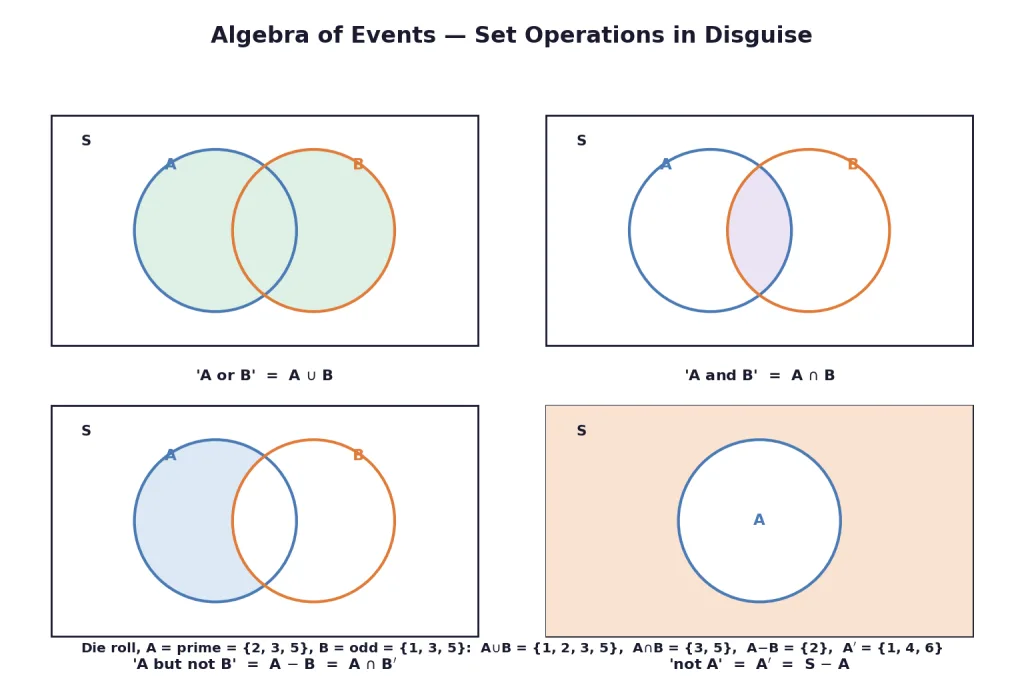
Complementary event ('not '). . Tossing three coins with ('exactly one tail'), the complement is — every outcome on which fails.
The event ' or ' is the union — either happens, possibly both.
The event ' and ' is the intersection . Throwing a die twice with = 'first throw shows six' and = 'sum is atleast 11': .
The event ' but not ' is the difference — happens while does not.
A worked specimen (die roll): = prime , = odd . Then , , , .
Mutually Exclusive and Exhaustive Events
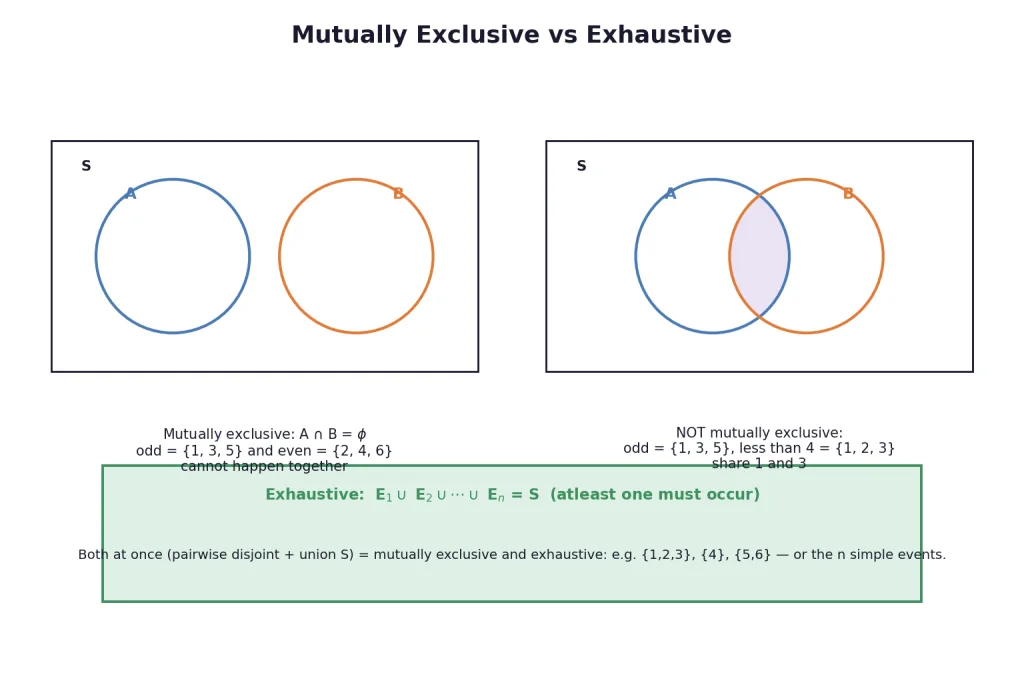
Mutually exclusive. Events and are mutually exclusive if the occurrence of one rules out the other — they cannot happen together — i.e. . Die roll: 'odd' and 'even' are mutually exclusive. But 'odd' and 'less than 4' are not: they share 1 and 3.
Remark. Simple events of a sample space are always mutually exclusive — two distinct singletons never overlap.
Exhaustive. Events are exhaustive if : atleast one of them necessarily occurs on every run. Die roll: , , are exhaustive (their union is ) though and overlap.
Both at once. If the events are pairwise disjoint AND their union is , they are mutually exclusive and exhaustive — they chop into non-overlapping pieces that cover everything. The simple events always form such a family; so do .
This vocabulary is the exact grammar of the axioms coming in the next section — Axiom 3 speaks only about mutually exclusive events.
Solved Examples
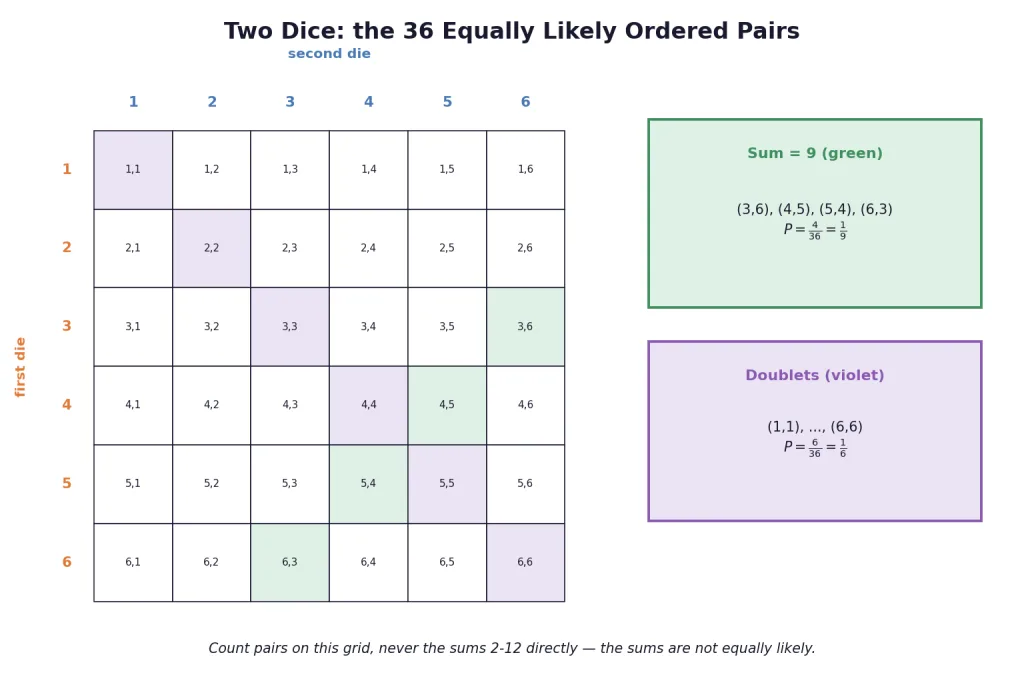
For any two-dice question, count cells on this 36-pair grid — each cell has probability .
Example 1. A die is rolled. = 'getting a prime number', = 'getting an odd number'. Write the sets for (i) or (ii) and (iii) but not (iv) not .
Solution.
Step 1 — write the sample space and both events as sets. A die shows one of . The primes in this range are 2, 3, 5, so . The odd numbers are .
Step 2 — (i) ' or ' is the union. Collect every element appearing in either set (write each once): .
Step 3 — (ii) ' and ' is the intersection. Keep only the common elements: 3 and 5 are in both, 2 is only in , 1 is only in . So — the odd primes.
Step 4 — (iii) ' but not ' is the difference. Remove from anything that lies in : drop 3 and 5, keep 2. So — sensible, since 2 is the only even prime.
Step 5 — (iv) 'not ' is the complement. Take everything in outside : .
Example 2. Two dice are thrown and the sum is noted. : sum is even; : sum is a multiple of 3; : sum is less than 4; : sum is greater than 11. Which pairs are mutually exclusive?
Solution.
Step 1 — set up the sample space. The experiment records an ordered pair, so with .
Step 2 — write the small events explicitly. Sums below 4 are 2 and 3: . The only sum above 11 is 12: .
Step 3 — test each pair by hunting for one common outcome. : a sum that is even AND a multiple of 3 — sum 6 works, e.g. , and sum 12 gives ; non-empty. : has even sum 2 and is in ; non-empty. : has even sum 12; non-empty. : has sum 3; non-empty. : has sum 12, a multiple of 3; non-empty.
Step 4 — the remaining pair. would need a sum that is simultaneously less than 4 and greater than 11 — impossible, so .
Conclusion. Only and are mutually exclusive; every other pair shares atleast one outcome.
Example 3. A coin is tossed three times. : no head appears; : exactly one head; : atleast two heads. Do , , form a mutually exclusive and exhaustive set?
Solution.
Step 1 — list the events by head-count. has outcomes. Zero heads: . Exactly one head: . Two or three heads: .
Step 2 — check exhaustive (does the union cover ?). The three sets contain outcomes, which is every element of : . ✓
Step 3 — check mutually exclusive (pairwise disjoint?). Every outcome has one definite number of heads (0, 1, 2 or 3), so it can satisfy at most one of the three descriptions: . ✓
Conclusion. Yes — counting heads chops into non-overlapping pieces that cover everything: a partition.
Example 4. A die is rolled. = 'die shows 4', = 'die shows an even number'. Are and mutually exclusive?
Solution.
Step 1 — write the events. and .
Step 2 — compute the intersection. The outcome 4 lies in both sets: .
Step 3 — interpret. When the die shows 4, BOTH events occur on the same roll, so they are not mutually exclusive. In fact : showing a 4 is one particular way of showing an even number.
Example 5. A die is thrown. Describe: A: a number less than 7; B: a number greater than 7; C: a multiple of 3; D: a number less than 4; E: an even number greater than 4; F: a number not less than 3. Also find , , , , , , , , .
Solution.
Step 1 — translate each description into a subset of . Every face is less than 7, so (the sure event). No face exceeds 7, so (impossible). Multiples of 3: . Below 4: . Even and above 4: only 6 qualifies, . Not less than 3 means atleast 3: .
Step 2 — unions and intersections with the extremes. ; (nothing is in the empty set); .
Step 3 — the mixed ones. : 6 is in both → . : and share nothing → . : remove 3 and 6 from → . : remove 6 from — but , so nothing changes → .
Step 4 — the complement pieces. . Then .
Example 6. A pair of dice is rolled. A: the sum is greater than 8; B: 2 occurs on either die; C: the sum is atleast 7 and a multiple of 3. Which pairs are mutually exclusive?
Solution.
Step 1 — understand each event. collects sums 9, 10, 11, 12. collects every ordered pair containing a 2 (eleven pairs: ). For , the sum must be AND divisible by 3 — that means sum 9 or 12: .
Step 2 — test and . If a die shows 2, the biggest possible sum is , which is not greater than 8. So no outcome of reaches : — mutually exclusive. ✓
Step 3 — test and . Every outcome of has sum 9 or 12, and by Step 2 a pair containing a 2 sums to atmost 8. So — mutually exclusive. ✓
Step 4 — test and . Sums 9 and 12 are certainly greater than 8, so every outcome of already lies in : — NOT mutually exclusive.
Conclusion. The mutually exclusive pairs are and .
Example 7. Three coins are tossed once. A: three heads; B: two heads and one tail; C: three tails; D: a head on the first coin. Classify: (i) mutually exclusive pairs (ii) simple events (iii) compound events.
Solution.
Step 1 — write all four events. , , , (first letter H).
Step 2 — check all six pairs for overlap. : 3 heads vs exactly 2 heads — ✓. : all heads vs all tails — ✓. : starts with H — , overlaps. : 2 heads vs 0 heads — ✓. : and start with H — overlaps. : starts with T — ✓.
Step 3 — conclude (i). Mutually exclusive pairs: , , , .
Step 4 — (ii) and (iii) by counting sample points. and contain exactly one point each: simple. (3 points) and (4 points): compound.
Example 8. Three coins are tossed. Describe (i) two mutually exclusive events (ii) three mutually exclusive and exhaustive events (iii) two events that are not mutually exclusive (iv) two mutually exclusive but not exhaustive events (v) three mutually exclusive but not exhaustive events.
Solution. Many correct answers exist; here is one for each, with the check that makes it valid.
(i) 'Atleast two heads' and 'atleast two tails' : with only three coins you cannot have two of each, so the sets are disjoint. ✓
(ii) 'No head' , 'exactly one head' , 'atleast two heads' (4 outcomes): pairwise disjoint by head-count AND the union is all 8 outcomes — a partition of . ✓
(iii) 'Atleast one head' and 'atleast one tail': the outcome has both, so the two events overlap. ✓
(iv) and : disjoint, but their union has only 2 of the 8 outcomes — six outcomes (like ) belong to neither, so not exhaustive. ✓
(v) , , : three singletons are automatically pairwise disjoint, and their union misses five outcomes — mutually exclusive but far from exhaustive. ✓
Example 9. Two dice are thrown. A: even number on the first die; B: odd number on the first die; C: sum atmost 5. Describe (i) (ii) not (iii) or (iv) and (v) but not (vi) or (vii) and (viii) .
Solution.
Step 1 — see the complement relationship first. The first die is either even or odd, never both, so and . This single observation answers half the parts.
Step 2 — (i) to (iv). (i) = 'first die odd' . (ii) not . (iii) : even-first together with odd-first is every outcome — . (iv) : the first die cannot be even and odd at once — .
Step 3 — (v) . Keep even-first pairs whose sum EXCEEDS 5. From the even-first pairs remove the small-sum ones : what remains is .
Step 4 — (vi) and (vii). : all odd-first pairs, plus the even-first pairs with sum , namely . : odd-first with sum atmost 5: .
Step 5 — (viii) simplify before listing. , so — exactly the event of part (v). Recognising the complement saves re-counting.
Example 10. With the events of Example 9, state true or false: (i) and are mutually exclusive (ii) , are mutually exclusive and exhaustive (iii) (iv) and are mutually exclusive (v) and are mutually exclusive (vi) , , are mutually exclusive and exhaustive.
Solution.
(i) True. from Example 9(iv): a first die cannot be both even and odd.
(ii) True. Beyond disjointness we also have (Example 9(iii)), so the pair is exhaustive too.
(iii) True. 'Not odd' on a die is exactly 'even'.
(iv) False. One shared outcome kills mutual exclusivity: has an even first die AND sum , so .
(v) False. , so , which is certainly non-empty — an event can never be mutually exclusive with itself (unless it is ).
(vi) False. and are fine as a pair, but overlaps both: (odd first, small sum) and (even first, small sum). The three are not pairwise disjoint, so they cannot be 'mutually exclusive and exhaustive'.