
Tool 1: 'Atleast One' Through the Complement
JEE loves 'atleast one'. Direct case-counting explodes; the complement collapses it to one case:
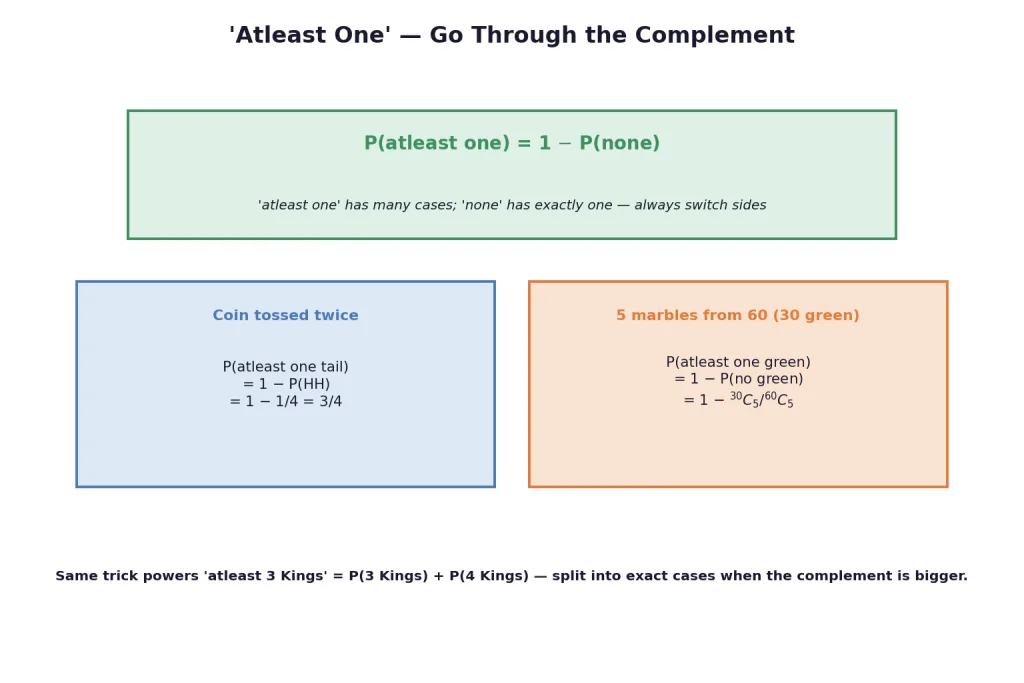
When the complement is the bigger side (e.g. 'atleast 3 Kings' in a 7-card hand), flip strategy: split into the few exact cases and add — the cases are mutually exclusive.
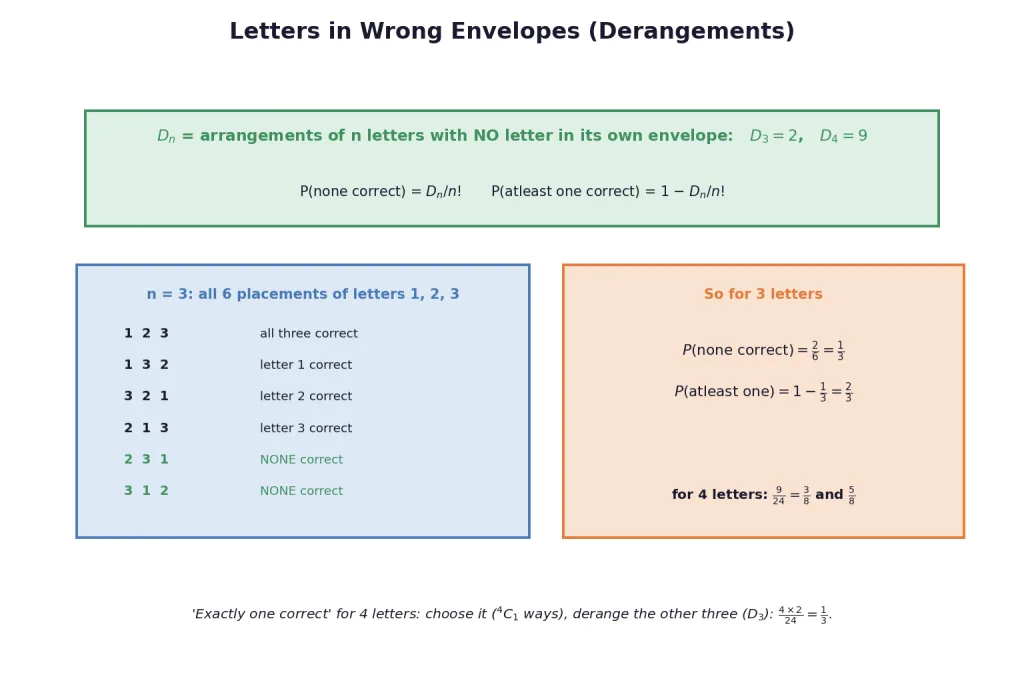
Derangements (letters in wrong envelopes). The number of ways to place letters so that NO letter reaches its own envelope: , (memorise these two). So with 4 letters, , and .
Tool 2: Inclusion-Exclusion for Three Events
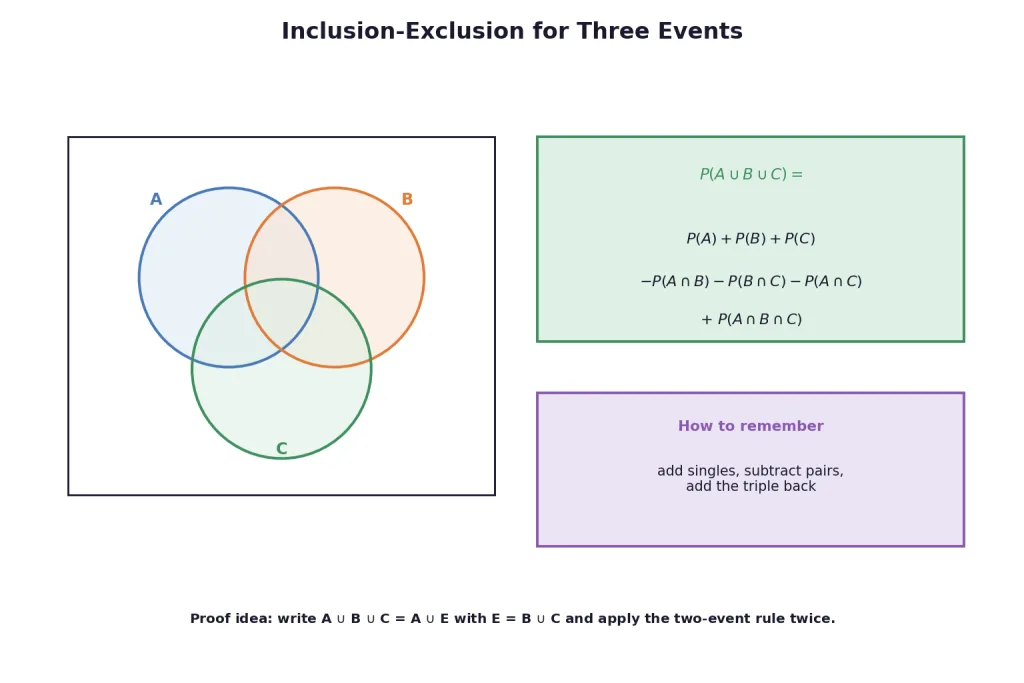
Add singles, subtract pairs, add the triple back. 'None of the three' is then .
Tool 3: Bounds and Identities
From and :
Two identities that headline JEE questions:
- Exactly one of , occurs: .
- Complement sum: .
Tool 4: Odds
'Odds in favour of are ' means , i.e. . 'Odds against are ' means , i.e. . Translate odds to probability immediately, then compute as usual.
Tool 5: Heavy Counting
The hardest Chapter 14 questions are Chapter 6 questions in disguise: multinomial letter arrangements, committee selections with constraints, digit constructions. Build and with , , — then divide. Every JEE probability mistake is usually a counting mistake.
Solved Examples
Example 1. Four letters are placed at random into four addressed envelopes. Find the probability that (i) no letter is in its correct envelope (ii) atleast one is correct (iii) exactly one is correct.
Solution.
Step 1 — sample space. The letters fill the envelopes in equally likely ways.
(i) Step 2 — derangements. Placements with NO letter correct are the derangements of 4 objects: (a fact worth memorising along with ). So .
(ii) Step 3 — complement. .
(iii) Step 4 — build 'exactly one'. Choose WHICH letter is correct ( ways), then derange the other three so none of them is correct ( ways): placements → .
Example 2. , , , , , , . Find and .
Solution.
Step 1 — 'atleast one' is the union. Apply three-event inclusion-exclusion: singles ; pairs ; triple .
Step 2 — combine. .
Step 3 — 'none' is the complement. .
Example 3. and . Show that , and find the possible range of .
Solution.
Step 1 — upper bound for the intersection. forces (and also ; the smaller wins).
Step 2 — lower bound from the union cap. The addition rule gives . Since , we get . Together: .
Step 3 — range of the union. The union contains each event, so ; and from Step 2's identity with : . Range: — both endpoints achievable ( gives 0.7; minimal overlap gives 1).
Example 4. , , . Find the probability that exactly one of , occurs.
Solution.
Step 1 — decompose into disjoint pieces. 'Exactly one' , and the two pieces cannot overlap.
Step 2 — each piece strips the overlap. ; .
Step 3 — add. — equivalently the formula : the overlap is subtracted twice because 'both' must leave BOTH pieces.
Example 5. (a) The odds in favour of an event are 3 : 5. Find its probability. (b) The odds against an event are 7 : 3. Find its probability.
Solution.
(a) Step 1 — unpack the ratio. In favour means . Step 2 — the two parts total 1, so .
(b) Step 3 — 'against' swaps the roles. Against means , so .
Step 4 — sanity. In both parts the favourable share sits over the SUM of the ratio terms; the only question is which term is favourable.
Example 6. Five cards are drawn from a deck of 52. Find the probability of exactly 2 aces.
Solution.
Step 1 — sample space. Unordered hands: .
Step 2 — construct a favourable hand. Exactly 2 aces: choose them from the 4 aces, ways; the other cards must be non-aces, ways.
Step 3 — multiply and divide. . Forgetting the factor leaves the hand incomplete — a standard error.
Example 7. Three dice are thrown. Find the probability that the sum is 9.
Solution.
Step 1 — sample space. Ordered triples: .
Step 2 — organise by unordered pattern. Digit triples summing to 9 with entries 1-6: .
Step 3 — count arrangements of each. All-distinct patterns give ordered triples each: → . One-repeat patterns give each: → . The triple-repeat gives 1.
Step 4 — total and divide. → .
Example 8. The letters of MATHEMATICS are arranged at random. Find the probability that all vowels are together.
Solution.
Step 1 — inventory. MATHEMATICS has 11 letters: M×2, A×2, T×2, H, E, I, C, S. Total arrangements (divide once per repeated letter).
Step 2 — glue the vowels. The vowels are A, A, E, I. As one block, the units are the 7 consonants (M, M, T, T, H, C, S) plus the block: 8 units with M and T still doubled → arrangements.
Step 3 — arrange inside the block. The four vowels with A doubled: internal orders.
Step 4 — divide. .
Example 9. From 6 boys and 4 girls, a committee of 4 is chosen at random. Find the probability that it has atleast 2 girls.
Solution.
Step 1 — sample space. committees.
Step 2 — split 'atleast 2' into exact disjoint cases. Exactly 2 girls: . Exactly 3 girls: . Exactly 4 girls: .
Step 3 — add and divide. .
Step 4 — cross-check via the complement. 0 girls: ; 1 girl: . ✓.
Example 10. and . Find .
Solution.
Step 1 — the key identity. Adding the addition rule's two sides differently: — union plus intersection recovers the sum.
Step 2 — substitute. .
Step 3 — complement each and add. . (A sum of two probabilities may exceed 1 — it is not itself a probability.)
Example 11. A number is chosen at random from the first 200 natural numbers. Find the probability that it is divisible by 6 or 8.
Solution.
Step 1 — count each family. Multiples of 6 up to 200: . Multiples of 8: .
Step 2 — the overlap. Divisible by both 6 and 8 means divisible by (note: NOT ): .
Step 3 — inclusion-exclusion and divide. Favourable → .
Example 12. A card is drawn from a deck of 52. Events: A = 'a spade', B = 'a face card (J, Q, K)'. Find and the odds in favour of .
Solution.
Step 1 — the three ingredient counts. Spades: 13. Face cards: 3 per suit 4 suits . Spade face cards (J♠, Q♠, K♠): 3.
Step 2 — addition rule. .
Step 3 — convert to odds. — odds in favour are .