Solved Examples
Example 1. Anil qualifies an exam with probability 0.05, Ashima with 0.10, both with 0.02. Find the probability that (a) both do not qualify (b) atleast one does not qualify (c) only one qualifies.
Solution.
Step 1 — name the events and record the data. Let E = 'Anil qualifies', F = 'Ashima qualifies'. Given: P(E)=0.05, P(F)=0.10, P(E∩F)=0.02.
(a) Step 2 — translate. 'Both do not qualify' means E fails AND F fails: the event E′∩F′, which De Morgan rewrites as (E∪F)′.
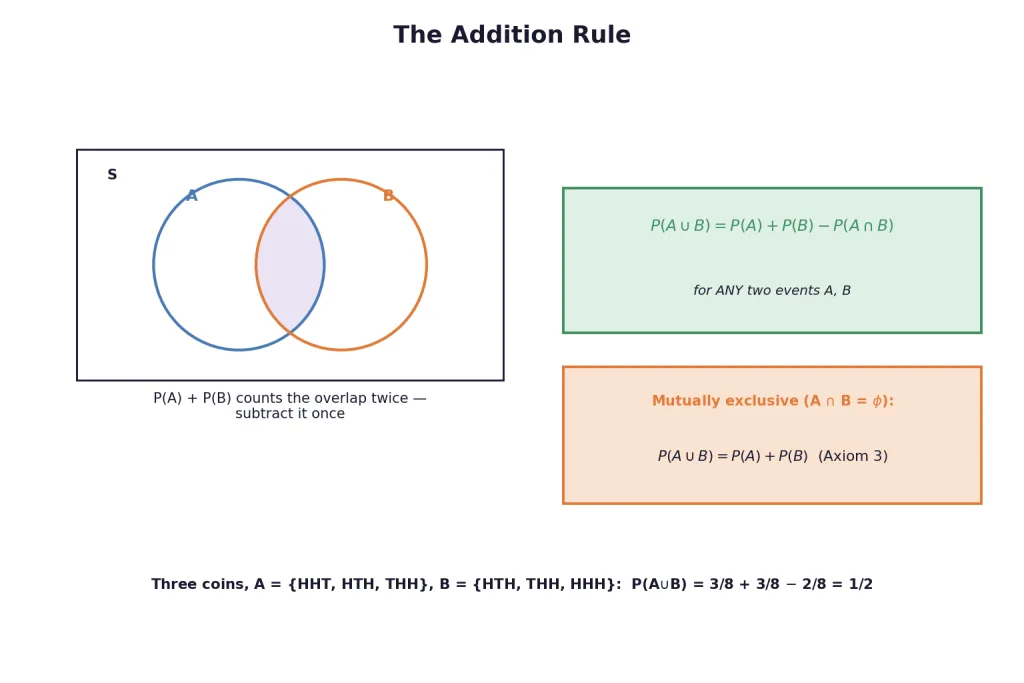
Step 3 — compute the union first. P(E∪F)=P(E)+P(F)−P(E∩F)=0.05+0.10−0.02=0.13.
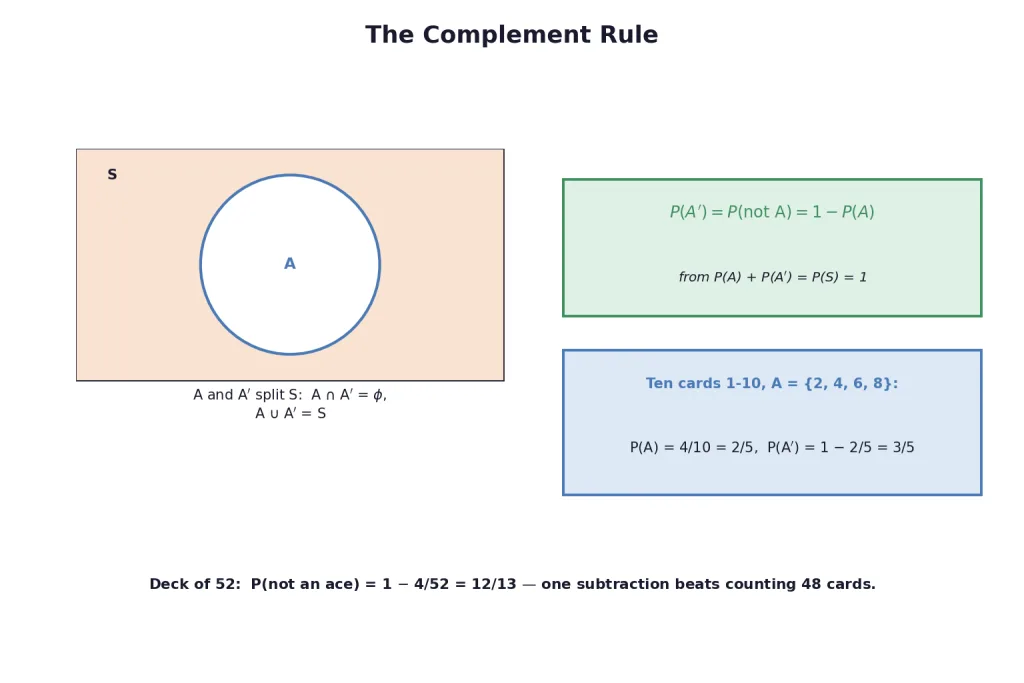
Step 4 — complement. P(E′∩F′)=1−0.13=0.87.
(b) Step 5 — spot the cleaner complement. 'Atleast one does NOT qualify' is the complement of 'both qualify': 1−P(E∩F)=1−0.02=0.98.
(c) Step 6 — split 'only one' into disjoint cases. Either (Anil yes, Ashima no) =E∩F′ or (Anil no, Ashima yes) =E′∩F. Each is an event minus the overlap: P(E∩F′)=0.05−0.02=0.03 and P(E′∩F)=0.10−0.02=0.08.
Step 7 — add the disjoint pieces. P(only one)=0.03+0.08=0.11.
Example 2. A committee of two is selected from two men and two women. Find the probability of (a) no man (b) one man (c) two men.
Solution.
Step 1 — count all committees. Choosing 2 people from 4: (24)=6 equally likely committees.
(a) Step 2. No man forces two women: (22)=1 way → P=61.
(b) Step 3. One man AND one woman: (12)×(12)=2×2=4 ways → P=64=32.
(c) Step 4. Two men: (22)=1 way → P=61.
Step 5 — verify the three cases exhaust everything. 61+64+61=1 ✓ — the committee must contain 0, 1 or 2 men.
Example 3. Are these consistently defined? (i) P(A)=0.5, P(B)=0.7, P(A∩B)=0.6 (ii) P(A)=0.5, P(B)=0.4, P(A∪B)=0.8.
Solution.
Step 1 — know the consistency tests. Any legal data must satisfy P(A∩B)≤min(P(A),P(B)) (the part cannot beat the whole) and 0≤P(A∪B)≤1 with the addition rule connecting the four numbers.
(i) Step 2. Here P(A∩B)=0.6 but P(A)=0.5. Since A∩B⊆A, we need P(A∩B)≤0.5 — violated. Not consistent (no experiment can produce these numbers).
(ii) Step 3. Recover the intersection from the addition rule: P(A∩B)=P(A)+P(B)−P(A∪B)=0.5+0.4−0.8=0.1.
Step 4 — check it is legal. 0.1≥0 ✓ and 0.1≤min(0.5,0.4)=0.4 ✓. Consistent.
Example 4. Fill in the blanks:
|
P(A) |
P(B) |
P(A∩B) |
P(A∪B) |
| (i) |
31 |
51 |
151 |
? |
| (ii) |
0.35 |
? |
0.25 |
0.6 |
| (iii) |
0.5 |
0.35 |
? |
0.7 |
Solution. All three rows are the SAME equation P(A∪B)=P(A)+P(B)−P(A∩B), solved for a different unknown.
(i) Step 1. Common denominator 15: P(A)=155, P(B)=153, P(A∩B)=151. Step 2. P(A∪B)=155+3−1=157.
(ii) Step 1. Substitute: 0.6=0.35+P(B)−0.25. Step 2. Simplify the knowns: 0.35−0.25=0.10, so 0.6=0.10+P(B), giving P(B)=0.5.
(iii) Step 1. Rearrange for the intersection: P(A∩B)=P(A)+P(B)−P(A∪B)=0.5+0.35−0.7. Step 2. =0.15.
Example 5. (a) P(A)=53, P(B)=51, A and B mutually exclusive: find P(A or B). (b) P(E)=41, P(F)=21, P(E and F)=81: find (i) P(E or F) (ii) P(not E and not F).
Solution.
(a) Step 1. Mutually exclusive means P(A∩B)=0, so the addition rule loses its correction term. Step 2. P(A∪B)=53+51=54.
(b)(i) Step 1. Full addition rule over denominator 8: P(E∪F)=82+84−81. Step 2. =85.
(b)(ii) Step 3. 'Not E and not F' =E′∩F′=(E∪F)′ by De Morgan. Step 4. P=1−85=83.
Example 6. P(not E or not F)=0.25. Are E and F mutually exclusive?
Solution.
Step 1 — rewrite with De Morgan. E′∪F′=(E∩F)′: 'atleast one fails' is exactly 'not both occur'.
Step 2 — take the complement. P(E∩F)=1−P((E∩F)′)=1−0.25=0.75.
Step 3 — interpret. Mutually exclusive would force P(E∩F)=0; here it is 0.75>0, so E and F can occur together and are not mutually exclusive.
Example 7. P(A)=0.42, P(B)=0.48, P(A and B)=0.16. Find (i) P(not A) (ii) P(not B) (iii) P(A or B).
Solution.
Step 1 — (i) and (ii) are complements. P(A′)=1−0.42=0.58 and P(B′)=1−0.48=0.52.
Step 2 — (iii) addition rule. P(A∪B)=P(A)+P(B)−P(A∩B)=0.42+0.48−0.16.
Step 3 — arithmetic. 0.42+0.48=0.90; 0.90−0.16=0.74.
Example 8. In Class XI, 40% study Mathematics, 30% study Biology, 10% study both. A student is picked at random; find the probability that they study Mathematics or Biology.
Solution.
Step 1 — percentages to probabilities. P(M)=0.40, P(B)=0.30, P(M∩B)=0.10.
Step 2 — why subtract? Adding 40%+30% counts the both-subject students twice — once in each group — so remove them once.
Step 3 — compute. P(M∪B)=0.40+0.30−0.10=0.6.
Example 9. An entrance test has two exams. P(pass first)=0.8, P(pass second)=0.7, P(pass atleast one)=0.95. Find the probability of passing both.
Solution.
Step 1 — translate. 'Atleast one' is the union: P(A∪B)=0.95; 'both' is the intersection we want.
Step 2 — rearrange the addition rule. P(A∩B)=P(A)+P(B)−P(A∪B).
Step 3 — substitute. =0.8+0.7−0.95=1.5−0.95=0.55. Sanity check: 0.55≤min(0.8,0.7) ✓.
Example 10. P(pass both English and Hindi)=0.5, P(pass neither)=0.1, P(pass English)=0.75. Find P(pass Hindi).
Solution.
Step 1 — convert 'neither' into the union. 'Neither' is the complement of 'atleast one': P(E∪H)=1−0.1=0.9.
Step 2 — set up the addition rule with the unknown. 0.9=P(E)+P(H)−P(E∩H)=0.75+P(H)−0.5.
Step 3 — solve. 0.9=0.25+P(H), so P(H)=0.65.
Step 4 — verify. 0.75+0.65−0.5=0.9=1−0.1 ✓.
Example 11. Of 60 students, 30 opted for NCC, 32 for NSS, 24 for both. A student is selected at random. Find the probability that the student opted for (i) NCC or NSS (ii) neither (iii) NSS but not NCC.
Solution.
Step 1 — data as probabilities. P(N)=6030, P(S)=6032, P(N∩S)=6024.
(i) Step 2. P(N∪S)=6030+32−24=6038=3019. (In headcount: 30+32−24=38 students in atleast one.)
(ii) Step 3. Complement of the union: 1−3019=3011. (Headcount check: 60−38=22, and 6022=3011 ✓.)
(iii) Step 4. 'NSS but not NCC' removes the overlap from NSS: P(S∩N′)=P(S)−P(N∩S)=6032−24=608=152.
Example 12. (a) A card is selected from a pack of 52. (i) How many points are there in the sample space? (ii) P(ace of spades)? (iii) P(ace) and P(black card)? (b) Four men and six women are on a city council; one member is selected at random. How likely is it that it is a woman?
Solution.
(a) Step 1. Each card is one outcome: n(S)=52.
Step 2. The ace of spades is a single card: P=521.
Step 3. Four aces: P(ace)=524=131. Twenty-six black cards: P(black)=5226=21.
(b) Step 4. The council has 4+6=10 members, each equally likely to be picked; 6 are women: P(woman)=106=53.