
How to Work This Section
Thirty fully worked problems: classic ordering and card-hand problems, a full mixed practice set, and sixteen drills that rehearse the exam-standard patterns — dice pairs, card hands via , arrangement probabilities via and , and 'atleast one' through the complement.
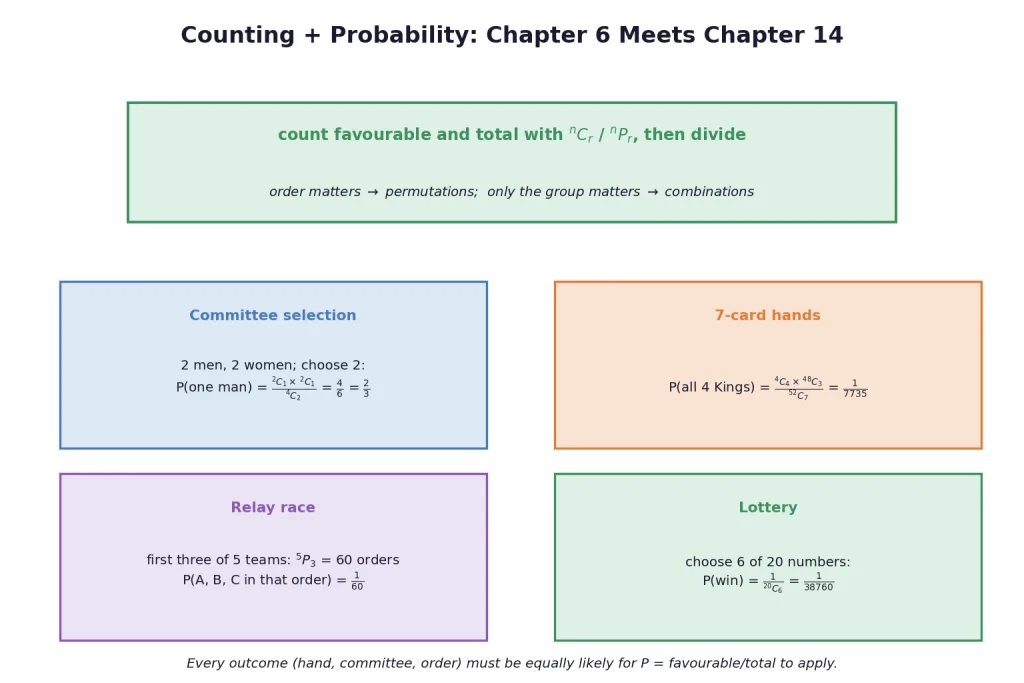
The single test that decides every setup: are my outcomes equally likely? Choose the sample space so they are (ordered pairs for dice, unordered hands for cards, arrangements for orderings), count favourable and total with Chapter 6 tools, then divide.
Classic Worked Examples
Example 1. Veena visits four cities A, B, C, D in a random order. Find the probability that she visits (i) A before B (ii) A before B and B before C (iii) A first and B last (iv) A either first or second (v) A just before B.
Solution.
Step 1 — sample space. A visiting plan is an ordering of the four cities: equally likely orders.
(i) Step 2 — use symmetry. Pair every order with the one obtained by swapping A and B. In each pair exactly one order has A before B, so exactly half the orders do: — no listing needed.
(ii) Step 3 — fix a relative order of three cities. Among the possible relative orders of A, B, C, all are equally likely, and only one is A→B→C. So the favourable orders number (they differ only in where D sits): .
(iii) Step 4 — pin the ends. A in position 1 and B in position 4 leaves C, D for the middle two places: orders → .
(iv) Step 5 — disjoint cases. 'A first' gives orders; 'A second' gives another 6; the two cases cannot overlap → .
(v) Step 6 — glue the block. 'A just before B' means AB appear as an adjacent block in that order. Treat AB as one unit: the units arrange in ways → . Note how (v) differs from (i): adjacency is a stronger demand than mere precedence.
Example 2. A hand of 7 cards is drawn from a deck of 52. Find the probability that it contains (i) all 4 Kings (ii) exactly 3 Kings (iii) atleast 3 Kings.
Solution.
Step 1 — sample space. A hand is an unordered set of 7 cards: equally likely hands.
(i) Step 2 — build the favourable hands. Take all 4 Kings ( way), then complete the hand with cards from the remaining 48 ( ways).
Step 3 — divide. .
(ii) Step 4 — same recipe, 3 Kings. Choose 3 of the 4 Kings () and 4 non-Kings (): .
(iii) Step 5 — add disjoint cases. 'Atleast 3' means exactly 3 or exactly 4 — a hand cannot be both: .
Example 3. For any three events , , , prove that .
Solution.
Step 1 — reduce three events to two. Set , so and the two-event rule applies: .
Step 2 — expand . By the two-event rule again: .
Step 3 — expand . Distribute the intersection over the union: . Apply the two-event rule to THIS union: , and the last set simplifies to .
Step 4 — substitute back. , which rearranges to the claimed formula. Memory hook: add the singles, subtract the pairs, add the triple back.
Example 4. In a relay race with five teams A, B, C, D, E: (a) P(A, B, C finish first, second, third respectively) (b) P(A, B, C are the first three in any order).
Solution.
Step 1 — sample space. Record only the first three places, in order: equally likely outcomes.
(a) Step 2. Exactly one outcome reads A-B-C in that order: .
(b) Step 3. Now any shuffling of A, B, C across the three places counts: favourable outcomes → .
Step 4 — cross-check (b) by combinations. Ignore order entirely: the set of first-three teams is one of equally likely triples, and exactly one triple is → ✓.
Mixed Practice Problems
Example 5. A box contains 10 red, 20 blue, 30 green marbles; 5 are drawn. Find the probability that (i) all are blue (ii) atleast one is green.
Solution.
Step 1 — sample space. Five marbles from : equally likely draws.
(i) Step 2. All five from the 20 blue: ways → .
(ii) Step 3 — complement. 'Atleast one green' has five messy cases; 'NO green' has one: all five marbles from the non-green ones, ways.
Step 4 — subtract. , so — with half the box green, missing green entirely is rare.
Example 6. 4 cards are drawn from a deck of 52. What is the probability of obtaining 3 diamonds and one spade?
Solution.
Step 1 — sample space. unordered 4-card draws.
Step 2 — build a favourable draw. Choose the 3 diamonds from 13 ( ways) AND the 1 spade from 13 ( ways): draws.
Step 3 — divide and simplify. (dividing numerator and denominator by 13).
Example 7. A die has two faces with '1', three faces with '2', one face with '3'. It is rolled once. Determine (i) (ii) (iii) .
Solution.
Step 1 — choose the right sample space. The three NUMBERS are not equally likely, but the six FACES are. Work with faces: 2 faces show 1, 3 faces show 2, 1 face shows 3.
(i) Step 2. .
(ii) Step 3. '1 or 3' covers faces → . (Equivalently the complement of rolling a 2.)
(iii) Step 4. .
Example 8. A lottery sells 10,000 tickets with ten equal prizes. Find the probability of NOT getting a prize when buying (a) one ticket (b) two tickets (c) 10 tickets.
Solution.
Step 1 — count the blanks. tickets win nothing.
(a) Step 2. One ticket is one draw from 10,000: .
(b) Step 3. Your two tickets form an unordered pair; missing every prize means BOTH tickets come from the 9990 blanks: .
(c) Step 4. Same structure with ten tickets: . Each answer is a ratio of 'all-blank selections' to 'all selections' — only the selection size changes.
Example 9. Out of 100 students, two sections of 40 and 60 are formed. If you and your friend are among the 100, find the probability that (a) you both enter the same section (b) you both enter different sections.
Solution.
Step 1 — focus on the pair of seats. Only the positions of you and your friend matter: the pair of seats you occupy is a random 2-subset of 100, so .
(a) Step 2 — two disjoint ways to be together. Both in the 40-section: ; both in the 60-section: .
Step 3 — add and divide. .
(b) Step 4 — complement. . Direct check: one seat in each section can be chosen in ways, and ✓.
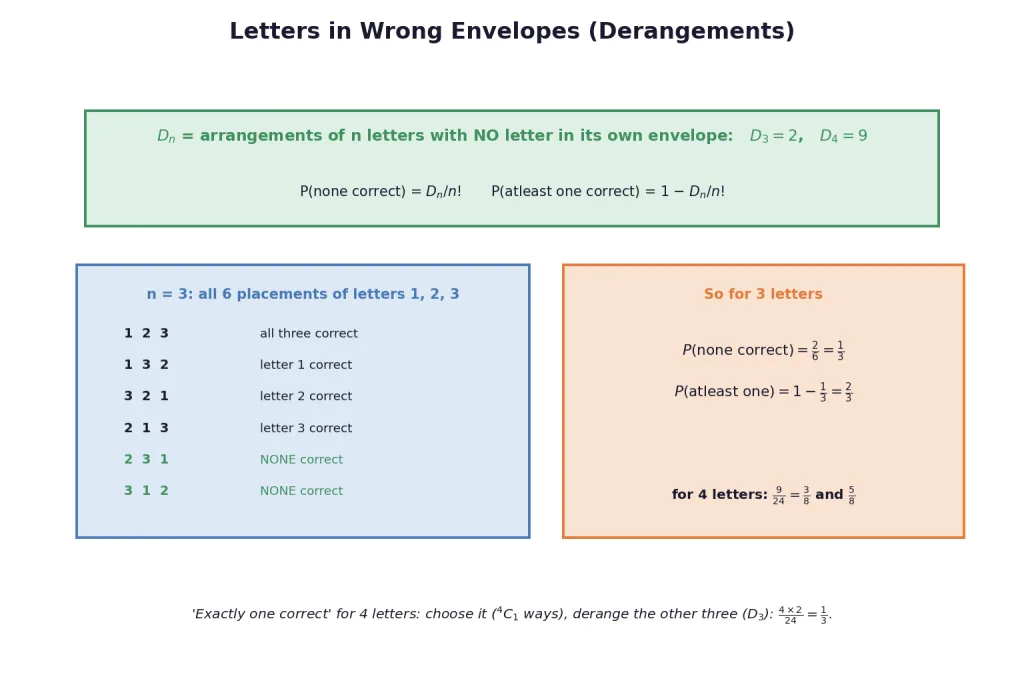
Example 10. Three letters are put at random into three addressed envelopes, one per envelope. Find the probability that atleast one letter is in its proper envelope.
Solution.
Step 1 — sample space. The letters fill the envelopes in equally likely ways.
Step 2 — go through the complement. 'Atleast one correct' has overlapping cases, but its complement — 'NO letter in its own envelope' — is a single clean condition.
Step 3 — count the derangements. Writing each placement as the order the letters land in envelopes 1, 2, 3: of the six orders , check each against the correct positions — only and put every letter in a wrong envelope. So .
Step 4 — finish. , hence .
Example 11. , , . Find (i) (ii) (iii) (iv) .
Solution.
(i) Step 1 — addition rule. .
(ii) Step 2 — De Morgan. , so .
(iii) Step 3 — ' only'. Strip the overlap from : .
(iv) Step 4 — ' only'. Symmetrically: .
Step 5 — consistency check. The four disjoint regions only, only, both, neither must total 1: ✓.
Example 12. Five employees: Harish (M, 30), Rohan (M, 33), Sheetal (F, 46), Alis (F, 28), Salim (M, 41). One is chosen at random as spokesperson. Find the probability the spokesperson is male or over 35.
Solution.
Step 1 — read off the two events. Males: Harish, Rohan, Salim → . Over 35: Sheetal (46), Salim (41) → .
Step 2 — find the overlap. Male AND over 35: only Salim → .
Step 3 — addition rule. . Direct check: the favourable people are Harish, Rohan, Salim, Sheetal — 4 of 5 ✓ (only Alis, a 28-year-old woman, fails both).
Example 13. 4-digit numbers greater than 5000 are formed from 0, 1, 3, 5, 7. Find the probability the number is divisible by 5 when (i) digits may repeat (ii) repetition is not allowed.
Solution.
(i) Step 1 — count numbers greater than 5000, repetition allowed. The first digit must be 5 or 7 (2 choices); the other three places are free (5 each): strings. One of them is exactly 5000, which is NOT greater than 5000 — remove it: numbers.
Step 2 — count the multiples of 5. Divisible by 5 needs last digit 0 or 5: first digit 2 choices, middle two , last 2 choices → , minus the excluded 5000 → 99.
Step 3 — divide. .
(ii) Step 4 — repeat without repetition. First digit 5 or 7 (2 ways), then the remaining three places take distinct leftover digits: each → numbers, all automatically (5000 itself needs repeated zeros).
Step 5 — favourable count, split by first digit. First digit 5: the last digit can only be 0 (5 is used), middles from the remaining 3 digits: numbers. First digit 7: last digit 0 or 5 (2 ways), middles → 12 numbers. Total .
Step 6 — divide. .
Example 14. A number lock has 4 wheels each with digits 0-9; the code is a sequence of four digits with no repeats. What is the probability of guessing it?
Solution.
Step 1 — recognise ordered-without-repetition. A lock code is a SEQUENCE (order matters) of DISTINCT digits, so count permutations: .
Step 2 — favourable. Exactly one sequence opens the lock.
Step 3 — divide. . Contrast: with repeats allowed the total would be ; unordered would be — both wrong models for a lock.
Drill Set A — Dice and Coins
Example 15. Two dice are thrown. Find the probability that the sum is 9.
Solution.
Step 1. Sample space: 36 ordered pairs, each with probability .
Step 2. List the pairs summing to 9 systematically by first die: — first die 1 or 2 cannot reach 9. Four pairs.
Step 3. .
Example 16. Two dice are thrown. Find the probability of a doublet.
Solution.
Step 1. A doublet means both dice agree: — one per face value, six in all.
Step 2. . (Quick view: whatever the first die shows, the second matches it with probability .)
Example 17. Two dice are thrown. Find the probability that atleast one die shows a 6.
Solution.
Step 1 — complement. 'Atleast one six' mixes one-six and two-six cases; 'NO six' is one case.
Step 2 — count no-six outcomes. Each die then has 5 allowed faces: pairs.
Step 3 — subtract. . Direct check: pairs contain a six (row six plus column six, minus counted twice) ✓.
Example 18. Two dice are thrown. Find the probability that the sum is divisible by 3.
Solution.
Step 1. The achievable sums divisible by 3 are 3, 6, 9, 12.
Step 2 — count each. Sum 3: — 2. Sum 6: — 5. Sum 9: 4 (Example 15). Sum 12: — 1.
Step 3. Total pairs → . (Elegant check: sums mod 3 are uniform, so exactly.)
Example 19. Two dice are thrown. Find the probability that the product of the numbers is even.
Solution.
Step 1 — flip to the complement. A product is ODD exactly when both factors are odd; every other case is even.
Step 2 — count both-odd. Each die shows 1, 3 or 5: pairs.
Step 3. .
Example 20. A fair coin is tossed 4 times. Find the probability of (i) all heads (ii) atleast one tail.
Solution.
Step 1. Four tosses: equally likely strings.
(i) Step 2. Only one string is : .
(ii) Step 3. 'Atleast one tail' is the complement of 'all heads': .
Example 21. Two dice are thrown. Find the probability that the sum is atleast 10.
Solution.
Step 1. 'Atleast 10' means sum 10, 11 or 12.
Step 2 — count each. Sum 10: — 3. Sum 11: — 2. Sum 12: — 1.
Step 3. Total 6 pairs → .
Example 22. In a leap year, find the probability of 53 Sundays.
Solution.
Step 1 — split the year into weeks. : every weekday occurs 52 times for sure, and TWO extra consecutive days remain.
Step 2 — list the possibilities for the extra pair. Depending on the year's starting day: (Sun, Mon), (Mon, Tue), (Tue, Wed), (Wed, Thu), (Thu, Fri), (Fri, Sat), (Sat, Sun) — 7 equally likely pairs.
Step 3 — favourable pairs. Sunday appears in (Sun, Mon) and (Sat, Sun): 2 of 7.
Step 4. . (For an ordinary year the single extra day gives .)
Drill Set B — Cards, Committees, Arrangements
Example 23. Two cards are drawn together from a deck of 52. Find the probability that both are aces.
Solution.
Step 1. 'Together' means an unordered pair: pairs.
Step 2. Favourable pairs pick 2 of the 4 aces: .
Step 3. . Sequential cross-check: ✓.
Example 24. From 5 boys and 3 girls, three are chosen at random. Find the probability that (i) all are boys (ii) atleast one is a girl.
Solution.
Step 1. Total selections: .
(i) Step 2. All three from the 5 boys: → .
(ii) Step 3 — complement. 'Atleast one girl' is the complement of 'all boys': .
Example 25. The letters of the word EXAM are arranged at random. Find the probability that the vowels are together.
Solution.
Step 1. EXAM has 4 distinct letters: arrangements.
Step 2 — glue the vowels. Treat E and A as one block: the units arrange in ways, and inside the block the vowels order themselves in ways → favourable arrangements.
Step 3. .
Example 26. A number is selected at random from 1 to 100. Find the probability that it is divisible by 4 or 6.
Solution.
Step 1 — count each family. Multiples of 4 up to 100: . Multiples of 6: .
Step 2 — find the double-counted ones. Divisible by both 4 and 6 means divisible by (not 24!): .
Step 3 — inclusion-exclusion. Favourable → .
Example 27. A bag has 5 red and 4 blue balls; two are drawn together. Find the probability that both are the same colour.
Solution.
Step 1. Total pairs: .
Step 2 — two disjoint colour cases. Both red: ; both blue: .
Step 3. . (Complement check: mixed pairs , and ✓.)
Example 28. A committee of 3 is chosen from 4 men and 2 women. Find the probability that it contains atleast one woman.
Solution.
Step 1. Total committees: .
Step 2 — complement. 'No woman' means all three from the 4 men: → .
Step 3. .
Example 29. A two-digit number (10 to 99) is chosen at random. Find the probability that it is divisible by 7.
Solution.
Step 1. Two-digit numbers run 10 to 99: of them.
Step 2 — locate the multiples of 7. Smallest : 14; largest : 98. Count: .
Step 3. .
Example 30. A 3-digit number is formed from the digits 1, 2, 3, 4, 5 without repetition. Find the probability that it is even.
Solution.
Step 1. Total numbers: (no leading-zero worry here).
Step 2 — condition on the last digit. Even needs the units digit 2 or 4: 2 choices. The hundreds and tens places then take ordered choices from the remaining digits.
Step 3. Favourable → .
Step 4 — symmetry shortcut. Every digit is equally likely to land in the units place, so directly ✓.