
From Absolute Values to Squares
Mean deviation dodged the sign problem with absolute values; squaring the deviations dodges it more gracefully — every is non-negative, and squares welcome algebra.
But the raw sum of squares misleads. Compare set A (; six values, mean 30) with set B (; thirty-one values, mean 30):
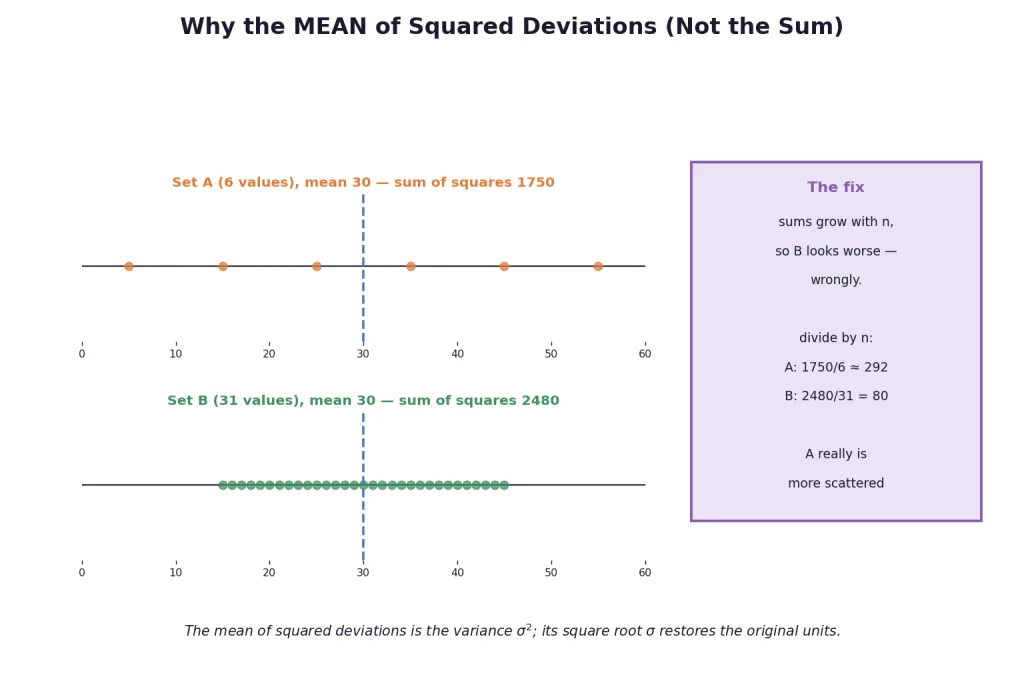
Sum of squared deviations: A gives 1750, B gives 2480 — the sum crowns B as more scattered, yet A's values visibly stray farther from 30. Sums grow just because grows. Divide by : A gives , B gives — now A correctly shows more scatter.
Key Point (Variance and standard deviation):
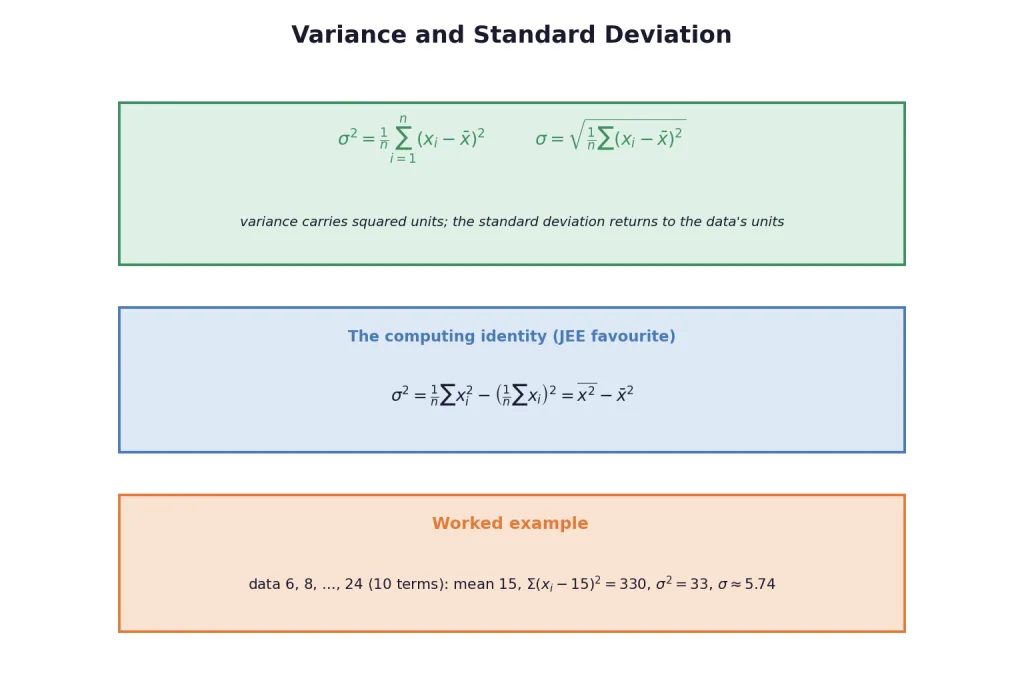
The variance carries squared units (cm² for heights in cm); taking the positive square root — the standard deviation — returns to the data's own units, which is why is the preferred measure of dispersion about the mean.
Computing Variance for Ungrouped Data
The direct method: for (ten terms), the mean is 15; the squared deviations sum to 330, so
The computing identity — expand and simplify:
"Mean of squares minus square of mean." It avoids subtracting the mean from every observation and powers most JEE problems (finding missing observations, correcting statistics).
Two standard results worth memorising:
For the first natural numbers: and — derived from and via the identity.
For the first ten multiples of 3 (): each value is 3 times a natural number, so the mean triples () and the variance picks up : — a first taste of the scaling law made precise in the JEE Corner.
Interpretation: small means the data hugs the mean; forces every observation to equal the mean; large means wide scatter.
[Board Tip] State variance and standard deviation as separate answers with units — variance in squared units, SD in original units. Writing when the question wanted is a silent full-mark loss.
Solved Examples
Example 1: The direct method
Find the variance of .
Solution:
Step 1 — Mean. .
Step 2 — Squared deviations. — symmetric about the centre, summing to 330.
Step 3 — Divide. ; .
Takeaway: Evenly spaced data gives mirror-image squared deviations — compute half the column and double it.
Example 2: Mean and variance together
Find the mean and variance of .
Solution:
Step 1 — Mean. .
Step 2 — Squared deviations. — sum 74.
Step 3 — Divide. .
Takeaway: Tabulate , , in three columns — the layout is half the accuracy.
Example 3: First natural numbers
Find the mean and variance of the first natural numbers.
Solution:
Step 1 — Mean from the power sum. .
Step 2 — Computing identity. .
Step 3 — Simplify. Factor : .
Takeaway: , — memorise the pair; JEE quotes them without derivation time.
Example 4: First ten multiples of 3
Find the mean and variance of .
Solution:
Step 1 — Recognise the scaling. The data is .
Step 2 — Scale the mean. Mean .
Step 3 — Scale the variance by . .
Takeaway: Multiplying data by multiplies the mean by and the variance by — the scaling law, met here for the first time.
Example 5: The computing identity in action
Using , recompute the variance of .
Solution:
Step 1 — The two sums. ; .
Step 2 — Apply. .
Step 3 — Conclude. ✓ — matching Example 2 without touching a single deviation.
Takeaway: "Mean of squares minus square of mean" needs only and — the identity JEE problems assume you use.
Example 6: When is the variance zero?
Show that forces all observations to be equal.
Solution:
Step 1 — Write the condition. — a sum of non-negative terms equal to zero.
Step 2 — Kill each term. Every , so for all .
Step 3 — Conclude. Zero variance means zero scatter: a constant data set. ∎
Takeaway: Non-negative terms summing to zero must each vanish — a proof pattern that recurs across inequalities and statistics.
Example 7: Comparing two data sets
Set P: . Set Q: . Compare means and standard deviations.
Solution:
Step 1 — Means. Both are 50 — the centres agree.
Step 2 — Set P's spread. Squared deviations : , .
Step 3 — Set Q's spread. : , — ten times P's.
Takeaway: Q is P stretched tenfold about the same centre — and its SD is exactly ten times larger, previewing the scaling law.
Example 8: Variance from sums alone
For 10 observations, and . Find .
Solution:
Step 1 — Mean. .
Step 2 — Identity. .
Step 3 — Root. .
Takeaway: Two sums fully determine mean and SD — no individual observations needed; this is the format JEE uses for "corrected statistics" problems.
Example 9: An unknown observation from the mean
The observations have mean 3. Verify and find the variance.
Solution:
Step 1 — Solve for . : .
Step 2 — Recognise the data. — the first five naturals.
Step 3 — Quote the standard result. .
Takeaway: Solve for unknowns from the mean FIRST — the completed data set often collapses onto a known formula.
Example 10: SD of a symmetric AP
Find the standard deviation of .
Solution:
Step 1 — Mean by symmetry. The terms balance about : .
Step 2 — Squared deviations. — sum .
Step 3 — Variance and SD. : .
Takeaway: The centre never appears in the answer — dispersion sees only spacing, not location. That is the shift-invariance law in miniature.