
The Perpendicular Distance Formula
The distance of a point from a line always means the perpendicular distance — the length of the shortest segment from the point to the line.
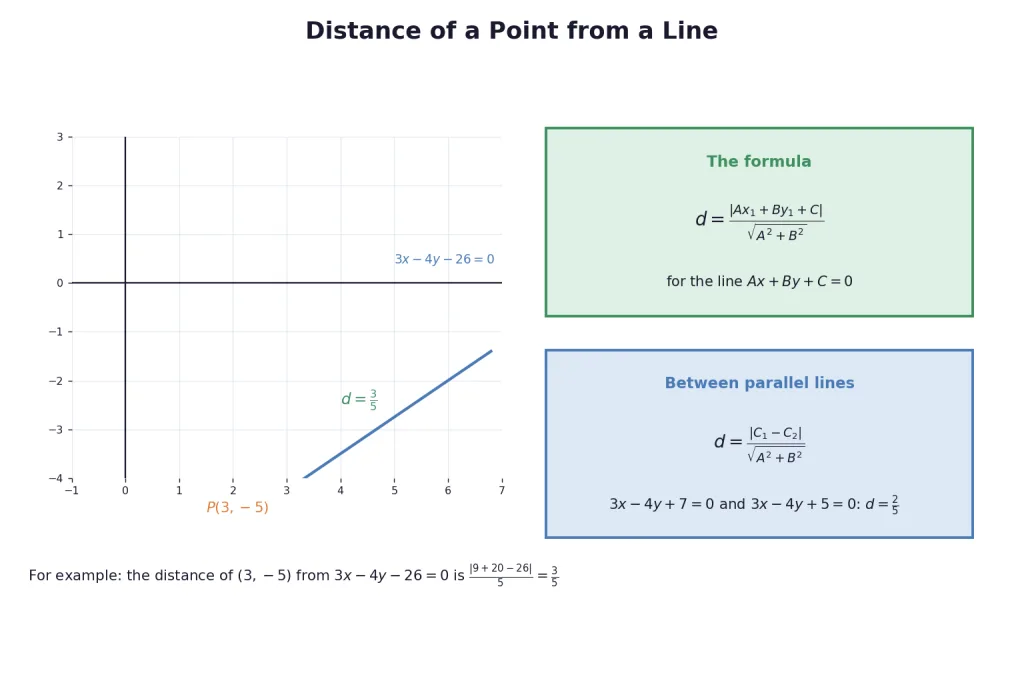
Key Point (Distance of a point from a line): The distance of from the line is
The derivation (triangle-area argument). Let the line meet the axes at and . The perpendicular from to the line is the height of triangle on base , so
Computing the area from the three coordinates gives , and . Dividing, everything except the formula cancels:
How to use it: put the line in general form first, substitute the point into the left side, take the absolute value, divide by .
For example: the distance of from :
Special case: the distance of the origin from is simply .
The absolute value is essential: is positive for points on one side of the line and negative on the other, but a distance must come out non-negative either way.
Distance Between Parallel Lines
Parallel lines can be written with the same and : and . Picking any point on one line and dropping a perpendicular to the other gives:
Key Point (Distance between parallel lines):
For example: the lines and are at distance
Warning: the formula needs matching coefficients. For and , first divide the second by 2 to get , and only then apply the formula: .
Two constructions used constantly:
A line parallel to through keeps the same :
A line perpendicular to through swaps the coefficients and one sign:
Both follow from slopes: the given line has slope , so a parallel line repeats it and a perpendicular line uses .
[Board Tip] In distance calculations, the single most common slip is forgetting to move the equation into general form first. must become before substituting the point — substituting into a non-standard form gives garbage that still looks like a number.
Solved Examples
Example 1: Reduce to slope-intercept form
Reduce to slope-intercept form and read off slope and -intercept: (i) (ii) (iii) .
Solution:
Step 1 — (i) Solve for . : slope , -intercept .
Step 2 — (ii) Solve for . : slope , -intercept .
Step 3 — (iii) Read directly. : slope 0, intercept 0 — the -axis itself.
Takeaway: "Reduce" just means solve for — the two numbers you need then sit in plain sight.
Example 2: Reduce to intercept form
Reduce to intercept form and find the intercepts: (i) (ii) (iii) .
Solution:
Step 1 — (i) Divide by 12. : intercepts 4 and 6.
Step 2 — (ii) Divide by 6. : intercepts and .
Step 3 — (iii) Recognise the special case. is parallel to the -axis — no -intercept, hence NO intercept form.
Takeaway: Divide by the constant to force a 1 on the right; horizontal and vertical lines refuse the form entirely.
Example 3: First distance computation
Find the distance of the point from the line .
Solution:
Step 1 — Substitute into the numerator. .
Step 2 — Compute the denominator. .
Step 3 — Divide. .
Takeaway: Numerator: plug the point in; denominator: root of the coefficient squares — nothing else.
Example 4: Put it in general form first
Find the distance of the point from the line .
Solution:
Step 1 — Convert to general form. , i.e. .
Step 2 — Substitute. .
Step 3 — Divide. .
Takeaway: ALWAYS move to before substituting — a non-standard form gives a wrong number that looks right.
Example 5: Points at a given distance
Find the points on the -axis whose distances from the line are 4 units.
Solution:
Step 1 — General form. Multiply by 12: .
Step 2 — Set up the distance equation. For : .
Step 3 — Solve both signs. : or .
Step 4 — Report both points. and — one on each side of the line.
Takeaway: Removing an absolute value always spawns two cases — geometrically, one point on each side.
Example 6: Parallel lines
Find the distance between (i) and , (ii) and , (iii) and .
Solution:
Step 1 — (i). Matching coefficients already: .
Step 2 — (ii). : .
Step 3 — (iii). Coefficients : .
Takeaway: The formula is one subtraction once the coefficient pairs match — check that first, every time.
Example 7: Parallel and perpendicular constructions
(i) Find the line parallel to through . (ii) Find the line perpendicular to with -intercept 3.
Solution:
Step 1 — (i) Keep the coefficients. , i.e. .
Step 2 — (ii) Perpendicular slope. Given slope → perpendicular slope , through .
Step 3 — (ii) Write it. , i.e. .
Takeaway: Parallel: same , adjust via the point. Perpendicular: swap coefficients, flip one sign.
Example 8: Angle and a right-angle condition
(i) Find the angles between and . (ii) The line through and meets at right angles: find .
Solution:
Step 1 — (i) Slopes. and .
Step 2 — (i) Angle formula. : , and the obtuse partner is .
Step 3 — (ii) Perpendicularity. : gives , so .
Takeaway: Report both the acute and obtuse angles unless the question specifies — they always pair to .
Example 9: The parallel-line identity
Prove that the line through parallel to is .
Solution:
Step 1 — Same slope. The proposed equation has coefficients , hence slope — parallel to the given line.
Step 2 — Passes through the point. Substituting : ✓.
Step 3 — Conclude. A line with the right slope through the right point — exactly the claim. ∎
Takeaway: This identity is the fastest parallel-line constructor — no slope computation, no rearrangement.
Example 10: Right bisector
Find the equation of the right bisector of the segment joining and .
Solution:
Step 1 — Midpoint. .
Step 2 — Perpendicular slope. Segment slope ; bisector slope .
Step 3 — Point-slope. , i.e. .
Takeaway: Right bisector = midpoint + negative-reciprocal slope — two ingredients, one line.
Example 11: Foot of the perpendicular
Find the foot of the perpendicular from to the line .
Solution:
Step 1 — Write the perpendicular line. Given slope → perpendicular slope through : , i.e. .
Step 2 — Intersect the two lines. Solve and : multiply and add to eliminate — , .
Step 3 — Conclude. The foot is .
Takeaway: Foot of perpendicular = intersection of the line with its perpendicular through the point.
Example 12: Perpendicular data
(i) The perpendicular from the origin to meets it at : find and . (ii) In with , , , find the equation and length of the altitude from .
Solution:
Step 1 — (i) Slope from the foot. Origin to : slope ; the line is perpendicular: .
Step 2 — (i) Find . on the line: , so .
Step 3 — (ii) Altitude's equation. has slope ; altitude slope 1 through : .
Step 4 — (ii) Altitude's length. Line : ; distance from : .
Takeaway: An altitude is a perpendicular construction plus a point-to-line distance — both from this section's toolkit.
Example 13: A clean distance identity
If is the distance of the origin from the line with intercepts and , show that .
Solution:
Step 1 — General form of the intercept line. becomes .
Step 2 — Distance from the origin. .
Step 3 — Square and invert. . ∎
Takeaway: Origin distances need only — the identity is one clean algebraic split.