
Concurrency and the Family of Lines
The chapter so far gives you the machinery; JEE tests four standard extensions of it. This section builds each one from what you already know.
1. Concurrency of three lines. Three lines () are concurrent when they pass through one common point. Two equivalent tests:
Key Point (Concurrency): Either solve two of the lines and substitute the point into the third, or use the determinant test:
The determinant condition is necessary; in exam practice (non-degenerate, non-parallel lines) it settles the question in one computation.
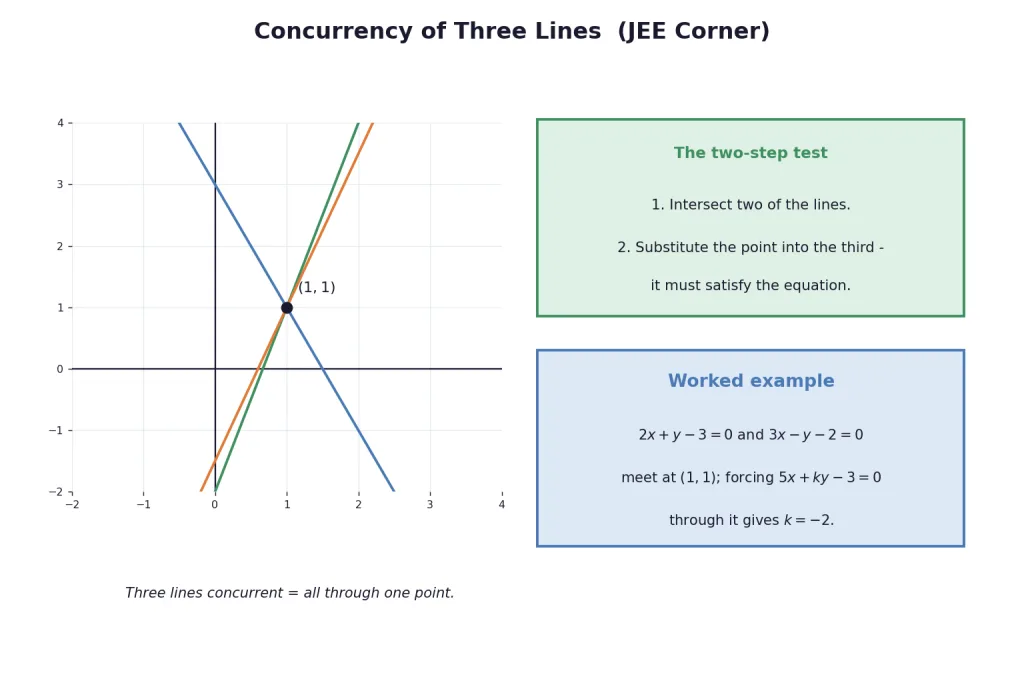
2. Family of lines through an intersection. For lines and , every equation
is a line through their intersection point (substituting makes both and vanish, hence the whole expression). Varying sweeps out all lines through except itself.
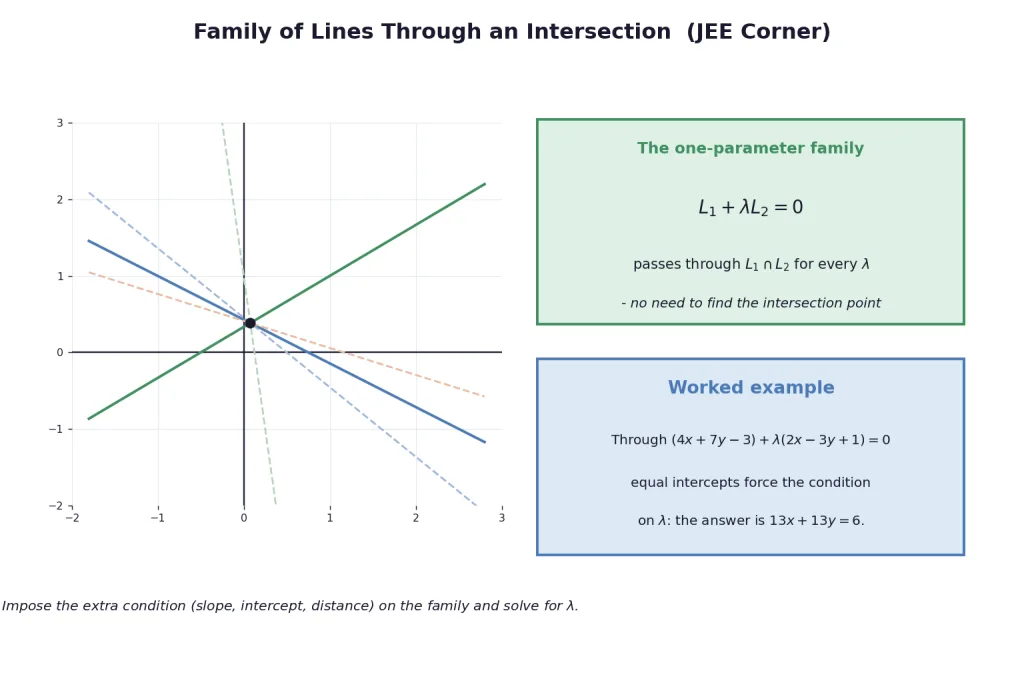
Why it saves time: you impose the extra condition (passes through a given point, parallel or perpendicular to a given line, given distance from a point) directly on and solve for — no need to compute the intersection point first.
Worked micro-example: the line through the intersection of and , perpendicular to : write and demand slope . That gives , so , and the line is — the same answer the junction-point route reaches with more work.
A useful extreme case: among all lines of the family through , the one farthest from a given point is the line through perpendicular to (any other member passes closer). The one closest would pass through itself if allowed.
Foot, Image, and Distance Along a Direction
3. Foot of the perpendicular and image in a line — the JEE formulas. For the line and point , set
Key Point (Foot and image): The foot of the perpendicular and the image of are
The direction is perpendicular to the line, and measures how far (in that normalized direction) sits from the line; going lands on the line, going lands the mirror image. This one formula replaces the two-equation setup (perpendicular slope + midpoint) — both give the same answer, but the formula is a 30-second computation.
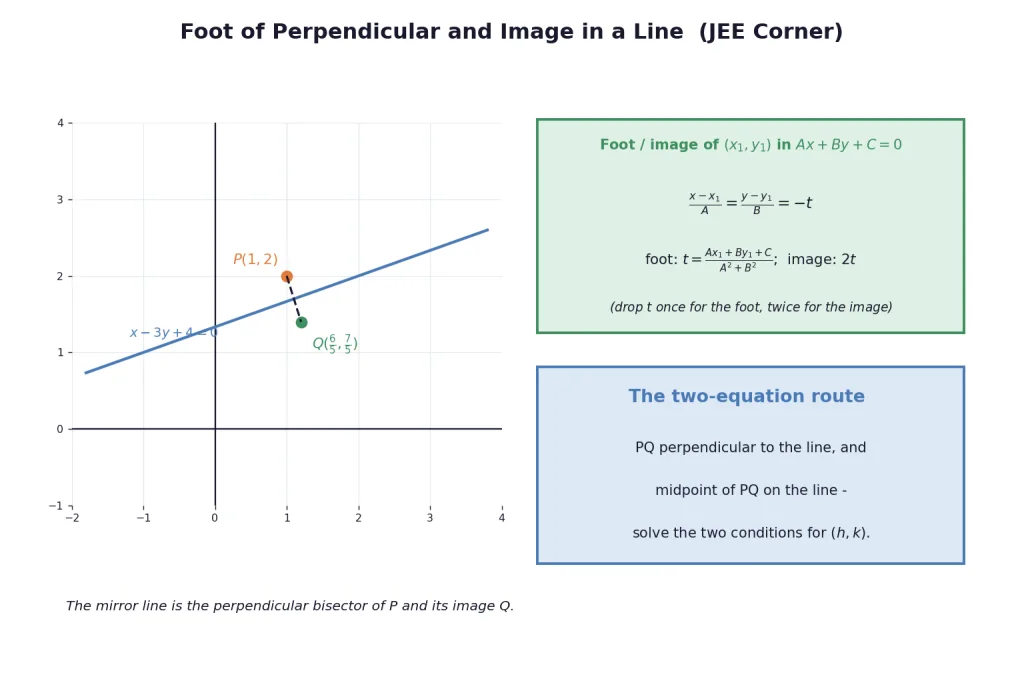
Check it: for and : , so the foot is — exactly the answer the two-equation route produced earlier.
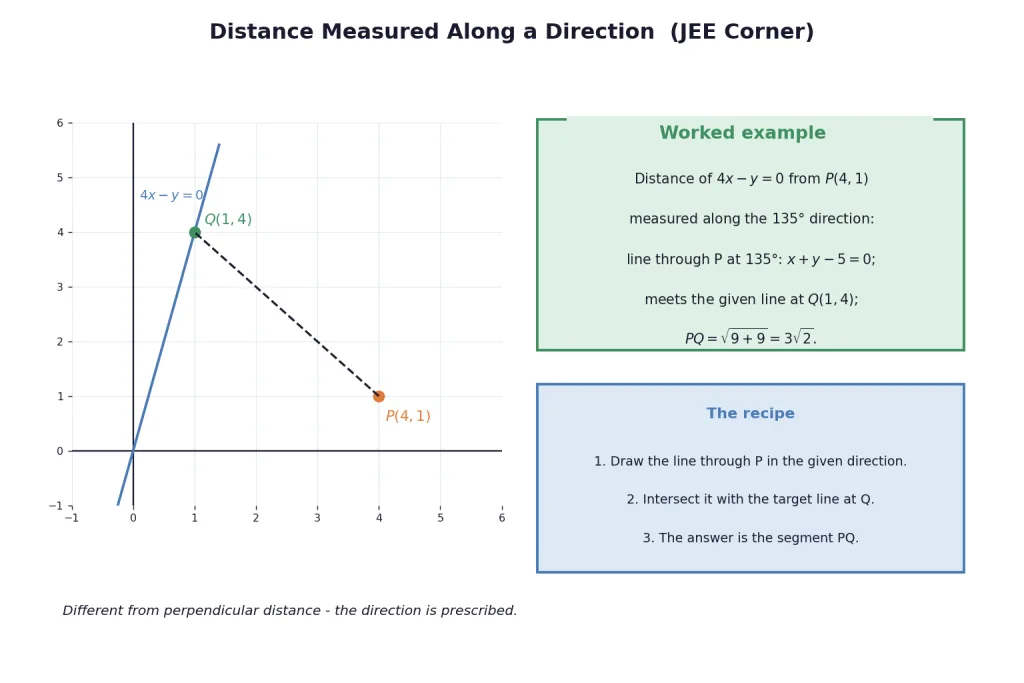
4. Distance measured along a direction (the parametric idea). A point at distance from along the direction making angle with the positive -axis is
To find how far you travel from along direction before hitting a line , substitute this point into and solve for . This is the clean way to handle every distance-along-a-direction problem, and it is the seed of the parametric form of a line used heavily in JEE conics.
5. Two more exam staples.
The area of the triangle formed by three lines: find the three vertices by solving the lines in pairs, then use . Special case worth memorising: , , give area .
Reflection problems: a ray from reflecting off a mirror line to reach travels as if it went straight from the image to — reflection questions are image questions in disguise.
[JEE Tip] In the foot/image formula, the most common exam error is dropping the denominator in or forgetting the factor 2 for the image. Anchor it with the origin check: the image of the origin in has , so — symmetric, as it must be.
JEE-Style Solved Examples
Example 1: Concurrency check
Show that the lines , and are concurrent, and find the common point.
Solution:
Step 1 — Intersect the first two. Double the first: ; subtract from the second: , so and then .
Step 2 — Test the third. ✓.
Step 3 — Conclude. All three pass through — concurrent. ∎
Takeaway: Line up the coefficients (double, subtract) — elimination beats formula-hunting for 2×2 systems.
Example 2: Family of lines through a given point
Find the line through the intersection of and that passes through the origin.
Solution:
Step 1 — Write the family. .
Step 2 — Impose the condition. At : , so .
Step 3 — Substitute back. gives , i.e. .
Takeaway: The family method never computes the intersection point — the condition finds directly.
Example 3: Farthest member of a family
Among all lines through the intersection of and , find the one at maximum distance from .
Solution:
Step 1 — Find . Adding the equations: , so .
Step 2 — Use the extreme-case fact. The farthest line through from is perpendicular to — any other member cuts closer to .
Step 3 — Build it. slope → line slope : , i.e. ; its distance from is .
Takeaway: Farthest = perpendicular to at ; the maximum distance is itself.
Example 4: Foot of the perpendicular by formula
Find the foot of the perpendicular from to the line .
Solution:
Step 1 — Compute . .
Step 2 — Apply the foot formula. .
Step 3 — Check. ✓ — the foot lies on the line.
Takeaway: One , two coordinates — and the on-the-line check is instant.
Example 5: Image by formula
Find the image of in the line .
Solution:
Step 1 — Compute . .
Step 2 — Apply the image formula (factor 2). .
Step 3 — Check the midpoint. : ✓.
Takeaway: Foot uses ; image uses — the factor 2 is the exam's favourite thing to steal.
Example 6: Distance along a direction
A line is drawn through making with the positive -axis. How far from does it meet ?
Solution:
Step 1 — Parametrise. A point at distance along the direction: .
Step 2 — Substitute into the line. gives .
Step 3 — Solve. .
Takeaway: The parametric point turns "how far along" into a linear equation in .
Example 7: Area of a triangle formed by three lines
Find the area of the triangle formed by , and .
Solution:
Step 1 — Vertices from pairwise intersections. meets at ; meets at ; meets at .
Step 2 — Shoelace formula. .
Step 3 — Evaluate. .
Takeaway: Three lines → three 2×2 solves → one shoelace. Keep the vertices exact; the moduli handle orientation.
Example 8: A family member parallel to an axis
For what is parallel to the -axis, and what is the line?
Solution:
Step 1 — Collect coefficients. .
Step 2 — Kill the -term. : .
Step 3 — Substitute back. , i.e. .
Takeaway: Structural conditions (parallel to an axis, given slope) act on the COEFFICIENTS of the family — no geometry needed.
Example 9: Reflection as an image problem
A ray of light leaves , strikes the mirror line and passes through . Verify the reflection point using the image principle, and state the principle.
Solution:
Step 1 — State the principle. The reflected path straightens into the segment , where is the image of in the mirror — so .
Step 2 — Compute. ; line has slope .
Step 3 — Intersect with . gives : — matching the direct computation.
Takeaway: Equal angles at the mirror = straight line through the image; every reflection question is an image question.
Example 10: Perpendicular distance as a minimum
Of all points on the line , find the one closest to the origin, and the minimum distance.
Solution:
Step 1 — The closest point is the foot. .
Step 2 — Foot formula. .
Step 3 — Minimum distance. — and confirms it.
Takeaway: "Closest point on a line" = foot of the perpendicular; the distance formula gives the value without the point.