Solved Examples — the Full Chapter Workout
Thirty-plus worked problems: slope and coordinate drills, every equation form, distances, images and reflections, and the full range of miscellaneous-level classics. Attempt each before reading the solution.
Example 1: Coordinate warm-ups
(i) The base of an equilateral triangle of side 2 a 2a 2 a y y y P ( x 1 , y 1 ) P(x_1, y_1) P ( x 1 , y 1 ) Q ( x 2 , y 2 ) Q(x_2, y_2) Q ( x 2 , y 2 ) P Q PQ P Q y y y x x x
Solution:
Step 1 — (i) Place the base. Ends at ( 0 , a ) (0, a) ( 0 , a ) ( 0 , − a ) (0, -a) ( 0 , − a )
Step 2 — (i) Locate the apex. It lies on the x x x ( 2 a ) 2 − a 2 = 3 a \sqrt{(2a)^2 - a^2} = \sqrt{3}a ( 2 a ) 2 − a 2 = 3 a ( ± 3 a , 0 ) \left(\pm\sqrt{3}a, 0\right) ( ± 3 a , 0 )
Step 3 — (ii) Axis-parallel distances. Parallel to the y y y x 1 = x 2 x_1 = x_2 x 1 = x 2 ∣ y 2 − y 1 ∣ |y_2 - y_1| ∣ y 2 − y 1 ∣ x x x ∣ x 2 − x 1 ∣ |x_2 - x_1| ∣ x 2 − x 1 ∣
Takeaway: Placing figures symmetrically about the origin turns geometry into single-coordinate arithmetic.
Example 2: The simplest equations
Write the equations of (i) the x x x y y y ( − 4 , 3 ) (-4, 3) ( − 4 , 3 ) 1 2 \frac{1}{2} 2 1 m m m
Solution:
Step 1 — (i). x x x y = 0 y = 0 y = 0 y y y x = 0 x = 0 x = 0
Step 2 — (ii). y − 3 = 1 2 ( x + 4 ) y - 3 = \frac{1}{2}(x + 4) y − 3 = 2 1 ( x + 4 ) x − 2 y + 10 = 0 x - 2y + 10 = 0 x − 2 y + 10 = 0
Step 3 — (iii). Point-slope at the origin: y = m x y = mx y = m x
Takeaway: Every one of these is point-slope form with progressively simpler anchors.
Example 3: Two-point form
Find the equation of the line through ( − 1 , 1 ) (-1, 1) ( − 1 , 1 ) ( 2 , − 4 ) (2, -4) ( 2 , − 4 )
Solution:
Step 1 — Slope. m = − 4 − 1 2 − ( − 1 ) = − 5 3 m = \frac{-4 - 1}{2 - (-1)} = -\frac{5}{3} m = 2 − ( − 1 ) − 4 − 1 = − 3 5
Step 2 — Point-slope. y − 1 = − 5 3 ( x + 1 ) y - 1 = -\frac{5}{3}(x + 1) y − 1 = − 3 5 ( x + 1 ) 3 y − 3 = − 5 x − 5 3y - 3 = -5x - 5 3 y − 3 = − 5 x − 5
Step 3 — General form. 5 x + 3 y + 2 = 0 5x + 3y + 2 = 0 5 x + 3 y + 2 = 0 ( 2 , − 4 ) (2, -4) ( 2 , − 4 ) 10 − 12 + 2 = 0 10 - 12 + 2 = 0 10 − 12 + 2 = 0
Takeaway: Clear fractions before rearranging — sign slips live in the × 3 \times 3 × 3
Example 4: A ratio condition
A line perpendicular to the segment joining ( 1 , 0 ) (1, 0) ( 1 , 0 ) ( 2 , 3 ) (2, 3) ( 2 , 3 ) 1 : n 1 : n 1 : n
Solution:
Step 1 — Section point. Dividing 1 : n 1 : n 1 : n ( 1 , 0 ) (1,0) ( 1 , 0 ) ( n + 2 n + 1 , 3 n + 1 ) \left(\frac{n + 2}{n + 1}, \frac{3}{n + 1}\right) ( n + 1 n + 2 , n + 1 3 )
Step 2 — Perpendicular slope. Segment slope 3 → line slope − 1 3 -\frac{1}{3} − 3 1
Step 3 — Point-slope and clear. y − 3 n + 1 = − 1 3 ( x − n + 2 n + 1 ) y - \frac{3}{n+1} = -\frac{1}{3}\left(x - \frac{n+2}{n+1}\right) y − n + 1 3 = − 3 1 ( x − n + 1 n + 2 ) ( 1 + n ) x + 3 ( 1 + n ) y = n + 11 (1 + n)x + 3(1 + n)y = n + 11 ( 1 + n ) x + 3 ( 1 + n ) y = n + 11
Takeaway: Keep the parameter n n n
Example 5: An angle of 2 π 3 \frac{2\pi}{3} 3 2 π
Find the line through ( 0 , 2 ) (0, 2) ( 0 , 2 ) 2 π 3 \frac{2\pi}{3} 3 2 π x x x y y y
Solution:
Step 1 — Slope from the angle. m = tan 2 π 3 = − 3 m = \tan\frac{2\pi}{3} = -\sqrt{3} m = tan 3 2 π = − 3
Step 2 — First line. Through ( 0 , 2 ) (0, 2) ( 0 , 2 ) y = − 3 x + 2 y = -\sqrt{3}x + 2 y = − 3 x + 2 3 x + y − 2 = 0 \sqrt{3}x + y - 2 = 0 3 x + y − 2 = 0
Step 3 — Parallel line. Through ( 0 , − 2 ) (0, -2) ( 0 , − 2 ) 3 x + y + 2 = 0 \sqrt{3}x + y + 2 = 0 3 x + y + 2 = 0
Takeaway: Parallel lines differ only in the constant — the slope work is done once.
Example 6: The copper rod model
The length L L L C C C L = 124.942 L = 124.942 L = 124.942 C = 20 C = 20 C = 20 L = 125.134 L = 125.134 L = 125.134 C = 110 C = 110 C = 110 L L L C C C
Solution:
Step 1 — Slope from the data. 125.134 − 124.942 110 − 20 = 0.192 90 \frac{125.134 - 124.942}{110 - 20} = \frac{0.192}{90} 110 − 20 125.134 − 124.942 = 90 0.192
Step 2 — Point-slope. L = 124.942 + 0.192 90 ( C − 20 ) L = 124.942 + \frac{0.192}{90}(C - 20) L = 124.942 + 90 0.192 ( C − 20 )
Takeaway: "Linear function of" = two-point form on the data pairs; leave the slope as an exact fraction.
Example 7: Lines at 60 ° 60° 60°
Two lines through ( 2 , 3 ) (2, 3) ( 2 , 3 ) 60 ° 60° 60°
Solution:
Step 1 — Angle equation. ∣ m − 2 1 + 2 m ∣ = tan 60 ° = 3 \left|\frac{m - 2}{1 + 2m}\right| = \tan 60° = \sqrt{3} 1 + 2 m m − 2 = tan 60° = 3
Step 2 — Solve both signs. m − 2 = ± 3 ( 1 + 2 m ) m - 2 = \pm\sqrt{3}(1 + 2m) m − 2 = ± 3 ( 1 + 2 m ) m = 5 3 − 8 11 m = \frac{5\sqrt{3} - 8}{11} m = 11 5 3 − 8 − - − m = − 8 + 5 3 11 m = -\frac{8 + 5\sqrt{3}}{11} m = − 11 8 + 5 3 + + +
Step 3 — Write the lines. y − 3 = 5 3 − 8 11 ( x − 2 ) y - 3 = \frac{5\sqrt{3} - 8}{11}(x - 2) y − 3 = 11 5 3 − 8 ( x − 2 ) y − 3 = − 8 + 5 3 11 ( x − 2 ) y - 3 = -\frac{8 + 5\sqrt{3}}{11}(x - 2) y − 3 = − 11 8 + 5 3 ( x − 2 )
Takeaway: Surd slopes are normal here — resist the urge to decimalise; the exact forms are the expected answers.
Example 8: A trigonometric distance identity
If p p p q q q x cos θ − y sin θ = k cos 2 θ x\cos\theta - y\sin\theta = k\cos 2\theta x cos θ − y sin θ = k cos 2 θ x sec θ + y c o s e c θ = k x\sec\theta + y\,\mathrm{cosec}\,\theta = k x sec θ + y cosec θ = k p 2 + 4 q 2 = k 2 p^2 + 4q^2 = k^2 p 2 + 4 q 2 = k 2
Solution:
Step 1 — Compute p p p Coefficient vector ( cos θ , − sin θ ) (\cos\theta, -\sin\theta) ( cos θ , − sin θ ) p = ∣ k cos 2 θ ∣ p = |k\cos 2\theta| p = ∣ k cos 2 θ ∣
Step 2 — Compute q q q sec 2 θ + c o s e c 2 θ = 1 ∣ sin θ cos θ ∣ \sqrt{\sec^2\theta + \mathrm{cosec}^2\theta} = \frac{1}{|\sin\theta\cos\theta|} sec 2 θ + cosec 2 θ = ∣ s i n θ c o s θ ∣ 1 q = ∣ k sin θ cos θ ∣ = ∣ k sin 2 θ ∣ 2 q = |k\sin\theta\cos\theta| = \frac{|k\sin 2\theta|}{2} q = ∣ k sin θ cos θ ∣ = 2 ∣ k s i n 2 θ ∣
Step 3 — Combine. p 2 + 4 q 2 = k 2 cos 2 2 θ + k 2 sin 2 2 θ = k 2 p^2 + 4q^2 = k^2\cos^2 2\theta + k^2\sin^2 2\theta = k^2 p 2 + 4 q 2 = k 2 cos 2 2 θ + k 2 sin 2 2 θ = k 2
Takeaway: Distances built from unit or normalisable coefficient vectors collapse via sin 2 + cos 2 = 1 \sin^2 + \cos^2 = 1 sin 2 + cos 2 = 1
Example 9: Concurrency
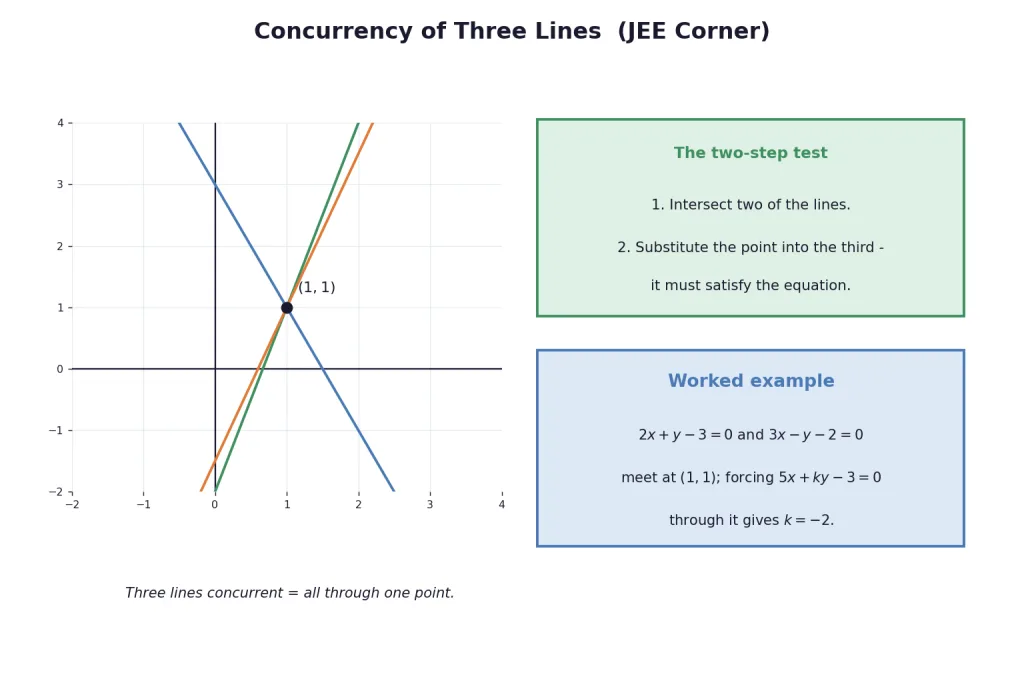
If 2 x + y − 3 = 0 2x + y - 3 = 0 2 x + y − 3 = 0 5 x + k y − 3 = 0 5x + ky - 3 = 0 5 x + k y − 3 = 0 3 x − y − 2 = 0 3x - y - 2 = 0 3 x − y − 2 = 0 k k k
Solution:
Step 1 — Intersect the two known lines. 2 x + y = 3 2x + y = 3 2 x + y = 3 3 x − y = 2 3x - y = 2 3 x − y = 2 5 x = 5 5x = 5 5 x = 5 ( 1 , 1 ) (1, 1) ( 1 , 1 )
Step 2 — Force the third line through it. 5 ( 1 ) + k ( 1 ) − 3 = 0 5(1) + k(1) - 3 = 0 5 ( 1 ) + k ( 1 ) − 3 = 0
Step 3 — Solve. k = − 2 k = -2 k = − 2
Takeaway: Concurrency = intersect two, substitute into the third — never solve all three simultaneously.
Example 10: Distance measured along a direction
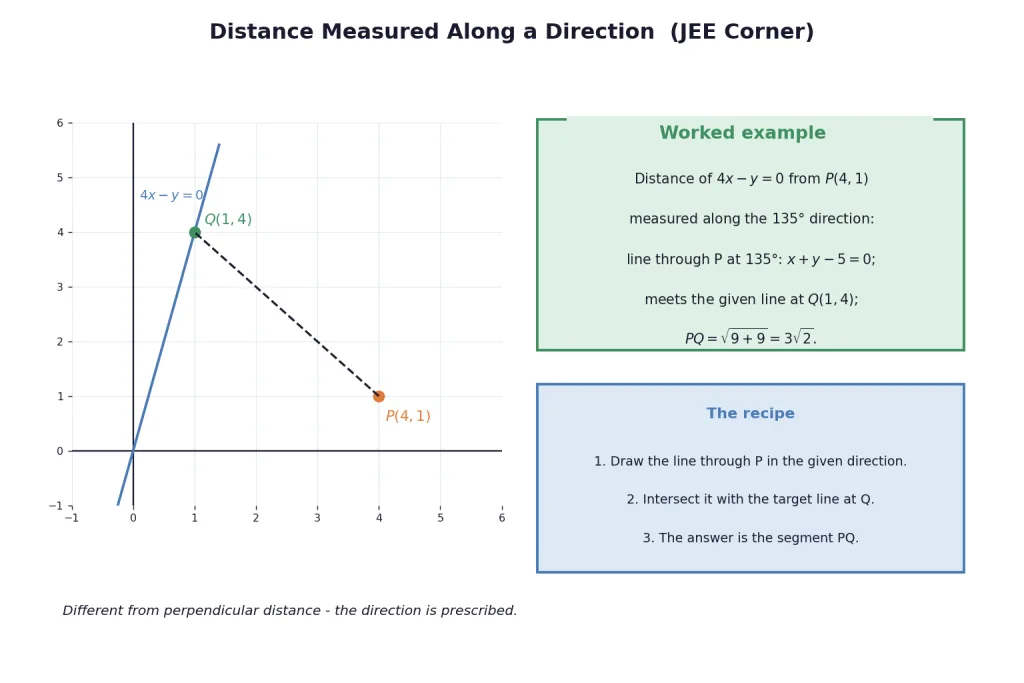
Find the distance of the line 4 x − y = 0 4x - y = 0 4 x − y = 0 P ( 4 , 1 ) P(4, 1) P ( 4 , 1 ) 135 ° 135° 135° x x x
Solution:
Step 1 — Draw the measuring line. Slope tan 135 ° = − 1 \tan 135° = -1 tan 135° = − 1 P P P y − 1 = − ( x − 4 ) y - 1 = -(x - 4) y − 1 = − ( x − 4 ) x + y − 5 = 0 x + y - 5 = 0 x + y − 5 = 0
Step 2 — Intersect with the target line. 4 x − y = 0 4x - y = 0 4 x − y = 0 x + y = 5 x + y = 5 x + y = 5 5 x = 5 5x = 5 5 x = 5 Q ( 1 , 4 ) Q(1, 4) Q ( 1 , 4 )
Step 3 — Measure the segment. P Q = ( 1 − 4 ) 2 + ( 4 − 1 ) 2 = 18 = 3 2 PQ = \sqrt{(1-4)^2 + (4-1)^2} = \sqrt{18} = 3\sqrt{2} P Q = ( 1 − 4 ) 2 + ( 4 − 1 ) 2 = 18 = 3 2
Takeaway: "Distance along a direction" is NOT the perpendicular distance — draw, intersect, measure.
Example 11: Image in a mirror line
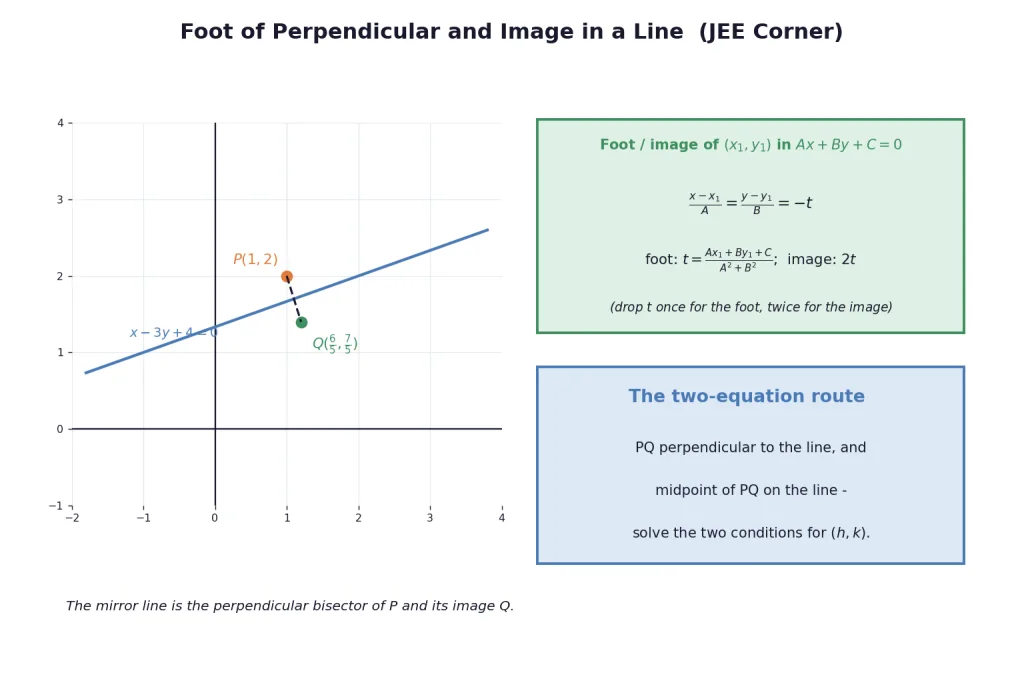
Find the image of ( 1 , 2 ) (1, 2) ( 1 , 2 ) x − 3 y + 4 = 0 x - 3y + 4 = 0 x − 3 y + 4 = 0
Solution:
Step 1 — Perpendicularity condition. P Q ⊥ PQ \perp P Q ⊥ 1 3 \frac{1}{3} 3 1 k − 2 h − 1 = − 3 \frac{k - 2}{h - 1} = -3 h − 1 k − 2 = − 3 3 h + k = 5 3h + k = 5 3 h + k = 5
Step 2 — Midpoint condition. ( h + 1 2 , k + 2 2 ) \left(\frac{h+1}{2}, \frac{k+2}{2}\right) ( 2 h + 1 , 2 k + 2 ) h + 1 2 − 3 ( k + 2 ) 2 + 4 = 0 \frac{h+1}{2} - \frac{3(k+2)}{2} + 4 = 0 2 h + 1 − 2 3 ( k + 2 ) + 4 = 0 h − 3 k = − 3 h - 3k = -3 h − 3 k = − 3
Step 3 — Solve the pair. h = 6 5 h = \frac{6}{5} h = 5 6 k = 7 5 k = \frac{7}{5} k = 5 7 ( 6 5 , 7 5 ) \left(\frac{6}{5}, \frac{7}{5}\right) ( 5 6 , 5 7 )
Takeaway: The mirror line is the perpendicular bisector of point and image — two conditions, two unknowns, always.
Example 12: Area of a triangle from three lines
Show that the triangle formed by y = m 1 x + c 1 y = m_1x + c_1 y = m 1 x + c 1 y = m 2 x + c 2 y = m_2x + c_2 y = m 2 x + c 2 x = 0 x = 0 x = 0 ( c 1 − c 2 ) 2 2 ∣ m 1 − m 2 ∣ \frac{(c_1 - c_2)^2}{2|m_1 - m_2|} 2∣ m 1 − m 2 ∣ ( c 1 − c 2 ) 2
Solution:
Step 1 — Find the vertices. On x = 0 x = 0 x = 0 P ( 0 , c 1 ) P(0, c_1) P ( 0 , c 1 ) Q ( 0 , c 2 ) Q(0, c_2) Q ( 0 , c 2 ) R R R x R = c 2 − c 1 m 1 − m 2 x_R = \frac{c_2 - c_1}{m_1 - m_2} x R = m 1 − m 2 c 2 − c 1
Step 2 — Base and height. Base P Q = ∣ c 1 − c 2 ∣ PQ = |c_1 - c_2| P Q = ∣ c 1 − c 2 ∣ y y y = ∣ x R ∣ = ∣ c 1 − c 2 ∣ ∣ m 1 − m 2 ∣ = |x_R| = \frac{|c_1 - c_2|}{|m_1 - m_2|} = ∣ x R ∣ = ∣ m 1 − m 2 ∣ ∣ c 1 − c 2 ∣
Step 3 — Area. 1 2 ∣ c 1 − c 2 ∣ ⋅ ∣ c 1 − c 2 ∣ ∣ m 1 − m 2 ∣ = ( c 1 − c 2 ) 2 2 ∣ m 1 − m 2 ∣ \frac{1}{2}|c_1 - c_2| \cdot \frac{|c_1 - c_2|}{|m_1 - m_2|} = \frac{(c_1 - c_2)^2}{2|m_1 - m_2|} 2 1 ∣ c 1 − c 2 ∣ ⋅ ∣ m 1 − m 2 ∣ ∣ c 1 − c 2 ∣ = 2∣ m 1 − m 2 ∣ ( c 1 − c 2 ) 2
Takeaway: With one side on an axis, base-times-height beats the determinant formula.
Example 13: A bisected segment
A line's segment between 5 x − y + 4 = 0 5x - y + 4 = 0 5 x − y + 4 = 0 3 x + 4 y − 4 = 0 3x + 4y - 4 = 0 3 x + 4 y − 4 = 0 ( 1 , 5 ) (1, 5) ( 1 , 5 )
Solution:
Step 1 — Parametrise the endpoints. On the lines: ( α 1 , 5 α 1 + 4 ) (\alpha_1, 5\alpha_1 + 4) ( α 1 , 5 α 1 + 4 ) ( α 2 , 4 − 3 α 2 4 ) \left(\alpha_2, \frac{4 - 3\alpha_2}{4}\right) ( α 2 , 4 4 − 3 α 2 )
Step 2 — Midpoint equations. α 1 + α 2 = 2 \alpha_1 + \alpha_2 = 2 α 1 + α 2 = 2 5 α 1 + 4 1 + 4 − 3 α 2 4 = 10 \frac{5\alpha_1 + 4}{1} + \frac{4 - 3\alpha_2}{4} = 10 1 5 α 1 + 4 + 4 4 − 3 α 2 = 10 20 α 1 − 3 α 2 = 20 20\alpha_1 - 3\alpha_2 = 20 20 α 1 − 3 α 2 = 20
Step 3 — Solve. α 1 = 26 23 \alpha_1 = \frac{26}{23} α 1 = 23 26 ( 26 23 , 222 23 ) \left(\frac{26}{23}, \frac{222}{23}\right) ( 23 26 , 23 222 )
Step 4 — Line through the midpoint and endpoint. Slope = 222 / 23 − 5 26 / 23 − 1 = 107 3 = \frac{222/23 - 5}{26/23 - 1} = \frac{107}{3} = 26/23 − 1 222/23 − 5 = 3 107 y − 5 = 107 3 ( x − 1 ) y - 5 = \frac{107}{3}(x - 1) y − 5 = 3 107 ( x − 1 ) 107 x − 3 y − 92 = 0 107x - 3y - 92 = 0 107 x − 3 y − 92 = 0
Takeaway: Put unknown endpoints ON their lines (one parameter each) and let the midpoint supply the equations.
Example 14: An equidistance locus
Show that the path of a point whose distances from 3 x − 2 y = 5 3x - 2y = 5 3 x − 2 y = 5 3 x + 2 y = 5 3x + 2y = 5 3 x + 2 y = 5
Solution:
Step 1 — Equate the distances. Both denominators are 13 \sqrt{13} 13 ∣ 3 h − 2 k − 5 ∣ = ∣ 3 h + 2 k − 5 ∣ |3h - 2k - 5| = |3h + 2k - 5| ∣3 h − 2 k − 5∣ = ∣3 h + 2 k − 5∣
Step 2 — Open the moduli. Same-sign case: 3 h − 2 k − 5 = 3 h + 2 k − 5 3h - 2k - 5 = 3h + 2k - 5 3 h − 2 k − 5 = 3 h + 2 k − 5 k = 0 k = 0 k = 0 3 h − 2 k − 5 = − ( 3 h + 2 k − 5 ) 3h - 2k - 5 = -(3h + 2k - 5) 3 h − 2 k − 5 = − ( 3 h + 2 k − 5 ) 6 h = 10 6h = 10 6 h = 10 h = 5 3 h = \frac{5}{3} h = 3 5
Step 3 — Conclude. The locus is y = 0 y = 0 y = 0 x = 5 3 x = \frac{5}{3} x = 3 5
Takeaway: Equidistance from two lines always yields the pair of angle bisectors — expect two answers.
Example 15: Reading a parametrised line
For which k k k ( k − 3 ) x − ( 4 − k 2 ) y + k 2 − 7 k + 6 = 0 (k - 3)x - (4 - k^2)y + k^2 - 7k + 6 = 0 ( k − 3 ) x − ( 4 − k 2 ) y + k 2 − 7 k + 6 = 0 x x x y y y
Solution:
Step 1 — (a) No x x x Parallel to the x x x x x x k − 3 = 0 k - 3 = 0 k − 3 = 0 k = 3 k = 3 k = 3
Step 2 — (b) No y y y 4 − k 2 = 0 4 - k^2 = 0 4 − k 2 = 0 k = ± 2 k = \pm 2 k = ± 2
Step 3 — (c) Zero constant. k 2 − 7 k + 6 = ( k − 1 ) ( k − 6 ) = 0 k^2 - 7k + 6 = (k-1)(k-6) = 0 k 2 − 7 k + 6 = ( k − 1 ) ( k − 6 ) = 0 k = 1 k = 1 k = 1 6 6 6
Takeaway: Each geometric condition switches off exactly one coefficient — read the equation structurally.
Example 16: Intercepts from sum and product
Find the lines whose intercepts on the axes have sum 1 and product − 6 -6 − 6
Solution:
Step 1 — Build the quadratic. a + b = 1 a + b = 1 a + b = 1 a b = − 6 ab = -6 ab = − 6 t 2 − t − 6 = 0 t^2 - t - 6 = 0 t 2 − t − 6 = 0
Step 2 — Solve. ( t − 3 ) ( t + 2 ) = 0 (t - 3)(t + 2) = 0 ( t − 3 ) ( t + 2 ) = 0 { a , b } = { 3 , − 2 } \{a, b\} = \{3, -2\} { a , b } = { 3 , − 2 }
Step 3 — Write both lines. x 3 + y − 2 = 1 ⇒ 2 x − 3 y − 6 = 0 \frac{x}{3} + \frac{y}{-2} = 1 \Rightarrow 2x - 3y - 6 = 0 3 x + − 2 y = 1 ⇒ 2 x − 3 y − 6 = 0 x − 2 + y 3 = 1 ⇒ 3 x − 2 y + 6 = 0 \frac{x}{-2} + \frac{y}{3} = 1 \Rightarrow 3x - 2y + 6 = 0 − 2 x + 3 y = 1 ⇒ 3 x − 2 y + 6 = 0
Takeaway: Sum-and-product data is a quadratic in disguise — and the two orderings give two lines.
Example 17: Points on the y y y
What are the points on the y y y x 3 + y 4 = 1 \frac{x}{3} + \frac{y}{4} = 1 3 x + 4 y = 1
Solution:
Step 1 — General form. 4 x + 3 y − 12 = 0 4x + 3y - 12 = 0 4 x + 3 y − 12 = 0
Step 2 — Distance equation for ( 0 , b ) (0, b) ( 0 , b ) ∣ 3 b − 12 ∣ 5 = 4 \frac{|3b - 12|}{5} = 4 5 ∣3 b − 12∣ = 4
Step 3 — Solve both signs. 3 b − 12 = ± 20 3b - 12 = \pm 20 3 b − 12 = ± 20 b = 32 3 b = \frac{32}{3} b = 3 32 − 8 3 -\frac{8}{3} − 3 8 ( 0 , 32 3 ) \left(0, \frac{32}{3}\right) ( 0 , 3 32 ) ( 0 , − 8 3 ) \left(0, -\frac{8}{3}\right) ( 0 , − 3 8 )
Takeaway: Same template as the x x x
Example 18: A trigonometric chord
Find the perpendicular distance from the origin to the line joining ( cos θ , sin θ ) (\cos\theta, \sin\theta) ( cos θ , sin θ ) ( cos φ , sin φ ) (\cos\varphi, \sin\varphi) ( cos φ , sin φ )
Solution:
Step 1 — Equation of the chord. Two-point form plus sum-to-product identities give
x cos θ + φ 2 + y sin θ + φ 2 = cos θ − φ 2 x\cos\frac{\theta + \varphi}{2} + y\sin\frac{\theta + \varphi}{2} = \cos\frac{\theta - \varphi}{2} x cos 2 θ + φ + y sin 2 θ + φ = cos 2 θ − φ
Step 2 — Distance from the origin. The coefficient vector has length 1 1 1 d = ∣ cos θ − φ 2 ∣ d = \left|\cos\frac{\theta - \varphi}{2}\right| d = cos 2 θ − φ
Takeaway: Both points sit on the unit circle — the chord's normalised equation hands over the distance for free.
Example 19: A vertical line through an intersection
Find the line parallel to the y y y x − 7 y + 5 = 0 x - 7y + 5 = 0 x − 7 y + 5 = 0 3 x + y = 0 3x + y = 0 3 x + y = 0
Solution:
Step 1 — Intersect. Substitute y = − 3 x y = -3x y = − 3 x x + 21 x + 5 = 0 x + 21x + 5 = 0 x + 21 x + 5 = 0 x = − 5 22 x = -\frac{5}{22} x = − 22 5
Step 2 — Write the vertical line. Parallel to the y y y x = − 5 22 x = -\frac{5}{22} x = − 22 5
Takeaway: A vertical line needs only the x x x y y y
Example 20: Perpendicular at the y y y
Find the line perpendicular to x 4 + y 6 = 1 \frac{x}{4} + \frac{y}{6} = 1 4 x + 6 y = 1 y y y
Solution:
Step 1 — General form and slope. 3 x + 2 y − 12 = 0 3x + 2y - 12 = 0 3 x + 2 y − 12 = 0 − 3 2 -\frac{3}{2} − 2 3 y y y ( 0 , 6 ) (0, 6) ( 0 , 6 )
Step 2 — Perpendicular slope. 2 3 \frac{2}{3} 3 2
Step 3 — Write the line. y = 2 3 x + 6 y = \frac{2}{3}x + 6 y = 3 2 x + 6 2 x − 3 y + 18 = 0 2x - 3y + 18 = 0 2 x − 3 y + 18 = 0
Takeaway: "Where it meets the y y y x = 0 x = 0 x = 0
Example 21: A triangle's area and a concurrency value
(i) Find the area of the triangle formed by y − x = 0 y - x = 0 y − x = 0 x + y = 0 x + y = 0 x + y = 0 x − k = 0 x - k = 0 x − k = 0 p p p 3 x + y − 2 = 0 3x + y - 2 = 0 3 x + y − 2 = 0 p x + 2 y − 3 = 0 px + 2y - 3 = 0 p x + 2 y − 3 = 0 2 x − y − 3 = 0 2x - y - 3 = 0 2 x − y − 3 = 0
Solution:
Step 1 — (i) Vertices. Pairwise intersections: ( 0 , 0 ) (0, 0) ( 0 , 0 ) ( k , k ) (k, k) ( k , k ) ( k , − k ) (k, -k) ( k , − k )
Step 2 — (i) Area. Vertical base of length 2 ∣ k ∣ 2|k| 2∣ k ∣ x = k x = k x = k ∣ k ∣ |k| ∣ k ∣ = 1 2 ⋅ 2 ∣ k ∣ ⋅ ∣ k ∣ = k 2 = \frac{1}{2} \cdot 2|k| \cdot |k| = k^2 = 2 1 ⋅ 2∣ k ∣ ⋅ ∣ k ∣ = k 2
Step 3 — (ii) Concurrency. First and third lines: adding 3 x + y = 2 3x + y = 2 3 x + y = 2 2 x − y = 3 2x - y = 3 2 x − y = 3 5 x = 5 5x = 5 5 x = 5 ( 1 , − 1 ) (1, -1) ( 1 , − 1 ) p ( 1 ) + 2 ( − 1 ) − 3 = 0 p(1) + 2(-1) - 3 = 0 p ( 1 ) + 2 ( − 1 ) − 3 = 0 p = 5 p = 5 p = 5
Takeaway: Two independent mini-problems, one method each — vertices then base-height; intersect then substitute.
Example 22: The concurrency identity
If y = m 1 x + c 1 y = m_1x + c_1 y = m 1 x + c 1 y = m 2 x + c 2 y = m_2x + c_2 y = m 2 x + c 2 y = m 3 x + c 3 y = m_3x + c_3 y = m 3 x + c 3 m 1 ( c 2 − c 3 ) + m 2 ( c 3 − c 1 ) + m 3 ( c 1 − c 2 ) = 0 m_1(c_2 - c_3) + m_2(c_3 - c_1) + m_3(c_1 - c_2) = 0 m 1 ( c 2 − c 3 ) + m 2 ( c 3 − c 1 ) + m 3 ( c 1 − c 2 ) = 0
Solution:
Step 1 — Intersect the first two. x = c 2 − c 1 m 1 − m 2 x = \frac{c_2 - c_1}{m_1 - m_2} x = m 1 − m 2 c 2 − c 1 y = m 1 c 2 − m 2 c 1 m 1 − m 2 y = \frac{m_1c_2 - m_2c_1}{m_1 - m_2} y = m 1 − m 2 m 1 c 2 − m 2 c 1
Step 2 — Substitute into the third. m 1 c 2 − m 2 c 1 m 1 − m 2 = m 3 ⋅ c 2 − c 1 m 1 − m 2 + c 3 \frac{m_1c_2 - m_2c_1}{m_1 - m_2} = m_3 \cdot \frac{c_2 - c_1}{m_1 - m_2} + c_3 m 1 − m 2 m 1 c 2 − m 2 c 1 = m 3 ⋅ m 1 − m 2 c 2 − c 1 + c 3
Step 3 — Clear and rearrange. m 1 c 2 − m 2 c 1 = m 3 ( c 2 − c 1 ) + c 3 ( m 1 − m 2 ) m_1c_2 - m_2c_1 = m_3(c_2 - c_1) + c_3(m_1 - m_2) m 1 c 2 − m 2 c 1 = m 3 ( c 2 − c 1 ) + c 3 ( m 1 − m 2 ) m 1 ( c 2 − c 3 ) + m 2 ( c 3 − c 1 ) + m 3 ( c 1 − c 2 ) = 0 m_1(c_2 - c_3) + m_2(c_3 - c_1) + m_3(c_1 - c_2) = 0 m 1 ( c 2 − c 3 ) + m 2 ( c 3 − c 1 ) + m 3 ( c 1 − c 2 ) = 0
Takeaway: The identity is cyclic in the indices — a structure check on your final rearrangement.
Example 23: Lines at 45 ° 45° 45°
Find the lines through ( 3 , 2 ) (3, 2) ( 3 , 2 ) 45 ° 45° 45° x − 2 y = 3 x - 2y = 3 x − 2 y = 3
Solution:
Step 1 — Angle equation. Given slope 1 2 \frac{1}{2} 2 1 ∣ m − 1 2 1 + m 2 ∣ = 1 \left|\frac{m - \frac{1}{2}}{1 + \frac{m}{2}}\right| = 1 1 + 2 m m − 2 1 = 1
Step 2 — Solve both signs. m = 3 m = 3 m = 3 m = − 1 3 m = -\frac{1}{3} m = − 3 1
Step 3 — Write the lines through ( 3 , 2 ) (3, 2) ( 3 , 2 ) y − 2 = 3 ( x − 3 ) ⇒ 3 x − y − 7 = 0 y - 2 = 3(x - 3) \Rightarrow 3x - y - 7 = 0 y − 2 = 3 ( x − 3 ) ⇒ 3 x − y − 7 = 0 y − 2 = − 1 3 ( x − 3 ) ⇒ x + 3 y − 9 = 0 y - 2 = -\frac{1}{3}(x - 3) \Rightarrow x + 3y - 9 = 0 y − 2 = − 3 1 ( x − 3 ) ⇒ x + 3 y − 9 = 0
Takeaway: The two answers are perpendicular to each other (3 × − 1 3 = − 1 3 \times -\frac{1}{3} = -1 3 × − 3 1 = − 1 45 ° 45° 45°
Example 24: Equal intercepts through an intersection
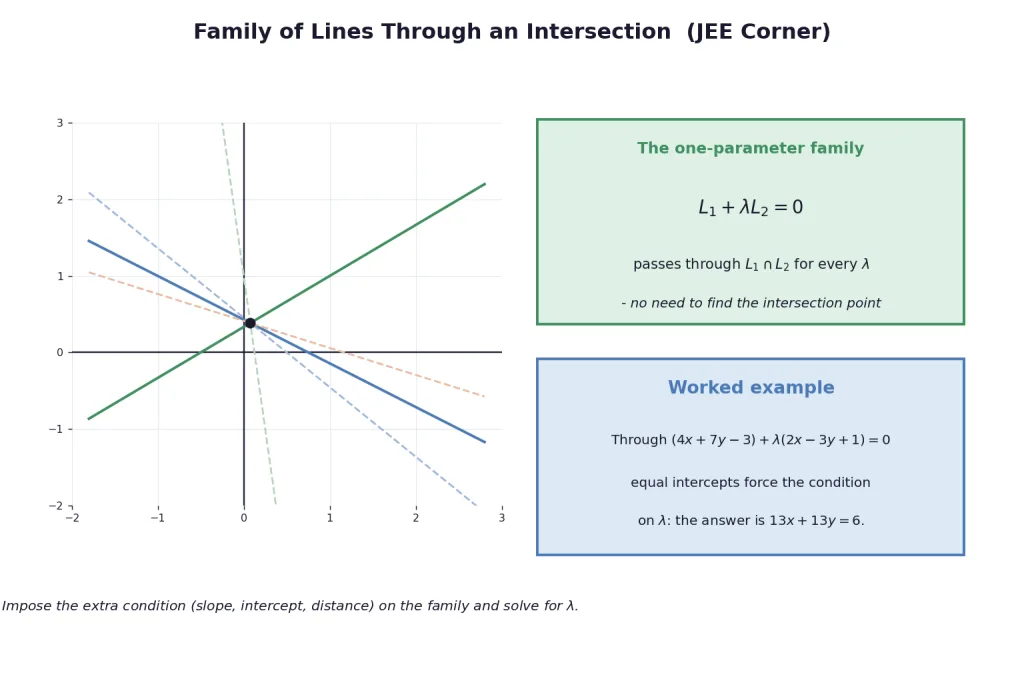
Find the line through the intersection of 4 x + 7 y − 3 = 0 4x + 7y - 3 = 0 4 x + 7 y − 3 = 0 2 x − 3 y + 1 = 0 2x - 3y + 1 = 0 2 x − 3 y + 1 = 0
Solution:
Step 1 — Find the intersection. From 4 x + 7 y = 3 4x + 7y = 3 4 x + 7 y = 3 2 x − 3 y = − 1 2x - 3y = -1 2 x − 3 y = − 1 13 y = 5 13y = 5 13 y = 5 y = 5 13 y = \frac{5}{13} y = 13 5 x = 1 13 x = \frac{1}{13} x = 13 1
Step 2 — Equal-intercept form. x + y = a x + y = a x + y = a ( 1 13 , 5 13 ) \left(\frac{1}{13}, \frac{5}{13}\right) ( 13 1 , 13 5 ) a = 6 13 a = \frac{6}{13} a = 13 6
Step 3 — Write the line. x + y = 6 13 x + y = \frac{6}{13} x + y = 13 6 13 x + 13 y = 6 13x + 13y = 6 13 x + 13 y = 6
Takeaway: The family trick L 1 + λ L 2 = 0 L_1 + \lambda L_2 = 0 L 1 + λ L 2 = 0 λ \lambda λ 13 x + 13 y = 6 13x + 13y = 6 13 x + 13 y = 6
Example 25: A section ratio
In what ratio does the line x + y = 4 x + y = 4 x + y = 4 ( − 1 , 1 ) (-1, 1) ( − 1 , 1 ) ( 5 , 7 ) (5, 7) ( 5 , 7 )
Solution:
Step 1 — Parametrise the section point. Ratio k : 1 k : 1 k : 1 ( 5 k − 1 k + 1 , 7 k + 1 k + 1 ) \left(\frac{5k - 1}{k + 1}, \frac{7k + 1}{k + 1}\right) ( k + 1 5 k − 1 , k + 1 7 k + 1 )
Step 2 — Put it on the line. 5 k − 1 + 7 k + 1 k + 1 = 4 \frac{5k - 1 + 7k + 1}{k + 1} = 4 k + 1 5 k − 1 + 7 k + 1 = 4 12 k k + 1 = 4 \frac{12k}{k+1} = 4 k + 1 12 k = 4
Step 3 — Solve. 12 k = 4 k + 4 12k = 4k + 4 12 k = 4 k + 4 k = 1 2 k = \frac{1}{2} k = 2 1 1 : 2 1 : 2 1 : 2
Takeaway: Let the ratio be k : 1 k : 1 k : 1 k k k
Example 26: Distance along 2 x − y = 0 2x - y = 0 2 x − y = 0
Find the distance of the line 4 x + 7 y + 5 = 0 4x + 7y + 5 = 0 4 x + 7 y + 5 = 0 ( 1 , 2 ) (1, 2) ( 1 , 2 ) 2 x − y = 0 2x - y = 0 2 x − y = 0
Solution:
Step 1 — Check the direction line. ( 1 , 2 ) (1, 2) ( 1 , 2 ) 2 x − y = 0 2x - y = 0 2 x − y = 0 2 x − y = 0 2x - y = 0 2 x − y = 0
Step 2 — Intersect with the target. Substitute y = 2 x y = 2x y = 2 x 4 x + 14 x + 5 = 0 4x + 14x + 5 = 0 4 x + 14 x + 5 = 0 x = − 5 18 x = -\frac{5}{18} x = − 18 5 y = − 5 9 y = -\frac{5}{9} y = − 9 5
Step 3 — Measure. d = ( 1 + 5 18 ) 2 + ( 2 + 5 9 ) 2 = 23 18 1 + 4 = 23 5 18 d = \sqrt{\left(1 + \frac{5}{18}\right)^2 + \left(2 + \frac{5}{9}\right)^2} = \frac{23}{18}\sqrt{1 + 4} = \frac{23\sqrt{5}}{18} d = ( 1 + 18 5 ) 2 + ( 2 + 9 5 ) 2 = 18 23 1 + 4 = 18 23 5
Takeaway: Factor the common 23 18 \frac{23}{18} 18 23
Example 27: Direction and axis-parallel legs
(i) In what direction should a line through ( − 1 , 2 ) (-1, 2) ( − 1 , 2 ) x + y = 4 x + y = 4 x + y = 4 ( − 1 , 2 ) (-1, 2) ( − 1 , 2 ) ( 1 , 3 ) (1, 3) ( 1 , 3 ) ( − 4 , 1 ) (-4, 1) ( − 4 , 1 )
Solution:
Step 1 — (i) Parametrise by direction. A point at distance 3 in direction θ \theta θ ( − 1 + 3 cos θ , 2 + 3 sin θ ) (-1 + 3\cos\theta,\ 2 + 3\sin\theta) ( − 1 + 3 cos θ , 2 + 3 sin θ )
Step 2 — (i) Put it on the line. ( − 1 + 3 cos θ ) + ( 2 + 3 sin θ ) = 4 (-1 + 3\cos\theta) + (2 + 3\sin\theta) = 4 ( − 1 + 3 cos θ ) + ( 2 + 3 sin θ ) = 4 cos θ + sin θ = 1 \cos\theta + \sin\theta = 1 cos θ + sin θ = 1
Step 3 — (i) Solve. 2 sin ( θ + 45 ° ) = 1 \sqrt{2}\sin\left(\theta + 45°\right) = 1 2 sin ( θ + 45° ) = 1 θ = 0 ° \theta = 0° θ = 0° 90 ° 90° 90°
Step 4 — (ii) Two possible corner vertices. Right angle at ( 1 , 1 ) (1, 1) ( 1 , 1 ) x = 1 x = 1 x = 1 y = 1 y = 1 y = 1 ( − 4 , 3 ) (-4, 3) ( − 4 , 3 ) x = − 4 x = -4 x = − 4 y = 3 y = 3 y = 3
Takeaway: The polar parametrisation ( x 0 + r cos θ , y 0 + r sin θ ) (x_0 + r\cos\theta, y_0 + r\sin\theta) ( x 0 + r cos θ , y 0 + r sin θ ) r r r
Example 28: Image in x + 3 y = 7 x + 3y = 7 x + 3 y = 7
Find the image of ( 3 , 8 ) (3, 8) ( 3 , 8 ) x + 3 y = 7 x + 3y = 7 x + 3 y = 7
Solution:
Step 1 — Perpendicularity. Line slope − 1 3 -\frac{1}{3} − 3 1 P Q PQ P Q k − 8 h − 3 = 3 \frac{k - 8}{h - 3} = 3 h − 3 k − 8 = 3 3 h − k = 1 3h - k = 1 3 h − k = 1
Step 2 — Midpoint on the mirror. h + 3 2 + 3 ⋅ k + 8 2 = 7 \frac{h + 3}{2} + 3 \cdot \frac{k + 8}{2} = 7 2 h + 3 + 3 ⋅ 2 k + 8 = 7 h + 3 k = − 13 h + 3k = -13 h + 3 k = − 13
Step 3 — Solve. From 3 h − k = 1 3h - k = 1 3 h − k = 1 h + 3 k = − 13 h + 3k = -13 h + 3 k = − 13 h = − 1 h = -1 h = − 1 k = − 4 k = -4 k = − 4 ( − 1 , − 4 ) (-1, -4) ( − 1 , − 4 )
Step 4 — Check. Midpoint ( 1 , 2 ) (1, 2) ( 1 , 2 ) 1 + 6 = 7 1 + 6 = 7 1 + 6 = 7
Takeaway: Always check the midpoint lands on the mirror — it catches sign slips instantly.
Example 29: Equally inclined lines
If y = 3 x + 1 y = 3x + 1 y = 3 x + 1 2 y = x + 3 2y = x + 3 2 y = x + 3 y = m x + 4 y = mx + 4 y = m x + 4 m m m
Solution:
Step 1 — Set the two angle-tangents equal and opposite. 3 − m 1 + 3 m = − 1 2 − m 1 + m 2 \frac{3 - m}{1 + 3m} = -\frac{\frac{1}{2} - m}{1 + \frac{m}{2}} 1 + 3 m 3 − m = − 1 + 2 m 2 1 − m 3 = 1 2 3 = \frac{1}{2} 3 = 2 1
Step 2 — Cross-multiply. ( 3 − m ) ( 2 + m ) = − ( 1 − 2 m ) ( 1 + 3 m ) (3 - m)(2 + m) = -(1 - 2m)(1 + 3m) ( 3 − m ) ( 2 + m ) = − ( 1 − 2 m ) ( 1 + 3 m )
Step 3 — Expand and solve. 6 + m − m 2 = − ( 1 + m − 6 m 2 ) 6 + m - m^2 = -(1 + m - 6m^2) 6 + m − m 2 = − ( 1 + m − 6 m 2 ) 7 m 2 − 2 m − 7 = 0 7m^2 - 2m - 7 = 0 7 m 2 − 2 m − 7 = 0 m = 1 ± 5 2 7 m = \frac{1 \pm 5\sqrt{2}}{7} m = 7 1 ± 5 2
Takeaway: "Equally inclined" means equal angle sizes on opposite sides — hence the minus sign linking the two tangents.
Example 30: A sum-of-distances locus
The sum of the distances of P ( x , y ) P(x, y) P ( x , y ) x + y − 5 = 0 x + y - 5 = 0 x + y − 5 = 0 3 x − 2 y + 7 = 0 3x - 2y + 7 = 0 3 x − 2 y + 7 = 0 P P P
Solution:
Step 1 — Write the condition. ∣ x + y − 5 ∣ 2 + ∣ 3 x − 2 y + 7 ∣ 13 = 10 \frac{|x + y - 5|}{\sqrt{2}} + \frac{|3x - 2y + 7|}{\sqrt{13}} = 10 2 ∣ x + y − 5∣ + 13 ∣3 x − 2 y + 7∣ = 10
Step 2 — Fix a region. Within any one of the four regions cut out by the two lines, each modulus opens with a definite sign.
Step 3 — Conclude. The condition becomes a single linear equation in x , y x, y x , y
Takeaway: Moduli are piecewise-linear — argue region by region and the locus is linear in each.
Example 31: The midway parallel
Find the line equidistant from the parallel lines 9 x + 6 y − 7 = 0 9x + 6y - 7 = 0 9 x + 6 y − 7 = 0 3 x + 2 y + 6 = 0 3x + 2y + 6 = 0 3 x + 2 y + 6 = 0
Solution:
Step 1 — Match the coefficients. Divide the first by 3: 3 x + 2 y − 7 3 = 0 3x + 2y - \frac{7}{3} = 0 3 x + 2 y − 3 7 = 0
Step 2 — Average the constants. The midway line keeps A , B A, B A , B C = − 7 3 + 6 2 = 11 6 C = \frac{-\frac{7}{3} + 6}{2} = \frac{11}{6} C = 2 − 3 7 + 6 = 6 11
Step 3 — Write it. 3 x + 2 y + 11 6 = 0 3x + 2y + \frac{11}{6} = 0 3 x + 2 y + 6 11 = 0 18 x + 12 y + 11 = 0 18x + 12y + 11 = 0 18 x + 12 y + 11 = 0
Takeaway: Midway between parallels = average the constants — but only AFTER matching the coefficient pairs.
Example 32: Reflection off the x x x
A ray through ( 1 , 2 ) (1, 2) ( 1 , 2 ) x x x A A A ( 5 , 3 ) (5, 3) ( 5 , 3 ) A A A
Solution:
Step 1 — Use the mirror image. The reflected ray extended backwards passes through the image of ( 1 , 2 ) (1, 2) ( 1 , 2 ) x x x ( 1 , − 2 ) (1, -2) ( 1 , − 2 )
Step 2 — Line through image and target. Through ( 1 , − 2 ) (1, -2) ( 1 , − 2 ) ( 5 , 3 ) (5, 3) ( 5 , 3 ) 5 4 \frac{5}{4} 4 5 y + 2 = 5 4 ( x − 1 ) y + 2 = \frac{5}{4}(x - 1) y + 2 = 4 5 ( x − 1 )
Step 3 — Intersect the mirror. At y = 0 y = 0 y = 0 2 = 5 4 ( x − 1 ) 2 = \frac{5}{4}(x - 1) 2 = 4 5 ( x − 1 ) x = 13 5 x = \frac{13}{5} x = 5 13 A = ( 13 5 , 0 ) A = \left(\frac{13}{5}, 0\right) A = ( 5 13 , 0 )
Takeaway: Reflection problems straighten out through the image point — one line replaces two rays.
Example 33: Two classics
(i) Prove that the product of the perpendiculars from ( ± a 2 − b 2 , 0 ) \left(\pm\sqrt{a^2 - b^2}, 0\right) ( ± a 2 − b 2 , 0 ) x a cos θ + y b sin θ = 1 \frac{x}{a}\cos\theta + \frac{y}{b}\sin\theta = 1 a x cos θ + b y sin θ = 1 b 2 b^2 b 2 2 x − 3 y + 4 = 0 2x - 3y + 4 = 0 2 x − 3 y + 4 = 0 3 x + 4 y − 5 = 0 3x + 4y - 5 = 0 3 x + 4 y − 5 = 0 6 x − 7 y + 8 = 0 6x - 7y + 8 = 0 6 x − 7 y + 8 = 0
Solution:
Step 1 — (i) Clear the line. b x cos θ + a y sin θ − a b = 0 bx\cos\theta + ay\sin\theta - ab = 0 b x cos θ + a y sin θ − ab = 0 c = a 2 − b 2 c = \sqrt{a^2 - b^2} c = a 2 − b 2
Step 2 — (i) Multiply the two distances. ∣ b c cos θ − a b ∣ ⋅ ∣ b c cos θ + a b ∣ b 2 cos 2 θ + a 2 sin 2 θ = ∣ b 2 c 2 cos 2 θ − a 2 b 2 ∣ b 2 cos 2 θ + a 2 sin 2 θ \frac{|bc\cos\theta - ab| \cdot |bc\cos\theta + ab|}{b^2\cos^2\theta + a^2\sin^2\theta} = \frac{|b^2c^2\cos^2\theta - a^2b^2|}{b^2\cos^2\theta + a^2\sin^2\theta} b 2 c o s 2 θ + a 2 s i n 2 θ ∣ b c c o s θ − ab ∣ ⋅ ∣ b c c o s θ + ab ∣ = b 2 c o s 2 θ + a 2 s i n 2 θ ∣ b 2 c 2 c o s 2 θ − a 2 b 2 ∣
Step 3 — (i) Collapse. c 2 cos 2 θ − a 2 = − ( a 2 sin 2 θ + b 2 cos 2 θ ) c^2\cos^2\theta - a^2 = -(a^2\sin^2\theta + b^2\cos^2\theta) c 2 cos 2 θ − a 2 = − ( a 2 sin 2 θ + b 2 cos 2 θ ) b 2 b^2 b 2
Step 4 — (ii) Junction and direction. The lines meet at ( − 1 17 , 22 17 ) \left(-\frac{1}{17}, \frac{22}{17}\right) ( − 17 1 , 17 22 ) 6 7 \frac{6}{7} 7 6 − 7 6 -\frac{7}{6} − 6 7 y − 22 17 = − 7 6 ( x + 1 17 ) y - \frac{22}{17} = -\frac{7}{6}\left(x + \frac{1}{17}\right) y − 17 22 = − 6 7 ( x + 17 1 ) 119 x + 102 y = 125 119x + 102y = 125 119 x + 102 y = 125
Takeaway: "Least time to reach a line" always means the perpendicular from where you stand.