
Inclination and Slope
A line crossing the -axis makes two supplementary angles with it. The angle measured anticlockwise from the positive -axis is the inclination of the line, with .
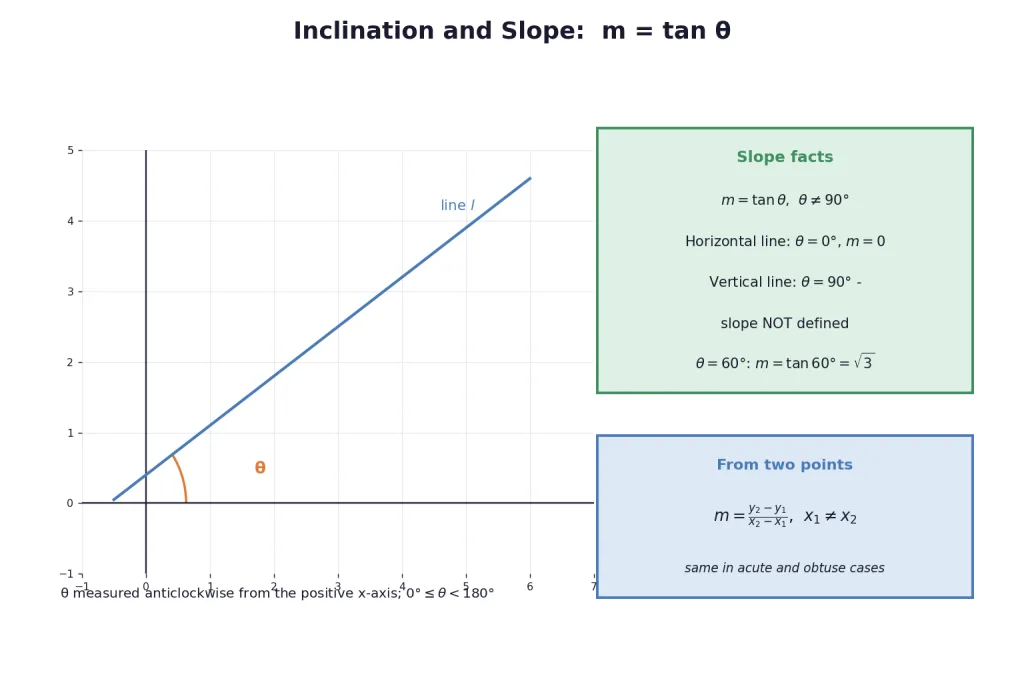
Key Point (Definition): The slope (or gradient) of a line with inclination is , . The -axis has slope 0; a vertical line has no slope — is undefined.
Key Point (Two-point formula): The line through and with has
The textbook proof runs both the acute and obtuse cases — the same formula emerges, so you never need to know which case you are in.
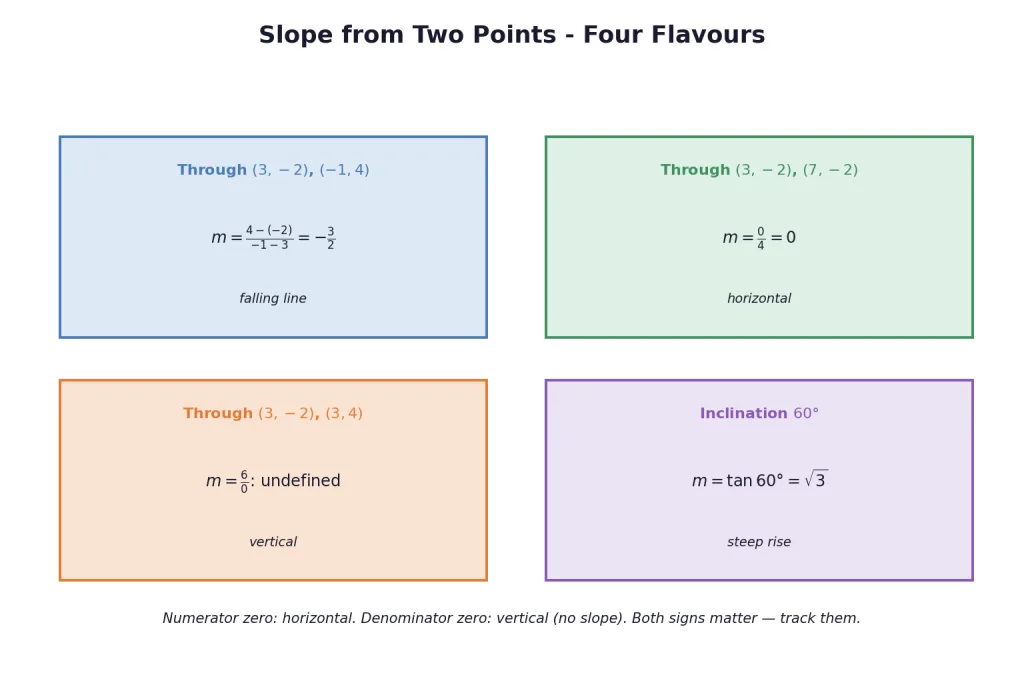
[Board Tip] Four little computations are the whole story: to gives (falling); equal 's give (horizontal); equal 's give an undefined slope (vertical); inclination gives .
Parallel, Perpendicular, and the Angle Between Lines
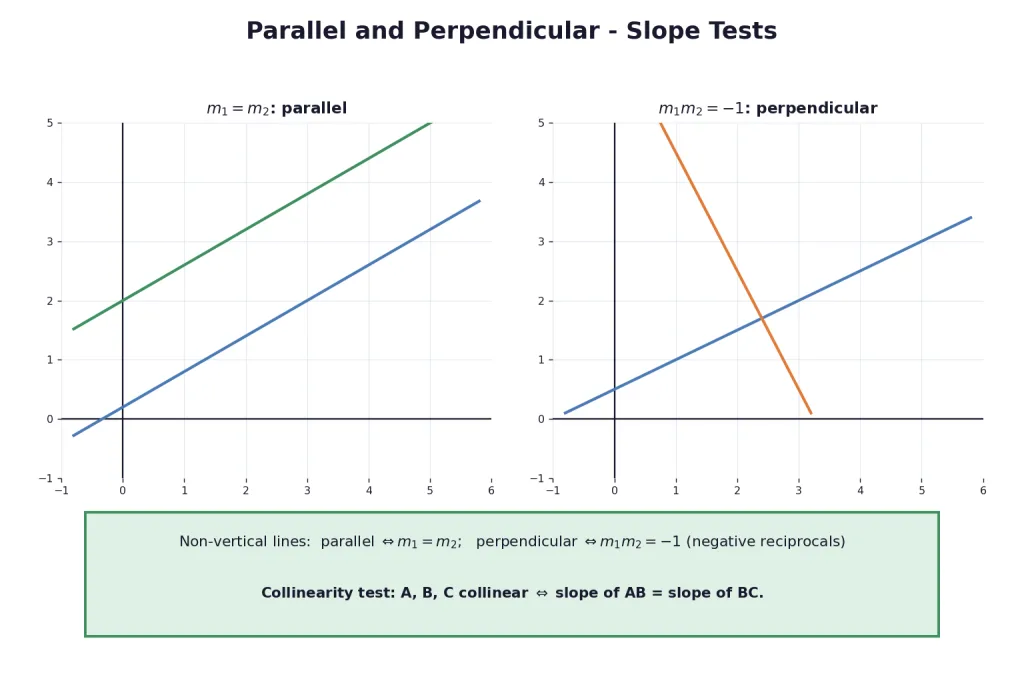
Key Point: For non-vertical lines: parallel (equal inclinations) and perpendicular (slopes are negative reciprocals). Three points are collinear exactly when slope of = slope of .
When two lines cross, they make a pair of supplementary angles. In terms of slopes:
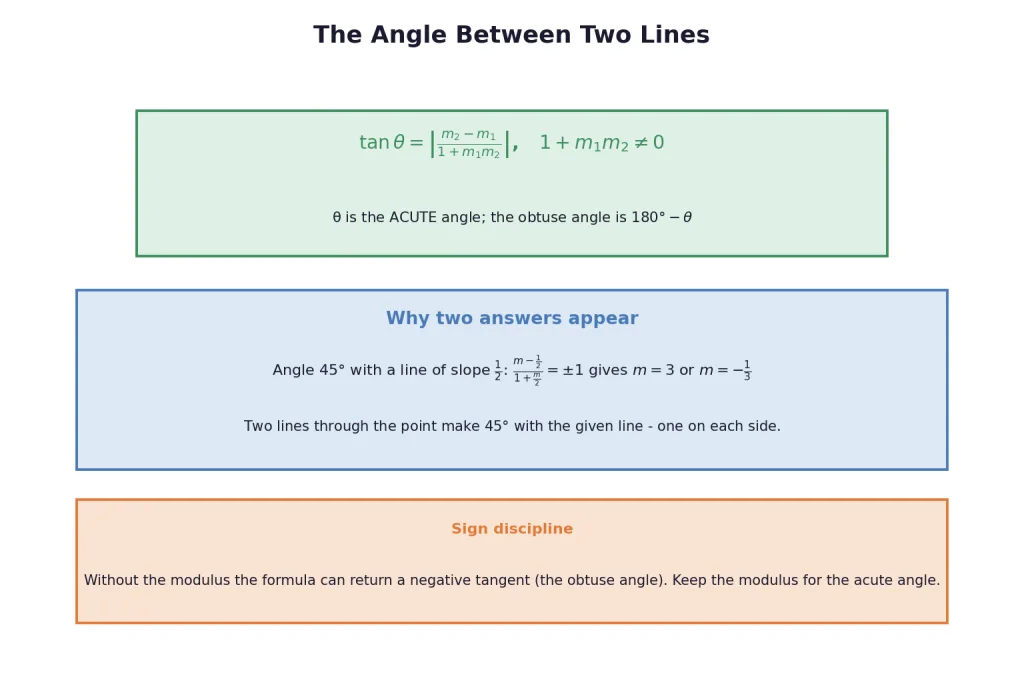
Key Point (Angle formula): The acute angle between lines with slopes satisfies
The obtuse angle is .
For example: a line makes with a line of slope — solving gives two slopes, or : one line on each side of the given one.
[JEE Tip] The is not a nuisance — it is geometry. Any "line making angle with a given line" problem has two answers unless a further condition (a point, a quadrant) kills one.
Solved Examples
Example 1: Slopes four ways
Find the slope of the line (a) through and (b) through and (c) through and (d) with inclination .
Solution:
Step 1 — (a) Two-point formula. — a falling line.
Step 2 — (b) Equal 's. — horizontal.
Step 3 — (c) Equal 's. Denominator zero — the slope is not defined: a vertical line.
Step 4 — (d) From the inclination. .
Takeaway: Numerator zero → horizontal; denominator zero → vertical (no slope). Both signs matter — track them.
Example 2: Two lines at 45°
If the angle between two lines is and the slope of one is , find the slope of the other.
Solution:
Step 1 — Set up the angle formula. With : , i.e. .
Step 2 — Solve the case. gives : .
Step 3 — Solve the case. gives : .
Takeaway: Two answers is geometry, not error — one line on each side of the given line makes with it.
Example 3: Perpendicularity fixes a coordinate
The line through and is perpendicular to the line through and . Find .
Solution:
Step 1 — Compute both slopes. ; .
Step 2 — Impose . , so .
Step 3 — Solve. : .
Takeaway: Perpendicularity converts a geometric condition into a one-line equation in the unknown coordinate.
Example 4: Equidistant point on the x-axis
Find a point on the -axis equidistant from and .
Solution:
Step 1 — Name the point. On the -axis it is .
Step 2 — Equate squared distances. .
Step 3 — Expand and solve. gives : .
Step 4 — Check. ; ✓.
Takeaway: Work with squared distances — the terms cancel and a linear equation remains.
Example 5: Slope via a midpoint
Find the slope of the line through the origin and the midpoint of the segment joining and .
Solution:
Step 1 — Midpoint. .
Step 2 — Slope from the origin. .
Takeaway: Composite constructions decompose into one formula per step — midpoint first, slope second.
Example 6: Right angle without Pythagoras
Show that , and are vertices of a right-angled triangle.
Solution:
Step 1 — Slopes of two sides from . To : . To : .
Step 2 — Multiply. — the two sides are perpendicular.
Step 3 — Conclude. The angle at is a right angle. ∎
Takeaway: The slope test replaces three distance computations with two subtractions.
Example 7: Angle with the y-axis
Find the slope of the line making a angle with the positive direction of the -axis, measured anticlockwise.
Solution:
Step 1 — Convert to an inclination. The positive -axis sits at from the positive -axis; anticlockwise more gives inclination .
Step 2 — Take the tangent. .
Takeaway: Always convert to the inclination from the positive -axis before applying .
Example 8: Parallelogram by slopes
Without the distance formula, show , , , are vertices of a parallelogram.
Solution:
Step 1 — First pair of opposite sides. to : ; to : — parallel.
Step 2 — Second pair. to : ; to : — parallel.
Step 3 — Conclude. Two pairs of parallel opposite sides: a parallelogram. ∎
Takeaway: "Without the distance formula" is a hint to use slopes — half the arithmetic, same conclusion.
Example 9: Inclination from two points
Find the angle between the -axis and the line joining and .
Solution:
Step 1 — Slope. .
Step 2 — Solve in range. With : .
Takeaway: Negative slope forces an obtuse inclination — never answer ; inclinations live in .
Example 10: Double slope
The slope of one line is double that of another. If the tangent of the angle between them is , find the slopes.
Solution:
Step 1 — Set up. Slopes and : , so .
Step 2 — Solve for . gives : or .
Step 3 — Collect all answers. Slopes or ; the sign gives the mirror pairs and .
Takeaway: The modulus hides a second family of solutions — solve each sign case and report all.
Example 11: Collinearity by slope
Show that , and are collinear.
Solution:
Step 1 — Two slopes from the shared point. to : ; to : .
Step 2 — Conclude. Equal slopes through a common point put all three points on one line. ∎
Takeaway: Collinearity = equal slopes from a shared point — one comparison, no distances.