
What "Equation of a Line" Means
The equation of a line is a condition on that is true exactly when the point lies on . Every form below is the same idea — slope read between a fixed point and the moving point .
Horizontal and vertical lines come first: a horizontal line at distance from the -axis is or ; a vertical line at distance from the -axis is or . Through : the horizontal line is and the vertical line is .
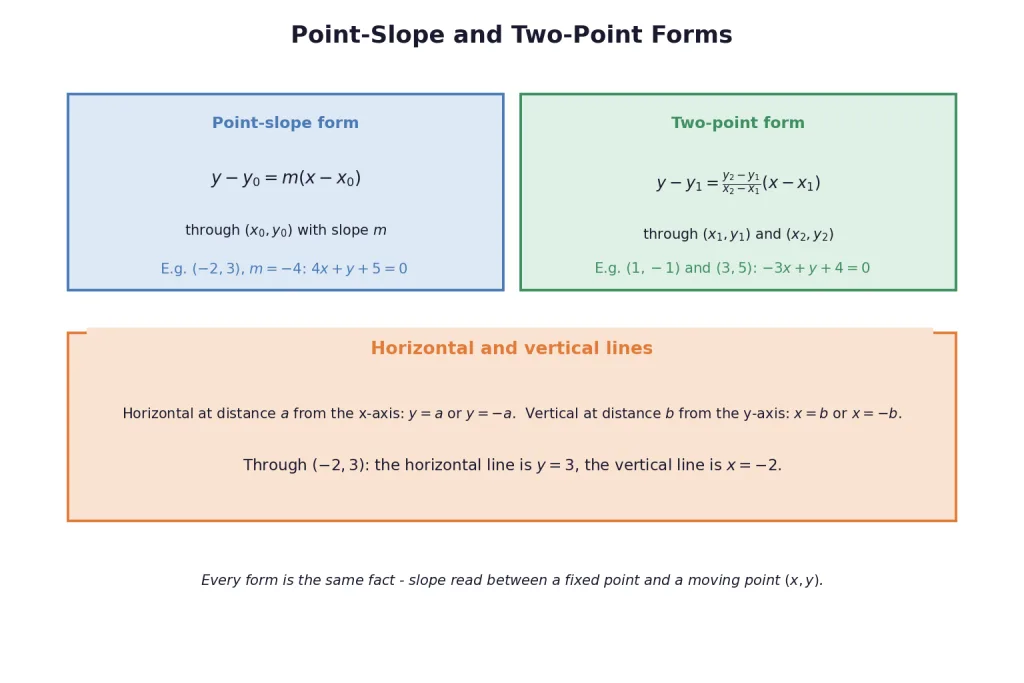
Key Point (Point-slope form): The line through with slope is
Key Point (Two-point form): Through and :
For example: through with : , i.e. ; and through and : .
Intercept Forms and the General Equation
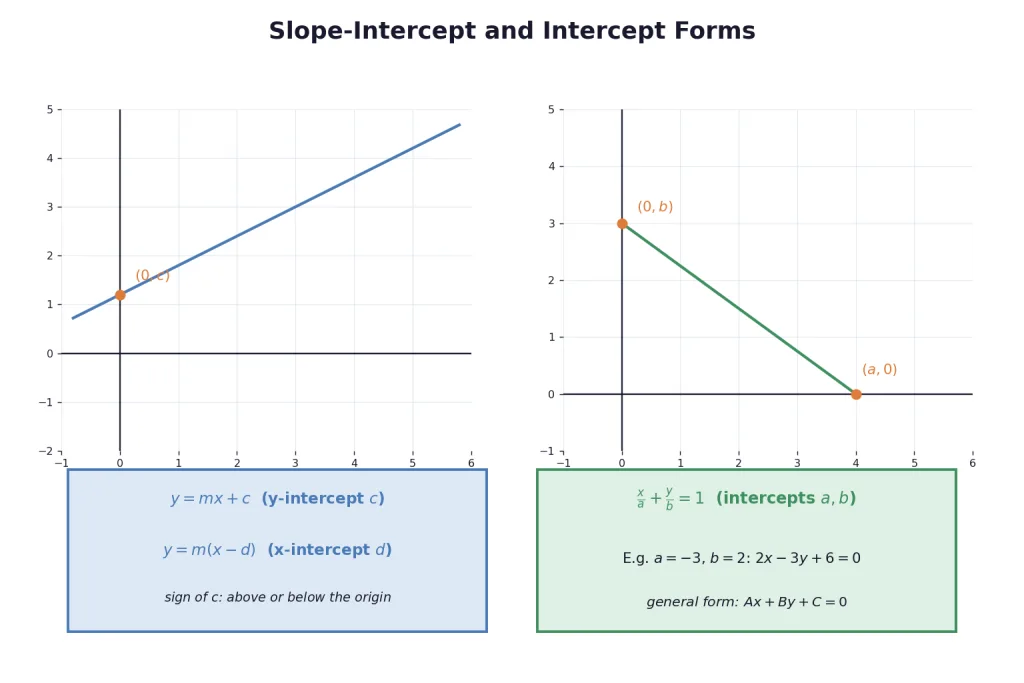
Key Point (Slope-intercept forms): With slope and -intercept : . With slope and -intercept : . The sign of records whether the line meets the -axis above or below the origin.
Key Point (Intercept form): Making intercepts and on the axes:
For example: intercepts and give , i.e. .
Every line — including vertical ones — fits the general equation ( not both zero), with slope when .
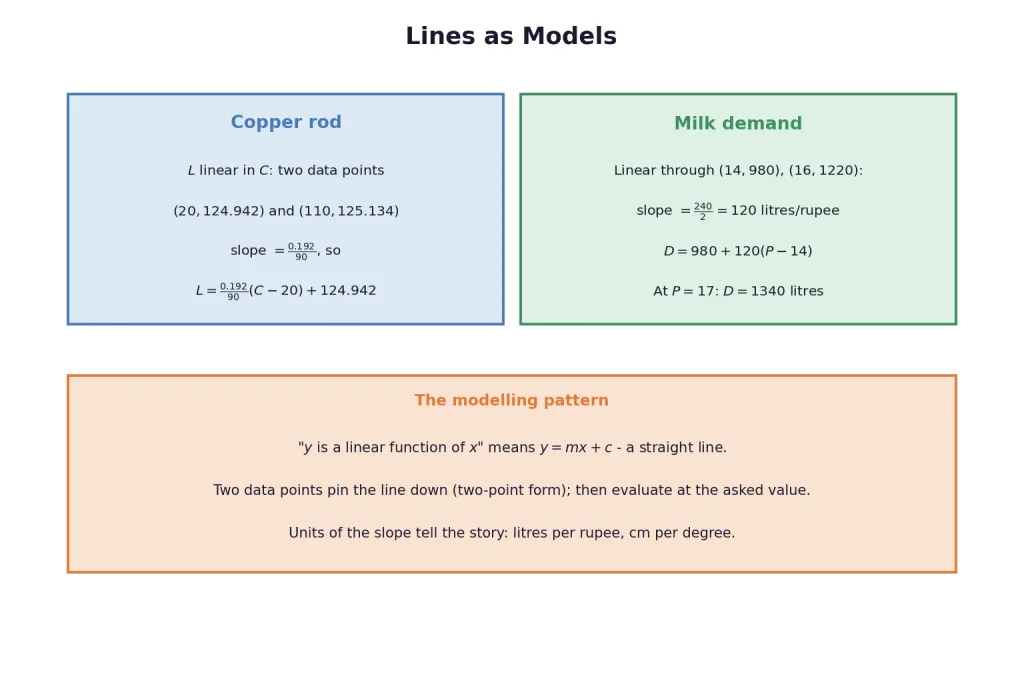
Lines as models: " is a linear function of " means a line through two data points — find it by two-point form, then evaluate.
[Board Tip] Present final answers in the form the question requests — "in intercept form" or "in general form." Converting at the end costs seconds; skipping the conversion costs the mark.
Solved Examples
Example 1: Point-slope
Find the equation of the line through with slope .
Solution:
Step 1 — Substitute into point-slope form. .
Step 2 — Expand. , so .
Step 3 — Check. At : ✓.
Takeaway: Substituting the given point back is a two-second full check on any line equation.
Example 2: Two-point
Write the equation of the line through and .
Solution:
Step 1 — Slope. .
Step 2 — Point-slope from either point. .
Step 3 — Simplify. , i.e. . Check with : ✓.
Takeaway: Two-point form is point-slope with the slope computed first — use whichever point makes the arithmetic lighter.
Example 3: Both intercept flavours
Write the equations of the lines with and (i) -intercept (ii) -intercept 4.
Solution:
Step 1 — (i) Slope-intercept. ; multiply by 2: .
Step 2 — (ii) x-intercept form. ; multiply by 2: .
Takeaway: is where the line crosses the -axis; is where it crosses the -axis — same slope, different anchors.
Example 4: Intercept form
Find the equation of the line making intercepts and on the axes.
Solution:
Step 1 — Substitute into intercept form. .
Step 2 — Clear denominators. Multiply by 6: , i.e. .
Step 3 — Check the intercepts. : ✓; : ✓.
Takeaway: Negative intercepts go straight into the form — the signs sort themselves out on clearing.
Example 5: From an inclination
Find the equation of the line through inclined at to the -axis.
Solution:
Step 1 — Convert the angle to a slope. .
Step 2 — Point-slope. .
Takeaway: Exact-angle slopes come from the tangent addition formula — memorise and .
Example 6: Intercept data
(i) Line with -intercept and slope . (ii) Line meeting the -axis 2 units above the origin at to the positive -axis.
Solution:
Step 1 — (i). Through with : , i.e. .
Step 2 — (ii). , : ; multiply by : .
Takeaway: "2 units above the origin on the -axis" is just — translate words to parameters before writing anything.
Example 7: A median
The vertices of are , , . Find the equation of the median through .
Solution:
Step 1 — Find the opposite side's midpoint. Midpoint of : .
Step 2 — Slope of the median. From to : .
Step 3 — Write the line. , i.e. . Check at : ✓.
Takeaway: A median is just "line through two points" once the midpoint is computed.
Example 8: A perpendicular through a point
Find the line through perpendicular to the line through and .
Solution:
Step 1 — Slope of the given line. .
Step 2 — Perpendicular slope. Negative reciprocal: .
Step 3 — Point-slope. , i.e. .
Takeaway: Flip and negate the slope, then it is one more point-slope application.
Example 9: Equal intercepts
Find the line with equal intercepts through .
Solution:
Step 1 — Impose . , i.e. .
Step 2 — Push through the point. .
Step 3 — Write the line. .
Takeaway: Equal intercepts collapse the intercept form to — the point then reads off directly.
Example 10: Intercepts with a given sum
Find the line through whose intercepts sum to 9.
Solution:
Step 1 — Parametrise. Intercepts and : .
Step 2 — Push through . ; multiply by : .
Step 3 — Solve the quadratic. , so : or .
Step 4 — Write both lines. : , i.e. ; : .
Takeaway: A sum condition plus a point gives a quadratic in — expect (and report) two lines.
Example 11: Line from its perpendicular's foot
The perpendicular from the origin to a line meets it at . Find the equation of the line.
Solution:
Step 1 — Slope of the perpendicular. From the origin to : .
Step 2 — Slope of the line. Negative reciprocal: .
Step 3 — Point-slope at the foot. ; multiply by 9: .
Takeaway: The foot of the perpendicular is ON the line — it supplies both the point and (via the origin) the slope.
Example 12: The milk model
A store sells 980 litres weekly at Rs 14/litre and 1220 litres at Rs 16/litre. Assuming linearity, how much at Rs 17/litre?
Solution:
Step 1 — Slope from the two data points. litres per rupee.
Step 2 — Point-slope model. .
Step 3 — Evaluate. At : litres.
Takeaway: "Linear relationship" = two-point form; the slope's units (litres/rupee) tell the story.
Example 13: Midpoints and ratios on a segment between axes
(i) is the midpoint of a segment between the axes: show the line is . (ii) divides such a segment in ratio : find the line.
Solution:
Step 1 — (i) Name the endpoints. and : the midpoint is , so , .
Step 2 — (i) Write the intercept form. , i.e. . ∎
Step 3 — (ii) Section formula. divides to in : , , so , .
Step 4 — (ii) Intercept form. , i.e. , or .
Takeaway: Segments between the axes are begging for intercept form — name the endpoints , and use the section formula.