
About This Paper
This is the main March 2025 exam (Exam-1). The mark splits are from the board's official scheme for this paper.
Sit it in 3 hours with log tables before you look at any answer. When you mark yourself, only your first answer counts in Part A, and a numerical without steps and a unit gets nothing.
Watch for: Q15 (a tertiary alcohol over hot copper loses water, so X and Y are the same alkene) and Q40 (a methanol, methanal and methanoic acid chain with Cannizzaro's reaction). Four of the six Part E problems are textbook regulars that keep coming back.
Part F (alternate questions for visually challenged students) is not included.
Question Paper: Part A
I. Select the correct option from the given choices. (15 × 1 = 15)
1. Incorrect statement regarding vitamins,
(a) Excess vitamin intake is harmful
(b) Most of the vitamins contain amino groups
(c) Vitamins can be produced by plants
(d) Vitamin deficiency causes diseases
2. Camphor in nitrogen gas is an example of __.
(a) liquid solution
(b) solid solution
(c) gaseous solution
(d) aqueous solution
3. Which of the following is not a subdivision of structural isomerism?
(a) Coordination isomerism
(b) Linkage isomerism
(c) Ionisation isomerism
(d) Geometrical isomerism
4. Cumene hydroperoxide on hydrolysis with dilute acid gives _.
(a) alcohol and phenol
(b) only phenol
(c) phenol and acetone
(d) alcohol and acetone
5. An example for pseudo first-order reaction is,
(a) The decomposition of gaseous ammonia on a hot platinum surface
(b) Photochemical reaction between hydrogen and chlorine
(c) Inversion of cane sugar
(d) Hydrogenation of ethene
6. The hybridisation of 'N' atom in trimethyl amine is,
(a) sp
(b) sp
(c) sp
(d) dsp
7. The IUPAC name of CH–CH(Br)–CH–CHO is
(a) 3-bromobutyraldehyde
(b) 2-bromopropanaldehyde
(c) 3-bromobutanal
(d) 2-bromobutanal
8. Select non-semiconductor from the following,
(a) silicon
(b) carbon-black
(c) gallium arsenide
(d) doped silicon
9. Given below are two statements. Statement I: Ammonolysis of alkyl halides has the disadvantage of yielding a mixture of primary, secondary, tertiary amines and quaternary ammonium salt. Statement II: Tertiary amine is obtained as a major product by taking large excess of ammonia in ammonolysis of alkyl halides. In the light of the above statements, choose the appropriate answer.
(a) Statement I is incorrect but Statement II is correct
(b) Both Statement I and Statement II are correct
(c) Both Statement I and Statement II are incorrect
(d) Statement I is correct but Statement II is incorrect
10. The structure of pentacarbonyliron(0) is,
(a) tetrahedral
(b) trigonal bipyramidal
(c) octahedral
(d) square pyramidal
11. Two compounds 'A' and 'B' were being tested for their boiling points. It was observed that 'A' started boiling after 'B', when both were subjected to same conditions. If the compound 'B' is acetone, which of the following can be compound 'A'?
(a) Propanal
(b) Propan-1-ol
(c) Methoxyethane
(d) n-Butane
12. Select the correct order of melting points of isomeric dichlorobenzenes.
(a) o-dichlorobenzene > m-dichlorobenzene > p-dichlorobenzene
(b) p-dichlorobenzene > m-dichlorobenzene > o-dichlorobenzene
(c) p-dichlorobenzene > o-dichlorobenzene > m-dichlorobenzene
(d) m-dichlorobenzene > o-dichlorobenzene > p-dichlorobenzene
13. Match List-I with List-II. List-I: (i) VO, (ii) TiCl with Al(CH), (iii) PdCl, (iv) Nickel complexes. List-II: (A) Oxidation of ethyne to ethanal, (B) Polymerisation of alkynes, (C) Oxidation of SO in the manufacture of sulphuric acid, (D) Manufacture of polyethylene. Choose the correct option.
(a) i – C, ii – D, iii – A, iv – B
(b) i – A, ii – B, iii – C, iv – D
(c) i – A, ii – C, iii – B, iv – D
(d) i – C, ii – A, iii – D, iv – B
14. Which of the following explains the increase in the reaction rate by a catalyst?
(a) Catalyst decreases the rate of backward reaction so that rate of forward reaction increases
(b) Catalyst provides extra energy to reacting molecules, so that they produce effective collisions
(c) Catalyst provides an alternative pathway by reducing the activation energy between the reactants and products
(d) Catalyst increases the number of collisions between the reacting molecules
15. Sufficient amount of 2-methylpropan-2-ol heated with 20% phosphoric acid at 358 K gives main product 'X' with the elimination of water, and tert-butyl alcohol undergoes dehydration when it is passed over heated copper at 573 K to give 'Y'. Pick the correct statement regarding X and Y.
(a) The boiling points of 'X' and 'Y' are equal
(b) The boiling point of 'X' is greater than the boiling point of 'Y'
(c) The boiling point of 'X' is lesser than the boiling point of 'Y'
(d) At room temperature both 'X' and 'Y' exist as solids
II. Fill in the blanks by choosing the appropriate word from those given in the brackets. (5 × 1 = 5)
[carbocation, pre-exponential, exponential, unpaired, carbohydrate, CClF]
16. Arrhenius factor is also called __ factor.
17. Paramagnetism arises from the presence of __ electrons.
18. __ is one of the most common freons in industrial use.
19. The electrophilic attack of HO on alkene forms __.
20. The hormone glucocorticoids control the __ metabolism.
Question Paper: Parts B to E
Part B
III. Answer any three of the following. Each question carries 2 marks. (3 × 2 = 6)
21. Explain Wurtz reaction with suitable chemical equation.
22. Molarity (M), molality (m) and mole fraction (χ) are some methods for expressing concentration of solutions. Which of these are temperature dependent? Give reason.
23. What are non-essential amino acids? Name an optically inactive naturally occurring α-amino acid.
24. Write any two characteristic properties of interstitial compounds.
25. While separating a mixture of ortho and para nitrophenols by steam distillation, name the isomer which will be steam volatile. Give reason.
Part C
IV. Answer any three of the following. Each question carries 3 marks. (3 × 3 = 9)
26. State any three postulates of Werner's theory of coordination compounds.
27. Write the balanced chemical equations involved in the manufacture of potassium dichromate (KCrO) from chromite ore (FeCrO).
28. [Co(NH)Br]SO is an octahedral coordination compound. Write its IUPAC name and draw the diagram which indicates the splitting of d-orbitals in the above complex with respect to CFT.
29. What is lanthanoid contraction? Write one comparison and one difference between lanthanoids and actinoids with respect to oxidation states shown by them.
30. Write the facial (fac) and meridional (mer) isomeric structures of [Co(NH)(NO)]. Mention the coordination number of the metal ion in the above complex.
V. Answer any two of the following. Each question carries 3 marks. (2 × 3 = 6)
31. Derive an integrated rate equation for the rate constant of a zero-order reaction.
32. Write a neat labelled diagram, cell representation and half-cell reaction of Standard Hydrogen Electrode (S.H.E.).
33. Define azeotropes. What type of azeotropes are formed by solutions with negative deviation from Raoult's law? Give an example for it.
34. Lead storage battery is commonly used as a secondary cell in automobiles. What is a secondary cell? Write down the reactions that occur at anode and cathode during discharging of the lead storage battery.
Part D
VI. Answer any four of the following. Each question carries 5 marks. (4 × 5 = 20)
35. (a) Write the S@@GYANGHAR_MATH@@122 mechanism for the conversion of chloromethane to methanol. Mention its order. (3)
(b) What is a racemic mixture? Represent butan-2-ol in racemic mixture form. (2)
36. (a) Amylose and Amylopectin are two components of starch. Write any two differences between them. (2)
(b) List any two nitrogenous bases commonly found in both RNA and DNA. (2)
(c) Name the enzyme that catalyses hydrolysis of maltose into glucose. (1)
37. (a) Write the mechanism of addition of HCN (hydrogen cyanide) to carbonyl group in presence of base. (3)
(b) Explain Rosenmund reduction with chemical equation. (2)
38. (a) Describe carbylamine reaction with suitable chemical equation. (2)
(b) Explain the conversion of aniline to benzene diazonium chloride with chemical equation. (2)
(c) Among aryl amines and ammonia, which is more basic? (1)
39. (a) Lucas reagent is an important reagent which helps to distinguish between three classes of alcohols. Write the chemical composition of the Lucas reagent and explain how the above reagent helps to distinguish 1° and 3° alcohols. (3)
(b) Illustrate preparation of ether by Williamson synthesis with a general chemical equation. (2)
40. An organic compound 'A' on treatment with ethanoic acid in the presence of hydrochloric acid gas as a catalyst produces an ester 'B'. 'A' on oxidation with CrO in an anhydrous medium gives 'C'. 'C' is heated with concentrated KOH followed by acidification with dilute HCl generates 'A' and 'D'. Three moles of 'D' react with PCl to give three moles of a compound with molecular formula HCOCl and 'E'. 'D' is reduced to 'A' by lithium aluminium hydride followed by hydrolysis. Write the molecular formulas of the compounds 'A', 'B', 'C', 'D' and 'E'. (5)
Part E
VII. Answer any three of the following. Each question carries 3 marks. (3 × 3 = 9)
41. The initial concentration of NO in the first order reaction NO(g) → 2NO(g) + ½O(g) was 1.24 × 10 mol L at 318 K. The concentration of NO after 60 minutes was 0.20 × 10 mol L. Calculate the rate constant of the reaction at 318 K.
42. Calculate the osmotic pressure in pascals exerted by a solution prepared by dissolving 1.0 g of polymer of molar mass 185000 in 450 mL of water at 37 °C. [R = 8.314 × 10 Pa L K mol]
43. The standard electrode potential for Daniell cell is 1.1 V. Calculate the standard Gibbs energy for the reaction Zn(s) + Cu(aq) → Zn(aq) + Cu(s).
44. The vapour pressures of pure liquids 'A' and 'B' are 450 and 700 mm Hg respectively at 350 K. Find out the composition of the liquid mixture if total vapour pressure is 600 mm Hg.
45. The rate constant of a first order reaction increases from 2 × 10 s to 4 × 10 s when the temperature changes from 300 K to 310 K. Calculate the energy of activation (E). [log 2 = 0.3010, log 2.5 = 0.3979, log 4 = 0.6021, R = 8.314 J K mol]
46. The conductivity of 0.001028 mol L acetic acid is 4.95 × 10 S cm. Calculate its dissociation constant if for acetic acid is 390.5 S cm mol.
Answers: Part A
Question 1: Pick the incorrect statement about vitamins.
Answer. (b) Most of the vitamins contain amino groups. The name comes from "vital amine", but most vitamins have no amino group at all. The other three statements are true.
Question 2: Camphor in nitrogen gas is an example of what kind of solution?
Answer. (c) gaseous solution. The solvent decides the type. Here the solvent is nitrogen gas and the solute is solid camphor, so it is a gaseous solution.
Question 3: Which is not a kind of structural isomerism?
Answer. (d) Geometrical isomerism. Geometrical isomerism is a kind of stereoisomerism: the same bonds, arranged differently in space. The other three are structural.
Question 4: Cumene hydroperoxide hydrolysed with dilute acid gives?
Answer. (c) phenol and acetone. This is the cumene process for making phenol; acetone is the by-product.
Question 5: Which is a pseudo first order reaction?
Answer. (c) Inversion of cane sugar. Water takes part in the inversion of cane sugar but is present in such large excess that its concentration hardly changes, so the rate depends on sucrose alone.
Question 6: Hybridisation of N in trimethylamine?
Answer. (a) sp. N forms three bonds and keeps one lone pair, four groups in all, so it is sp and the molecule is pyramidal.
Question 7: IUPAC name of CH–CH(Br)–CH–CHO?
Answer. (c) 3-bromobutanal. The CHO carbon is C-1. Counting from it, the chain has four carbons (butanal) and Br sits on C-3.
Question 8: Which of these is not a semiconductor?
Answer. (b) carbon-black. Silicon, doped silicon and gallium arsenide are semiconductors. Carbon black is listed with graphite among the non-metals that conduct electricity like metals.
Question 9: Ammonolysis of alkyl halides: Statement I (it gives a mixture of amines) and Statement II (a large excess of ammonia gives mainly the tertiary amine).
Answer. (d) Statement I is correct but Statement II is incorrect. Ammonolysis does give a mixture. But a large excess of ammonia makes the primary amine the main product, not the tertiary one.
Question 10: Shape of pentacarbonyliron(0), [Fe(CO)]?
Answer. (b) trigonal bipyramidal. Five CO groups around Fe arrange themselves as a trigonal bipyramid.
Question 11: A boils at a higher temperature than acetone (B). Which can A be?
Answer. (b) Propan-1-ol. Propan-1-ol has hydrogen bonding, so it boils well above acetone. Propanal, methoxyethane and butane all boil below acetone.
Question 12: Melting point order of the dichlorobenzenes?
Answer. (c) p-dichlorobenzene > o-dichlorobenzene > m-dichlorobenzene. The para isomer is symmetrical and packs best in the crystal, so it melts highest. Ortho comes next and meta is lowest.
Question 13: Match the catalysts VO, TiCl with Al(CH), PdCl and nickel complexes with their uses.
Answer. (a) i – C, ii – D, iii – A, iv – B. VO is the contact process catalyst; the Ziegler catalyst makes polyethylene; PdCl is used in the Wacker process; nickel complexes polymerise alkynes.
Question 14: How does a catalyst increase the rate?
Answer. (c) Catalyst provides an alternative pathway by reducing the activation energy between the reactants and products. A catalyst gives no extra energy. It opens a different path with a lower energy barrier.
Question 15: 2-Methylpropan-2-ol gives X with 20% HPO at 358 K, and Y over heated copper at 573 K. Which statement about X and Y is correct?
Answer. (a) The boiling points of 'X' and 'Y' are equal. Both routes remove water from the same tertiary alcohol and give the same alkene, 2-methylpropene. A tertiary alcohol has no H on the carbon carrying OH, so copper can't dehydrogenate it. Same compound, same boiling point.
Question 16: Arrhenius factor is also called __ factor.
Answer. pre-exponential. A in stands in front of the exponential term, hence the name.
Question 17: Paramagnetism arises from the presence of __ electrons.
Answer. unpaired. Only unpaired electrons give a net magnetic moment.
Question 18: __ is one of the most common freons in industrial use.
Answer. CClF. Dichlorodifluoromethane (freon-12) is the most common freon.
Question 19: The electrophilic attack of HO on alkene forms __.
Answer. carbocation. This is the first step of acid-catalysed hydration: the alkene picks up H and becomes a carbocation.
Question 20: The hormone glucocorticoids control the __ metabolism.
Answer. carbohydrate. Glucocorticoids, from the adrenal cortex, control carbohydrate metabolism.
Answers: Part B
Question 21: Explain Wurtz reaction with suitable chemical equation.
Answer. When an alkyl halide is treated with sodium in dry ether, two alkyl groups join and an alkane with double the number of carbon atoms is formed. This is the Wurtz reaction.
Marks: statement 1, equation 1. The general equation is also accepted, and a self-explanatory equation alone gets both marks.
Question 22: Molarity (M), molality (m) and mole fraction (χ) are some methods for expressing concentration of solutions. Which of these are temperature dependent? Give reason.
Answer. Molarity depends on temperature. Molarity is the number of moles of solute in one litre of solution, and the volume of a solution changes with temperature. Molality and mole fraction depend only on masses and moles, which do not change with temperature.
Marks: molarity 1, reason 1.
Question 23: What are non-essential amino acids? Name an optically inactive naturally occurring α-amino acid.
Answer. Amino acids which the body can make for itself are called non-essential amino acids.
Glycine is the optically inactive natural α-amino acid. Its α-carbon has two H atoms, so it is not chiral.
Marks: definition 1, glycine 1.
Question 24: Write any two characteristic properties of interstitial compounds.
Answer. Any two of these:
- They have high melting points, higher than those of the pure metals.
- They are very hard.
- They keep metallic conductivity.
- They are chemically inert.
Marks: any two properties, 1 each.
Question 25: While separating a mixture of ortho and para nitrophenols by steam distillation, name the isomer which will be steam volatile. Give reason.
Answer. o-Nitrophenol is steam volatile. In o-nitrophenol, the –OH and –NO groups are next to each other, so it forms an intramolecular hydrogen bond and its molecules do not hold on to each other. p-Nitrophenol forms intermolecular hydrogen bonds, so its molecules stay associated and it is not steam volatile.
Marks: o-nitrophenol 1, reason 1.
Answers: Part C
Question 26: State any three postulates of Werner's theory of coordination compounds.
Answer. Any three of these postulates:
- In coordination compounds, metals show two types of valency: primary and secondary.
- Primary valency is ionisable and is satisfied by negative ions.
- Secondary valency is non-ionisable and is satisfied by negative ions or neutral molecules. It is equal to the coordination number.
- Secondary valencies are directional, so they give the complex a definite shape.
Marks: any three postulates, 1 each.
Question 27: Write the balanced chemical equations involved in the manufacture of potassium dichromate (KCrO) from chromite ore (FeCrO).
Answer. Step 1: Chromite ore is fused with sodium carbonate in free access of air, giving sodium chromate.
Step 2: The sodium chromate solution is acidified, giving sodium dichromate.
Step 3: Sodium dichromate is treated with potassium chloride, giving potassium dichromate.
Marks: 1 for each step. This scheme also accepted HSO in step 2, but 2026 Exam-1 accepted only 2H, so always write 2H.
Question 28: [Co(NH)Br]SO is an octahedral coordination compound. Write its IUPAC name and draw the diagram which indicates the splitting of d-orbitals in the above complex with respect to CFT.
Answer. IUPAC name: pentaamminebromidocobalt(III) sulphate
In an octahedral field, the five d orbitals split into a lower set of three, t (at −0.4 ), and an upper set of two, e (at +0.6 ). Co is 3d. NH is a strong field ligand, so all six electrons pair up in t, giving t e.
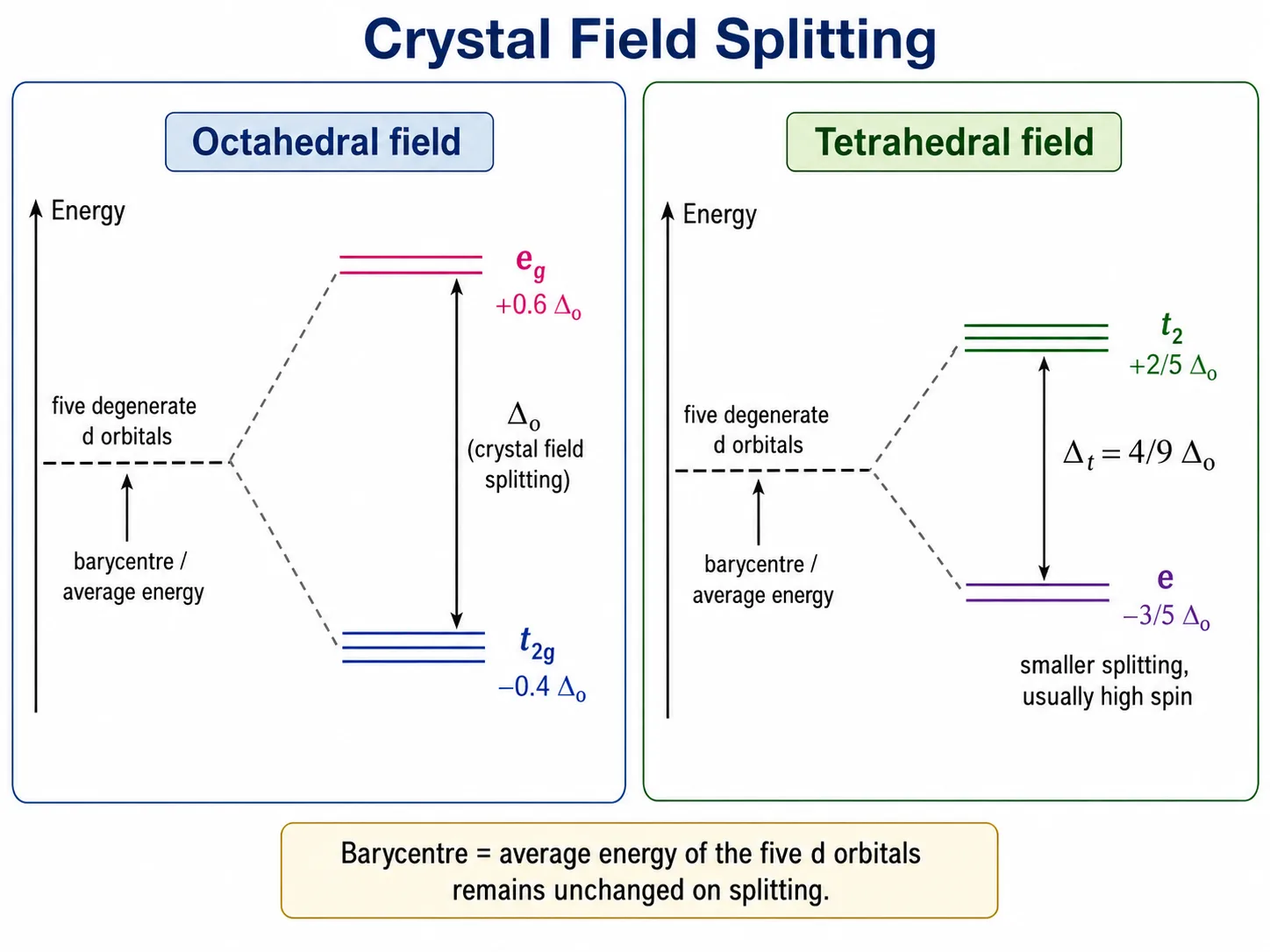
In the exam, draw only the octahedral splitting and label t, e and .
Marks: name 1, splitting diagram 2.
Question 29: What is lanthanoid contraction? Write one comparison and one difference between lanthanoids and actinoids with respect to oxidation states shown by them.
Answer. Lanthanoid contraction is the steady decrease in the atomic and ionic radii from lanthanum to lutetium.
Comparison: both lanthanoids and actinoids show +3 as their common oxidation state.
Difference: actinoids show a much wider range of oxidation states (up to +7), while lanthanoids mostly show +3, with +2 and +4 only in a few cases.
Marks: definition 1, comparison 1, difference 1.
Question 30: Write the facial (fac) and meridional (mer) isomeric structures of [Co(NH)(NO)]. Mention the coordination number of the metal ion in the above complex.
Answer. Coordination number of cobalt = 6.
Number the corners of the octahedron: 1 at the top, 6 at the bottom, and 2, 3, 4, 5 around the middle, with 2 opposite 4 and 3 opposite 5.
fac isomer: the three NH groups are on one triangular face, at positions 1, 2 and 3, all at 90° to each other. The three NO groups are at 4, 5 and 6.
mer isomer: the three NH groups are around a meridian, at positions 1, 2 and 6, so two of them (1 and 6) are opposite each other. The three NO groups are at 3, 4 and 5.
In the exam, draw two octahedra and write NH and NO at these corners.
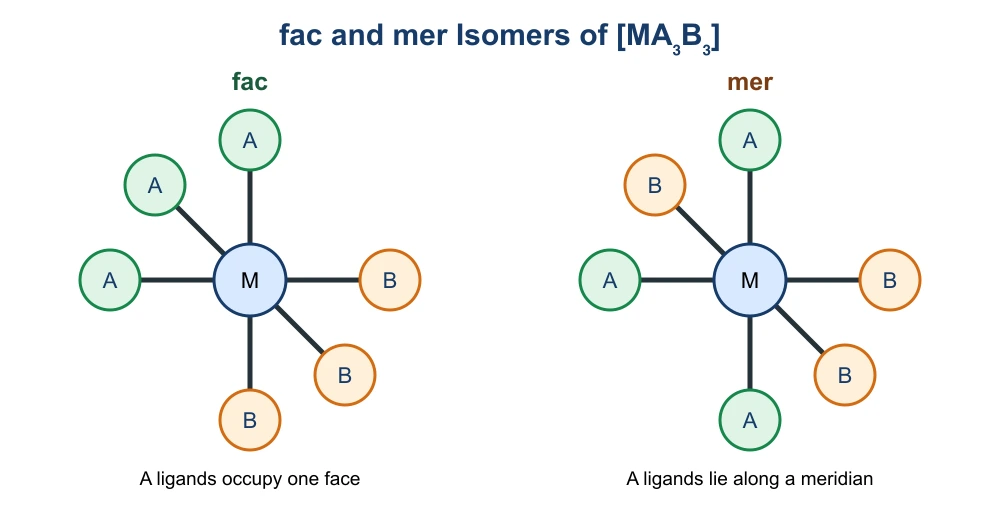
Marks: fac structure 1, mer structure 1, coordination number 1.
Question 31: Derive an integrated rate equation for the rate constant of a zero-order reaction.
Answer. Consider the zero order reaction R → P.
Integrating both sides:
At , , so . Substituting:
Marks: rate expression 1, integration and value of I 1, final equation 1. Any correct alternate derivation also gets full marks.
Question 32: Write a neat labelled diagram, cell representation and half-cell reaction of Standard Hydrogen Electrode (S.H.E.).
Answer.
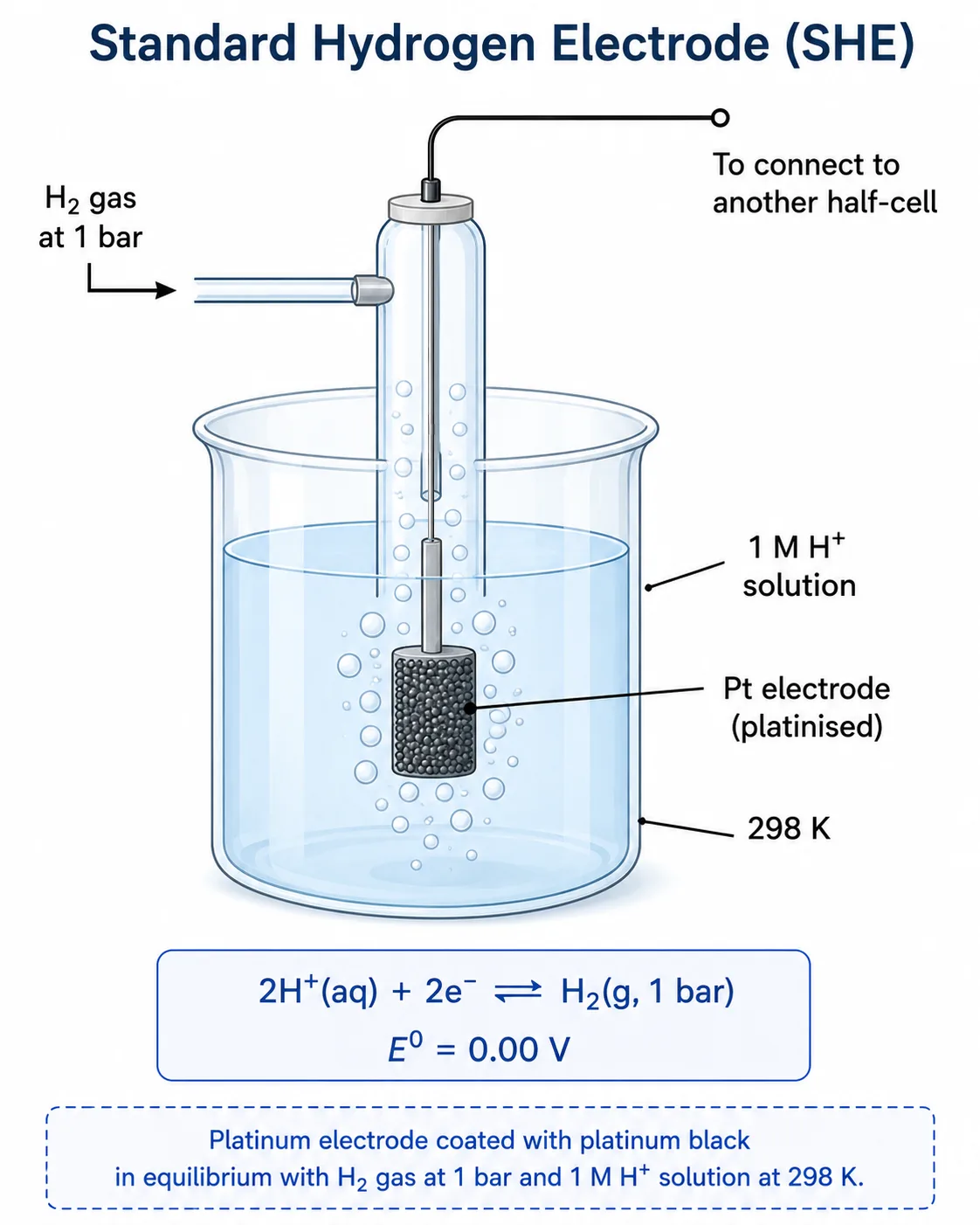
Labels: platinum foil coated with platinum black, H gas at 1 bar, 1 M H solution.
Cell representation: Pt(s) | H(g, 1 bar) | H(aq, 1 M)
Half-cell reaction:
Marks: diagram with any two labels 1, representation 1, half-cell reaction 1. The anode form, , is also accepted.
Question 33: Define azeotropes. What type of azeotropes are formed by solutions with negative deviation from Raoult's law? Give an example for it.
Answer. Azeotropes are binary mixtures which have the same composition in the liquid and vapour phases and boil at a constant temperature.
Solutions with negative deviation from Raoult's law form maximum boiling azeotropes.
Example: 68% nitric acid and 32% water by mass.
Marks: definition 1, type 1, example 1. Chloroform and acetone, or about 20% HCl in water, are also accepted as examples.
Question 34: Lead storage battery is commonly used as a secondary cell in automobiles. What is a secondary cell? Write down the reactions that occur at anode and cathode during discharging of the lead storage battery.
Answer. A secondary cell is a cell which can be recharged by passing current through it in the opposite direction, so it can be used again.
At the anode:
At the cathode:
Marks: definition 1, anode reaction 1, cathode reaction 1.
Answers: Part D
Question 35: (a) S mechanism for chloromethane to methanol, and its order. (3) (b) What is a racemic mixture? Write butan-2-ol in racemic form. (2)
Answer.
(a) The OH ion attacks the carbon from the side opposite to the chlorine. In the transition state, the C–O bond is forming while the C–Cl bond is breaking. Then Cl leaves, and the configuration of the carbon is inverted.
The reaction is of second order: rate = k[CHCl][OH].
(b) A racemic mixture is a mixture containing equal amounts of the d and l forms of a compound. It shows no optical rotation, because the rotation by one form is cancelled by the other.
Butan-2-ol in racemic form is written as (±)-butan-2-ol or dl-butan-2-ol.
Marks: (a) attack and transition state 1, product with inversion 1, order 1; (b) definition 1, racemic form 1.
Question 36: (a) Two differences between amylose and amylopectin. (2) (b) Two bases found in both RNA and DNA. (2) (c) The enzyme that hydrolyses maltose into glucose. (1)
Answer.
(a) Any two of these:
| Amylose | Amylopectin |
|---|---|
| Soluble in water | Insoluble in water |
| About 15–20% of starch | About 80–85% of starch |
| Unbranched chain | Branched chain |
| α-D-glucose units joined only by C1–C4 links | C1–C4 links, with C1–C6 links at the branches |
(b) Any two of these bases: adenine, guanine and cytosine.
(c) Maltase hydrolyses maltose into glucose.
Marks: (a) any two differences, 1 each; (b) any two bases, 1 each; (c) 1.
Question 37: (a) Mechanism of base-catalysed addition of HCN to a carbonyl group. (3) (b) Rosenmund reduction with an equation. (2)
Answer.
(a) The addition of HCN to a carbonyl compound is a nucleophilic addition. It takes place in three steps.
Step 1: The base generates the cyanide ion.
Step 2: CN attacks the carbonyl carbon, forming a tetrahedral alkoxide ion.
Step 3: The alkoxide ion takes a proton from HCN to form the cyanohydrin, and CN is formed again.
(b) When an acyl chloride is hydrogenated over palladium on barium sulphate, an aldehyde is formed. This is Rosenmund reduction.
Marks: (a) 1 for each step; (b) statement 1, equation 1.
Question 38: (a) Carbylamine reaction with an equation. (2) (b) Aniline to benzene diazonium chloride. (2) (c) Aryl amines or ammonia: which is more basic? (1)
Answer.
(a) When a primary amine, aliphatic or aromatic, is heated with chloroform and ethanolic KOH, a foul-smelling isocyanide is formed. This is the carbylamine reaction.
(b) Aniline is treated with nitrous acid (NaNO + HCl) at 273–278 K, and benzene diazonium chloride is formed.
(c) Ammonia is more basic. In aryl amines, the lone pair on nitrogen is delocalised into the benzene ring, so it is less available to accept a proton.
Marks: (a) statement 1, equation 1; (b) statement 1, equation 1; (c) 1.
Question 39: (a) Composition of Lucas reagent and how it tells 1° and 3° alcohols apart. (3) (b) Williamson synthesis with a general equation. (2)
Answer.
(a) Lucas reagent is a mixture of concentrated HCl and anhydrous ZnCl.
When an alcohol is shaken with Lucas reagent at room temperature:
- a tertiary alcohol gives turbidity immediately;
- a primary alcohol gives no turbidity at room temperature.
(b) When an alkyl halide reacts with a sodium alkoxide, an ether is formed. This is the Williamson synthesis.
Marks: (a) composition 1, tertiary alcohol 1, primary alcohol 1; (b) statement 1, equation 1.
Question 40: Identify A to E: A with ethanoic acid gives ester B; A with CrO gives C; C with concentrated KOH, then acid, gives A and D; 3D with PCl gives 3HCOCl and E; LiAlH reduces D to A. (5)
Answer. D with PCl gives HCOCl, so D is methanoic acid (HCOOH) and E is phosphorous acid.
C gives A and D with concentrated KOH. This is Cannizzaro's reaction of methanal, which gives methanol and potassium methanoate (methanoic acid after acidifying). So C is methanal and A is methanol. This fits the other clues too: CrO oxidises methanol to methanal, LiAlH reduces methanoic acid to methanol, and methanol with ethanoic acid gives the ester methyl ethanoate.
| Compound | Name | Molecular formula |
|---|---|---|
| A | Methanol | CHO |
| B | Methyl ethanoate | CHO |
| C | Methanal | CHO |
| D | Methanoic acid | CHO |
| E | Phosphorous acid | HPO |
Marks: 1 for each compound, A to E.
Answers: Part E
Question 41: The initial concentration of NO in the first order reaction NO(g) → 2NO(g) + ½O(g) was 1.24 × 10 mol L at 318 K. The concentration of NO after 60 minutes was 0.20 × 10 mol L. Calculate the rate constant of the reaction at 318 K.
Answer.
Given: = 1.24 × 10 mol L; = 0.20 × 10 mol L; t = 60 min
To find: Rate constant, k
Formula:
Substitution:
Answer: Rate constant = 0.0304 min (or 5.07 × 10 s)
Marks: formula 1, substitution 1, answer with unit 1.
Question 42: Calculate the osmotic pressure in pascals exerted by a solution prepared by dissolving 1.0 g of polymer of molar mass 185000 in 450 mL of water at 37 °C. [R = 8.314 × 10 Pa L K mol]
Answer.
Given: = 1.0 g; = 185000 g mol; V = 450 mL = 0.450 L; T = 37 + 273 = 310 K; R = 8.314 × 10 Pa L K mol
To find: Osmotic pressure,
Formula:
Substitution:
Answer: Osmotic pressure = 30.96 Pa
Marks: formula 1, substitution 1, answer with unit 1.
Question 43: The standard electrode potential for Daniell cell is 1.1 V. Calculate the standard Gibbs energy for the reaction Zn(s) + Cu(aq) → Zn(aq) + Cu(s).
Answer.
Given: = 1.1 V; n = 2; F = 96500 C mol
To find: Standard Gibbs energy,
Formula:
Substitution:
Answer: = −212300 J mol (−212.3 kJ mol)
Marks: formula 1, substitution 1, answer with unit 1.
Question 44: The vapour pressures of pure liquids 'A' and 'B' are 450 and 700 mm Hg respectively at 350 K. Find out the composition of the liquid mixture if total vapour pressure is 600 mm Hg.
Answer.
Given: = 450 mm Hg; = 700 mm Hg; = 600 mm Hg
To find: Composition of the liquid mixture, and
Formula:
Substitution: , so
Answer: = 0.40 and = 1 − 0.40 = 0.60
Marks: formula 1, substitution 1, answer 1.
Question 45: The rate constant of a first order reaction increases from 2 × 10 s to 4 × 10 s when the temperature changes from 300 K to 310 K. Calculate the energy of activation (E). [log 2 = 0.3010, log 2.5 = 0.3979, log 4 = 0.6021, R = 8.314 J K mol]
Answer.
Given: = 2 × 10 s at = 300 K; = 4 × 10 s at = 310 K; R = 8.314 J K mol
To find: Energy of activation,
Formula:
Substitution: , so
Answer: = 53599 J mol (about 53.6 kJ mol)
Marks: formula 1, substitution 1, answer with unit 1.
Question 46: The conductivity of 0.001028 mol L acetic acid is 4.95 × 10 S cm. Calculate its dissociation constant if for acetic acid is 390.5 S cm mol.
Answer.
Given: C = 0.001028 mol L; = 4.95 × 10 S cm; = 390.5 S cm mol
To find: Dissociation constant,
Formulae: ; ;
Substitution: = 48.15 S cm mol; = 0.1233;
Answer: Dissociation constant = 1.78 × 10 mol L
Marks: 1, 1, with unit 1.