
About This Paper
This is the second 2026 exam (Exam-2), the most recent paper here. The mark splits are from the board's scheme for it.
Sit it in 3 hours, then mark yourself. It reuses a lot of 2026 Exam-1 (Q36, and Q42's log K problem with the same numbers), so check that those answers are now word-perfect.
Watch for: Q34 (a Daniell cell with an opposing potential above 1.1 V), an easy question to lose marks on. In Q26 this scheme accepted 2H or HSO in the dichromate equation, but Exam-1 accepted only 2H, so always write 2H.
Part F (alternate questions for visually challenged students) is not included.
Question Paper: Part A
I. Select the correct option from the given choices. (15 × 1 = 15)
1. The mixture which shows positive deviation from Raoult's law is
(a) n-hexane and n-heptane
(b) Bromoethane and chloroethane
(c) Ethanol and acetone
(d) Chloroform and acetone
2. Which of the following is a homoleptic complex?
(a) [Co(NH)Cl]
(b) [Co(NH)Cl]Cl
(c) [Co(NH)(HO)]Cl
(d) [Co(NH)]Cl
3. The difference between the electrode potentials of two electrodes, when no current is drawn through the cell, is called
(a) Cell potential
(b) Cell emf
(c) Potential difference
(d) Standard electrode potential
4. The unit of rate for a gaseous reaction is expressed in
(a) atm s
(b) L atm s
(c) atm mol s
(d) mol s
5. The chemical formula of Hinsberg's reagent is
(a) CHSOCl
(b) CHSOCl
(c) CHSOCl
(d) CHSOH
6. Cumene hydroperoxide on hydrolysis with dilute acids gives
(a) Phenol and oxygen
(b) Phenol and hydrogen
(c) Hydrogen and oxygen
(d) Phenol and acetone
7. The best reagent useful for separation and purification of aldehyde from ketone is
(a) Tollens' reagent
(b) Sodium hydrogen sulphite
(c) Sodium sulphate
(d) 2,4-DNP reagent
8. The function of enzymes in the living system is to
(a) catalyse biochemical reactions
(b) provide energy
(c) provide immunity
(d) transport oxygen
9. Statement I: NO and SCN ions are ambidentate ligands. Statement II: NO and SCN ions can coordinate only through N to a central metal atom or ion.
(a) Both Statement I and Statement II are correct
(b) Statement I is correct but Statement II is incorrect
(c) Both Statement I and Statement II are incorrect
(d) Statement I is incorrect but Statement II is correct
10. Match List-I with List-II. List-I: (i) Vitamin A, (ii) Vitamin D, (iii) Vitamin B, (iv) Vitamin K. List-II: (A) Rickets, (B) Pernicious anaemia, (C) Increased blood clotting time, (D) Xerophthalmia.
(a) i – D, ii – A, iii – B, iv – C
(b) i – B, ii – D, iii – A, iv – C
(c) i – D, ii – A, iii – C, iv – B
(d) i – A, ii – D, iii – B, iv – C
11. Acetylation of salicylic acid produces a compound which has anti-inflammatory and antipyretic property. The compound is
(a) Bakelite
(b) Acetic anhydride
(c) Formalin
(d) Aspirin
12. A compound 'X' with molecular formula CH reacts with HBr to give compound 'Y', which further reacts with NaI in the presence of dry acetone and gives compound 'Z'. The compound 'Z' is
(a) CH
(b) CHBr
(c) CHI
(d) CHF
13. Transition metal 'A' forms a metal oxide with oxygen which is acidic and covalent. Its oxoanion oxidises iodide ion to iodate ion in neutral medium. The metal 'A' is
(a) Mn
(b) Sc
(c) Ag
(d) Cr
14. The major product obtained and the type of reaction involved when (CH)CBr reacts with CHONa are
(a) t-butyl methyl ether and nucleophilic substitution reaction
(b) t-butyl methyl ether and elimination reaction
(c) 2-methylpropene and nucleophilic substitution reaction
(d) 2-methylpropene and elimination reaction
15. In three beakers labelled A, B and C, 200 mL of water, 200 mL of 0.1 M sucrose solution and 200 mL of 0.01 M sucrose solution are taken respectively and kept at the same temperature. Then
(a) Vapour pressures in all three beakers are the same
(b) Vapour pressure of beaker 'C' is lowest
(c) Vapour pressure of beaker 'B' is highest
(d) Vapour pressure of beaker 'B' is lower than that of beaker 'C', and vapour pressure of beaker 'C' is lower than that of beaker 'A'
II. Fill in the blanks by choosing the appropriate word from those given in the brackets. (5 × 1 = 5)
[primary, ethoxyethane, mass by volume percentage, chloroform, cerium, tertiary]
16. The unit of concentration of solutions commonly used in medicine and pharmacy is __.
17. A member of the lanthanoid series which is well known to exhibit +4 oxidation state is __.
18. __ is a symmetrical ether.
19. The polyhalogen compound used as an anaesthetic during surgery was __.
20. Gabriel synthesis is used for the preparation of __ amines.
Question Paper: Parts B to E
Part B
III. Answer any three of the following. Each question carries 2 marks. (3 × 2 = 6)
21. Write two differences between order and molecularity of a reaction.
22. What is lanthanoid contraction? Mention one consequence of it.
23. Explain dehydrohalogenation reaction of haloalkanes with an example.
24. What is Lucas reagent? Which class of alcohols produces turbidity immediately with it?
25. Write the Haworth structure of maltose.
Part C
IV. Answer any three of the following. Each question carries 3 marks. (3 × 3 = 9)
26. Write the balanced chemical equations involved in the manufacture of potassium dichromate from chromite ore.
27. (a) Transition metals show good catalytic property. Give any two reasons. (2)
(b) What are interstitial compounds? (1)
28. On the basis of Valence Bond Theory, explain the hybridisation, geometry and magnetic property of the complex ion [Ni(CN)]. [Given: atomic number of Ni = 28]
29. (a) Draw the energy level diagram for the splitting of d-orbitals in an octahedral complex. (2)
(b) Write the structure of octacarbonyldicobalt(0). (1)
30. For the complex [Fe(en)Cl]Cl (atomic number of Fe = 26): (a) What is the oxidation state of the metal ion? (b) Mention the coordination number. (c) How many moles of AgNO are required to react with one mole of the complex?
V. Answer any two of the following. Each question carries 3 marks. (2 × 3 = 6)
31. Write any three differences between ideal and non-ideal solutions.
32. Derive an integrated rate equation for the rate constant of a zero order reaction.
33. What are fuel cells? Draw a neat labelled diagram and write the overall cell reaction of the H–O fuel cell.
34. The Daniell cell converts the chemical energy released during the redox reaction Zn(s) + Cu(aq) → Zn(aq) + Cu(s) to electrical energy and has an electrical potential equal to 1.1 V when the concentrations of Zn and Cu ions are unity. When an external opposite potential greater than 1.1 V is applied to the cell: (i) predict the direction of flow of current; (ii) specify whether zinc is deposited or dissolved at the respective electrode; (iii) what type of cell is it?
Part D
VI. Answer any four of the following. Each question carries 5 marks. (4 × 5 = 20)
35. (a) Write the steps involved in the S@@GYANGHAR_MATH@@111 mechanism for the conversion of 2-bromo-2-methylpropane into 2-methylpropan-2-ol. (2)
(b) Explain Fittig reaction with an example. (2)
(c) Define chirality. (1)
36. (a) Write the steps involved in the mechanism of acid catalysed dehydration of ethanol to ethene. (3)
(b) Complete the following reactions: (i) phenol with NaCrO and HSO → _ (1) (ii) phenol + 3Br → _ + 3HBr (1)
37. (a) Write the reactions to show that glucose contains (i) five hydroxyl groups (1) (ii) an aldehyde group (1)
(b) What are essential amino acids? Give an example. (2)
(c) Name the nitrogenous base present in RNA but not in DNA. (1)
38. (a) How is methanamine prepared by Hofmann's bromamide degradation reaction? Write the equation. (2)
(b) How do you convert benzenediazonium chloride to p-aminoazobenzene? Give the equation. (2)
(c) Write the IUPAC name of (CH)N–CH. (1)
39. (a) How is benzoyl chloride converted to benzaldehyde? Write the equation and name the reaction. (3)
(b) Explain aldol condensation reaction with an example. (2)
40. On hydrolysis, benzoic ethanoic anhydride gives two compounds A and B. Compound B on treatment with chlorine in the presence of red phosphorus followed by hydrolysis forms compound C. Compound A reacts with a mixture of concentrated nitric acid and concentrated sulphuric acid to give compound D. Identify A, B, C and D. Among A and B, which has the higher pK value? (5)
Part E
VII. Answer any three of the following. Each question carries 3 marks. (3 × 3 = 9)
41. 2.00 g of a non-electrolyte solute dissolved in 100 g of benzene lowered the freezing point of benzene by 0.40 K. The freezing point depression constant of benzene is 5.12 K kg mol. Find the molar mass of the solute.
42. For the cell in which the reaction 2Fe(aq) + 2I(aq) → 2Fe(aq) + I(s) occurs, E° = 0.230 V at 298 K. Calculate the value of log K (K = equilibrium constant) of the cell reaction.
43. The rate constants of a reaction at 500 K and 700 K are 0.04 s and 0.08 s respectively. Calculate the value of E for the reaction. (Given: R = 8.314 J K mol)
44. A first order reaction has a half-life of 23 min. How much time will be needed for 30% completion of the reaction?
45. HS, a toxic gas with a rotten egg like smell, is used for qualitative analysis. If the solubility of HS in water at STP is 0.195 m, calculate Henry's law constant. (Given: p at STP is 0.987 bar)
46. The molar conductivity of 0.025 mol L methanoic acid is 46.1 S cm mol. Calculate its degree of dissociation. Given: = 349.6 S cm mol and = 54.6 S cm mol.
Answers: Part A
Question 1: Which mixture shows positive deviation from Raoult's law?
Answer. (c) Ethanol and acetone. Acetone gets between ethanol molecules and breaks some of their hydrogen bonds, so the mixture escapes more easily. The first two pairs are nearly ideal; chloroform and acetone show negative deviation.
Question 2: Which is a homoleptic complex?
Answer. (d) [Co(NH)]Cl. In a homoleptic complex the metal is bound to only one kind of ligand. Only [Co(NH)] has just NH; the Cl ions are outside the sphere.
Question 3: The potential difference of a cell when no current is drawn is called?
Answer. (b) Cell emf. The cell potential measured when no current flows is the emf of the cell.
Question 4: Unit of rate for a gaseous reaction?
Answer. (a) atm s. For gases, concentration is expressed as partial pressure, so rate is pressure per unit time: atm s.
Question 5: Formula of Hinsberg's reagent?
Answer. (c) CHSOCl. Hinsberg's reagent is benzenesulphonyl chloride, CHSOCl. CHSOH is benzenesulphonic acid.
Question 6: Cumene hydroperoxide with dilute acid gives?
Answer. (d) Phenol and acetone. The cumene process gives phenol, with acetone as the by-product.
Question 7: Best reagent to separate and purify an aldehyde from a ketone?
Answer. (b) Sodium hydrogen sulphite. Aldehydes form crystalline bisulphite addition compounds that can be filtered off and then broken down by dilute acid or alkali to give back the pure aldehyde.
Question 8: The function of enzymes in living systems is to?
Answer. (a) catalyse biochemical reactions. Enzymes are biological catalysts.
Question 9: Statement I: NO and SCN are ambidentate. Statement II: they can bind only through N.
Answer. (b) Statement I is correct but Statement II is incorrect. Ambidentate means they can bind through two different atoms: NO through N or O, SCN through S or N. So 'only through N' is false.
Question 10: Match vitamins A, D, B and K with their deficiency diseases.
Answer. (a) i – D, ii – A, iii – B, iv – C. A: xerophthalmia; D: rickets; B: pernicious anaemia; K: increased blood clotting time.
Question 11: Acetylation of salicylic acid gives which drug?
Answer. (d) Aspirin. Aspirin is acetylsalicylic acid. This exact question was also Q5 of 2026 Exam-1.
Question 12: CH (X) with HBr gives Y; Y with NaI in dry acetone gives Z. What is Z?
Answer. (c) CHI. Ethene adds HBr to give bromoethane; the Finkelstein reaction swaps Br for I, giving iodoethane.
Question 13: Metal A has an acidic covalent oxide, and its oxoanion oxidises I to IO in neutral medium. What is A?
Answer. (a) Mn. MnO is an acidic, covalent oxide, and permanganate oxidises iodide to iodate in neutral or faintly alkaline solution.
Question 14: Major product and reaction type for (CH)CBr with CHONa?
Answer. (d) 2-methylpropene and elimination reaction. With a tertiary halide, the strongly basic methoxide removes a proton instead of substituting, so elimination gives 2-methylpropene. That's why Williamson synthesis uses primary halides.
Question 15: Beakers A (water), B (0.1 M sucrose) and C (0.01 M sucrose): how do their vapour pressures compare?
Answer. (d) Vapour pressure of beaker 'B' is lower than that of beaker 'C', and vapour pressure of beaker 'C' is lower than that of beaker 'A'. More solute means a bigger lowering of vapour pressure. Pure water (A) is highest, 0.01 M (C) next, and 0.1 M (B) lowest.
Question 16: The unit of concentration of solutions commonly used in medicine and pharmacy is __.
Answer. mass by volume percentage. Medicine and pharmacy use mass by volume percentage (w/V).
Question 17: A member of the lanthanoid series which is well known to exhibit +4 oxidation state is __.
Answer. cerium. Ce has the noble gas configuration (4f), so cerium shows +4.
Question 18: __ is a symmetrical ether.
Answer. ethoxyethane. Ethoxyethane, CH–O–CH, has the same group on both sides of O.
Question 19: The polyhalogen compound used as an anaesthetic during surgery was __.
Answer. chloroform. Chloroform was once used as a general anaesthetic; it is now replaced by safer compounds.
Question 20: Gabriel synthesis is used for the preparation of __ amines.
Answer. primary. Gabriel phthalimide synthesis gives only primary amines (and not aromatic ones).
Answers: Part B
Question 21: Write two differences between order and molecularity of a reaction.
Answer. Any two of these differences:
| Order | Molecularity |
|---|---|
| It is the sum of the powers of the concentration terms in the experimental rate law. | It is the number of reacting species taking part in an elementary step. |
| It is found by experiment. | It is worked out from the balanced elementary step. |
| It can be zero or a fraction. | It is always a whole number, never zero. |
| It applies to elementary and complex reactions. | It applies only to elementary reactions. |
Marks: any two differences, 1 each.
Question 22: What is lanthanoid contraction? Mention one consequence of it.
Answer. Lanthanoid contraction is the overall decrease in the atomic and ionic radii from lanthanum to lutetium.
One consequence (any one): Zr and Hf have almost the same radius; lanthanoids are hard to separate because their properties are so similar; or the basic character of the hydroxides decreases across the series.
Marks: definition 1, consequence 1.
Question 23: Explain dehydrohalogenation reaction of haloalkanes with an example.
Answer. When a haloalkane having a β-hydrogen is heated with alcoholic KOH, H and X are removed from neighbouring carbon atoms and an alkene is formed. This is dehydrohalogenation.
Marks: statement 1, example with equation 1.
Question 24: What is Lucas reagent? Which class of alcohols produces turbidity immediately with it?
Answer. Lucas reagent is a mixture of concentrated HCl and anhydrous ZnCl.
Tertiary alcohols produce turbidity immediately with it.
Marks: composition 1, tertiary alcohols 1.
Question 25: Write the Haworth structure of maltose.
Answer. Maltose is made of two α-D-glucose units joined by an α-glycosidic linkage between C-1 of the first unit and C-4 of the second. Draw two six-membered rings with the groups placed as below:
| Carbon | First glucose unit | Second glucose unit |
|---|---|---|
| C-1 | –O– link to C-4 of the second unit (down, α) | OH down (α) |
| C-2 | OH down | OH down |
| C-3 | OH up | OH up |
| C-4 | OH down | –O– link from the first unit |
| C-5 | CHOH up | CHOH up |
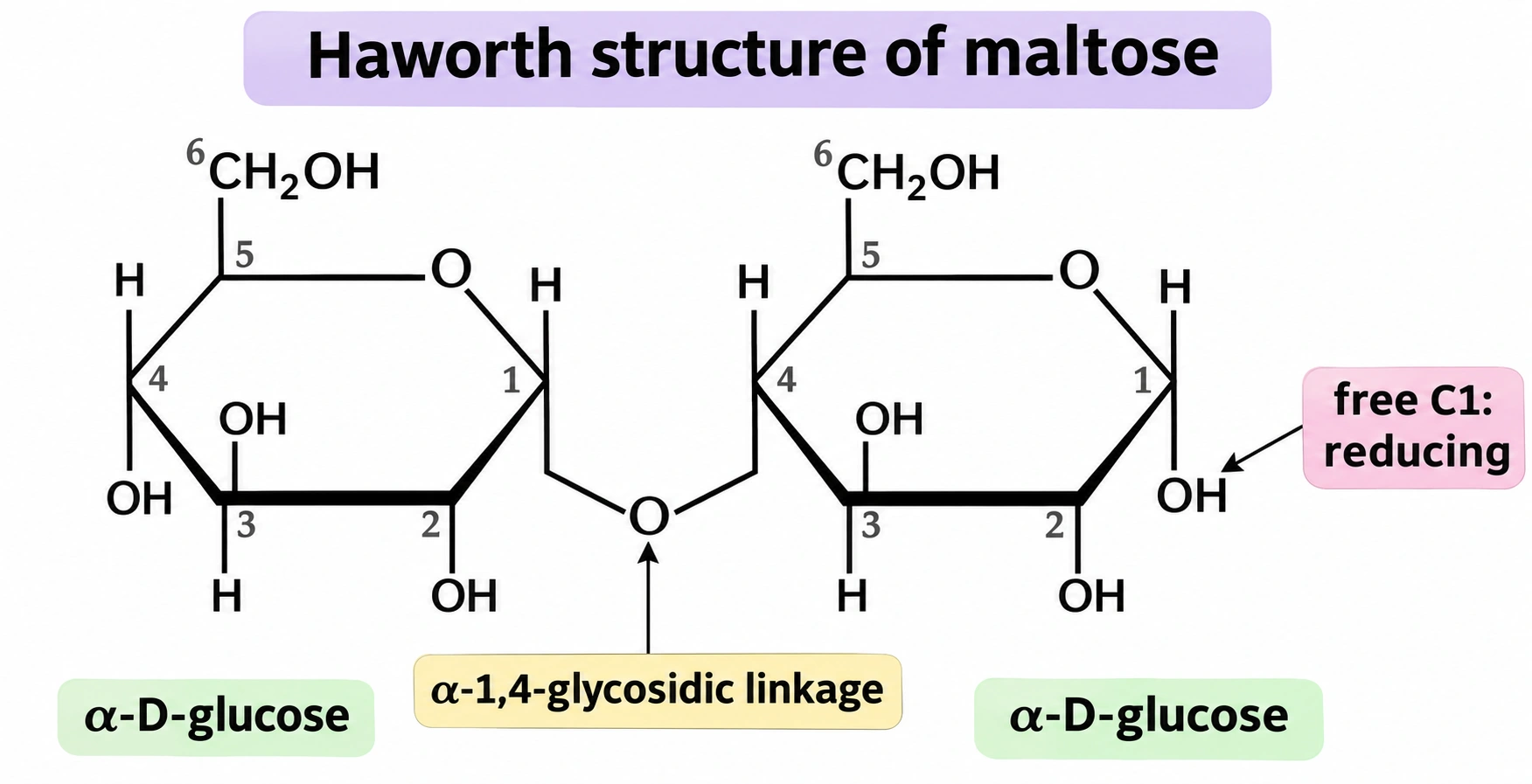
Marks: correct Haworth structure 2.
Answers: Part C
Question 26: Write the balanced chemical equations involved in the manufacture of potassium dichromate from chromite ore.
Answer. Step 1: Chromite ore is fused with sodium carbonate in free access of air, giving sodium chromate.
Step 2: The sodium chromate solution is acidified, giving sodium dichromate.
Step 3: Sodium dichromate is treated with potassium chloride, giving potassium dichromate.
Marks: 1 for each step. This scheme also accepted for step 2, but 2026 Exam-1 accepted only 2H, so write 2H.
Question 27: (a) Two reasons why transition metals are good catalysts. (2) (b) What are interstitial compounds? (1)
Answer.
(a) Any two of these reasons:
- They show variable oxidation states.
- They have a large surface area for the reactants to stick to.
- They can form complexes (intermediates) with the reactants.
- Their small atoms can hold reactant molecules close together.
(b) Interstitial compounds are formed when small atoms such as H, C or N are trapped inside the crystal lattice of a metal.
Marks: (a) any two reasons, 1 each; (b) 1.
Question 28: On the basis of Valence Bond Theory, explain the hybridisation, geometry and magnetic property of the complex ion [Ni(CN)]. [Given: atomic number of Ni = 28]
Answer. Ni has the configuration [Ar] 3d. CN is a strong field ligand, so the two unpaired 3d electrons pair up and one 3d orbital becomes empty. One 3d orbital, the 4s orbital and two 4p orbitals hybridise to give dsp hybrid orbitals, which accept four electron pairs from the four CN ions.
Geometry: square planar
Magnetic property: there are no unpaired electrons, so it is diamagnetic.
Marks: explanation with hybridisation 1, geometry 1, magnetic property 1.
Question 29: (a) Energy level diagram for d-orbital splitting in an octahedral complex. (2) (b) Structure of octacarbonyldicobalt(0). (1)
Answer.
(a) In an octahedral field, the five degenerate d orbitals split into a lower set of three, t (d, d, d, at −0.4 ), and an upper set of two, e (d, d, at +0.6 ). The energy gap between them is .
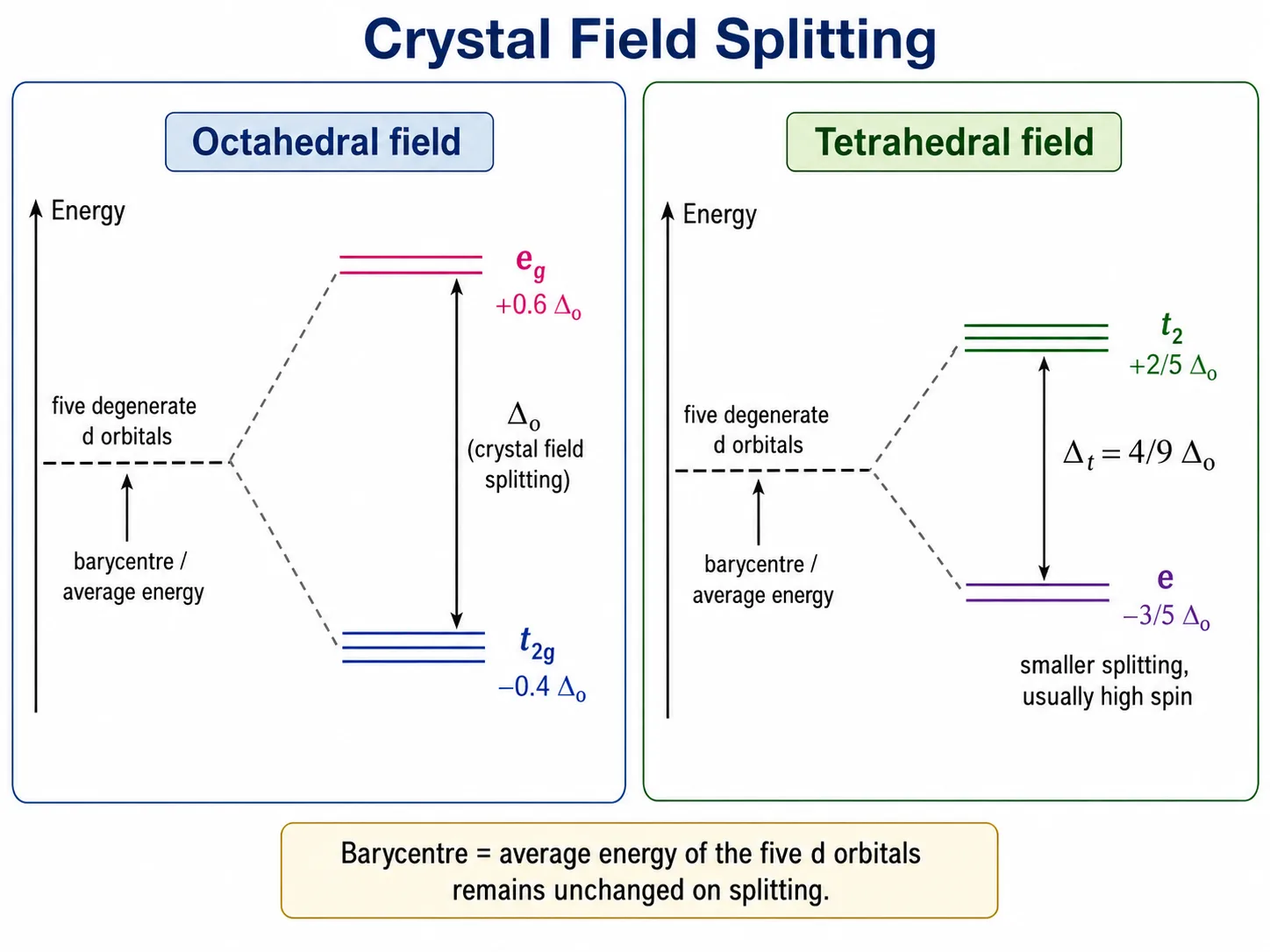
(b) In [Co(CO)], the two Co atoms are joined by a Co–Co bond. Two CO groups bridge the two Co atoms, and each Co has three terminal CO groups.
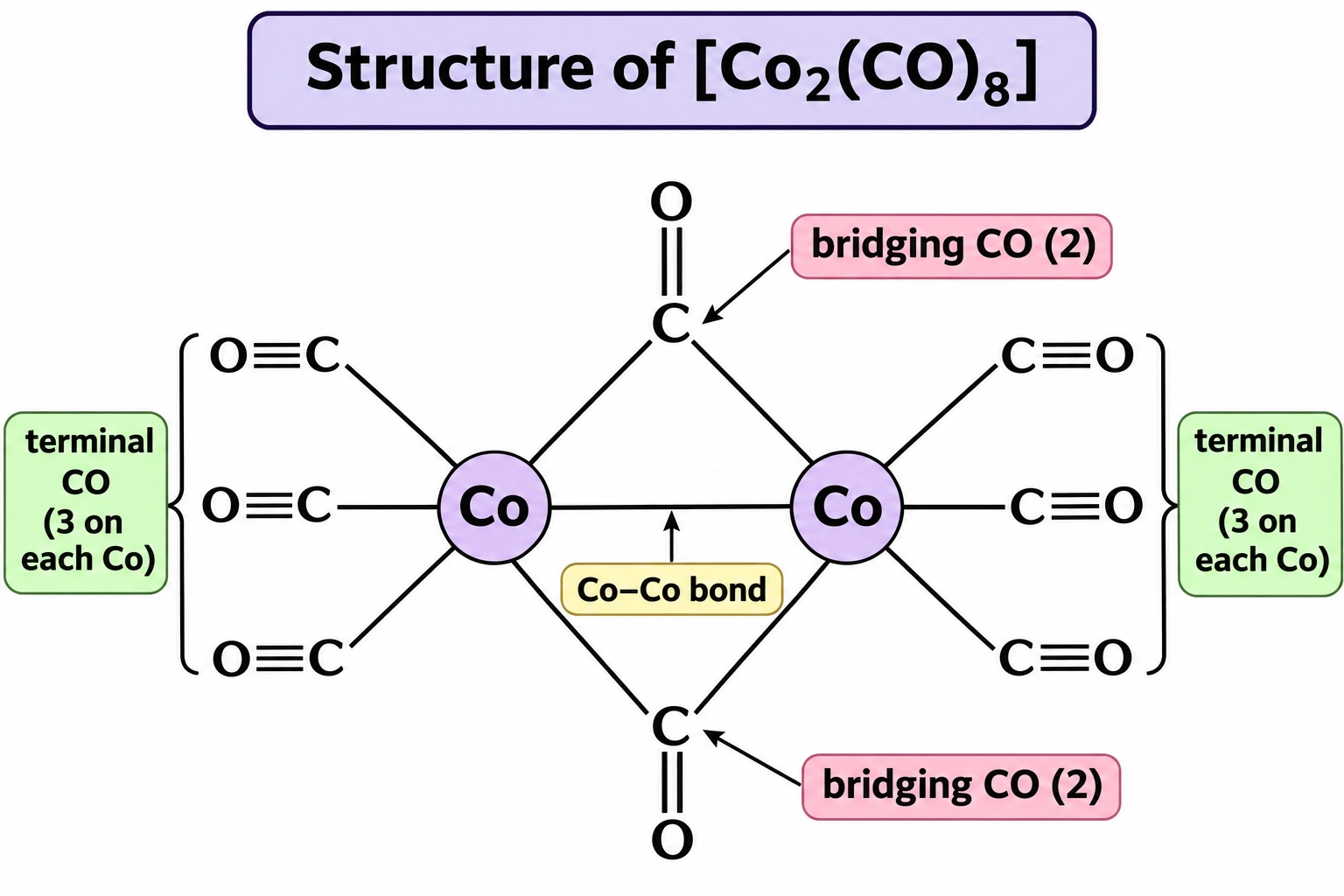
Marks: (a) labelled diagram 2; (b) structure 1.
Question 30: For the complex [Fe(en)Cl]Cl (atomic number of Fe = 26): (a) What is the oxidation state of the metal ion? (b) Mention the coordination number. (c) How many moles of AgNO are required to react with one mole of the complex?
Answer.
(a) Let the oxidation state of Fe be x. Then x + 2(0) + 2(−1) = +1, so x = +3.
(b) Each en uses two donor atoms, so the coordination number is 2 × 2 + 2 = 6.
(c) Only the Cl ion outside the bracket is free, so 1 mole of AgNO is required.
Marks: 1 for each.
Question 31: Write any three differences between ideal and non-ideal solutions.
Answer. Any three of these differences:
| Ideal solutions | Non-ideal solutions |
|---|---|
| They obey Raoult's law at all concentrations. | They do not obey Raoult's law. |
| The A–A, B–B and A–B attractions are the same. | The A–B attractions are different from the A–A and B–B attractions. |
Marks: any three differences, 1 each.
Question 32: Derive an integrated rate equation for the rate constant of a zero order reaction.
Answer. Consider the zero order reaction R → P.
Integrating both sides:
At , , so . Substituting:
Marks: rate expression and integration 1, value of I 1, final equation 1.
Question 33: What are fuel cells? Draw a neat labelled diagram and write the overall cell reaction of the H–O fuel cell.
Answer. Fuel cells are galvanic cells which convert the energy of combustion of fuels such as hydrogen, methane or methanol directly into electrical energy.
Diagram: two porous carbon electrodes containing a catalyst dip in concentrated aqueous KOH or NaOH. H is bubbled in at the anode and O at the cathode.
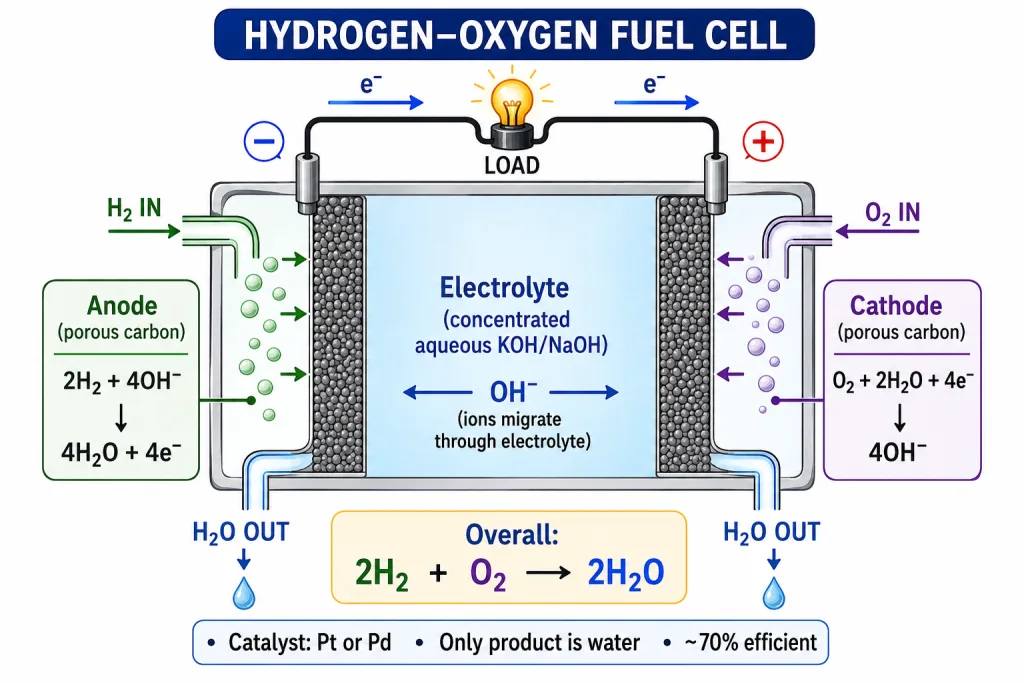
Overall reaction:
Marks: definition 1, diagram 1, overall reaction 1.
Question 34: The Daniell cell converts the chemical energy released during the redox reaction Zn(s) + Cu(aq) → Zn(aq) + Cu(s) to electrical energy and has an electrical potential equal to 1.1 V when the concentrations of Zn and Cu ions are unity. When an external opposite potential greater than 1.1 V is applied to the cell: (i) predict the direction of flow of current; (ii) specify whether zinc is deposited or dissolved at the respective electrode; (iii) what type of cell is it?
Answer. The external potential is now stronger than the cell potential, so the reaction runs in the reverse direction.
(i) Electrons flow from Cu to Zn, so current flows from Zn to Cu.
(ii) Zinc is deposited at the zinc electrode, and copper dissolves at the copper electrode.
(iii) The cell works as an electrolytic cell.
Marks: 1 for each.
Answers: Part D
Question 35: (a) S steps for 2-bromo-2-methylpropane to 2-methylpropan-2-ol. (2) (b) Fittig reaction. (2) (c) Define chirality. (1)
Answer.
(a) The S reaction takes place in two steps.
Step 1 (slow): the C–Br bond breaks and a carbocation is formed.
Step 2 (fast): OH attacks the carbocation.
(b) When an aryl halide is heated with sodium in dry ether, two aryl groups join and a diaryl compound is formed. This is the Fittig reaction.
(c) An object which cannot be superimposed on its mirror image is called chiral, and this property is called chirality.
Marks: (a) 1 for each step (reversible arrows also accepted); (b) statement 1, equation 1; (c) 1.
Question 36: (a) Mechanism of acid-catalysed dehydration of ethanol to ethene. (3) (b) Complete: (i) phenol with NaCrO/HSO; (ii) phenol + 3Br → ? + 3HBr. (2)
Answer. This is the same question as Q38 of 2026 Exam-1.
(a) The acid-catalysed dehydration of ethanol takes place in three steps.
Step 1: Protonation of ethanol.
Step 2: Loss of water to form a carbocation.
Step 3: Loss of a proton to form ethene.
(b) (i) Phenol is oxidised to benzoquinone (p-benzoquinone).
(ii) The product is 2,4,6-tribromophenol.
Marks: (a) 1 for each step, and the charges were strictly expected; (b) 1 for each product.
Question 37: (a) Reactions showing that glucose has (i) five –OH groups, (ii) an aldehyde group. (2) (b) Essential amino acids, with an example. (2) (c) The base in RNA but not in DNA. (1)
Answer.
(a) (i) On acetylation with acetic anhydride, glucose gives glucose pentaacetate. This shows that glucose has five –OH groups.
(ii) On mild oxidation with bromine water, glucose gives gluconic acid, a six-carbon acid. This shows that the carbonyl group is an aldehyde group.
(b) Amino acids which the body cannot make and must get from food are called essential amino acids. Example: valine (or lysine, leucine, arginine).
(c) Uracil is found in RNA but not in DNA.
Marks: (a) 1 for each reaction; (b) definition 1, example 1; (c) 1.
Question 38: (a) Methanamine by Hofmann bromamide degradation. (2) (b) Benzenediazonium chloride to p-aminoazobenzene. (2) (c) IUPAC name of (CH)N–CH. (1)
Answer.
(a) When acetamide is heated with bromine and aqueous (or ethanolic) NaOH, methanamine is formed. The amine has one carbon atom less than the amide. This is Hofmann bromamide degradation.
(b) Benzenediazonium chloride couples with aniline at the para position, giving p-aminoazobenzene, a yellow dye.
(c) N,N-Dimethylethanamine
Marks: (a) statement 1, equation 1; (b) statement 1, equation 1; (c) 1.
Question 39: (a) Benzoyl chloride to benzaldehyde: equation and name. (3) (b) Aldol condensation with an example. (2)
Answer.
(a) Benzoyl chloride is hydrogenated over palladium on barium sulphate to give benzaldehyde.
This is Rosenmund reduction.
(b) Aldehydes or ketones having an α-hydrogen, in the presence of dilute alkali, give a β-hydroxy aldehyde (aldol) or β-hydroxy ketone (ketol). On heating, this loses water to give an α,β-unsaturated aldehyde or ketone. This is aldol condensation.
Marks: (a) statement 1, equation 1, name 1; (b) statement 1, example 1.
Question 40: Benzoic ethanoic anhydride hydrolyses to A and B; B with Cl/red P gives C; A with concentrated HNO and HSO gives D. Identify A to D, and say which of A and B has the higher pK. (5)
Answer. Benzoic ethanoic anhydride is hydrolysed to two acids.
B undergoes the HVZ reaction, so it has α-hydrogens: B is ethanoic acid. So A is benzoic acid, and its –COOH group directs nitration to the meta position.
| Compound | Formula | |
|---|---|---|
| A | Benzoic acid | CHCOOH |
| B | Ethanoic acid | CHCOOH |
| C | Chloroethanoic acid | ClCHCOOH |
| D | 3-Nitrobenzoic acid | m-ON–CH–COOH |
B (ethanoic acid) has the higher pK. It is the weaker acid, because the –CH group pushes electrons towards the carboxylate ion and makes it less stable.
Marks: 1 for each of A to D; higher pK 1.
Answers: Part E
Question 41: 2.00 g of a non-electrolyte solute dissolved in 100 g of benzene lowered the freezing point of benzene by 0.40 K. The freezing point depression constant of benzene is 5.12 K kg mol. Find the molar mass of the solute.
Answer.
Given: = 2.00 g; = 100 g; = 0.40 K; = 5.12 K kg mol
To find: Molar mass of the solute,
Formula:
Substitution:
Answer: Molar mass of the solute = 256 g mol
Marks: formula 1, substitution 1, answer with unit 1.
Question 42: For the cell in which the reaction 2Fe(aq) + 2I(aq) → 2Fe(aq) + I(s) occurs, E° = 0.230 V at 298 K. Calculate the value of log K (K = equilibrium constant) of the cell reaction.
Answer. This is the same problem as Q43 of 2026 Exam-1.
Given: = 0.230 V; n = 2; T = 298 K
To find: log
Formula:
Substitution:
Answer: log = 7.78
Marks: formula 1, substitution 1, answer 1.
Question 43: The rate constants of a reaction at 500 K and 700 K are 0.04 s and 0.08 s respectively. Calculate the value of E for the reaction. (Given: R = 8.314 J K mol)
Answer.
Given: = 0.04 s at = 500 K; = 0.08 s at = 700 K; R = 8.314 J K mol
To find: Energy of activation,
Formula:
Substitution: , so
Answer: = 10086 J mol (10.09 kJ mol)
Marks: formula 1, substitution 1, answer with unit 1.
Question 44: A first order reaction has a half-life of 23 min. How much time will be needed for 30% completion of the reaction?
Answer.
Given: = 23 min. Taking = 100, after 30% completion = 70
To find: Time for 30% completion, t
Formulae: and
Substitution: = 0.0301 min;
Answer: Time for 30% completion = 11.8 min
Marks: k 1, substitution 1, answer with unit 1.
Question 45: HS, a toxic gas with a rotten egg like smell, is used for qualitative analysis. If the solubility of HS in water at STP is 0.195 m, calculate Henry's law constant. (Given: p at STP is 0.987 bar)
Answer.
Given: Solubility of HS = 0.195 m, that is, 0.195 mol in 1 kg (1000 g) of water; = 0.987 bar; moles of water = = 55.55 mol
To find: Henry's law constant,
Formulae: and
Substitution: = 0.00350;
Answer: = 282 bar (282.8 bar if x is rounded to 0.00349; both are accepted)
Marks: mole fraction 1, substitution 1, answer with unit 1.
Question 46: The molar conductivity of 0.025 mol L methanoic acid is 46.1 S cm mol. Calculate its degree of dissociation. Given: = 349.6 S cm mol and = 54.6 S cm mol.
Answer.
Given: C = 0.025 mol L; = 46.1 S cm mol; = 349.6 S cm mol; = 54.6 S cm mol
To find: Degree of dissociation,
Formulae: and
Substitution: = 404.2 S cm mol;
Answer: Degree of dissociation = 0.114 (it has no unit)
Marks: 1, substitution 1, answer 1.