
About This Paper
This is the third and last 2025 exam (Exam-3). Its official scheme isn't in our set, so the mark splits follow the board's other schemes.
Sit it in 3 hours before you look at any answer. Much of it repeats Exam-1 and Exam-2, so it is also a check on those two papers.
Watch for: Q14 (what benzaldehyde is reduced to in Cannizzaro's reaction) and Q40 (a chain from toluene to benzamide). Two Part E problems repeat word for word: the NO rate constant and the 450/700 mm Hg vapour pressure problem.
A few questions were printed with small errors (such as "PtBr 4NH" in Q13); they are shown corrected below. Part F (alternate questions for visually challenged students) is not included.
Question Paper: Part A
I. Select the correct option from the given choices. (15 × 1 = 15)
1. The unit of rate constant of a zero order reaction is
(a) s
(b) mol L s
(c) mol L s
(d) mol L s
2. In a complex, the ligand that shows linkage isomerism is
(a) NO
(b) NH
(c) CO
(d) HN–CH–CH–NH
3. The product obtained when I reacts with KMnO in faintly alkaline or neutral medium is
(a) IO
(b) IMnO
(c) I
(d) IO
4. The reagent used in Sandmeyer's reaction is
(a) CuCl
(b) Cu and HCl
(c) CuCl
(d) CuCl
5. The mass percentage (w/w) of glucose in water is 10% means
(a) 10 g of glucose dissolved in 100 g of water
(b) 10 g of glucose dissolved in 10 g of water
(c) 10 g of glucose dissolved in 90 g of water
(d) 10 g of glucose dissolved in 90 mL of water
6. Cell wall of bacteria is made of
(a) Fructose
(b) Glycogen
(c) Starch
(d) Cellulose
7. The most basic amine in aqueous solution is
(a) Methyl amine
(b) dimethylamine
(c) trimethylamine
(d) tetramethylammonium ion
8. The method used to separate products obtained when phenol reacted with dilute HNO at low temperature is
(a) Simple distillation
(b) Sublimation
(c) Crystallisation
(d) Steam distillation
9. In monobromination of phenol, the polarisation of Br molecule takes place
(a) Only in the presence of strong acid
(b) Even in the absence of Lewis acid
(c) Only in the presence of Lewis acid
(d) Only in the presence of strong base
10. On assuming complete dissociation, the aqueous solution having highest freezing point is
(a) 2 M KCl (i ≈ 2)
(b) 2 M KSO (i ≈ 3)
(c) 2 M Al(SO) (i ≈ 5)
(d) 2 M K[Fe(CN)] (i ≈ 4)
11. The alkyl halide that produces a racemic mixture in S@@GYANGHAR_MATH@@321 reaction is
(a) tertiary butyl bromide
(b) 2-Chlorobutane
(c) Isopropyl chloride
(d) Methyl chloride
12. Statement I: NaCl and MgSO have the same value of constant 'A' in the plot of Λ against c. Statement II: All electrolytes of a particular type have the same value of 'A'.
(a) Both statement I and II are correct
(b) Both statement I and II are incorrect
(c) Statement I is correct but statement II is incorrect
(d) Statement I is incorrect but statement II is correct
13. A coordination complex with composition PtBr·4NH on reacting with excess of AgNO produces two moles of AgBr precipitate. The secondary and primary valence of the metal ion in this complex are
(a) 4 and 4
(b) 6 and 2
(c) 6 and 4
(d) 4 and 2
14. In Cannizzaro reaction, benzaldehyde is reduced to produce
(a) Sodium benzoate and benzyl alcohol
(b) Benzoic acid and benzyl alcohol
(c) Sodium benzoate only
(d) Benzyl alcohol only
15. A tripeptide contains
(a) Three amino acids and two peptide linkages
(b) Three amino acids and three peptide linkages
(c) Two amino acids and three peptide linkages
(d) Three amino acids and four peptide linkages
II. Fill in the blanks by choosing the appropriate word from those given in the brackets. (5 × 1 = 5)
[One, Cu, two, decreases, ketones, Aldehydes]
16. As temperature increases, solubility of gases in liquids __.
17. Number of hydroxyl groups present in ethylene glycol is __.
18. The number of lone pairs of electrons present on the nitrogen atom in dimethylamine is __.
19. The element of 3d series to have positive standard electrode potential is __.
20. Secondary alcohol on oxidation produces __.
Question Paper: Parts B to E
Part B
III. Answer any three of the following. Each question carries 2 marks. (3 × 2 = 6)
21. Define collision frequency. Mention any one factor that affects effective collisions.
22. Name the two main transition metals found in 'UK silver' coins.
23. Name two fat-storing tissues found in the human body that store fat-soluble vitamins.
24. Explain Fittig reaction with suitable chemical equation.
25. Classify anisole and methoxymethane into simple ether and mixed ether.
Part C
IV. Answer any three of the following. Each question carries 3 marks. (3 × 3 = 9)
26. Using Valence Bond Theory (VBT), explain hybridisation, magnetic property and geometry of [Ni(CN)]. (Atomic no. of Ni is 28)
27. Write the balanced chemical equations for the manufacture of potassium dichromate from chromite ore.
28. Write any three postulates of Werner's theory.
29. (a) Name two trivalent lanthanoid ions that are colourless. (2)
(b) What type of lanthanoid compounds are employed as catalysts in petroleum cracking? (1)
30. How many square pyramidal units are present in decacarbonyldimanganese(0)? Write its chemical formula and structure.
V. Answer any two of the following. Each question carries 3 marks. (2 × 3 = 6)
31. What are colligative properties? Name the colligative property expressed in terms of mole fraction. Write the mathematical equation of that colligative property.
32. Name the fuel cell used in the Apollo space programme. Write its anodic and cathodic reactions.
33. Derive an integrated rate equation for the rate constant of a first order reaction.
34. (a) State Faraday's first law of electrolysis. (1)
(b) Mention any two factors that determine the products of electrolysis. (2)
Part D
VI. Answer any four of the following. Each question carries 5 marks. (4 × 5 = 20)
35. (a) Write the mechanism of S reaction involved in the hydrolysis of tertiary butyl bromide. Mention the reactant on which the rate of reaction depends in the above reaction. (3)
(b) Explain Zaitsev (Saytzeff) rule with suitable chemical equation. (2)
36. (a) Write the Haworth structure of maltose. (2)
(b) What are globular proteins? Give one example for it. (2)
(c) Name the nitrogen base present in RNA and absent in DNA. (1)
37. (a) Among acetaldehyde and benzaldehyde, which one undergoes aldol condensation reaction? Explain its aldol condensation with equation. (3)
(b) Explain Stephen reaction with suitable chemical equation. (2)
38. (a) Write the steps in the mechanism of acid catalysed hydrolysis of ethene to ethanol. (3)
(b) Between p-nitrophenol and p-cresol, which has the highest pK and which the least pK value? (2)
39. (a) Write the chemical equations involved in Gabriel phthalimide synthesis for the preparation of methylamine. (3)
(b) Name the reducing agent most preferred to reduce nitrobenzene to aniline. Justify your answer. (2)
40. (a) Compound 'A' with formula CH on heating with alkaline KMnO and on further acidification produces compound B. Compound B on heating with ammonia at high temperature gives compound 'C' with formula CHNO. Write the structures of compounds A, B and C. (3)
(b) Do aromatic carboxylic acids undergo Friedel–Crafts reaction? Give the correct reason for it. (2)
Part E
VII. Answer any three of the following. Each question carries 3 marks. (3 × 3 = 9)
41. 400 cm of an aqueous solution of a protein contains 2.52 g of the protein. The osmotic pressure of such a solution at 300 K is found to be 2.57 × 10 bar. Calculate the molar mass of the protein. [R = 0.083 L bar mol K]
42. The following reaction takes place in the cell: Mg(s) + 2Ag (0.0001 M) → Mg (0.2 M) + 2Ag(s). If E° = 3.17 V, calculate E at 298 K.
43. The initial concentration of NO in the first order reaction NO(g) → 2NO(g) + ½O(g) was 1.24 × 10 mol L at 318 K. The concentration of NO after 60 minutes was 0.20 × 10 mol L. Calculate the rate constant of the reaction at 318 K.
44. The vapour pressures of pure liquids A and B are 450 and 700 mm Hg respectively at 350 K. Find out the vapour pressure of solution 'A' if the total vapour pressure of solution is 600 mm Hg.
45. If a current of 0.5 ampere flows through a metallic wire for 2 hours, then how many electrons would flow through the wire?
46. The activation energy for the reaction 2HI(g) → H(g) + I(g) is 209.5 kJ mol at 581 K. Calculate the fraction of molecules of reactants having energy equal to or greater than activation energy.
Answers: Part A
Question 1: Unit of the rate constant of a zero order reaction?
Answer. (c) mol L s. For zero order, rate = k, so k has the same unit as rate: mol L s.
Question 2: Which ligand can show linkage isomerism?
Answer. (a) NO. NO is ambidentate: it can bind through N (nitrito-N) or through O (nitrito-O).
Question 3: I with KMnO in neutral or faintly alkaline medium gives?
Answer. (a) IO. In neutral or faintly alkaline solution, permanganate oxidises iodide all the way to iodate, IO. In acid it stops at I.
Question 4: Reagent used in Sandmeyer's reaction?
Answer. (c) CuCl. Sandmeyer's reaction uses cuprous chloride, CuCl (with HCl). Copper powder with HCl is Gattermann's reaction.
Question 5: What does 10% (w/w) glucose in water mean?
Answer. (c) 10 g of glucose dissolved in 90 g of water. 10% by mass means 10 g of glucose in 100 g of solution, so 10 g of glucose in 90 g of water.
Question 6: The cell wall of bacteria is made of?
Answer. (d) Cellulose. The textbook statement is that the cell walls of bacteria and plants are made of cellulose, so that is the expected answer here.
Question 7: Most basic amine in aqueous solution?
Answer. (b) dimethylamine. In water, the balance of the +I effect, hydrogen bonding of the ion and crowding makes dimethylamine the strongest base of the methylamines. The tetramethylammonium ion has no lone pair at all.
Question 8: How are the products of phenol with dilute HNO separated?
Answer. (d) Steam distillation. The products are o- and p-nitrophenol. Only the ortho isomer is steam volatile, because of its intramolecular hydrogen bond.
Question 9: In monobromination of phenol, Br is polarised:
Answer. (b) Even in the absence of Lewis acid. The –OH group makes the ring so electron-rich that it polarises Br by itself. No FeBr is needed.
Question 10: Which solution has the highest freezing point?
Answer. (a) 2 M KCl (i ≈ 2). At the same concentration, the smallest i gives the smallest ΔT, and so the highest freezing point. KCl has the smallest i.
Question 11: Which alkyl halide gives a racemic mixture by S@@GYANGHAR_MATH@@201?
Answer. (b) 2-Chlorobutane. Only 2-chlorobutane has a chiral carbon. The flat carbocation is attacked from both faces, giving both enantiomers of butan-2-ol.
Question 12: Statement I: NaCl and MgSO have the same 'A' in the Λ against √c plot. Statement II: all electrolytes of one type have the same 'A'.
Answer. (d) Statement I is incorrect but statement II is correct. 'A' depends on the type of electrolyte. NaCl is 1-1 and MgSO is 2-2, so their A values differ. Statement II is the rule itself.
Question 13: PtBr·4NH gives 2 mol AgBr with excess AgNO. Secondary and primary valence of Pt?
Answer. (d) 4 and 2. Both Br are outside the sphere, so the complex is [Pt(NH)]Br. Four NH give secondary valence 4; two ionisable Br give primary valence 2.
Question 14: In Cannizzaro's reaction, benzaldehyde is reduced to produce?
Answer. (d) Benzyl alcohol only. One molecule is reduced to benzyl alcohol while another is oxidised to sodium benzoate. The question asks only about the reduction, which gives benzyl alcohol.
Question 15: A tripeptide contains?
Answer. (a) Three amino acids and two peptide linkages. Three amino acids in a chain are joined by two –CO–NH– links.
Question 16: As temperature increases, solubility of gases in liquids __.
Answer. decreases. Dissolving a gas gives out heat, so raising the temperature drives gas out of the liquid.
Question 17: Number of hydroxyl groups present in ethylene glycol is __.
Answer. two. Ethylene glycol is ethane-1,2-diol, HO–CH–CH–OH.
Question 18: The number of lone pairs of electrons present on the nitrogen atom in dimethylamine is __.
Answer. One. N makes three bonds (two C, one H) and keeps one lone pair.
Question 19: The element of 3d series to have positive standard electrode potential is __.
Answer. Cu. Cu is the only 3d metal with a positive (+0.34 V).
Question 20: Secondary alcohol on oxidation produces __.
Answer. ketones. A secondary alcohol, RCHOH, loses two H atoms and gives a ketone, RC=O. Primary alcohols give aldehydes.
Answers: Part B
Question 21: Define collision frequency. Mention any one factor that affects effective collisions.
Answer. Collision frequency is the number of collisions per second per unit volume of the reaction mixture.
A factor that affects effective collisions (any one): the colliding molecules must have energy equal to or more than the threshold energy, or they must collide with the proper orientation.
Marks: definition 1, any one factor 1.
Question 22: Name the two main transition metals found in 'UK silver' coins.
Answer. The two metals in "UK silver" coins are copper and nickel. These coins are made of a copper–nickel alloy.
Marks: 1 for each metal.
Question 23: Name two fat-storing tissues found in the human body that store fat-soluble vitamins.
Answer. Fat-soluble vitamins are stored in the liver and in adipose (fat-storing) tissue.
Marks: 1 for each tissue.
Question 24: Explain Fittig reaction with suitable chemical equation.
Answer. When an aryl halide is heated with sodium in dry ether, two aryl groups join and a diaryl compound is formed. This is the Fittig reaction.
Marks: statement 1, equation 1.
Question 25: Classify anisole and methoxymethane into simple ether and mixed ether.
Answer. Anisole, CH–O–CH, has two different groups on the oxygen, so it is a mixed (unsymmetrical) ether.
Methoxymethane, CH–O–CH, has the same group on both sides of the oxygen, so it is a simple (symmetrical) ether.
Marks: 1 for each.
Answers: Part C
Question 26: Using Valence Bond Theory (VBT), explain hybridisation, magnetic property and geometry of [Ni(CN)]. (Atomic no. of Ni is 28)
Answer. Ni has the configuration 3d. CN is a strong field ligand, so the two unpaired 3d electrons pair up and one 3d orbital becomes empty. One 3d orbital, the 4s orbital and two 4p orbitals hybridise and accept four electron pairs from the four CN ions.
Hybridisation: dsp
Magnetic property: all the electrons are paired, so it is diamagnetic.
Geometry: square planar
Marks: hybridisation 1, magnetic property 1, geometry 1.
Question 27: Write the balanced chemical equations for the manufacture of potassium dichromate from chromite ore.
Answer. Step 1: Chromite ore is fused with sodium carbonate in free access of air, giving sodium chromate.
Step 2: The sodium chromate solution is acidified, giving sodium dichromate.
Step 3: Sodium dichromate is treated with potassium chloride, giving potassium dichromate.
Marks: 1 for each step.
Question 28: Write any three postulates of Werner's theory.
Answer. Any three of these postulates:
- In coordination compounds, metals show two types of valency: primary and secondary.
- Primary valency is ionisable and is satisfied by negative ions.
- Secondary valency is non-ionisable and is satisfied by negative ions or neutral molecules. It is equal to the coordination number.
- Secondary valencies point in fixed directions, so they give the complex its shape.
Marks: any three postulates, 1 each.
Question 29: (a) Two colourless trivalent lanthanoid ions. (2) (b) Lanthanoid compounds used as catalysts in petroleum cracking. (1)
Answer.
(a) La (4f) and Lu (4f) are colourless. One has an empty f subshell and the other a completely filled one, so no f–f transition is possible.
(b) Mixed oxides of lanthanoids are used as catalysts in petroleum cracking.
Marks: (a) 1 for each ion; (b) 1.
Question 30: How many square pyramidal units are present in decacarbonyldimanganese(0)? Write its chemical formula and structure.
Answer. Formula: Mn(CO)
It has two square pyramidal Mn(CO) units.
Structure: the two units are joined by an Mn–Mn bond, and there is no bridging CO group. Each Mn has five terminal CO groups, four in a square around it and one along the Mn–Mn axis.
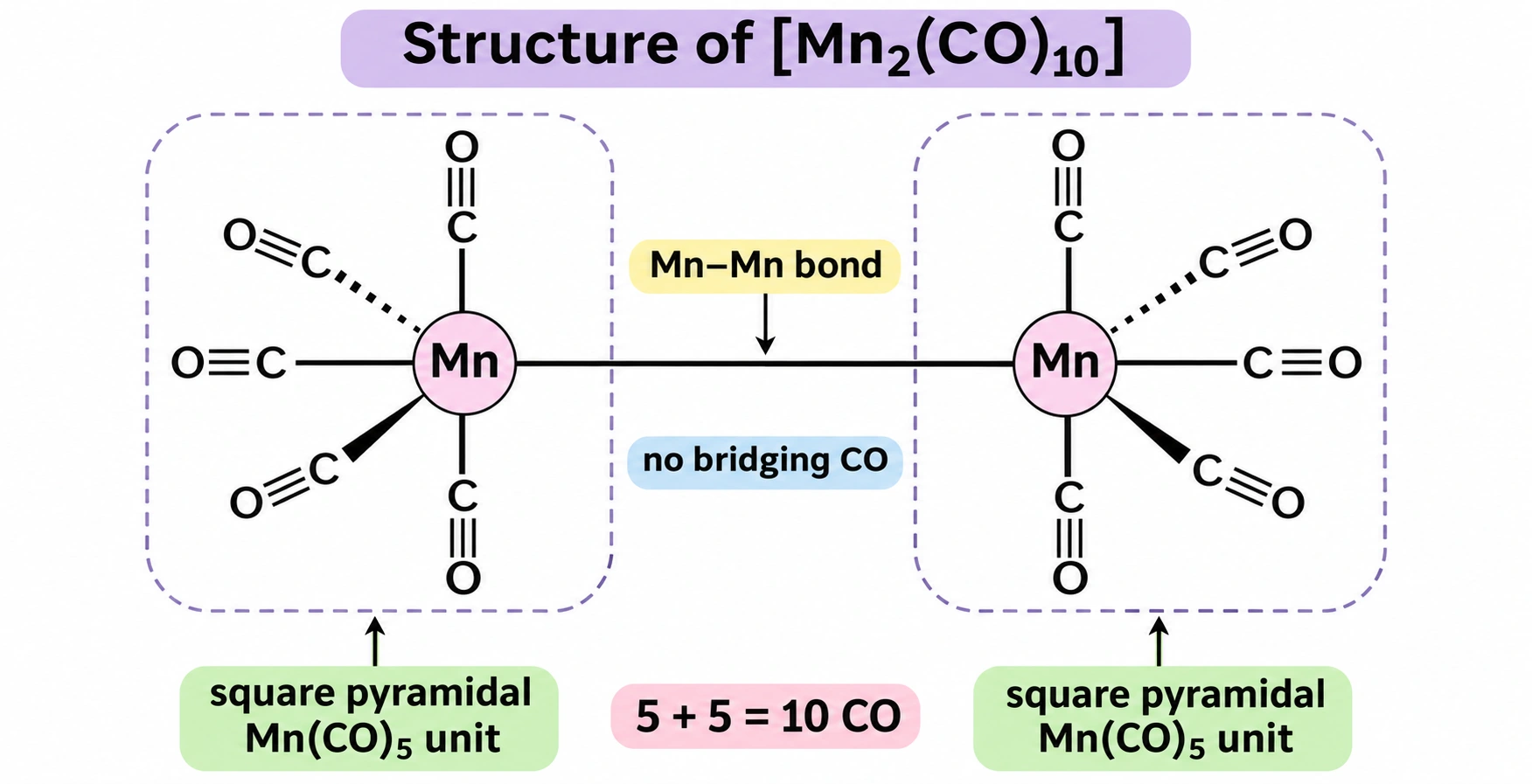
Marks: formula 1, number of units 1, structure 1.
Question 31: What are colligative properties? Name the colligative property expressed in terms of mole fraction. Write the mathematical equation of that colligative property.
Answer. Colligative properties are properties which depend only on the number of solute particles, and not on the nature of the particles.
The colligative property expressed in terms of mole fraction is the relative lowering of vapour pressure.
, where is the mole fraction of the solute.
Marks: definition 1, name 1, equation 1.
Question 32: Name the fuel cell used in the Apollo space programme. Write its anodic and cathodic reactions.
Answer. The hydrogen–oxygen fuel cell was used in the Apollo space programme.
At the anode:
At the cathode:
Marks: name 1, anode 1, cathode 1.
Question 33: Derive an integrated rate equation for the rate constant of a first order reaction.
Answer. Consider the first order reaction R → P.
Integrating both sides:
At , , so . Substituting:
Marks: rate expression 1, integration and value of I 1, final equation 1.
Question 34: (a) Faraday's first law. (1) (b) Two factors that decide the products of electrolysis. (2)
Answer.
(a) Faraday's first law: the amount of chemical change, or the mass of the substance deposited or set free at an electrode, is directly proportional to the quantity of electricity passed through the electrolyte.
(b) Any two of these factors:
- The nature of the material being electrolysed.
- The type of electrodes used (inert like Pt, or reactive).
- The standard electrode potentials of the competing reactions, together with overpotential.
- The concentration of the electrolyte.
Marks: (a) 1; (b) any two factors, 1 each.
Answers: Part D
Question 35: (a) S mechanism for hydrolysis of tert-butyl bromide, and the reactant the rate depends on. (3) (b) Zaitsev's rule with an equation. (2)
Answer.
(a) The S hydrolysis of tert-butyl bromide takes place in two steps.
Step 1 (slow): the C–Br bond breaks and a carbocation is formed.
Step 2 (fast): OH attacks the carbocation.
The rate depends only on the concentration of tert-butyl bromide: rate = k[(CH)CBr].
(b) Zaitsev's rule: in dehydrohalogenation, the main product is the alkene which has the greater number of alkyl groups on the doubly bonded carbon atoms.
Marks: (a) step 1 1, step 2 1, rate dependence 1; (b) statement 1, equation 1.
Question 36: (a) Haworth structure of maltose. (2) (b) Globular proteins, with an example. (2) (c) The base found in RNA but not in DNA. (1)
Answer.
(a) Maltose is made of two α-D-glucose units joined by an α-glycosidic linkage between C-1 of the first unit and C-4 of the second.
Draw two six-membered rings. The groups go up or down as below:
| Carbon | First glucose unit | Second glucose unit |
|---|---|---|
| C-1 | –O– link to C-4 of the second unit (down, α) | OH down (α) |
| C-2 | OH down | OH down |
| C-3 | OH up | OH up |
| C-4 | OH down | –O– link from the first unit |
| C-5 | CHOH up | CHOH up |
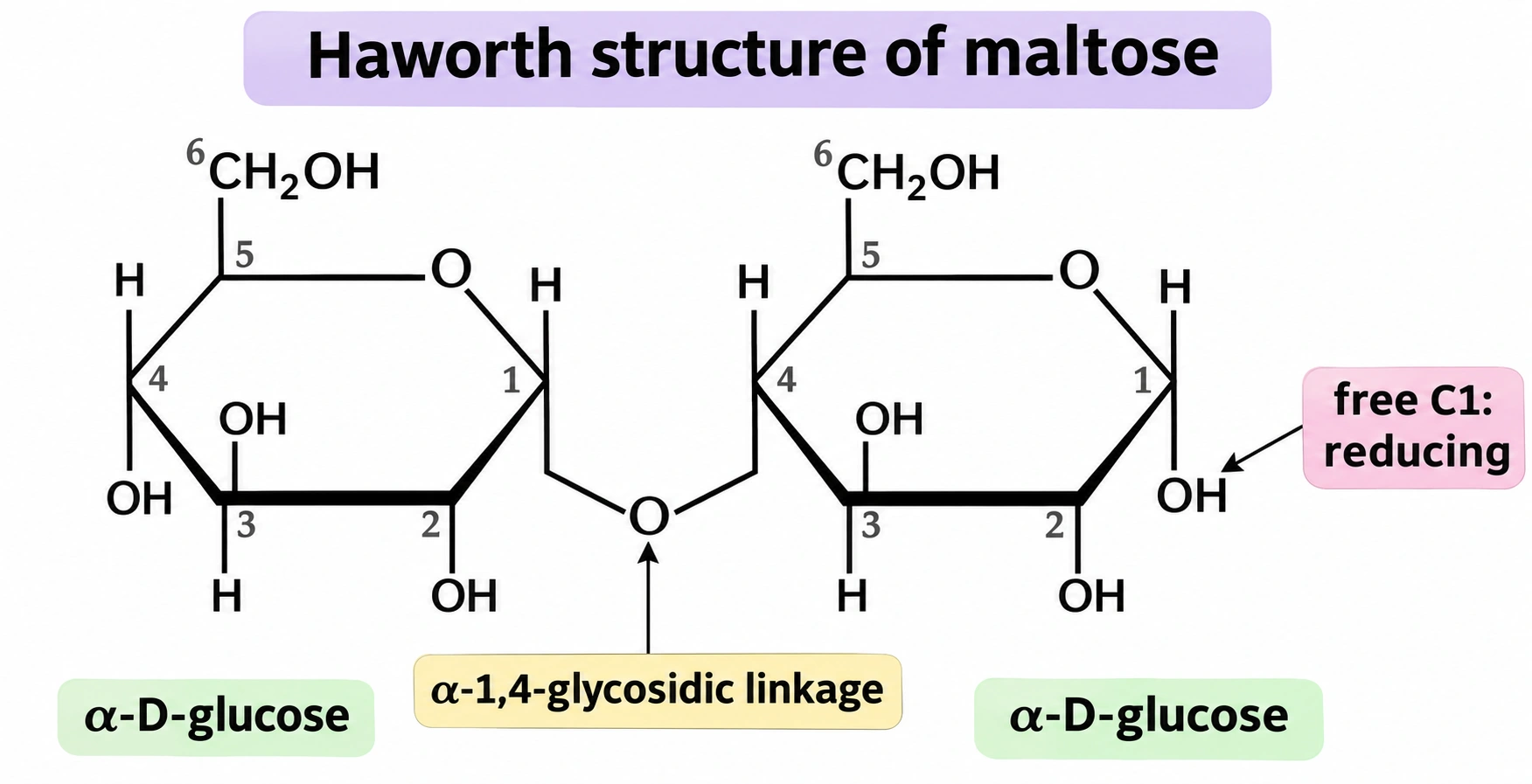
(b) In globular proteins, the polypeptide chains coil around to give a roughly spherical shape. They are usually soluble in water. Example: insulin or albumins.
(c) Uracil is found in RNA but not in DNA.
Marks: (a) units and linkage 1, structure 1; (b) definition 1, example 1; (c) 1.
Question 37: (a) Acetaldehyde or benzaldehyde: which gives aldol condensation? Show it. (3) (b) Stephen reaction. (2)
Answer.
(a) Acetaldehyde gives aldol condensation, because it has α-hydrogens. Benzaldehyde has no α-hydrogen.
With dilute NaOH, two molecules of acetaldehyde combine to form the aldol, 3-hydroxybutanal.
On heating, the aldol loses water and gives but-2-enal.
(b) Nitriles are reduced by stannous chloride and HCl to imines, which on hydrolysis give aldehydes. This is the Stephen reaction.
Marks: (a) acetaldehyde 1, aldol formation 1, dehydration 1; (b) statement 1, equation 1.
Question 38: (a) Mechanism of acid-catalysed hydration of ethene to ethanol. (3) (b) p-Nitrophenol or p-cresol: which has the higher pK, and which the lower? (2)
Answer.
(a) The acid-catalysed hydration of ethene takes place in three steps. Show every charge.
Step 1: Ethene takes a proton from HO and forms a carbocation.
Step 2: Water attacks the carbocation.
Step 3: Loss of a proton gives ethanol.
(The paper uses the word "hydrolysis"; the reaction is hydration.)
(b) p-Cresol has the higher pK, so it is the weaker acid. The –CH group pushes electrons into the ring and makes the phenoxide ion less stable.
p-Nitrophenol has the lower pK, so it is the stronger acid. The –NO group pulls electrons away and stabilises the phenoxide ion.
Marks: (a) 1 for each step; (b) 1 for each with its reason.
Question 39: (a) Gabriel phthalimide synthesis of methylamine. (3) (b) The preferred reducing agent for nitrobenzene to aniline, and why. (2)
Answer.
(a) Gabriel phthalimide synthesis takes place in three steps.
Step 1: Phthalimide reacts with ethanolic KOH to give potassium phthalimide.
Step 2: Potassium phthalimide is heated with methyl iodide to give N-methylphthalimide.
Step 3: Alkaline hydrolysis sets methylamine free.
(b) Iron scrap and HCl is preferred. The FeCl formed gets hydrolysed and gives back HCl, so only a small amount of acid is needed to start the reaction.
Marks: (a) 1 for each step; (b) reagent 1, reason 1.
Question 40: (a) CH (A) with alkaline KMnO, then acid, gives B; B with ammonia at high temperature gives CHNO (C). Identify A, B and C. (3) (b) Do aromatic carboxylic acids undergo Friedel–Crafts reactions? Why? (2)
Answer.
(a) CH with one benzene ring is toluene. Alkaline KMnO oxidises the side chain to –COOH, and heating the acid with ammonia gives the amide.
A = toluene, CHCH
B = benzoic acid, CHCOOH
C = benzamide, CHCONH
(b) No, aromatic carboxylic acids do not undergo Friedel–Crafts reactions. The –COOH group withdraws electrons and deactivates the ring, and the AlCl catalyst gets bound to the carboxyl group.
Marks: (a) 1 for each of A, B and C; (b) answer 1, reason 1.
Answers: Part E
Question 41: 400 cm of an aqueous solution of a protein contains 2.52 g of the protein. The osmotic pressure of such a solution at 300 K is found to be 2.57 × 10 bar. Calculate the molar mass of the protein. [R = 0.083 L bar mol K]
Answer.
Given: = 2.52 g; V = 400 cm = 0.400 L; T = 300 K; = 2.57 × 10 bar; R = 0.083 L bar mol K
To find: Molar mass of the protein,
Formula:
Substitution:
Answer: Molar mass of the protein = 61039 g mol (about 6.1 × 10 g mol)
Marks: formula 1, substitution 1, answer with unit 1.
Question 42: The following reaction takes place in the cell: Mg(s) + 2Ag (0.0001 M) → Mg (0.2 M) + 2Ag(s). If E° = 3.17 V, calculate E at 298 K.
Answer.
Given: = 3.17 V; [Mg] = 0.2 M; [Ag] = 0.0001 M = 10 M; n = 2; T = 298 K
To find:
Formula:
Substitution: and , so
Answer: = 2.95 V
Marks: formula 1, substitution 1, answer with unit 1.
Question 43: The initial concentration of NO in the first order reaction NO(g) → 2NO(g) + ½O(g) was 1.24 × 10 mol L at 318 K. The concentration of NO after 60 minutes was 0.20 × 10 mol L. Calculate the rate constant of the reaction at 318 K.
Answer. This is the same problem as Q41 of 2025 Exam-1.
Given: = 1.24 × 10 mol L; = 0.20 × 10 mol L; t = 60 min
To find: Rate constant, k
Formula:
Substitution:
Answer: Rate constant = 0.0304 min
Marks: formula 1, substitution 1, answer with unit 1.
Question 44: The vapour pressures of pure liquids A and B are 450 and 700 mm Hg respectively at 350 K. Find out the vapour pressure of solution 'A' if the total vapour pressure of solution is 600 mm Hg.
Answer. The printed question asks for "the vapour pressure of solution A". The working below gives both the composition and the partial vapour pressure of A.
Given: = 450 mm Hg; = 700 mm Hg; = 600 mm Hg
To find: Composition, and the partial vapour pressure of A
Formula: and
Substitution: , so = 0.40 and = 0.60;
Answer: Partial vapour pressure of A = 180 mm Hg (and = 700 × 0.60 = 420 mm Hg)
Marks: formula 1, composition 1, vapour pressure with unit 1.
Question 45: If a current of 0.5 ampere flows through a metallic wire for 2 hours, then how many electrons would flow through the wire?
Answer.
Given: I = 0.5 A; t = 2 h = 2 × 3600 = 7200 s; charge on one electron = 1.602 × 10 C
To find: Number of electrons
Formula: Q = It and number of electrons =
Substitution: Q = 0.5 × 7200 = 3600 C; number of electrons = (or )
Answer: Number of electrons = 2.25 × 10
Marks: charge 1, substitution 1, answer 1.
Question 46: The activation energy for the reaction 2HI(g) → H(g) + I(g) is 209.5 kJ mol at 581 K. Calculate the fraction of molecules of reactants having energy equal to or greater than activation energy.
Answer.
Given: = 209.5 kJ mol = 209500 J mol; T = 581 K; R = 8.314 J K mol
To find: Fraction of molecules, x, with energy equal to or greater than
Formula: , so
Substitution:
Answer: x = antilog(−18.832) = 1.47 × 10 (a fraction, so no unit)
Marks: formula 1, substitution 1, answer 1.