
About This Paper
This is the second 2025 exam (Exam-2). Its official scheme isn't in our set, so the mark splits follow the way the board's schemes mark the same kinds of question.
Sit it in 3 hours before you look at any answer, then mark yourself strictly.
Watch for: one-line facts in Part A (the metal in the blood pigment, chlorophyll, vitamin B and Wilkinson's catalyst), two drawings in Part B ([Ni(CO)] with [Co(CO)], and the Haworth structure of lactose), and Q34, the same zero order derivation as Exam-1 Q31.
Part F (alternate questions for visually challenged students) is not included.
Question Paper: Part A
I. Select the correct option from the given choices. (15 × 1 = 15)
1. When compared to the ΔT value of a 0.01 M glucose solution, the ΔT value of 0.01 M MgCl solution
(a) increases about three times
(b) increases about six times
(c) increases about ten times
(d) remains same
2. The product/s obtained during the electrolysis of aqueous sodium chloride solution is/are
(a) H only
(b) Na metal only
(c) Na and Cl
(d) H, Cl and NaOH
3. All natural and artificial radioactive decay of unstable nuclei take place by
(a) zero order kinetics
(b) first order kinetics
(c) second order kinetics
(d) third order kinetics
4. The energy required to form activated complex is known as
(a) Kinetic energy
(b) Potential energy
(c) Activation energy
(d) Collision frequency
5. Which of the following statements is NOT correct?
(a) KMnO oxidises iodide ion to iodine in acid medium
(b) Permanganate is diamagnetic
(c) Copper liberates hydrogen from acids
(d) Ti liberates hydrogen from dilute acids
6. The most stable complex in the following complexes is
(a) [Fe(CO)]
(b) [Fe(CN)]
(c) [Fe(HO)]
(d) [Fe(CO)]
7. Match List-I (complex) with List-II (central metal) and select the correct option. List-I: A. Blood pigment, B. Chlorophyll, C. Vitamin B, D. Wilkinson catalyst. List-II: i) Rh, ii) Co, iii) Mg, iv) Fe.
(a) A – i, B – ii, C – iii, D – iv
(b) A – iv, B – iii, C – ii, D – i
(c) A – iv, B – ii, C – iii, D – i
(d) A – i, B – iii, C – ii, D – iv
8. The main product obtained when alkyl halides react with AgCN is
(a) cyanide
(b) isocyanide
(c) alkyl nitrite
(d) nitroalkane
9. The compound used for the treatment of malaria is
(a) chloroquine
(b) chloramphenicol
(c) halothane
(d) chloroform
10. Which of the following is benzylic alcohol?
(a) CH–CH–CHOH
(b) CH–CH–CH(CH)–OH
(c) CH–CHOH
(d) CHCHOH
11. Among the following, the compound with highest pK value is
(a) o-nitrophenol
(b) phenol
(c) p-nitrophenol
(d) ethanol
12. In Clemmensen reduction, carbonyl compound is treated with
(a) Zinc amalgam + conc. HNO
(b) Zinc amalgam + conc. HCl
(c) Sodium amalgam + conc. HNO
(d) Sodium amalgam + conc. HCl
13. The reagent that can be used to convert benzene diazonium chloride to benzene is
(a) HPO + HO
(b) SnCl/HCl
(c) LiAlH
(d) HPO
14. The final product obtained in ammonolysis of alkyl halides is
(a) quaternary ammonium salt
(b) primary amine
(c) secondary amine
(d) tertiary amine
15. Statement I: All naturally occurring α-amino acids except glycine are optically active. Statement II: Most naturally occurring amino acids have 'D' configuration. Identify the correct option.
(a) Statement I and Statement II are correct
(b) Statement I and Statement II are incorrect
(c) Statement I is correct and Statement II is incorrect
(d) Statement I is incorrect and Statement II is correct
II. Fill in the blanks by choosing the appropriate word from those given in the brackets. (5 × 1 = 5)
[SCN, Cellulose, Starch, Gibbs energy, benzene, nylon-6,6]
16. A catalyst does not alter __.
17. __ is an example of ambidentate ligand.
18. Phenol is converted to __ on heating with zinc dust.
19. Adipic acid is used in the manufacture of __.
20. The most abundant organic substance in plant kingdom is __.
Question Paper: Parts B to E
Part B
III. Answer any three of the following. Each question carries 2 marks. (3 × 2 = 6)
21. What are azeotropes? Give an example.
22. Draw the structures of [Ni(CO)] and [Co(CO)].
23. Explain Fittig reaction with an example.
24. How do you convert isopropylbenzene into phenol? Write equations.
25. Write the Haworth structure of lactose.
Part C
IV. Answer any three of the following. Each question carries 3 marks. (3 × 3 = 9)
26. What are interstitial compounds? Write any two characteristics of them.
27. (a) Calculate the magnetic moment of Fe by using the spin only formula (atomic no. of Fe = 26). (2)
(b) Write the equation for the reaction of lanthanoids with oxygen. (1)
28. Give reason for the following: (a) Zn is colourless. (b) Cerium shows +4 oxidation state. (c) Zr and Hf exhibit similar radii.
29. Write the IUPAC name of [CoCl(en)]. Draw the geometrical isomers of it.
30. Explain the hybridisation, geometry and magnetic property of [Ni(CN)] on the basis of valence bond theory (VBT). (Atomic number of Ni = 28)
V. Answer any two of the following. Each question carries 3 marks. (2 × 3 = 6)
31. (a) State Henry's law. Write its mathematical form. (2)
(b) What is the effect of pressure on solubility of solids in liquids? (1)
32. Write the cathodic, anodic and overall reactions that occur in a fuel cell using H and O.
33. (a) Define molar conductivity. Write its SI unit. (2)
(b) How much electricity (in terms of Faraday) is required for the oxidation of FeO to FeO? (1)
34. Derive an integrated rate equation for the rate constant of a zero order reaction.
Part D
VI. Answer any four of the following. Each question carries 5 marks. (4 × 5 = 20)
35. (a) Aryl halides are less reactive than alkyl halides towards nucleophilic substitution reactions. Give any three reasons for it. (3)
(b) Write the general equation for Finkelstein reaction. What is the role of dry acetone in this reaction? (2)
36. (a) Write the equations for the steps in the mechanism of acid catalysed dehydration of ethanol to ethene. (3)
(b) Complete the following equations: (i) phenol + 3Br → _ + 3HBr (1) (ii) CHBr + CHONa → _ + NaBr (1)
37. (a) Identify the compounds A, B and C: benzene reacts with CO and HCl in the presence of anhydrous AlCl to give A; A is heated with concentrated NaOH to give B + C. (3)
(b) What is the composition of Tollens' reagent? Write its reaction with aldehydes in alkaline medium. (2)
38. (a) Explain Etard reaction with equation. (2)
(b) How will you prepare acetamide from acetic acid? Write the equations. (2)
(c) Between HCHO and CHCHCHO, which is the compound undergoing aldol reaction? (1)
39. (a) Write the equations for the conversion of aniline into 4-bromoaniline. (3)
(b) How do you distinguish between primary amine and secondary amine using Hinsberg's reagent? (2)
40. (a) What is peptide linkage? Write the structure of glycylalanine. (2)
(b) Write the chemical reactions to show that glucose contains (i) six carbon atoms in a straight chain (1) (ii) a primary alcoholic (–OH) group (1)
(c) Name the disease caused by the deficiency of ascorbic acid. (1)
Part E
VII. Answer any three of the following. Each question carries 3 marks. (3 × 3 = 9)
41. Calculate the mole fraction of benzene and carbon tetrachloride in a solution made by dissolving 20 g of benzene in 80 g of carbon tetrachloride. (Molar mass of benzene = 78 g mol, molar mass of carbon tetrachloride = 154 g mol)
42. Determine the amount (in grams) of CaCl (i = 2.47) dissolved in 2.5 L of water such that its osmotic pressure is 0.75 atm at 27 °C. (R = 0.0821 L atm K mol, molar mass of CaCl = 111 g mol)
43. At 25 °C, the reaction 2Fe(aq) + 2I(aq) → 2Fe(aq) + I(s) takes place in a cell which has E° = 0.235 V. Calculate the standard Gibbs energy. (F = 96500 C mol)
44. A solution of Ni(NO) is electrolysed between platinum electrodes using a current of 5 A for 20 min. What mass of Ni is deposited at the cathode? (Atomic mass of Ni = 58.7, F = 96500 C mol)
45. A first order reaction takes 40 min for 25% completion. Calculate the rate constant of the reaction.
46. The rate constant for the first order decomposition of HO is given by log k = 14.34 − 1.25 × 10 K/T. Calculate E for the reaction. (R = 8.314 J K mol)
Answers: Part A
Question 1: ΔT of 0.01 M MgCl compared with 0.01 M glucose?
Answer. (a) increases about three times. MgCl gives three ions (Mg and 2Cl), so i is about 3. Glucose doesn't dissociate (i = 1).
Question 2: Products of electrolysis of aqueous NaCl?
Answer. (d) H, Cl and NaOH. Water is reduced at the cathode (H), Cl is oxidised at the anode (Cl), and NaOH is left in solution. Na metal forms only from molten NaCl.
Question 3: Order of radioactive decay?
Answer. (b) first order kinetics. Radioactive decay is first order: its half-life doesn't depend on how much material is present.
Question 4: The energy needed to form the activated complex is called?
Answer. (c) Activation energy. Activation energy is the extra energy reactants need to reach the activated complex.
Question 5: Which statement is NOT correct? (KMnO and iodide, permanganate magnetism, copper and acids, Ti and acids)
Answer. (c) Copper liberates hydrogen from acids. Copper has a positive standard electrode potential (+0.34 V), so it can't push hydrogen out of acids. The other three are true.
Question 6: Which complex is the most stable?
Answer. (d) [Fe(CO)]. Oxalate is a bidentate ligand and forms rings with Fe. This chelate effect makes the oxalato complex the most stable.
Question 7: Match blood pigment, chlorophyll, vitamin B and Wilkinson's catalyst with their central metals.
Answer. (b) A – iv, B – iii, C – ii, D – i. Haemoglobin has Fe, chlorophyll Mg, vitamin B (cyanocobalamin) Co, and Wilkinson's catalyst Rh.
Question 8: Main product of alkyl halide with AgCN?
Answer. (b) isocyanide. AgCN is mainly covalent, so the cyanide group attacks through nitrogen and gives the isocyanide, R–NC.
Question 9: Which compound is used to treat malaria?
Answer. (a) chloroquine. Chloroquine is an antimalarial. Chloramphenicol is an antibiotic for typhoid; halothane and chloroform are anaesthetics.
Question 10: Which is a benzylic alcohol?
Answer. (c) CH–CHOH. In a benzylic alcohol, the –OH is on a carbon joined directly to the benzene ring. Only CHCHOH has that.
Question 11: Which has the highest pK?
Answer. (d) ethanol. Highest pK means weakest acid. Ethanol is a weaker acid than phenol and the nitrophenols, because its ethoxide ion has no resonance to spread the charge.
Question 12: Reagent for Clemmensen reduction?
Answer. (b) Zinc amalgam + conc. HCl. Zn–Hg with concentrated HCl reduces C=O to CH.
Question 13: Reagent to convert benzene diazonium chloride to benzene?
Answer. (a) HPO + HO. Hypophosphorous acid replaces the –N group with H, giving benzene.
Question 14: Final product of ammonolysis of alkyl halides?
Answer. (a) quaternary ammonium salt. Each amine formed reacts with more alkyl halide, so the chain ends at the quaternary ammonium salt.
Question 15: Statement I: all natural α-amino acids except glycine are optically active. Statement II: most natural amino acids have D configuration.
Answer. (c) Statement I is correct and Statement II is incorrect. Statement I is true. Most natural amino acids have the L configuration, so Statement II is false.
Question 16: A catalyst does not alter __.
Answer. Gibbs energy. A catalyst changes only the path and its activation energy. The energies of reactants and products, and so ΔG, stay the same.
Question 17: __ is an example of ambidentate ligand.
Answer. SCN. Thiocyanate can bind through S or through N.
Question 18: Phenol is converted to __ on heating with zinc dust.
Answer. benzene. Zinc dust removes the oxygen: .
Question 19: Adipic acid is used in the manufacture of __.
Answer. nylon-6,6. Nylon-6,6 is made from adipic acid and hexamethylenediamine.
Question 20: The most abundant organic substance in plant kingdom is __.
Answer. Cellulose. Cellulose makes up plant cell walls, which is why there is more of it than any other organic compound. Starch is a food store, present in much smaller amounts.
Answers: Part B
Question 21: What are azeotropes? Give an example.
Answer. Azeotropes are binary mixtures which have the same composition in the liquid and vapour phases and boil at a constant temperature, so they cannot be separated by fractional distillation.
Example: about 95% ethanol and water (a minimum boiling azeotrope), or 68% nitric acid and water (a maximum boiling azeotrope).
Marks: definition 1, example 1.
Question 22: Draw the structures of [Ni(CO)] and [Co(CO)].
Answer. [Ni(CO)]: it is tetrahedral. Ni is at the centre, and the four CO groups are at the corners of a tetrahedron. Each Ni–C≡O unit is linear.
[Co(CO)]: the two Co atoms are joined by a Co–Co bond. Two CO groups bridge the two Co atoms (each is bonded to both), and each Co also has three terminal CO groups.
In the exam, draw the Ni(CO) tetrahedron. For Co(CO), draw Co–Co with the two bridging C=O groups above and below the bond and three CO groups on each Co.
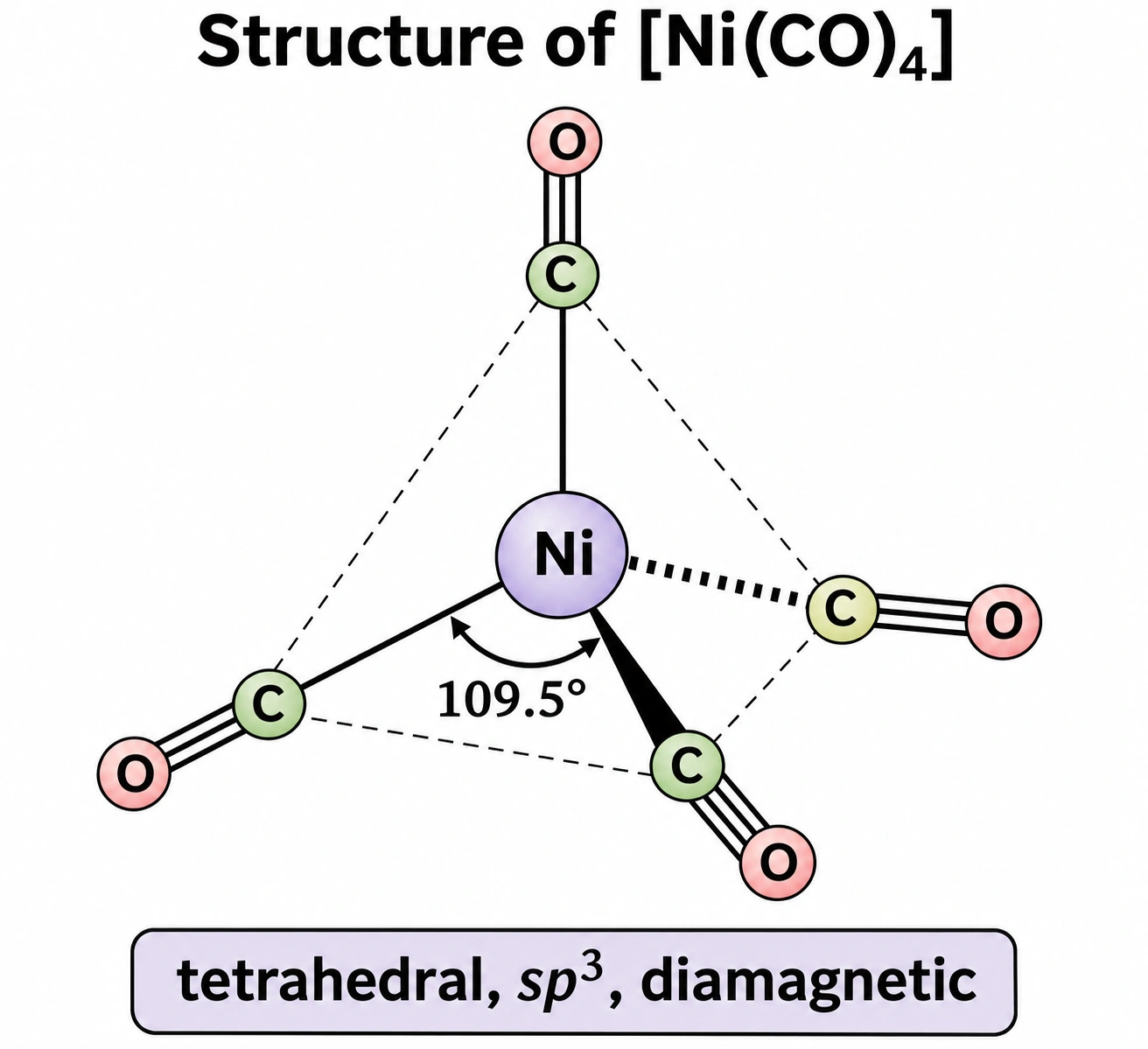
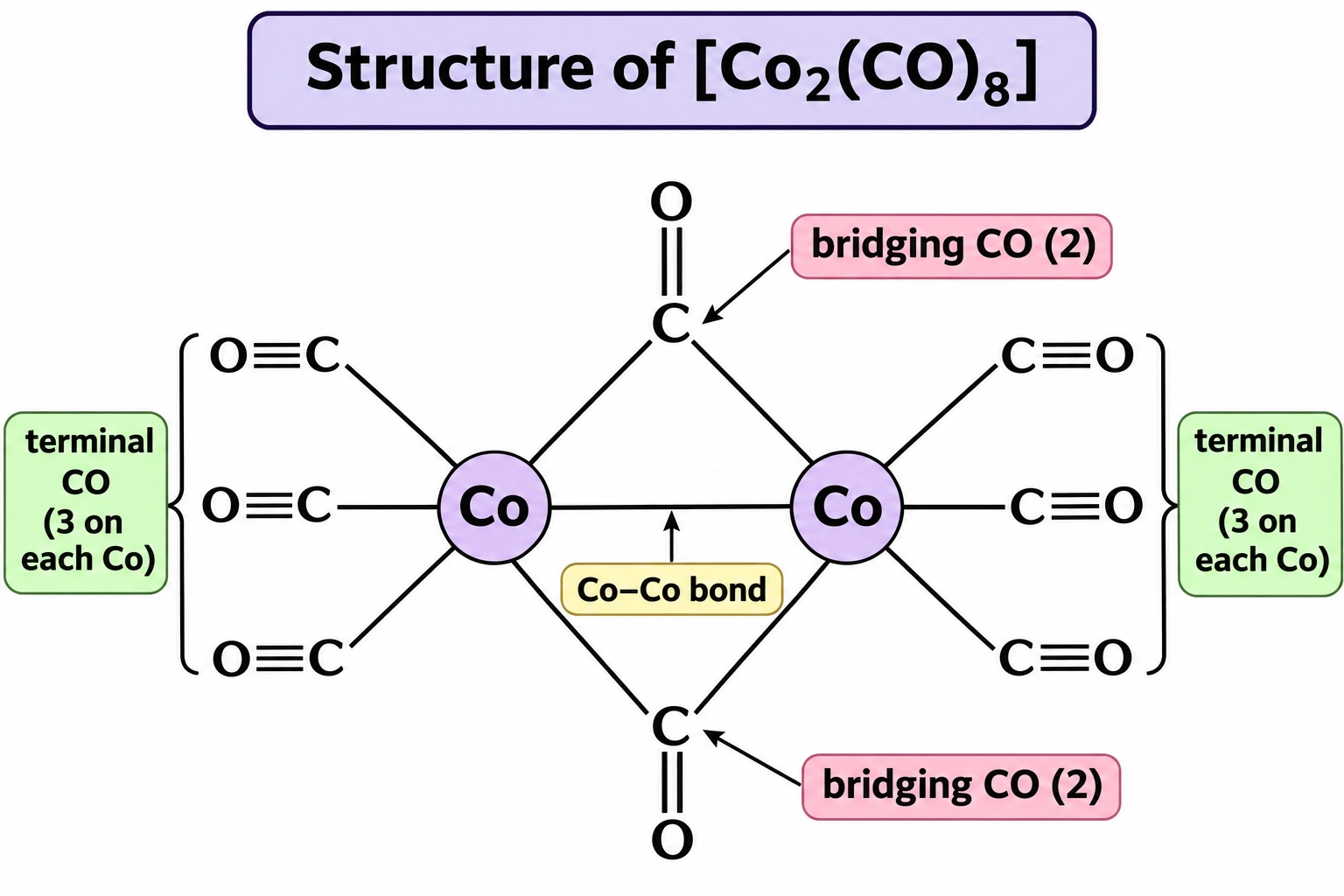
Marks: each structure 1.
Question 23: Explain Fittig reaction with an example.
Answer. When an aryl halide is heated with sodium in dry ether, two aryl groups join and a diaryl compound is formed. This is the Fittig reaction.
Marks: statement 1, equation 1.
Question 24: How do you convert isopropylbenzene into phenol? Write equations.
Answer. Step 1: Isopropylbenzene (cumene) is oxidised by air to cumene hydroperoxide.
Step 2: Cumene hydroperoxide is hydrolysed with dilute acid, giving phenol and acetone.
Marks: each step with its equation 1.
Question 25: Write the Haworth structure of lactose.
Answer. Lactose is made of β-D-galactose and β-D-glucose, joined by a β-glycosidic linkage between C-1 of galactose and C-4 of glucose.
Draw two six-membered rings (five carbons and one ring O), with galactose on the left. The groups above (up) and below (down) the rings are:
| Carbon | β-D-galactose unit | β-D-glucose unit |
|---|---|---|
| C-1 | –O– link to glucose C-4 (up, β) | OH up (β) |
| C-2 | OH down | OH down |
| C-3 | OH up | OH up |
| C-4 | OH up | –O– link from galactose |
| C-5 | CHOH up | CHOH up |
The only difference between the two units is at C-4: galactose has its C-4 OH up, and glucose has it down.
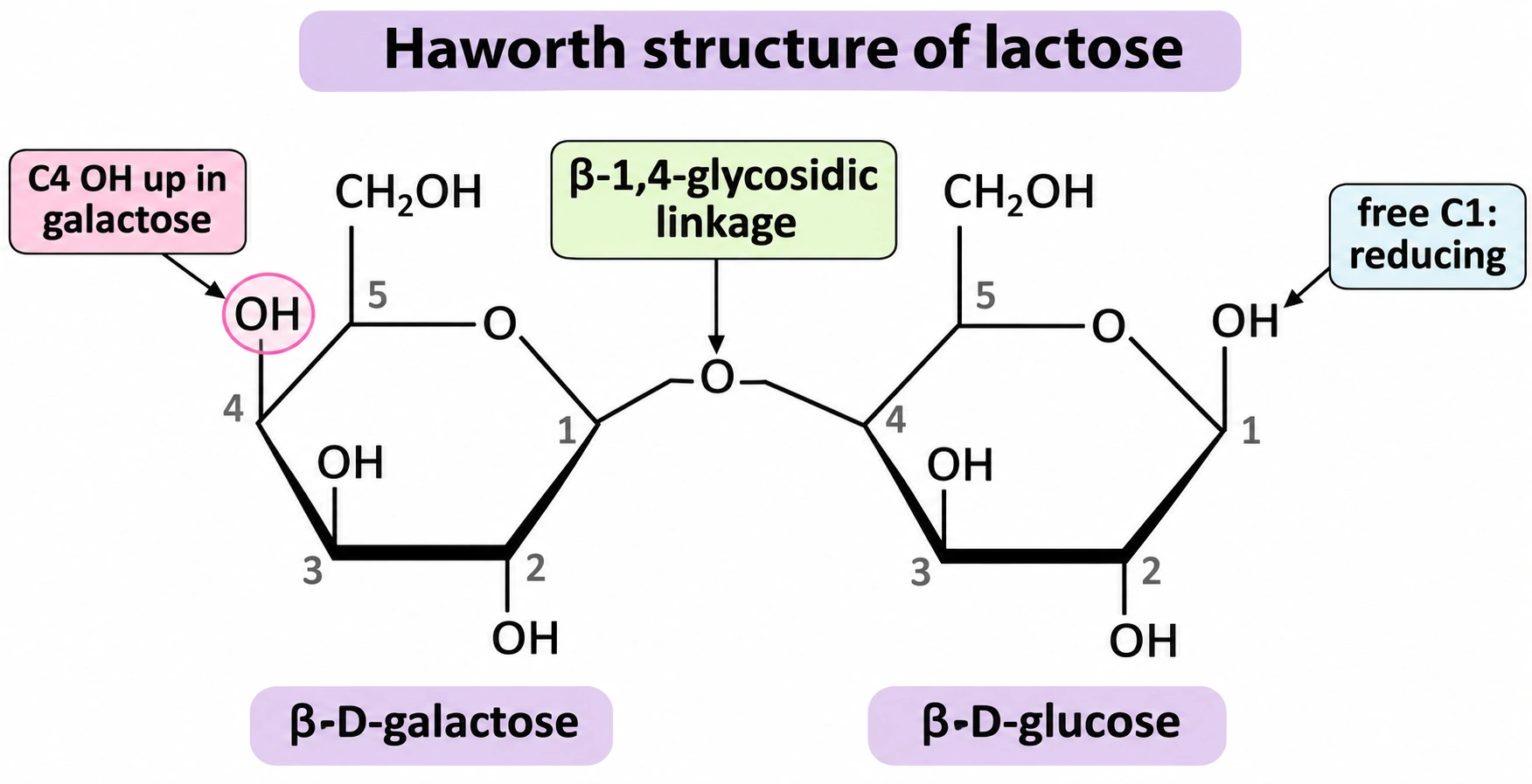
Marks: the two units and the linkage 1, correct ring structure 1.
Answers: Part C
Question 26: What are interstitial compounds? Write any two characteristics of them.
Answer. Interstitial compounds are formed when small atoms such as H, C or N are trapped in the empty spaces (interstitial sites) of the crystal lattice of a metal. Examples: TiC, MnN and FeH.
Any two characteristics:
- They have high melting points, higher than those of the pure metals.
- They are very hard.
- They keep metallic conductivity.
- They are chemically inert.
Marks: definition 1, any two characteristics 1 each.
Question 27: (a) Spin-only magnetic moment of Fe (Fe = 26). (2) (b) Reaction of lanthanoids with oxygen. (1)
Answer.
(a) Fe has the configuration [Ar] 3d, so it has 4 unpaired electrons: n = 4.
= 4.90 BM
(b) Lanthanoids burn in oxygen to form oxides of the type LnO.
Marks: (a) unpaired electrons 1, magnetic moment 1; (b) equation 1.
Question 28: Give reason for the following: (a) Zn is colourless. (b) Cerium shows +4 oxidation state. (c) Zr and Hf exhibit similar radii.
Answer.
(a) Zn has the configuration 3d. Its d subshell is completely filled, so no d–d transition is possible and it does not absorb visible light. So Zn is colourless.
(b) Ce has the stable noble gas configuration of xenon, ">Xe, so cerium shows the +4 oxidation state.
(c) This is due to lanthanoid contraction. The 14 lanthanoids that come before Hf make it shrink to almost the same size as Zr.
Marks: 1 for each reason.
Question 29: Write the IUPAC name of [CoCl(en)]. Draw the geometrical isomers of it.
Answer. The paper left out the charge. The complex ion is [CoCl(en)], with cobalt in the +3 state.
IUPAC name: dichloridobis(ethane-1,2-diamine)cobalt(III) ion
The complex is octahedral, and each en ligand spans two neighbouring corners.
trans isomer: the two Cl ions are opposite each other (top and bottom), and the two en rings lie in the middle plane.
cis isomer: the two Cl ions are next to each other, at 90°, and the en rings take the other four corners.
(The cis form is also optically active, but the question asks only for the geometrical isomers.)
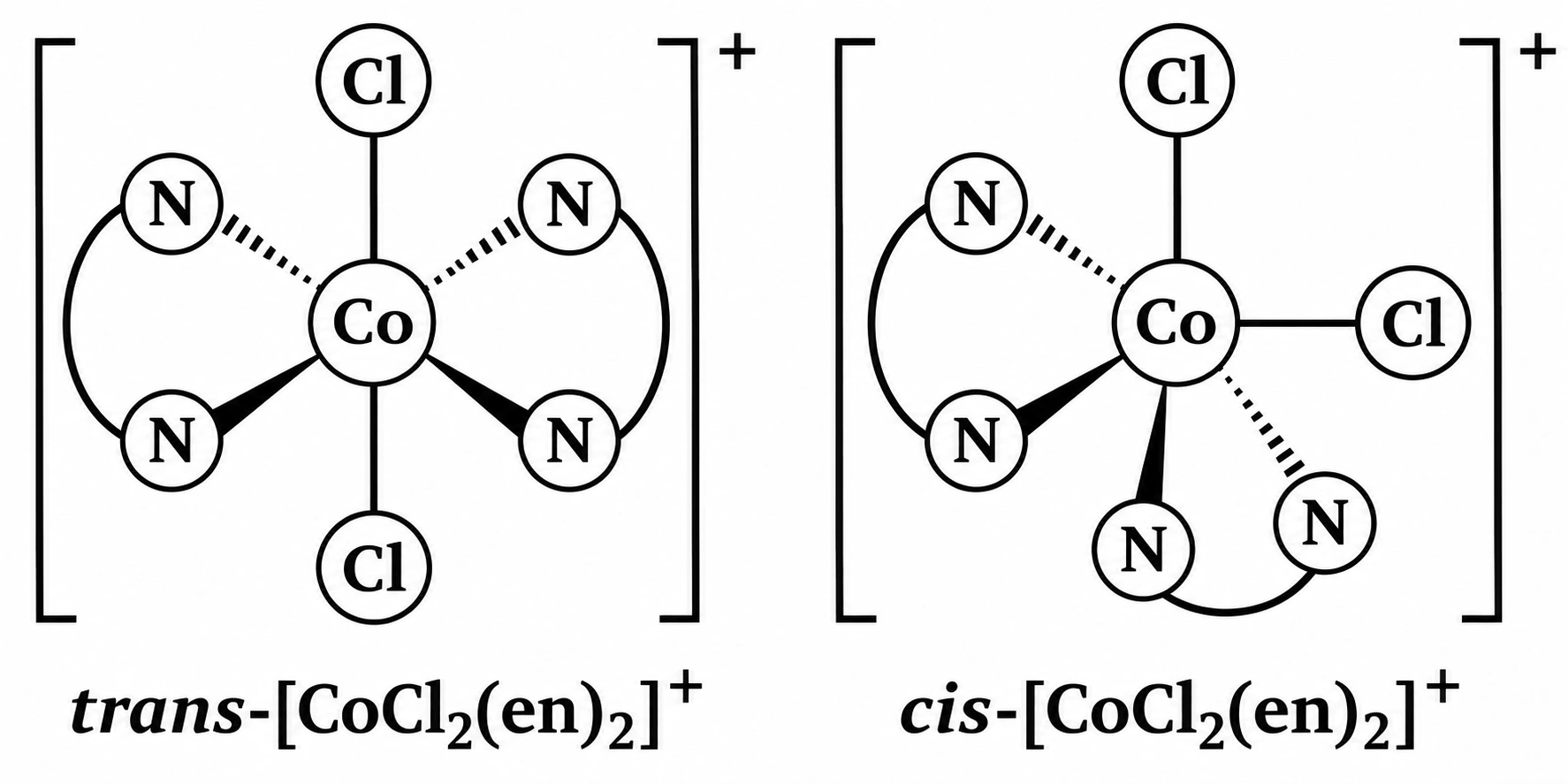
Marks: name 1, trans isomer 1, cis isomer 1.
Question 30: Explain the hybridisation, geometry and magnetic property of [Ni(CN)] on the basis of valence bond theory (VBT). (Atomic number of Ni = 28)
Answer. Ni has the configuration 3d. CN is a strong field ligand, so the two unpaired 3d electrons pair up and one 3d orbital becomes empty. This 3d orbital, the 4s orbital and two 4p orbitals hybridise and accept four electron pairs from the four CN ions.
Hybridisation: dsp
Geometry: square planar
Magnetic property: there are no unpaired electrons, so it is diamagnetic.
Marks: hybridisation 1, geometry 1, magnetic property 1.
Question 31: (a) Henry's law and its mathematical form. (2) (b) Effect of pressure on the solubility of solids in liquids. (1)
Answer.
(a) Henry's law states that the partial pressure of a gas in the vapour phase is proportional to its mole fraction in the solution.
(b) Pressure has no noticeable effect on the solubility of solids in liquids, because solids and liquids are almost incompressible.
Marks: (a) statement 1, mathematical form 1; (b) 1.
Question 32: Write the cathodic, anodic and overall reactions that occur in a fuel cell using H and O.
Answer.
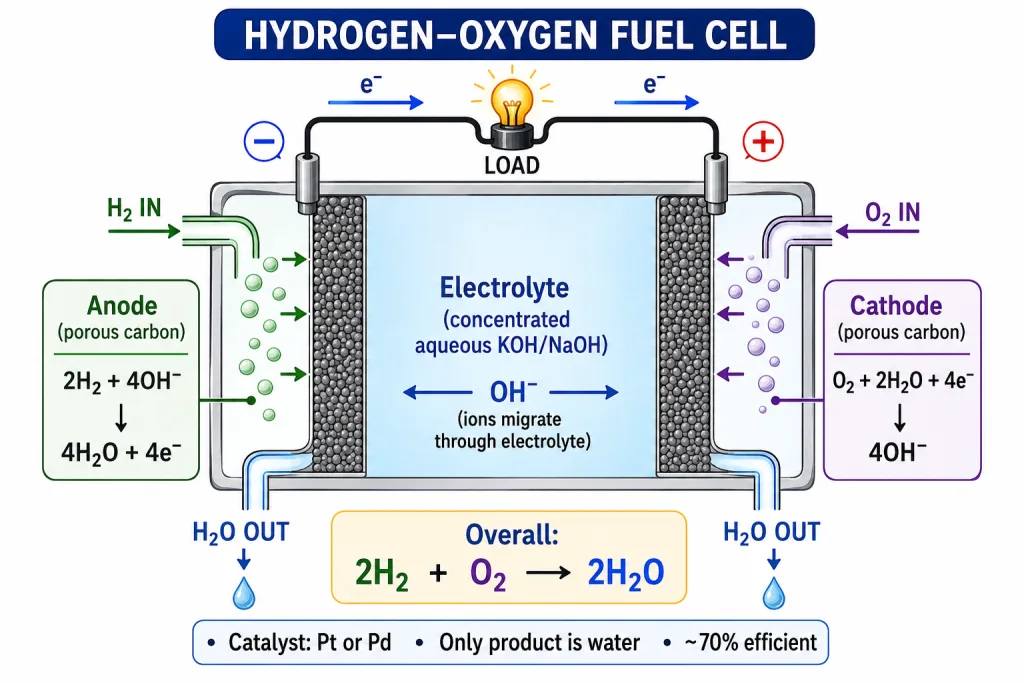
At the cathode:
At the anode:
Overall reaction:
Marks: cathode 1, anode 1, overall 1.
Question 33: (a) Define molar conductivity and give its SI unit. (2) (b) Faradays needed to oxidise FeO to FeO. (1)
Answer.
(a) Molar conductivity is the conductance of the volume of solution which contains one mole of the electrolyte.
SI unit: S m mol
(b) In FeO, iron is +2, and in FeO it is +3. One electron is lost per Fe atom, so 1 F is needed per mole of FeO.
Marks: (a) definition 1, SI unit 1; (b) 1.
Question 34: Derive an integrated rate equation for the rate constant of a zero order reaction.
Answer. Consider the zero order reaction R → P.
Integrating both sides:
At , , so . Substituting:
Marks: rate expression 1, integration and value of I 1, final equation 1.
Answers: Part D
Question 35: (a) Three reasons why aryl halides are less reactive than alkyl halides in nucleophilic substitution. (3) (b) Finkelstein reaction, and the role of dry acetone. (2)
Answer.
(a) Any three of these reasons:
- Resonance: the lone pair on the halogen is in resonance with the benzene ring, so the C–X bond gets partial double bond character and is harder to break.
- sp carbon: the carbon attached to the halogen is sp hybridised, with more s-character, so it holds the halogen more tightly and the bond is shorter.
- Unstable phenyl cation: the phenyl cation is not stabilised, so the S route is not possible.
- Repulsion: the electron-rich benzene ring repels the incoming nucleophile.
(b) When an alkyl chloride or bromide is heated with sodium iodide in dry acetone, an alkyl iodide is formed. This is the Finkelstein reaction.
(X = Cl, Br)
NaCl and NaBr do not dissolve in dry acetone, so they come out as a precipitate and the reaction is pushed forward.
Marks: (a) any three reasons, 1 each; (b) equation 1, role of dry acetone 1.
Question 36: (a) Mechanism of acid-catalysed dehydration of ethanol to ethene. (3) (b) Complete: (i) phenol + 3Br → ? + 3HBr; (ii) CHBr + CHONa → ? + NaBr. (2)
Answer.
(a) The acid-catalysed dehydration of ethanol takes place in three steps. Show every charge.
Step 1: Protonation of ethanol.
Step 2: Loss of water to form a carbocation (slow step).
Step 3: Loss of a proton to form ethene.
(b) (i) 2,4,6-tribromophenol, CHBrOH, a white precipitate.
(ii) Ethoxyethane, CH–O–CH (by Williamson synthesis).
Marks: (a) 1 for each step; (b) 1 for each product.
Question 37: (a) Benzene with CO, HCl and anhydrous AlCl gives A; A heated with concentrated NaOH gives B + C. Identify A, B and C. (3) (b) Composition of Tollens' reagent and its reaction with aldehydes. (2)
Answer.
(a) The first step is the Gattermann–Koch reaction. The second step is Cannizzaro's reaction, because benzaldehyde has no α-hydrogen.
A = benzaldehyde, CHCHO
B = benzyl alcohol, CHCHOH
C = sodium benzoate, CHCOONa
(b) Tollens' reagent is ammoniacal silver nitrate, [Ag(NH)]. An aldehyde reduces it to metallic silver, which deposits as a bright silver mirror.
Marks: (a) 1 for each of A, B and C; (b) composition 1, equation 1.
Question 38: (a) Etard reaction. (2) (b) Acetamide from acetic acid. (2) (c) HCHO or CHCHCHO: which undergoes aldol reaction? (1)
Answer.
(a) Chromyl chloride oxidises the methyl group of toluene to a chromium complex, which is hydrolysed to benzaldehyde. This is the Etard reaction.
(b) Acetic acid reacts with ammonia to give ammonium acetate, which loses water on heating to give acetamide.
(c) CHCHCHO undergoes aldol reaction, because it has α-hydrogens. HCHO has no α-hydrogen.
Marks: (a) statement 1, equation 1; (b) 1 for each step; (c) 1.
Question 39: (a) Aniline to 4-bromoaniline. (3) (b) Telling primary and secondary amines apart with Hinsberg's reagent. (2)
Answer.
(a) The –NH group is so activating that bromine water gives the tribromo product. To stop this, the –NH group is first protected by acetylation.
Step 1: Acetylation of aniline.
Step 2: Bromination of acetanilide.
Step 3: Hydrolysis to 4-bromoaniline.
(b) Hinsberg's reagent is benzenesulphonyl chloride, CHSOCl.
A primary amine gives an N-alkylbenzenesulphonamide. It still has an H atom on nitrogen, which is acidic, so the product dissolves in alkali.
A secondary amine gives an N,N-dialkylbenzenesulphonamide, which has no H atom on nitrogen, so it does not dissolve in alkali.
Marks: (a) 1 for each step; (b) primary amine 1, secondary amine 1.
Question 40: (a) Peptide linkage and the structure of glycylalanine. (2) (b) Reactions showing that glucose has (i) a straight chain of six carbons, (ii) a primary alcohol group. (2) (c) Disease from lack of ascorbic acid. (1)
Answer.
(a) A peptide linkage is the –CO–NH– bond formed when the –COOH group of one amino acid joins the –NH group of another, with the loss of a water molecule.
Structure of glycylalanine: HN–CH–CO–NH–CH(CH)–COOH
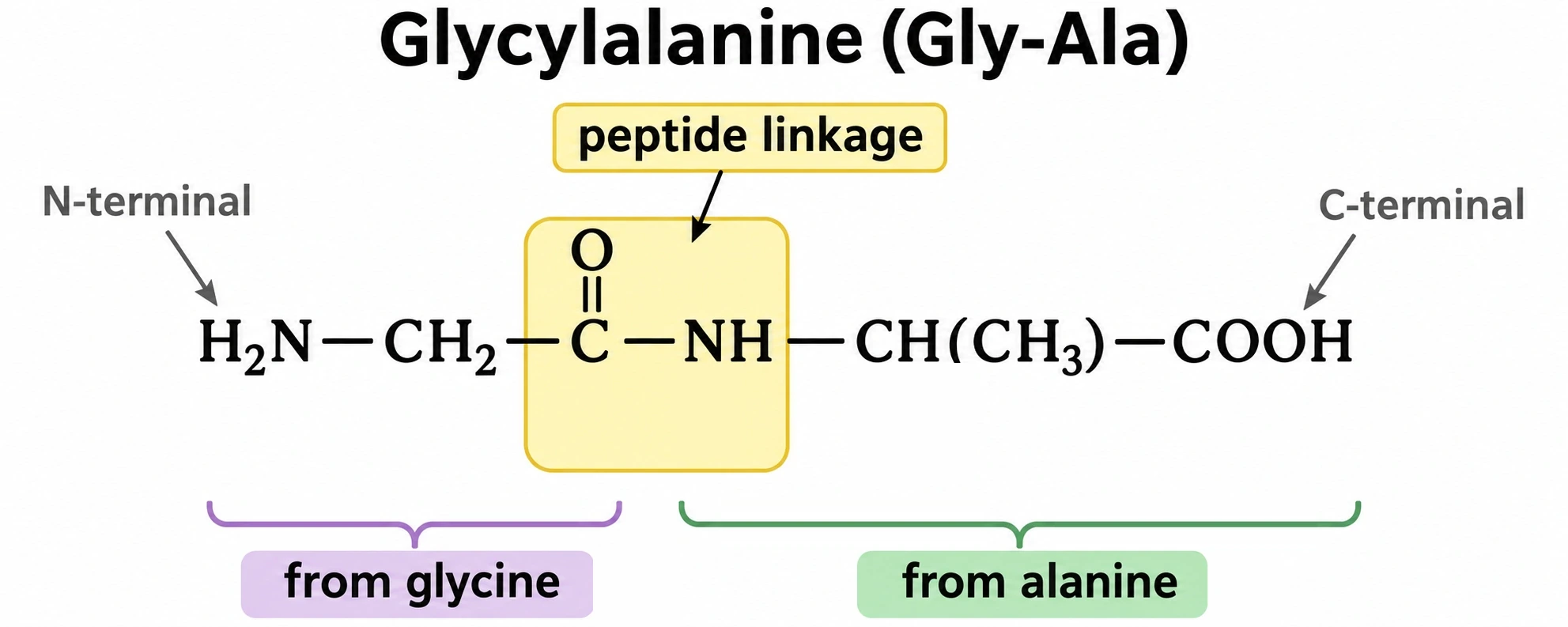
(b) (i) On long heating with HI, glucose gives n-hexane. This shows that its six carbon atoms are in a straight chain.
(ii) Nitric acid oxidises glucose to saccharic acid, HOOC–(CHOH)–COOH, a dicarboxylic acid. The second –COOH group comes from a –CHOH group, so glucose has a primary alcohol group.
(c) Lack of ascorbic acid (vitamin C) causes scurvy.
Marks: (a) definition 1, structure 1; (b) 1 for each reaction; (c) 1.
Answers: Part E
Question 41: Calculate the mole fraction of benzene and carbon tetrachloride in a solution made by dissolving 20 g of benzene in 80 g of carbon tetrachloride. (Molar mass of benzene = 78 g mol, molar mass of carbon tetrachloride = 154 g mol)
Answer.
Given: Mass of benzene = 20 g; mass of CCl = 80 g; molar mass of benzene = 78 g mol; molar mass of CCl = 154 g mol
To find: Mole fractions of benzene and CCl
Formula:
Substitution: mol; mol;
Answer: = 0.33 and = 1 − 0.33 = 0.67 (mole fraction has no unit)
Marks: moles 1, substitution 1, answer 1.
Question 42: Determine the amount (in grams) of CaCl (i = 2.47) dissolved in 2.5 L of water such that its osmotic pressure is 0.75 atm at 27 °C. (R = 0.0821 L atm K mol, molar mass of CaCl = 111 g mol)
Answer.
Given: = 0.75 atm; V = 2.5 L; i = 2.47; T = 27 + 273 = 300 K; R = 0.0821 L atm K mol; molar mass of CaCl = 111 g mol
To find: Mass of CaCl
Formula: , so
Substitution: mol; mass = 0.0308 × 111
Answer: Mass of CaCl = 3.42 g
Marks: formula 1, substitution 1, answer with unit 1.
Question 43: At 25 °C, the reaction 2Fe(aq) + 2I(aq) → 2Fe(aq) + I(s) takes place in a cell which has E° = 0.235 V. Calculate the standard Gibbs energy. (F = 96500 C mol)
Answer.
Given: = 0.235 V; F = 96500 C mol; two electrons move from 2I to 2Fe, so n = 2
To find: Standard Gibbs energy,
Formula:
Substitution:
Answer: = −45355 J mol (−45.36 kJ mol)
Marks: formula 1, substitution 1, answer with unit 1.
Question 44: A solution of Ni(NO) is electrolysed between platinum electrodes using a current of 5 A for 20 min. What mass of Ni is deposited at the cathode? (Atomic mass of Ni = 58.7, F = 96500 C mol)
Answer.
Given: I = 5 A; t = 20 min = 20 × 60 = 1200 s; atomic mass of Ni = 58.7; F = 96500 C mol; , so n = 2
To find: Mass of Ni deposited, w
Formula: Q = It and
Substitution: Q = 5 × 1200 = 6000 C;
Answer: Mass of Ni deposited = 1.825 g
Marks: formula 1, substitution 1, answer with unit 1.
Question 45: A first order reaction takes 40 min for 25% completion. Calculate the rate constant of the reaction.
Answer.
Given: t = 40 min for 25% completion. Taking = 100, after 25% reaction = 75
To find: Rate constant, k
Formula:
Substitution:
Answer: Rate constant = 7.19 × 10 min
Marks: formula 1, substitution 1, answer with unit 1.
Question 46: The rate constant for the first order decomposition of HO is given by log k = 14.34 − 1.25 × 10 K/T. Calculate E for the reaction. (R = 8.314 J K mol)
Answer.
Given: log k = 14.34 − 1.25 × 10 K/T; R = 8.314 J K mol
To find: Energy of activation,
Formula: Compare with the Arrhenius equation,
Substitution: K, so
Answer: = 2.39 × 10 J mol (239.3 kJ mol)
Marks: comparison with the Arrhenius equation 1, substitution 1, answer with unit 1.