
Intra Uterine Devices — The Third Category
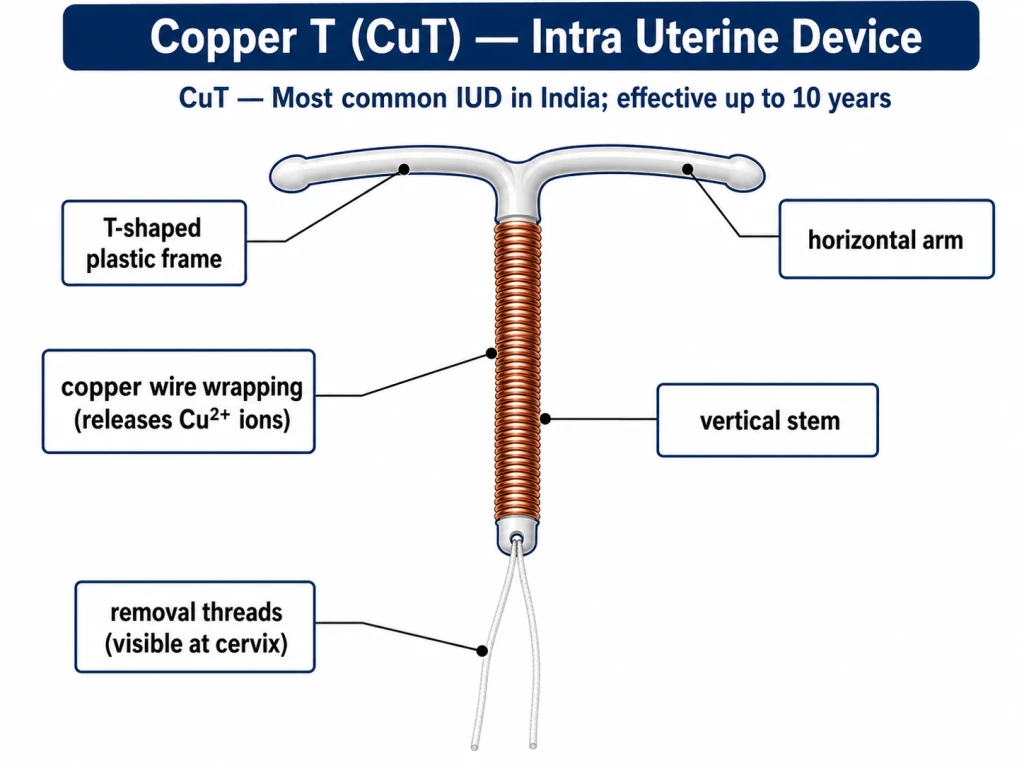
IUDs are devices inserted into the uterus by doctors or expert nurses, through the vagina, to prevent pregnancy. Once in place they work for years and ask nothing of the user day to day — a big advantage over pills.
Three generations of IUDs
We group IUDs into three generations based on what they're made of:
| Generation | Type | Example(s) |
|---|---|---|
| 1st | Non-medicated (plain plastic) | Lippes loop |
| 2nd | Copper-releasing | CuT (Copper T), Cu7, Multiload 375 |
| 3rd | Hormone-releasing | Progestasert, LNG-20 |
So the available IUDs are the non-medicated ones (e.g., Lippes loop), the copper-releasing ones (CuT, Cu7, Multiload 375) and the hormone-releasing ones (Progestasert, LNG-20). Memorise these example names — NEET asks for them directly.
One of India's most widely accepted contraceptives
IUDs are one of the most widely accepted methods of contraception in India. They're especially preferred by couples who want to space children — have a child now, plan another in 3-5 years — because they're long-acting yet fully reversible.
How IUDs Work — Three Mechanisms
The core idea is this: IUDs increase phagocytosis of sperms within the uterus, the Cu ions released suppress sperm motility and the fertilising capacity of sperms, and the hormone-releasing IUDs additionally make the uterus unsuitable for implantation and the cervix hostile to the sperms.
Let's break that down by generation.
Mechanism 1: All IUDs (including non-medicated)
Phagocytosis of sperm in the uterus.
The mere presence of a foreign body (the IUD) in the uterus triggers a localised inflammatory response — recruiting white blood cells (macrophages, neutrophils) that engulf and destroy sperm entering the uterus.
So even the simplest non-medicated Lippes loop works this way. Its very presence is the active ingredient.
Mechanism 2: Copper IUDs (CuT, Cu7, Multiload 375)
Additional copper ion release:
Copper IUDs continuously release Cu²⁺ ions into the uterine fluid. Effects:
- Suppress sperm motility — Cu ions impair sperm tail function (axoneme dynein activity).
- Reduce sperm fertilising capacity — Cu ions damage sperm metabolism.
So copper IUDs add a chemical sperm-killing layer on top of the phagocytosis.
Mechanism 3: Hormone-releasing IUDs (Progestasert, LNG-20)
Additional hormone release (progestogens, e.g., levonorgestrel):
- Make the uterus unsuitable for implantation — a thickened endometrium that won't support blastocyst attachment.
- Cervix becomes hostile to sperms — cervical mucus thickens, blocking sperm passage.
So hormonal IUDs work via 3 mechanisms at once: phagocytosis + hormonal endometrial change + hostile cervix.
Summary table — what does what
| IUD type | Phagocytosis | Cu ion sperm-killing | Hormonal endometrial change | Cervical mucus thickening |
|---|---|---|---|---|
| Lippes loop (non-medicated) | ✓ | — | — | — |
| CuT / Cu7 / Multiload (Cu) | ✓ | ✓ | — | — |
| Progestasert / LNG-20 (hormonal) | ✓ | — | ✓ | ✓ |
The more mechanisms an IUD provides, the more effective it is — but also the more side effects.
Why IUDs Are Ideal for Spacing Children
IUDs are ideal contraceptives for women who want to delay pregnancy and/or space children. Here's why.
Properties that suit delay/spacing
- Long-acting — Once inserted, an IUD works for years (3-10+ depending on type).
- Reversible — Removal restores fertility within months.
- No daily compliance — Unlike pills, nothing to remember every day.
- Convenient — A single doctor visit for insertion; few follow-ups.
- Effective — Failure rate under 1% — among the most effective reversible methods.
- Cost-effective long-term — One device for years versus years of pills.
Contrast with other methods
| Method | Best use case | Suits 'delay/spacing'? |
|---|---|---|
| Condoms | STI protection, occasional intercourse | Inconvenient for daily use |
| Pills | Daily compliance OK, hormonal tolerance | Requires daily action |
| Injectables | Long-acting hormonal | Good but needs repeat injections |
| IUDs | Spacing children ✓ | Best fit — long, reversible, low maintenance |
| Sterilisation | No more children desired | Poor reversibility — NOT for spacing |
Why IUDs stand out for spacing
The combination of high effectiveness + reversibility + low daily burden uniquely matches the needs of couples who:
- Have already had children.
- Don't want another for several years.
- Want pregnancy when ready (reversibility).
- Don't want to take a daily pill.
This is exactly why IUDs are the default 'spacing contraceptive' in family planning programmes around the world.
Common IUDs — Names & Mechanisms
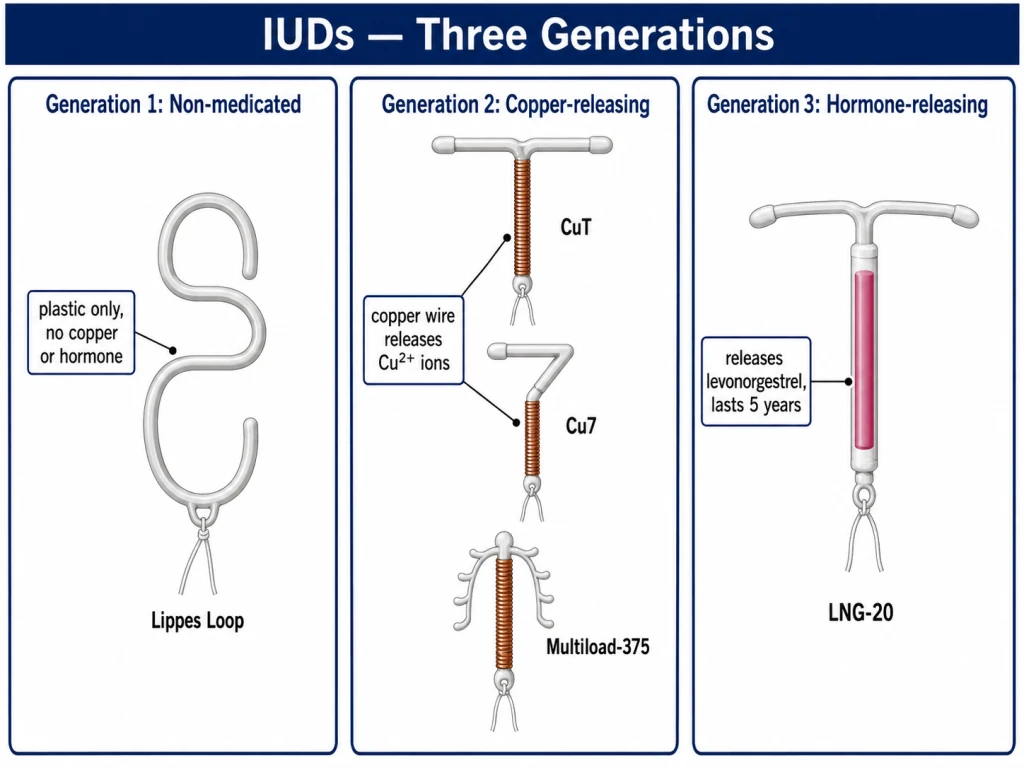
Let's drill the specific IUDs you need by name.
Non-medicated IUDs
Lippes loop
- The first widely-used IUD (introduced in the 1960s).
- Plain plastic, no medication.
- Mechanism: phagocytosis only.
- Largely replaced by newer-generation IUDs.
Copper-releasing IUDs
The three to know here are CuT, Cu7 and Multiload 375.
Copper T (CuT)
- T-shaped plastic device wrapped with copper wire.
- The most common IUD in India.
- Effective for ~10 years.
- Mechanism: phagocytosis + Cu ion release.
Cu7
- 7-shaped device with copper wire.
- Similar mechanism to CuT.
- Less common than CuT today.
Multiload 375
- A multi-armed (multi-load) device with 375 mm² surface area of copper.
- Effective up to 5 years.
- Less prone to expulsion than CuT in some women.
Hormone-releasing IUDs
The two to know here are Progestasert and LNG-20.
Progestasert
- T-shaped device releasing progesterone.
- Effective ~1 year (needs frequent replacement).
LNG-20
- Releases levonorgestrel (LNG, hence the name).
- T-shaped device.
- Effective up to 5 years.
- Better tolerated than Progestasert; reduces menstrual flow.
Memory tricks for NEET
| Mnemonic | Type | Examples |
|---|---|---|
| L = Lippes Loop | Non-medicated | Lippes loop |
| C = Copper | Cu-releasing | CuT, Cu7, Multiload 375 |
| H = Hormone | Hormone-releasing | Progestasert, LNG-20 |
Drill the exact names — examiners test these specifically (e.g., "Multiload 375 is a __" type questions).
Small Memory Capsule — Section 5
Lock these in before we move to oral contraceptives.
Three IUD generations
| Generation | Type | Examples |
|---|---|---|
| 1st | Non-medicated | Lippes loop |
| 2nd | Copper-releasing | CuT, Cu7, Multiload 375 |
| 3rd | Hormone-releasing | Progestasert, LNG-20 |
Three IUD mechanisms (cumulative)
- All IUDs: Increase phagocytosis of sperms in the uterus.
- Cu IUDs: Cu ions suppress sperm motility and fertilising capacity.
- Hormonal IUDs: Make the uterus unsuitable for implantation + cervix hostile to sperms.
The mechanism in one statement
IUDs increase phagocytosis of sperms within the uterus and the Cu ions released suppress sperm motility and the fertilising capacity of sperms; the hormone-releasing IUDs, in addition, make the uterus unsuitable for implantation and the cervix hostile to the sperms.
IUDs are ideal for…
Females who want to delay pregnancy and/or space children.
India's reality
One of the most widely accepted methods of contraception in India.
Properties
- Inserted by doctors or expert nurses (clinical procedure).
- Inserted through the vagina into the uterus.
- Long-acting (years).
- Reversible (remove the device, fertility returns).
One-line takeaway
IUDs are vaginally inserted uterine devices in 3 generations (non-medicated Lippes loop; copper-releasing CuT/Cu7/Multiload 375; hormone-releasing Progestasert/LNG-20) that prevent pregnancy via phagocytosis + Cu sperm-killing + hormonal endometrial changes — ideal for spacing children, and one of the most widely accepted methods in India (NCERT).
Oral Contraceptives — The Pills
The fourth contraceptive category is oral contraceptives — pills taken by mouth that contain hormones to prevent pregnancy.
These work by oral administration of small doses of either progestogens or progestogen–estrogen combinations. Because they're taken as tablets, they're popularly called the pills.
Two main types
| Type | What's inside | Common name |
|---|---|---|
| Combined pill | Progestogen + Estrogen | "Combined oral contraceptive" (COC) |
| Progestogen-only pill (POP) | Progestogen only | "Mini-pill" |
Why the pill is special
The pill is one of the most widely used contraceptives in the world. Reasons:
- Very high effectiveness (when taken correctly — failure rate under 1%).
- User-controlled by the woman.
- Reversible (stop taking, fertility returns within months).
- Improves menstrual cycle regularity in many users (a non-contraceptive benefit).
- Reduces menstrual flow and dysmenorrhea (combined pills).
- Reduces risk of certain cancers (ovarian, endometrial — long-term users).
India context
The pill is widely available in India:
- Government-subsidised brand: Mala D (combined pill).
- Non-prescription in most contexts.
- Free at PHCs (Primary Health Centres) for low-income women.
How the Pill Works — Three Mechanisms
Combined pills inhibit ovulation and implantation, and also alter the quality of cervical mucus to prevent or retard the entry of sperms. So there are three mechanisms working at once.
Mechanism 1: Inhibition of ovulation
- Synthetic estrogen and progestogen suppress the pituitary from releasing FSH and LH.
- Without an LH surge → no ovulation.
- Without an ovum → no fertilisation possible.
This is the primary mechanism of combined pills.
Mechanism 2: Inhibition of implantation
- Even if ovulation somehow occurred (rare), the endometrium becomes thin and atrophic.
- A thin endometrium cannot support blastocyst implantation.
- So even if a fertilised egg reaches the uterus, it can't implant.
Mechanism 3: Cervical mucus thickening
- Progestogens thicken the cervical mucus.
- Thick mucus is hostile to sperm passage.
- Sperm can't easily cross the cervix into the uterus.
Triple-action effectiveness
These three mechanisms together make the pill highly effective:
- Combined pills: failure rate ~0.1-1% (when taken correctly).
- Progestogen-only pills: slightly higher failure rate.
Why daily timing matters
Pills must be taken daily at the same time because:
- The hormone level must stay above a critical threshold.
- Missing a dose by more than 12 hours can let FSH/LH rebound.
- A rebound → potential ovulation → pregnancy risk.
This is why daily compliance is the pill's main challenge — not the biology.
The 21+7 Cycle — How Pills Are Taken
Pills have to be taken daily for a period of 21 days, starting preferably within the first five days of the menstrual cycle. After a gap of 7 days — during which menstruation occurs — the pattern is repeated for as long as the woman wishes to prevent conception.
The 28-day pattern
| Days | Action |
|---|---|
| 1-5 of menstrual cycle | Start the pill pack (preferably within the first 5 days) |
| 1-21 of pill cycle | Take 1 pill daily |
| 22-28 of pill cycle | 7-day gap — no pills; menstruation occurs during this gap |
| Day 29 onwards | Start a new pill pack — repeat the cycle |
Why the 21-day on / 7-day off pattern?
- 21 days of pill use → strong hormonal suppression of ovulation and endometrial thinning.
- 7-day gap → hormone withdrawal lets the endometrial lining shed → menstruation (technically a 'withdrawal bleed,' not a true period).
- Cycle resumes with a new pack on day 29.
Variations on this pattern
Modern pill brands have variations:
| Variant | Pattern |
|---|---|
| 21+7 active pills | 21 active + 7 placebo (or no pills) — classic pattern |
| 24+4 active pills | 24 active + 4 placebo — shorter break, more reliable |
| Continuous pills | No breaks — eliminates withdrawal bleeds |
| Extended cycle | 3 months continuous + 1 week break |
The classic 21+7 pattern is the one to know cold — it's tested verbatim.
Mala D — a widely used combined pill (its free-supply counterpart Mala-N is distributed at government facilities)
- 21 active hormone pills + 7 iron tablets (to prevent anaemia during the menstrual week).
- Government-subsidised, free at PHCs.
- The 7 iron pills support the woman through the bleeding week.
Saheli — India's Unique Non-Steroidal Pill
Saheli, a newer oral contraceptive for women, contains a non-steroidal preparation. It is a 'once a week' pill with very few side effects and high contraceptive value.
What makes Saheli special
Most oral contraceptives are steroidal (made of synthetic estrogens and progestogens). Saheli is different — it's non-steroidal.
| Feature | Saheli (India) | Standard combined pill |
|---|---|---|
| Active ingredient | Centchroman (non-steroidal) | Estrogen + progestogen |
| Frequency | Once a week | Once daily |
| Side effects | Very few | Nausea, weight gain, mood changes |
| Effectiveness | High | Very high |
| Compliance burden | Low (once a week) | Higher (daily) |
How Centchroman works
Centchroman is a selective estrogen receptor modulator (SERM):
- In the uterus: acts as an estrogen antagonist → endometrium becomes unsuitable for implantation.
- Elsewhere: minimal estrogenic side effects.
This selectivity is why side effects are minimal.
Indian origin
Saheli was developed in India by the Central Drug Research Institute (CDRI), Lucknow. It's marketed as Saheli (Hindi for 'female friend') — a uniquely Indian contribution to contraception.
Why this matters for NEET/Boards
Saheli shows up often in MCQs. Key facts to memorise:
- Non-steroidal preparation.
- Once-a-week dosing.
- Few side effects.
- High contraceptive value.
Exam trap to watch for: Saheli is described as a "new" oral contraceptive — referring to its (relatively recent) development at CDRI in the 1980s (launched in 1991). Don't confuse it with truly recent products.
Small Memory Capsule — Section 5
Lock these in before injectables and emergency contraception.
Pill mechanism (drill this)
Combined pills inhibit ovulation and implantation, and also alter the quality of cervical mucus to prevent or retard the entry of sperms.
So pills work via 3 mechanisms:
- Inhibit ovulation (no egg released).
- Inhibit implantation (thinned endometrium).
- Thicken cervical mucus (sperms can't get through).
The 21+7 regimen
| Days | Action |
|---|---|
| 1-21 | Take 1 pill daily |
| 22-28 (7-day gap) | No pills; menstruation occurs |
| Day 29 | Start new pack |
Pills should be started within the first 5 days of the menstrual cycle.
Two main pill types
| Type | Active hormones |
|---|---|
| Combined pill | Progestogen + Estrogen |
| Progestogen-only pill (POP) | Progestogen only |
Saheli — India's pride
- Non-steroidal (Centchroman — a SERM).
- Once-a-week dosing.
- Few side effects.
- High effectiveness.
- Developed in India (CDRI, Lucknow).
Effectiveness
- Combined pills: ~99% effective (when taken correctly).
- Saheli: high effectiveness.
- Both reversible.
Key statements to remember
Pills have to be taken daily for 21 days starting preferably within the first five days of the menstrual cycle. After a gap of 7 days (during which menstruation occurs) the pattern is repeated until the woman wishes to prevent conception.
Saheli is a non-steroidal oral contraceptive — a 'once a week' pill with very few side effects and high contraceptive value.
One-line takeaway
Oral contraceptive pills suppress ovulation + implantation + thicken cervical mucus; taken 21 days on + 7 days off; Saheli (India's CDRI-developed non-steroidal once-a-week pill) is a unique alternative with few side effects.
Long-Acting Hormonal Methods — Injectables & Implants
We move from daily pills to long-acting hormonal methods: injectables and implants. These work on the same hormonal principle as pills, but use different delivery routes for longer-lasting action.
Progestogens, alone or in combination with estrogen, can also be used by women as injections or as implants under the skin. Their mode of action is similar to that of pills, but their effective periods are much longer.
Why use injectables or implants instead of pills?
| Advantage | Why it matters |
|---|---|
| Long-acting | One administration covers weeks-months-years |
| No daily compliance | No risk of missed doses |
| Higher effectiveness in real use | Compliance failure isn't a factor |
| Convenient | Single procedure replaces years of pills |
| Reversible | Stop the injections / remove the implant, fertility returns |
Two formats
| Format | How it's delivered | Duration |
|---|---|---|
| Injectables | Intramuscular injection | Few weeks to ~3 months per injection |
| Implants | Subdermal rod placed under the skin | Several years per implant |
Same mechanism as pills
Since the active ingredients are similar (progestogens with or without estrogen), the mechanism mirrors pills:
- Inhibit ovulation.
- Inhibit implantation (thinned endometrium).
- Thicken cervical mucus.
The only difference is the delivery route and duration.
Injectables — Long-Acting Hormonal Injections
How injectables work
Injections of progestogens or progestogen + estrogen combinations are administered into a muscle (typically gluteal or arm). The hormones are slowly absorbed over weeks to months.
Common examples
| Injectable | Composition | Duration |
|---|---|---|
| DMPA (Depo-Provera) | Depot medroxyprogesterone acetate | ~3 months per injection |
| NET-EN | Norethisterone enanthate | ~2 months per injection |
Advantages
- No daily compliance — one injection covers weeks/months.
- Convenient — fits well for women who travel or have irregular schedules.
- Discreet — a partner doesn't need to know (a privacy advantage in some contexts).
- Highly effective — failure rate under 1% with consistent use.
Limitations
- Requires medical visits — every 2-3 months.
- Side effects — same as pills (nausea, irregular bleeding, weight gain).
- Delayed fertility return — may take 6-12 months after stopping for fertility to return fully.
- Doesn't protect against STIs.
The key fact
Injectables work just like pills (same triple mechanism) but their effective periods are much longer. That's the point to carry into the exam: same mode of action as pills, far longer duration.
Implants — Subdermal Hormone Rods
How implants work
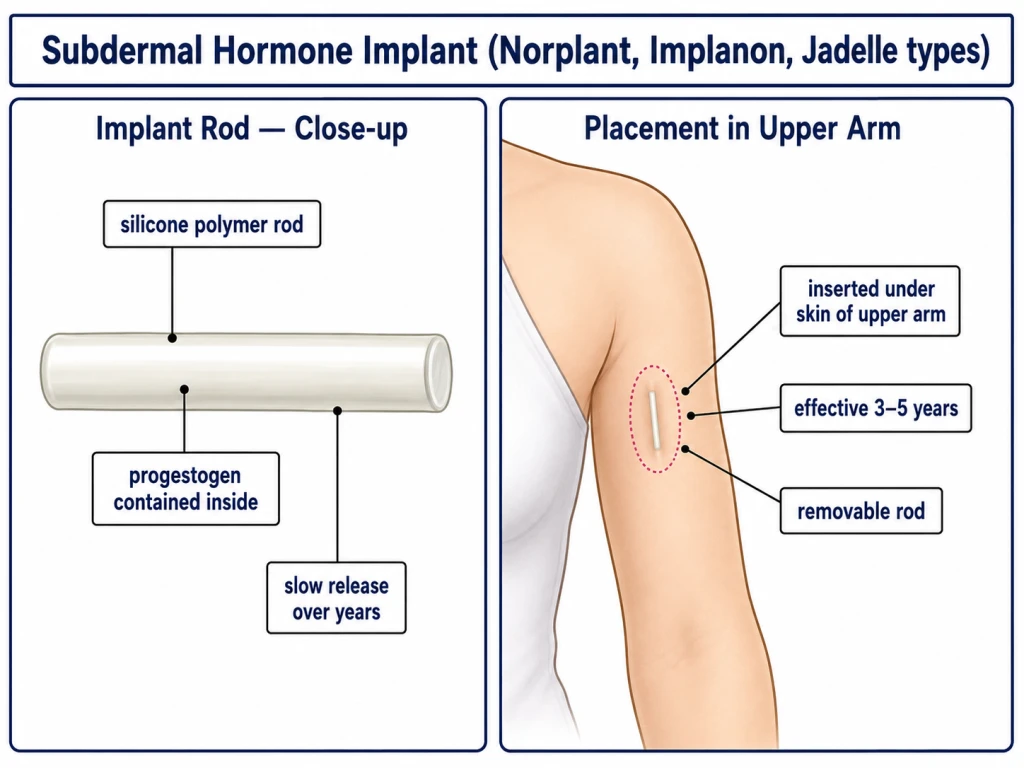
A small rod or set of rods containing slow-release progestogen is inserted just under the skin of the upper arm (subdermally) by a doctor.
The hormone is slowly released into the bloodstream over years, providing continuous contraception without any daily attention.
Common examples
| Implant | Active ingredient | Duration |
|---|---|---|
| Norplant (older) | Levonorgestrel (6 rods) | 5 years |
| Implanon / Nexplanon | Etonogestrel (single rod) | 3 years |
| Jadelle | Levonorgestrel (2 rods) | 5 years |
Implants as a category
Progestogens, alone or in combination with estrogen, can be used as implants under the skin. You won't be asked for specific brand names, but you should know that implants are a recognised contraceptive category.
Advantages
- Very long-acting — 3-5 years from a single insertion.
- Highly effective — failure rate under 1%, lower than even sterilisation in some studies.
- No daily compliance.
- Reversible — remove the rod, fertility returns within weeks.
Limitations
- Requires minor surgery for insertion and removal.
- Side effects — irregular bleeding (common in the first year), occasional mood changes.
- Visible/palpable — the rod can be felt under the skin (a small bump in the upper arm).
- Doesn't protect against STIs.
Emergency Contraception — The 72-Hour Window
The need
Sometimes unprotected intercourse happens unexpectedly:
- Failure of a barrier method (e.g., a condom broke).
- Missed pills for several days.
- Rape.
- Casual unprotected encounter.
In such cases the woman needs a last-resort intervention to prevent pregnancy. This is emergency contraception.
The core fact
Administration of progestogens, or progestogen-estrogen combinations, or IUDs within 72 hours of coitus is very effective as emergency contraception — used to avoid a possible pregnancy due to rape or casual unprotected intercourse.
The 72-hour rule
Emergency contraception is most effective when taken within 72 hours of unprotected intercourse:
| Time after unprotected coitus | Effectiveness |
|---|---|
| Within 24 hours | ~95% effective |
| 24-48 hours | ~85% effective |
| 48-72 hours | ~58% effective |
| After 72 hours | Reduced effectiveness; alternative options needed |
Three options
| Option | What it is |
|---|---|
| Progestogen pills | High-dose levonorgestrel (e.g., 'i-Pill' in India) |
| Progestogen + estrogen combinations | Similar to combined pills, higher dose |
| IUDs (within 5 days) | A Cu IUD can be inserted as emergency contraception |
How emergency contraception works
The mechanism depends on the cycle phase:
- Before ovulation: Suppresses or delays ovulation → no egg released.
- After ovulation: Inhibits sperm transport, fertilisation, or implantation.
So emergency contraception is NOT an abortion pill — it prevents pregnancy from establishing, but doesn't terminate an established pregnancy.
Key brand in India
- i-Pill — levonorgestrel 1.5 mg, single dose, available over-the-counter at pharmacies.
Important caveats
- Emergency contraception is NOT a routine method — it's for emergencies only.
- Not 100% effective — pregnancy can still happen.
- Doesn't protect against STIs.
- May cause nausea, breast tenderness, irregular bleeding for a few weeks.
Two situations it's meant for
- Rape — to prevent pregnancy in survivors.
- Casual unprotected intercourse — accidents.
This framing matters: emergency contraception is as much a woman's-rights and trauma-care intervention as it is a contraceptive method.
Small Memory Capsule — Section 5
Lock these in before surgical methods.
Injectables
- Hormonal injections (progestogens or progestogen-estrogen combinations).
- Long-acting — weeks to months per injection.
- Common examples: DMPA, NET-EN.
- Same mechanism as pills (suppress ovulation + implantation + cervical mucus).
- Doesn't protect against STIs.
Implants
- Subdermal rods under the skin of the upper arm.
- Years of contraception from a single insertion.
- Common examples: Norplant, Implanon, Jadelle.
- Same triple mechanism.
- Need minor surgery for insertion/removal.
Emergency contraception — the 72-hour rule
Administration of progestogens, or progestogen-estrogen combinations, or IUDs within 72 hours of coitus is very effective as emergency contraception.
Three options:
- Progestogens (high-dose levonorgestrel — e.g., i-Pill).
- Progestogen + estrogen combinations.
- IUDs (a Cu IUD inserted within 5 days).
Used for:
- Rape.
- Casual unprotected intercourse.
Mechanism:
- Pre-ovulation: delay/suppress ovulation.
- Post-ovulation: inhibit fertilisation/implantation.
Key point
Injectables and implants share the same mode of action as pills, but their effective periods are much longer.
One-line takeaway
Injectables (months-long) and implants (years-long) deliver the same hormonal mechanism as pills via injection or subdermal rod, without daily compliance; emergency contraception uses high-dose progestogens, combined pills, or Cu IUDs within 72 hours of unprotected intercourse for rape or accidents.
Solved Examples
Example 1: Three IUD generations and examples
Name the three generations of IUDs and give examples of each.
Answer: (1) Non-medicated — Lippes loop; (2) Copper-releasing — CuT, Cu7, Multiload 375; (3) Hormone-releasing — Progestasert, LNG-20. The progression reflects increasing sophistication: plain plastic, then copper for sperm-killing, then hormones for endometrial and cervical effects.
[Board Important] A common 2- or 3-mark CBSE question. Always cite all three generations with the exact example names.
Example 2: Three mechanisms of IUDs
Describe the three mechanisms by which IUDs prevent pregnancy, distinguishing what each generation contributes.
Answer: (1) Phagocytosis of sperm in the uterus — all IUDs, including the non-medicated Lippes loop, since a foreign body triggers a local inflammatory response. (2) Cu ions suppress sperm motility and fertilising capacity — copper IUDs (CuT, Cu7, Multiload 375). (3) Hormones make the uterus unsuitable for implantation and the cervix hostile to sperms — hormonal IUDs (Progestasert, LNG-20). Hormonal IUDs are typically the most effective because they combine the most mechanisms.
[Board Important] Common 3- or 5-mark CBSE question. State the mechanism precisely for full marks.
Example 3: Why are IUDs ideal for spacing children?
IUDs are ideal for couples who want to delay or space children. Why?
Answer: Because they combine six advantages no other reversible method offers together: long-acting (years per device), reversible (fertility returns within months of removal), no daily compliance burden, highly effective (~99%), cost-effective, and convenient (a single insertion). Condoms and pills demand daily action, injectables need repeat visits, and sterilisation isn't reliably reversible — so IUDs are the natural fit for "want another child in a few years."
[Board Important] Standard 3-mark CBSE question.
Example 4: Identify the IUD generation from a description
A doctor inserts a small T-shaped plastic device wrapped with copper wire into a woman's uterus. The device releases Cu²⁺ ions that suppress sperm motility for 10 years. Identify the device by generation and name.
Answer: It is a second-generation (copper-releasing) IUD — specifically the Copper T (CuT). The copper-ion release pins it to the copper-releasing generation, and the T-shape, copper wire and ~10-year life identify it as CuT, the most common IUD in India.
[NEET Important] Identification-from-description questions are NEET favourites. Drill each IUD's distinguishing features: plain plastic = Lippes loop; T + copper = CuT; 7-shape + copper = Cu7; multi-armed 375 mm² copper = Multiload 375; releases progesterone (~1 yr) = Progestasert; releases LNG (~5 yr) = LNG-20.
Example 5: Compare Cu IUDs with hormonal IUDs
Compare copper-releasing IUDs (e.g., CuT) with hormone-releasing IUDs (e.g., LNG-20) on (a) active ingredient, (b) primary mechanism, (c) typical duration, (d) effect on menstrual flow, (e) examples.
Answer:
| Feature | Copper IUDs | Hormonal IUDs |
|---|---|---|
| (a) Active ingredient | Copper ions (Cu²⁺) | Progestogens (e.g., levonorgestrel) |
| (b) Primary mechanism | Phagocytosis + Cu ions suppress sperm motility | Phagocytosis + endometrium unsuitable + cervical mucus thickening |
| (c) Typical duration | 5-10 years | 1-5 years (Progestasert: 1y; LNG-20: 5y) |
| (d) Effect on menstrual flow | May increase flow + cramping | Decreases flow (endometrial thinning) |
| (e) Examples | CuT, Cu7, Multiload 375 | Progestasert, LNG-20 |
In short: copper IUDs work without hormones and can worsen periods, while hormonal IUDs reduce flow (useful for heavy or painful periods).
[NEET Important] Drill the active-ingredient + mechanism + duration pairings.
Example 6: Three mechanisms of oral contraceptive pills
State the three mechanisms by which oral contraceptive pills prevent pregnancy.
Answer: (1) Inhibit ovulation — synthetic estrogen and progestogen suppress pituitary FSH/LH, so no LH surge and no egg is released (the primary mechanism). (2) Inhibit implantation — the endometrium is kept thin and unsuitable for a blastocyst. (3) Thicken cervical mucus — making it hostile to sperm. Together these give combined pills a failure rate under 1% with correct use.
[Board Important] Common 2- or 3-mark CBSE question. State the mechanism precisely for full marks.
Example 7: The 21+7 pill cycle
Describe how a woman should take combined oral contraceptive pills.
Answer: Start the first pack within the first 5 days of the menstrual cycle, then take 1 pill daily for 21 days. Stop for a 7-day gap, during which menstruation (a withdrawal bleed) occurs. Begin a new pack on day 29 and repeat for as long as she wishes to prevent pregnancy. Starting early ensures ovulation is suppressed before it can occur; in India, Mala D follows this pattern with 21 hormone pills plus 7 iron tablets.
[Board Important] Standard 3-mark CBSE question. Memorise the 21+7 regimen and the "within first 5 days" rule.
Example 8: Saheli — the unique Indian pill
What is special about Saheli? Why is it considered a unique contribution to oral contraception?
Answer: Saheli is a non-steroidal oral contraceptive whose active ingredient, Centchroman (a SERM), acts as an estrogen antagonist in the uterus rather than introducing sex steroids — which is why it has very few side effects. It is taken once a week (twice weekly for the first 12 weeks), is highly effective (over 99% with correct use), and was developed in India at the CDRI, Lucknow. Its primary action is anti-implantation rather than suppressing ovulation.
[NEET Important] A favourite MCQ topic. Drill: non-steroidal, once-a-week, few side effects, high value, Indian origin.
Example 9: Compare combined pills with Saheli
Compare combined oral contraceptive pills with Saheli on (a) composition, (b) frequency, (c) primary mechanism, (d) side effects.
Answer:
| Feature | Combined OC pill | Saheli |
|---|---|---|
| (a) Composition | Steroidal (synthetic estrogen + progestogen) | Non-steroidal (Centchroman — a SERM) |
| (b) Frequency | Daily for 21 days; 7-day gap | Once a week (twice/week for first 12 weeks) |
| (c) Primary mechanism | Suppress ovulation + thin endometrium + thicken mucus | Anti-implantation (estrogen antagonist in uterus) |
| (d) Side effects | Nausea, weight gain, breast tenderness, mood changes | Very few |
The big practical contrast: combined pills suppress ovulation and demand daily dosing, whereas the Indian-developed Saheli works mainly by anti-implantation, is taken weekly, and is far gentler on side effects.
[Board Important] Comparison-style CBSE 3- or 5-mark question.
Example 10: Why is daily compliance critical for combined pills?
Why must combined oral contraceptive pills be taken DAILY at the same time? What happens if a dose is missed?
Answer: The synthetic hormones must keep blood levels above the threshold that suppresses FSH/LH, but the body clears them within roughly 24 hours — so a steady daily dose is needed to hold ovulation in check. If a pill is missed by more than 12 hours, hormone levels fall, FSH/LH can rebound, and breakthrough ovulation (hence pregnancy) becomes possible; backup contraception is advised for 7 days. This is behavioural, not biological: perfect use gives under 1% failure, but typical use with missed doses rises to around 9%.
[Board Important] Application-style CBSE 3-mark question. Show that compliance — not the pill itself — is the weak link.
Example 11: Differences between pills, injectables, and implants
Compare oral contraceptive pills, injectables, and implants on (a) administration route, (b) duration of action, (c) compliance burden, (d) reversibility.
Answer:
| Feature | Oral pills | Injectables | Implants |
|---|---|---|---|
| (a) Administration | By mouth (daily) | Intramuscular injection | Subdermal rod (upper arm) |
| (b) Duration per dose | 24 hours | 2-3 months | 3-5 years |
| (c) Compliance burden | High (daily) | Medium (every 2-3 months) | Minimal (once every 3-5 years) |
| (d) Reversibility | Immediate (stop taking) | Few months (hormone clears) | Immediate (remove rod) |
All three share the same triple mechanism (suppress ovulation + implantation + thicken cervical mucus); only the delivery route and duration differ, and compliance burden falls as duration rises.
[Board Important] Common comparison 3-mark CBSE question.
Example 12: Emergency contraception — when, what, and how
What is emergency contraception? Describe its components and the 72-hour rule.
Answer: Emergency contraception is a post-coital intervention used after unprotected intercourse to prevent pregnancy. The three options are progestogens (high-dose levonorgestrel, e.g., i-Pill), progestogen-estrogen combinations, and IUDs, given within 72 hours of coitus (a Cu IUD extends the window to 5 days). It is meant for rape or casual unprotected intercourse, works by suppressing/delaying ovulation or blocking fertilisation/implantation, and is not an abortion pill.
[Board Important] Critical CBSE 3-mark question. Always cite the 72-hour rule + 3 options + 2 use cases.
Example 13: Why injectables are 'similar mechanism, longer duration'
Injectables work like pills but for longer periods. Explain why this is biologically true.
Answer: Pills and injectables deliver the same hormones (progestogens, with or without estrogen) and act the same way — suppressing FSH/LH (no ovulation), thinning the endometrium (no implantation), and thickening cervical mucus. The difference is delivery: an oral pill is absorbed and cleared within ~24 hours, so it needs daily replacement, whereas an injectable forms a slow-release depot in the muscle (e.g., DMPA) that supplies hormone for 2-3 months. Implants extend this further — a polymer rod releases hormone by diffusion over 3-5 years.
[Board Important] Common 3-mark CBSE conceptual question.
Example 14: Why must emergency contraception be taken within 72 hours?
Explain why emergency contraception is most effective within 72 hours of unprotected coitus and declines after that.
Answer: It works by acting before pregnancy is established — suppressing ovulation if no egg has yet been released, blocking sperm-ovum meeting before fertilisation, or preventing a blastocyst from implanting (implantation begins around day 6-10). The earlier it's taken, the more of these windows are still open; as hours pass, ovulation and fertilisation may already have happened, so hormonal pills lose effectiveness. A Cu IUD extends the window to 5 days because it mainly prevents implantation, which occurs later.
[Board Important] Common 3-mark CBSE application question.
Example 15: Implants — pros, cons, and when to choose
What are subdermal hormone implants? List their pros and cons. When is an implant the best choice?
Answer: They are small, slow-release progestogen rods inserted under the skin of the upper arm, giving 3-5 years of contraception via the same triple mechanism as pills (examples: Norplant, Jadelle, Implanon). Pros: very long-acting, highly effective (failure under 1%), no daily compliance, and reversible (fertility returns within weeks of removal). Cons: needs minor surgery to insert/remove, can cause irregular bleeding (especially early on), is palpable under the skin, and gives no STI protection. An implant is the best choice for a woman who wants reliable long-term contraception without daily action — for example, poor pill compliance, a busy schedule, or a completed family.
[Board Important] Application-style CBSE 3- or 5-mark question.