
The Final Contraceptive Category — Surgical Sterilisation
The seventh and final contraceptive category is surgical methods. These differ from every preceding method in one crucial way: they are intended to be TERMINAL — that is, permanent.
Surgical methods, also called sterilisation, are generally advised for the male or female partner as a terminal method to prevent any more pregnancies.
Key feature: terminal
The word 'terminal' means the final method. Surgical methods are recommended for couples who:
- Have completed their desired family.
- Definitely don't want any more children.
- Are willing to accept that future fertility will be very difficult or impossible to restore.
The mechanism
Surgical intervention blocks gamete transport and thereby prevents conception.
The mechanism is mechanical (not hormonal):
- A small section of the gamete-transport duct is removed or tied.
- After healing, gametes cannot travel from the gonad to the meeting site.
- No sperm-ovum meeting → no fertilisation → no pregnancy.
Two procedures — one for each partner
| Procedure | Performed on | Duct affected |
|---|---|---|
| Vasectomy | Male | Vas deferens |
| Tubectomy | Female | Fallopian tube |
Sterilisation in the male is called vasectomy and that in the female, tubectomy — each targeting the duct that carries its gametes.
Vasectomy — Male Sterilisation
The procedure
In vasectomy, a small part of the vas deferens is removed or tied up through a small incision on the scrotum.
Step-by-step:
- Local anaesthesia is applied to the scrotal skin.
- A small incision is made on the scrotum (~1 cm).
- The vas deferens is located.
- A small section is removed, OR the duct is tied off with sutures.
- The same is done on the other side (the vas deferens is bilateral).
- The incision is closed.
The procedure takes about 30 minutes under local anaesthesia, and the man can usually resume normal activities within a day or two.
What happens biologically
After vasectomy:
- Sperm continues to be produced in the testes (vasectomy doesn't affect spermatogenesis).
- Sperm cannot exit because the vas deferens is blocked.
- The sperm produced is reabsorbed by the body.
- Hormone production continues — testosterone is unaffected.
- Ejaculate volume drops only slightly (~3-5%) because seminal vesicle and prostate fluid still combine — only the sperm is missing.
- Sexual function is unchanged — libido, erection, ejaculation and orgasm all remain normal.
Effectiveness
- Vasectomy is highly effective — failure rate under 0.5%.
- There is a waiting period (~3 months, or about 20 ejaculations) for residual sperm to clear from the ducts.
- A post-vasectomy semen analysis confirms that no sperm remain.
Reversibility
Be clear about this: these techniques are highly effective, but their reversibility is very poor.
Vasectomy reversal:
- Possible via microsurgery (vasovasostomy).
- Success rate: 30-90%, depending on time since the vasectomy and surgical skill.
- Very expensive.
- Not all reversals restore fertility.
So a man should treat vasectomy as permanent.
Tubectomy — Female Sterilisation
The procedure
In tubectomy, a small part of the fallopian tube is removed or tied up through a small incision in the abdomen or through the vagina.
Step-by-step:
- General or local anaesthesia is applied.
- A small incision is made on the abdomen (laparoscopic) OR through the vagina (transvaginal).
- The fallopian tubes are accessed.
- A small section of each fallopian tube is removed, OR the tubes are tied off.
- The incision is closed.
The procedure takes about 30-60 minutes. Modern laparoscopic tubectomy is minimally invasive.
What happens biologically
After tubectomy:
- Ovaries continue to produce eggs (tubectomy doesn't affect ovarian function).
- Eggs are released into the abdominal cavity at the fimbrial end of the tube but cannot travel further because the tube is blocked.
- The eggs degenerate and are reabsorbed.
- Hormone production continues — estrogen, progesterone and ovulation all continue.
- Menstrual cycles continue normally.
- Sexual function is unchanged — libido, sensation and orgasm all remain normal.
Effectiveness
- Tubectomy is highly effective — failure rate under 0.5%.
- Effective immediately after surgery (no waiting period like vasectomy).
- In the rare event of failure, there is a small chance of ectopic pregnancy.
Reversibility
As with vasectomy, these techniques are highly effective but their reversibility is very poor.
Tubectomy reversal:
- Possible via microsurgery (tubal anastomosis).
- Success rate: 30-70%, depending on the length of remaining tube and surgical skill.
- Expensive.
- The risk of ectopic pregnancy rises after reversal.
So a woman should treat tubectomy as permanent.
Comparing Vasectomy and Tubectomy
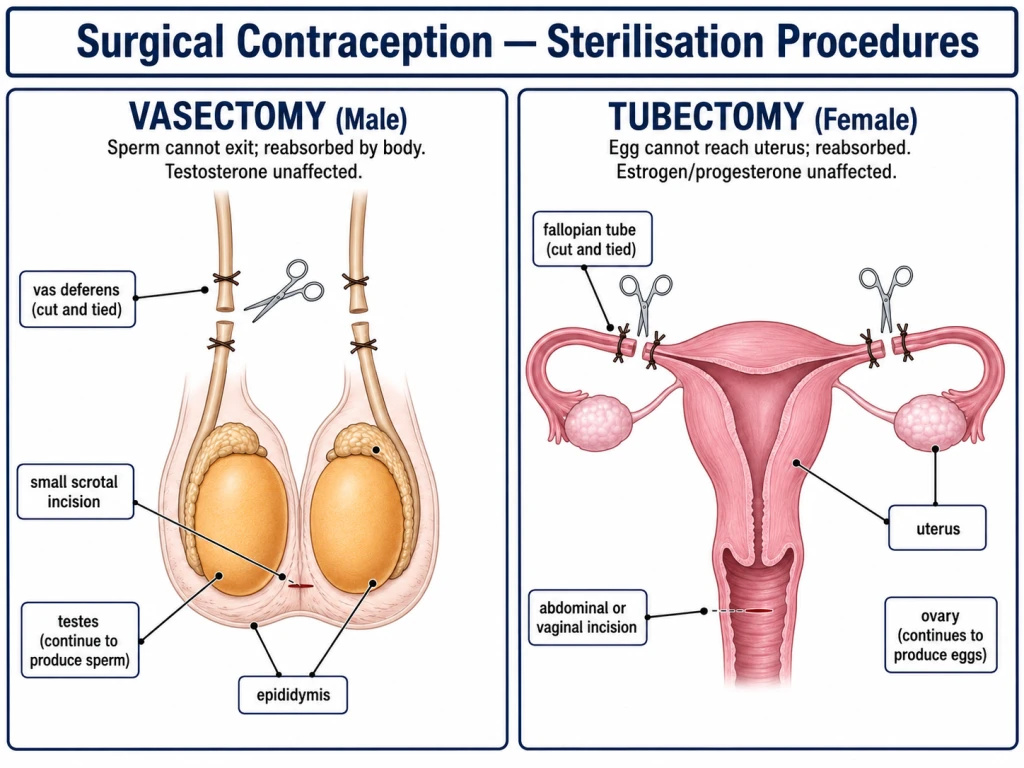
| Feature | Vasectomy (Male) | Tubectomy (Female) |
|---|---|---|
| Duct affected | Vas deferens | Fallopian tube |
| Incision site | Scrotum | Abdomen or vagina |
| Anaesthesia | Local | Local or general |
| Duration | ~30 minutes | ~30-60 minutes |
| Recovery | 1-2 days | 1-3 days |
| Effectiveness | <0.5% failure | <0.5% failure |
| Effective immediately? | No (3-month waiting) | Yes |
| Reversibility | Poor (30-90% success) | Poor (30-70% success) |
| Side effects | Minimal | Minimal |
| Hormonal effects | None | None |
| Sexual function | Unchanged | Unchanged |
| Cost (India) | ~₹500-2000 (often free at govt clinics) | ~₹3000-10,000 (often free at govt clinics) |
Common features
Both procedures share:
- High effectiveness (<0.5% failure).
- Poor reversibility.
- No hormonal disruption.
- No effect on sexual function or pleasure.
- No effect on hormone production.
Key difference — recovery and waiting period
- Vasectomy: Effective only after about 3 months (around 20 ejaculations), once residual sperm clear. Use backup contraception in the interim.
- Tubectomy: Effective immediately. No waiting period.
Government promotion in India
Both procedures are free at government hospitals and incentivised:
- Cash incentives for sterilisation acceptors.
- Mobile sterilisation camps in rural areas.
- Heavily promoted as a population-stabilisation tool.
Historically this focus has pushed tubectomy more than vasectomy — a controversial gender-equity issue, since tubectomy is the more invasive of the two.
The important caveat
Remember: these techniques are highly effective but their reversibility is very poor.
So the message is simple — don't do this lightly. Sterilisation is appropriate only when:
- You've completed your desired family.
- You're certain you don't want more children.
- You're prepared for situations (such as the loss of a child later) where you might wish for fertility back.
Small Memory Capsule — Section 6
Lock this in before MTP.
Two surgical methods
| Method | Sex | Duct affected | Incision site |
|---|---|---|---|
| Vasectomy | Male | Vas deferens | Scrotum |
| Tubectomy | Female | Fallopian tube | Abdomen or vagina |
The mechanism
Surgical intervention blocks gamete transport and thereby prevents conception.
Sterilisation is MECHANICAL — it physically blocks the gamete-transport duct. No hormones involved.
Key facts to remember
- Surgical methods, also called sterilisation, are advised as a terminal method to prevent any more pregnancies.
- Sterilisation in the male is called vasectomy; in the female, tubectomy.
- In vasectomy, a small part of the vas deferens is removed or tied up through a small incision on the scrotum.
- In tubectomy, a small part of the fallopian tube is removed or tied up through a small incision in the abdomen or through the vagina.
- These techniques are highly effective but their reversibility is very poor.
Key features
- Terminal method — intended to be permanent.
- Highly effective (<0.5% failure).
- Poor reversibility.
- No hormonal disruption.
- No effect on sexual function or pleasure.
Critical reminder
Sterilisation is NOT the same as castration (removal of the gonads). Sterilisation only blocks gamete transport — hormone production and sexual function are unaffected.
One-line takeaway
Vasectomy (cut/tie vas deferens) and tubectomy (cut/tie fallopian tube) are terminal surgical contraceptive methods — highly effective (<0.5% failure) but with very poor reversibility — appropriate only for couples certain they want no more children.
Solved Examples
Example 1: Vasectomy vs tubectomy — describe both
Describe vasectomy and tubectomy. Mention the duct affected, the incision site, and the effectiveness of each.
Answer: In vasectomy (male), a small part of the vas deferens is removed or tied up through a small incision on the scrotum, so sperm can no longer exit (it is reabsorbed). In tubectomy (female), a small part of the fallopian tube is removed or tied up through a small incision in the abdomen or vagina, so the egg can't reach the uterus. Both are terminal methods that block gamete transport mechanically, are highly effective (<0.5% failure), and leave hormone production and sexual function untouched — but their reversibility is very poor.
[Board Important] Standard 3-mark CBSE question — name the duct, incision site and effectiveness for full marks.
Example 2: Why is sterilisation called 'terminal'?
What does 'terminal method' mean? Why is sterilisation considered terminal despite some surgical reversal being possible?
Answer: 'Terminal' means the final method — it is meant to prevent any more pregnancies, unlike the earlier reversible methods. Sterilisation is treated as terminal because its reversibility is very poor: even microsurgery succeeds only 30-90% of the time (vasectomy) or 30-70% (tubectomy), is expensive, needs rare specialist surgeons, and may still leave fertility complications. So in practice a couple should choose it only when they are certain they want no more children.
[Board Important] Common 2- or 3-mark CBSE conceptual question.
Example 3: Does sterilisation affect hormone production or sexual function?
A common misconception is that vasectomy or tubectomy reduces hormone production or sexual function. Is this true? Explain.
Answer: No. Sterilisation is only a mechanical block of the gamete-transport duct (vas deferens or fallopian tube), so the gonads keep working — testosterone, or estrogen and progesterone, continue normally, as do libido, sexual function and (in women) menstrual cycles; only the gametes are reabsorbed. This is fundamentally different from castration or removal of the gonads, which removes the hormone-producing tissue itself and causes serious hormonal disruption — which is why removal of the gonads cannot be considered a contraceptive option.
[Board Important] Common conceptual CBSE 3-mark question — be ready to distinguish sterilisation from castration.
Example 4: Reversibility of sterilisation
Why is sterilisation reversibility 'very poor'? What are the implications for couples considering this method?
Answer: Reversal is poor because reconnecting these tiny ducts needs delicate microsurgery, scar tissue and (for vasectomy) anti-sperm antibodies can block function even after a technical reconnection, and removing too much fallopian tube can make tubectomy reversal impossible — so success is only 30-90% (vasectomy) or 30-70% (tubectomy) and depends heavily on time elapsed and surgeon skill. The practical implication: choose sterilisation only if certain you want no more children; if there is any doubt, use a reversible method (IUD, implant, pills) instead, and remember that assisted reproductive techniques like IVF are often a more reliable route to fertility than reversal surgery.
[Board Important] Standard 3-mark CBSE question — always state that reversibility is 'very poor'.
Example 5: Why is removal of gonads NOT a contraceptive option?
Explain why removal of the gonads cannot be considered a contraceptive option.
Answer: Because the gonads do not just make gametes — they also produce the sex hormones (testosterone in the testis; estrogen and progesterone in the ovary) that are essential for normal physiology and sexual function. Removing them would stop both gametes and hormones, causing severe hormonal deficiency: loss of libido, cessation of menstruation, bone loss and other complications. Since sterilisation (vasectomy/tubectomy) achieves the same contraceptive effect by blocking only the gamete-transport duct, with no hormonal cost, gonad removal is reserved for medical conditions such as cancer — never used as contraception.
[Board Important] Direct exercise question from the chapter — memorise this answer.