
The Three Natural Methods — Overview
Natural methods are the first category in the contraceptive classification — and the oldest known to humanity. They share three core features:
- No devices used (no condoms, no pills, no IUDs).
- No hormones introduced (so no chemical side effects).
- No surgery involved.
The method relies entirely on behavioural choices.
Natural methods work on the principle of avoiding the chances of the ovum and sperm meeting.
There are three natural methods
| # | Method | Mechanism |
|---|---|---|
| 1 | Periodic abstinence | Avoid coitus during fertile window |
| 2 | Coitus interruptus (withdrawal) | Male withdraws before ejaculation |
| 3 | Lactational amenorrhea | Breastfeeding suppresses ovulation |
Why use natural methods?
Pros:
- No side effects (no hormones, no devices).
- Free (no purchase needed).
- No ongoing medical supervision needed.
- Acceptable to religious/cultural groups that avoid artificial contraception.
Cons:
- High failure rates — these are the LEAST reliable methods.
- Require strict behavioural discipline.
- Don't protect against STIs.
- Require partner cooperation in the moment.
Method 1: Periodic Abstinence
The principle
Avoid sexual intercourse during the fertile window of the menstrual cycle. If no sperm meets ovum, no fertilisation.
The fertile window
Couples practising periodic abstinence avoid coitus from day 10 to day 17 of the menstrual cycle, the stretch when ovulation is expected. Because the chances of fertilisation are very high during this period, it is called the fertile period.
So:
- Fertile period: Day 10 to Day 17 of the menstrual cycle.
- Day 1 = first day of menstruation.
- Ovulation typically occurs around day 14 (mid-cycle).
- Secondary oocyte viable ~24 hours after ovulation; sperm viable ~3-5 days in the female tract.
- Fertile window = days when intercourse can lead to fertilisation = roughly day 10-17.
Why this window?
- Sperm can survive in the female tract for up to 5 days before ovulation. So intercourse on day 9-13 could result in sperm being present when the secondary oocyte is released on day 14.
- The secondary oocyte is viable for ~24 hours after ovulation. So intercourse on day 14-15 can also result in fertilisation.
- Day 10-17 covers both edges of this window with a safety margin.
Practical implementation
A couple practising periodic abstinence:
- Tracks the woman's menstrual cycle carefully.
- Marks day 10-17 as the fertile/abstinence period.
- Avoids coitus completely during these 8 days.
- Has coitus freely during days 1-9 (menstruation + early follicular) and days 18-28 (luteal phase).
Limitations
- Cycle irregularities make the fertile window hard to predict.
- Stress, illness, travel can shift ovulation by several days.
- Sperm survival can extend the effective fertile window.
- Failure rate: 20-30% in real-world use — much higher than hormonal methods.
Method 2: Coitus Interruptus (Withdrawal Method)
The principle
The male partner withdraws his penis from the vagina just before ejaculation, so that semen is not deposited in the vagina.
Definition
In coitus interruptus, also called the withdrawal method, the male partner withdraws his penis from the vagina just before ejaculation so as to avoid insemination.
How it works (or doesn't)
- The male partner must recognise the imminent ejaculation reflex.
- He must withdraw his penis BEFORE semen exits.
- If executed perfectly, no sperm enters the vagina → no fertilisation.
Why it fails
There are two main failure modes:
Failure mode 1: Pre-ejaculate (Cowper's gland secretion)
Before ejaculation, the bulbourethral (Cowper's) glands secrete a clear fluid that lubricates the urethra. This pre-ejaculate can contain sperm (especially in men who recently ejaculated). So even before withdrawal, some sperm may already be in the vagina.
Failure mode 2: Incomplete withdrawal
Reaching orgasm and withdrawing simultaneously is biologically difficult. Many men fail to withdraw in time — partial ejaculation occurs.
Failure rate
Coitus interruptus has a high real-world failure rate (~15-25% by non-NCERT estimates). Considered one of the least reliable contraceptive methods.
Pros and cons
Pros:
- No devices, no hormones, no cost.
- Acceptable to most religious/cultural traditions.
Cons:
- High failure rate.
- Requires significant self-control by male partner.
- Reduces sexual satisfaction (interrupts the natural sexual response).
- Doesn't protect against STIs.
This method isn't endorsed as reliable — it's simply one of the methods couples have long used.
Method 3: Lactational Amenorrhea
The principle
During intense breastfeeding (lactation) after childbirth, the mother's body suppresses ovulation. No ovulation → no fertilisation possible.
Definition
The lactational amenorrhea (absence of menstruation) method rests on the fact that ovulation, and therefore the cycle, does not occur during the period of intense lactation that follows childbirth. As long as the mother breast-feeds the child fully, the chances of conception are almost nil.
Why lactation suppresses ovulation
The hormonal mechanism:
- Breastfeeding releases prolactin (the milk-producing hormone) from the anterior pituitary.
- Prolactin suppresses GnRH from the hypothalamus.
- Suppressed GnRH → suppressed FSH and LH from the pituitary.
- Suppressed FSH/LH → no follicular development, no ovulation.
So lactation is nature's own birth control mechanism — designed (evolutionarily) to space pregnancies and allow the current child to thrive.
Time limit
This method has been found to be effective only up to a maximum period of six months following childbirth.
So:
- Effective for: maximum 6 months post-childbirth.
- Conditions for effectiveness:
- Mother is fully breastfeeding (not just supplementing).
- Lactation is intense (frequent feeds, day and night).
- Menstruation has not yet returned.
After 6 months — fertility returns
Once any of the conditions fails:
- Breastfeeding becomes less frequent (e.g., baby starting solids).
- Mother starts supplementing with formula or solid food.
- Menstruation returns.
→ Ovulation can resume → fertility returns.
Significance
Lactational amenorrhea is an important natural contraceptive method especially in:
- Developing countries where it's the primary form of contraception for many women.
- Post-partum couples wanting to space children naturally.
- Religious/cultural contexts that favour non-artificial contraception.
Limitations
- Time-limited to ~6 months.
- Requires intense breastfeeding (incompatible with formula feeding).
- Not 100% effective — ovulation can return unpredictably.
- Doesn't protect against STIs.
Small Memory Capsule — Section 4
Lock-in before barrier methods.
The 3 natural methods
| Method | Mechanism | Key fact |
|---|---|---|
| Periodic abstinence | Avoid coitus on day 10-17 of cycle | The 'fertile period' is day 10-17 |
| Coitus interruptus | Withdraw before ejaculation | High failure rate due to pre-ejaculate and timing |
| Lactational amenorrhea | Breastfeeding suppresses ovulation | Effective up to 6 months post-partum |
Pros of natural methods
- No side effects
- Free, no devices, no hormones
- Acceptable to all religious traditions
Cons of natural methods
- HIGH FAILURE RATES
- Don't protect against STIs
- Require strict discipline
Key statements to remember
Natural methods work on the principle of avoiding the chances of the ovum and sperm meeting.
In periodic abstinence, couples avoid coitus from day 10 to 17 of the menstrual cycle, when ovulation could be expected.
In lactational amenorrhea, ovulation and the cycle do not occur during intense lactation after childbirth; as long as the mother breast-feeds fully, the chances of conception are almost nil.
This method works only up to a maximum period of six months following childbirth.
One-line takeaway
Natural contraception works by preventing ovum-sperm meeting via behavioural choices: periodic abstinence (avoid day 10-17), coitus interruptus (withdrawal), or lactational amenorrhea (effective up to 6 months post-partum). All three have no side effects but high failure rates.
Barrier Methods — Physical Blocking
The second category is barrier methods. These work on a simple principle:
In barrier methods, the ovum and sperm are prevented from physically meeting with the help of barriers.
So instead of avoiding the meeting (natural methods) or chemically preventing fertilisation (hormonal methods), barriers physically block the sperm from reaching the ovum.
Barrier methods come in two categories
| Category | Used by | Examples |
|---|---|---|
| Male barriers | Male | Condoms (male) — 'Nirodh' |
| Female barriers | Female | Female condoms, Diaphragms, Cervical caps, Vaults |
The unique advantage of barrier methods
Condom use has increased in recent years because of the additional benefit of protecting the user from contracting STIs and AIDS.
Only condoms (within the barrier category) provide STI/AIDS protection — no other contraceptive categories do. This makes condoms uniquely important from a public health perspective.
Male and Female Condoms
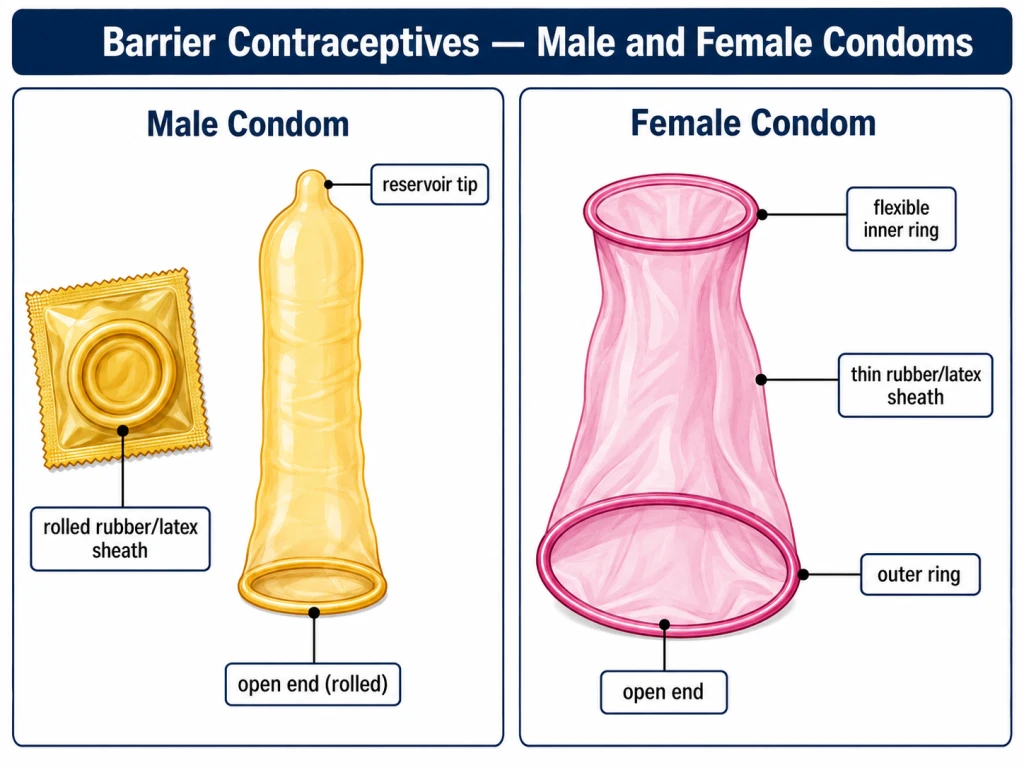
Male condom
Condoms are barriers made of a thin rubber/latex sheath used to cover the penis in the male, or the vagina and cervix in the female, just before coitus, so that the ejaculated semen does not enter the female reproductive tract.
Structure:
- A thin rubber or latex sheath (typically <0.1 mm thick).
- Open at one end, closed at the other (with a reservoir tip to collect semen).
- Lubricated for ease of use.
Mechanism:
- Covers the penis before coitus.
- Ejaculated semen collects in the closed end.
- Sperm never enters the vagina → no fertilisation.
Common Indian brand: 'Nirodh' — government-subsidised, widely available.
Female condom
- A larger pouch-like structure.
- Inserted into the vagina before coitus.
- Lines the vagina and cervix.
- Has rings at both ends to keep it in place.
Made of: rubber/latex.
Both condoms — key properties
Both the male and female condoms are disposable, can be self-inserted, and thereby give privacy to the user.
So condoms are:
- Disposable (single-use).
- Self-insertable — no medical assistance needed.
- Private — user controls without involving anyone else.
The big bonus: STI protection
Condom use has increased in recent years because of the additional benefit of protecting the user from contracting STIs and AIDS.
Condoms are uniquely valuable because they:
- Prevent HIV transmission.
- Prevent gonorrhoea, syphilis, hepatitis-B, herpes, etc.
- Reduce risk of cervical cancer (HPV transmission).
This makes condoms the first-line contraceptive recommendation for:
- New relationships where STI status is unknown.
- People with multiple partners.
- Casual encounters.
- Couples where one partner has an STI.
Diaphragms, Cervical Caps & Vaults
These are female barrier methods that work by covering the cervix specifically, blocking sperm from entering the uterus.
Diaphragms, cervical caps and vaults are barriers made of rubber that are inserted into the female reproductive tract to cover the cervix during coitus. They prevent conception by blocking the entry of sperm through the cervix, and they are reusable.
Diaphragm
- A dome-shaped rubber cap with a flexible rim.
- Inserted into the vagina to cover the cervix before coitus.
- Sits between the back of the cervix and the pubic bone.
- Comes in different sizes — requires medical fitting.
Cervical cap
- A smaller, deeper cap that fits directly over the cervix.
- Held in place by suction.
- Smaller than a diaphragm.
Vault cap
- A specialised cap covering the cervix.
- Designed for women with cervical or vaginal anatomical issues.
Key property: REUSABLE
Unlike disposable condoms, diaphragms/caps can be cleaned and reused for months or years. This makes them economical for long-term use.
Spermicidal creams as adjuncts
Spermicidal creams, jellies and foams are usually used along with these barriers to increase their contraceptive efficiency.
Spermicides are chemicals that kill sperm. They are NOT used alone (low efficacy) but are added to barrier methods to:
- Kill any sperm that slips around the barrier.
- Increase contraceptive efficiency.
So a diaphragm + spermicide is more effective than a diaphragm alone.
Limitations
- Need to be inserted before each act of intercourse.
- Less protection against STIs than condoms (don't cover the vagina entirely).
- Requires initial medical fitting (size matters).
- Some users find insertion uncomfortable.
Comparing the Barrier Methods
Let's lay out all the barrier methods side by side.
| Method | Used by | Disposable? | STI protection | Spermicide compatible | Notes |
|---|---|---|---|---|---|
| Male condom | Male | Single-use | YES (excellent) | Yes | Common brand: 'Nirodh' |
| Female condom | Female | Single-use | YES (good) | Yes | Larger pouch-style |
| Diaphragm | Female | Reusable | Limited | Yes (recommended) | Requires medical fitting |
| Cervical cap | Female | Reusable | Limited | Yes (recommended) | Smaller than diaphragm |
| Vault | Female | Reusable | Limited | Yes (recommended) | For specific anatomical issues |
When to use each
Use male/female condoms when:
- STI protection is needed (new partners, multiple partners, unknown STI status).
- Both partners want shared responsibility.
- Single-use disposable convenience is preferred.
- No advance planning is possible.
Use diaphragms/caps when:
- The relationship is monogamous and STI risk is low.
- Female-controlled contraception is preferred.
- Reusable / economical option is wanted.
- The woman is comfortable with self-insertion.
Properties worth highlighting
| Property | Meaning |
|---|---|
| Disposable | Single-use (condoms only) |
| Reusable | Multi-use after cleaning (diaphragms, caps, vaults) |
| Self-insertable | Can be used without medical assistance |
| Privacy | User-controlled |
| STI protection | Unique to condoms |
Why barrier methods score high on the 'ideal contraceptive' criteria
Mapping barriers against the 6 criteria for an ideal contraceptive:
- ✓ User-friendly — yes, anyone can use.
- ✓ Easily available — yes, widely sold.
- ~ Effective — moderately (failure rate lower (non-NCERT estimate ~5-15%), can be improved with spermicides).
- ✓ Reversible — instantly (just don't use one).
- ✓ No or least side-effects — yes, no hormonal disruption.
- ~ No interference with sexual drive/desire/act — minor sensation reduction with condoms.
Barriers score well on 5 of 6 criteria — making them excellent contraceptive options for couples who tolerate the slight sensation impact.
Small Memory Capsule — Section 4
Lock-in before IUDs.
Barrier methods — the list
| Method | Who uses | Disposable / Reusable |
|---|---|---|
| Male condom | Male | Disposable |
| Female condom | Female | Disposable |
| Diaphragm | Female | Reusable |
| Cervical cap | Female | Reusable |
| Vault | Female | Reusable |
Core principle
In barrier methods, the ovum and sperm are prevented from physically meeting with the help of barriers.
Key facts to memorise
- 'Nirodh' = popular Indian male condom brand.
- Both male and female condoms: disposable, self-insertable, give privacy.
- Diaphragms/caps/vaults: reusable rubber barriers covering the cervix.
- Spermicidal creams/jellies/foams: used alongside barriers to increase efficiency.
The UNIQUE benefit of condoms
Condom use has increased in recent years because of the additional benefit of protecting the user from contracting STIs and AIDS.
Only condoms (among all 7 contraceptive categories) provide STI/HIV protection.
Mechanism
- Male condom: covers penis → semen collects, doesn't enter vagina.
- Female condom: lines vagina/cervix.
- Diaphragm/cap/vault: covers cervix → blocks sperm from entering uterus.
One-line takeaway
Barrier methods physically block sperm from meeting ovum: male condoms (Nirodh), female condoms (both disposable + STI-protective), and reusable diaphragms/cervical caps/vaults covering the cervix — usually combined with spermicides for higher efficacy.
Solved Examples
Example 1: Three natural methods of contraception
List the three natural methods of contraception. State the mechanism of each.
Answer: (1) Periodic abstinence — couples avoid coitus on days 10-17 of the cycle, the fertile period, since ovulation occurs around day 14. (2) Coitus interruptus — the male withdraws his penis from the vagina just before ejaculation to avoid insemination. (3) Lactational amenorrhea — during intense breastfeeding, prolactin suppresses GnRH so ovulation stops, effective up to 6 months post-partum. All three are 'natural' because they use no devices, hormones or surgery, share zero side effects, but all have high failure rates.
[Board Important] Standard CBSE 2- or 3-mark question. Always include all 3 methods + mechanisms.
Example 2: Why is day 10-17 the 'fertile period'?
Explain why day 10-17 of the menstrual cycle is the 'fertile period.' Draw on knowledge of ovulation and gamete viability.
Answer: Ovulation occurs around day 14, the secondary oocyte stays viable ~24 hours, and sperm survive 3-5 days in the female tract. So intercourse from about day 10 leaves sperm alive when ovulation occurs, and intercourse up to day 17 can still find a viable oocyte. Adding safety margins for cycles where ovulation comes a little early or late gives the 8-day fertile window (day 10-17).
[Board Important] Common CBSE 3-mark question. Always cite both ovulation timing AND gamete viability.
Example 3: Why does coitus interruptus often fail?
Coitus interruptus is one of the oldest methods of contraception but has a high failure rate. Explain the two main reasons for its failure.
Answer: (1) Pre-ejaculate can contain sperm — the bulbourethral (Cowper's) glands secrete a lubricating fluid before ejaculation that may carry sperm, depositing some in the vagina before withdrawal. (2) Failed or delayed withdrawal — recognising the ejaculation reflex and withdrawing in time needs precise self-control, and many men fail, causing partial ejaculation inside the vagina. The real-world failure rate is high (~15-25%, a non-NCERT estimate).
[Board Important] Application-style 2- or 3-mark CBSE question.
Example 4: Lactational amenorrhea — mechanism and limits
Explain the mechanism of lactational amenorrhea as a contraceptive method. How long is it effective, and what conditions are required?
Answer: Suckling triggers prolactin release from the anterior pituitary; prolactin suppresses GnRH from the hypothalamus, which lowers FSH and LH, so no follicle develops and no ovulation occurs. It is effective for a maximum of 6 months post-partum, and only if the mother is fully and intensely breastfeeding (including night feeds) and her menstruation has not yet returned. If any condition fails, fertility resumes.
[Board Important] Standard 3-mark CBSE question. Memorise the hormonal mechanism + 6-month limit.
Example 5: Comparing the three natural methods
Make a comparative table of the three natural contraceptive methods on (a) mechanism, (b) failure rate, (c) duration of use, (d) main limitation.
Answer:
| Feature | Periodic abstinence | Coitus interruptus | Lactational amenorrhea |
|---|---|---|---|
| (a) Mechanism | Avoid coitus day 10-17 | Withdraw before ejaculation | Prolactin suppresses ovulation |
| (b) Failure rate | ~20-30% | ~15-25% | ~2-5% (within 6 months) |
| (c) Duration | Indefinite | Indefinite | Max 6 months post-partum |
| (d) Main limitation | Cycle irregularity | Pre-ejaculate + timing | Time-limited; needs exclusive breastfeeding |
All three share no side effects, no cost and no STI protection, but high failure rates. Lactational amenorrhea is unique in being time-limited and the most reliable of the three when conditions are met.
[Board Important] Comparative-table CBSE 5-mark question. Practice drawing this exact table.
Example 6: How do barrier methods work?
Define barrier methods and explain how they prevent conception. List the major barrier methods.
Answer: In barrier methods the ovum and sperm are prevented from physically meeting with the help of barriers, so no sperm reaches the ovum and no fertilisation occurs. Male barrier: the male condom (e.g., Nirodh). Female barriers: the female condom, diaphragm, cervical cap and vault. Spermicidal creams, jellies and foams are often added to raise efficiency. Among all methods, only condoms additionally protect against STIs and AIDS.
[Board Important] Common 2- or 3-mark CBSE question.
Example 7: Why are condoms the only contraceptive that protects against STIs?
Explain why condoms uniquely provide STI/AIDS protection while other contraceptive methods don't.
Answer: STIs spread through body fluids and skin-to-skin genital contact. Condoms cover the whole penis or vagina, so they block fluid exchange AND direct skin contact, cutting off both transmission routes. Other methods only prevent pregnancy: pills and IUDs act hormonally or locally, diaphragms cover only the cervix, and sterilisation blocks gamete transport — none stop fluid or skin contact, so STIs can still pass. This is why condom use is so heavily promoted for HIV prevention.
[Board Important] Application-style CBSE 3-mark question. Always frame condoms' unique role in public health terms.
Example 8: Compare male condoms with diaphragms
Compare male condoms with diaphragms on (a) who uses, (b) reusability, (c) STI protection, (d) need for medical fitting, (e) need for spermicides.
Answer:
| Feature | Male condom | Diaphragm |
|---|---|---|
| (a) Who uses | Male | Female |
| (b) Reusability | Disposable (single-use) | Reusable |
| (c) STI protection | Yes (excellent) | Limited (vagina exposed) |
| (d) Medical fitting | Not needed | Needed (custom-sized) |
| (e) Spermicide | Optional | Strongly recommended |
Both physically block sperm, but condoms uniquely protect against STIs, while the diaphragm is the reusable, female-controlled option for low-STI-risk couples.
[Board Important] Comparison CBSE 3-mark question.
Example 9: Role of spermicides in barrier methods
What are spermicides? Why are they used alongside barrier methods? Are they used alone?
Answer: Spermicides are chemicals (creams, jellies, foams; e.g., nonoxynol-9) that kill or inactivate sperm by disrupting the sperm cell membrane. They are usually used along with barrier methods to increase contraceptive efficiency — the barrier blocks most sperm and the spermicide kills any that slip past. They are NOT used alone because alone their failure rate is high (~25-30%, non-NCERT estimate): they dilute, wash away, and act only briefly. Combined with a diaphragm or condom, overall efficacy is much higher.
[Board Important] Common 2-mark CBSE question. Always frame: 'used alongside, not alone.'
Example 10: Why use barrier methods over hormonal methods?
When are barrier methods preferred over hormonal methods (like oral pills)? Give specific scenarios.
Answer: Barrier methods are preferred when (1) STI risk is significant (new partner, multiple partners, known STI) — only condoms protect against infection; (2) hormonal methods are contraindicated (hypertension, smoker over 35, breast cancer history, clotting disorders, migraine with aura); (3) intercourse is only occasional, so daily pills are unnecessary; (4) pregnancy is planned soon, since barriers are instantly reversible; (5) religious or cultural preference favours non-hormonal methods; (6) the woman cannot tolerate hormonal side effects. Hormonal methods stay better for stable, low-STI-risk couples and where they treat heavy bleeding or acne.
[Board Important] Application-style CBSE 3-mark or 5-mark question. Show that contraceptive choice depends on individual context.