
Absolute (Global) Maximum and Minimum
Local maxima and minima compare a point only with its neighbours. But applied problems usually want the overall champion — the largest or smallest value on the whole interval. These are the absolute maximum value (also called global maximum or greatest value) and the absolute minimum value (global minimum or least value).
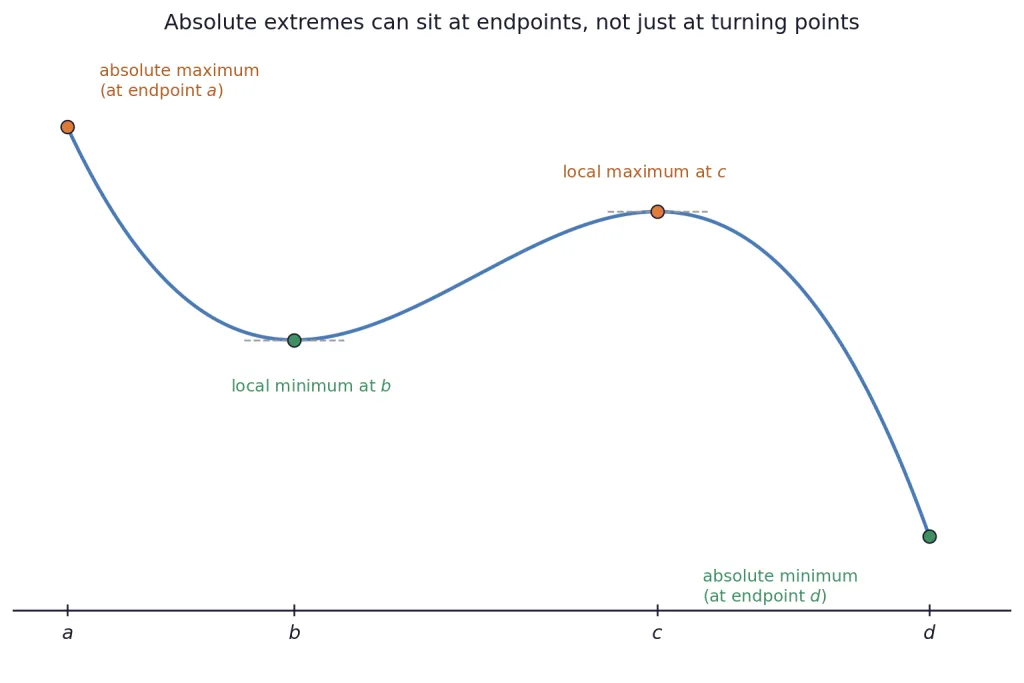
The graph above makes the crucial point: a function can have a local minimum at and a local maximum at , while its absolute maximum sits at the endpoint and its absolute minimum at the endpoint . Absolute extrema need not be turning points at all!
Two guarantees make everything work:
- Theorem 5. A continuous function on a closed interval attains both an absolute maximum value and an absolute minimum value somewhere in the interval.
- Theorem 6. If the absolute max or min occurs at an interior point where is differentiable, then .
Key Point: Together these say: the absolute extremes exist, and each is found either at a critical point or at an endpoint. That's why the checklist below never misses.
[JEE Tip] On an open interval the guarantee vanishes — on attains neither a max nor a min. When a JEE option says "has no maximum", check whether the domain's endpoints are included before dismissing it.
The Closed-Interval Method (Working Rule)
To find the absolute maximum and minimum of a continuous on :
- Find all critical points of in : solve and list points where is not differentiable.
- Add the endpoints and to the candidate list.
- Evaluate at every candidate.
- Pick the largest and smallest values. Done — no second derivative test needed!
Worked pattern: on .
| Candidate | ||||
|---|---|---|---|---|
| 24 | 29 | 28 | 56 |
Absolute maximum 56 at (an endpoint!); absolute minimum 24 at (the other endpoint). The interior critical points came second and third.
Don't forget non-differentiable critical points. For on :
vanishes at AND is undefined at — both are critical points. Evaluating at gives values : absolute maximum 18 at , absolute minimum at .
Key Point: The evaluation table IS the proof. Four candidate values, largest and smallest circled — full marks, no sign analysis required.
[Board Important] Read the interval from the question carefully. The same function on and on can have completely different answers (see the quiz!).
Optimisation Word Problems — the Strategy
These are the celebrated "maximum area / minimum cost" problems — nearly always a 5-mark Board question. The universal recipe:
- Name the variables and draw a figure if geometry is involved.
- Write the target quantity (the thing to maximise/minimise) as a formula.
- Use the constraint to eliminate all but ONE variable.
- Differentiate, solve , and confirm max/min with the second derivative (or first-derivative sign) test.
- Answer the actual question asked — the dimensions, the value, or both — with units.
Mini-example: Find two positive numbers whose sum is 15 and the sum of whose squares is minimum. Let one number be ; the other is (constraint used). Target: . Then gives , and confirms a minimum. The numbers are and .
The classic open box: a square tin sheet of side 18 cm becomes an open-top box after cutting a square of side from each corner and folding.
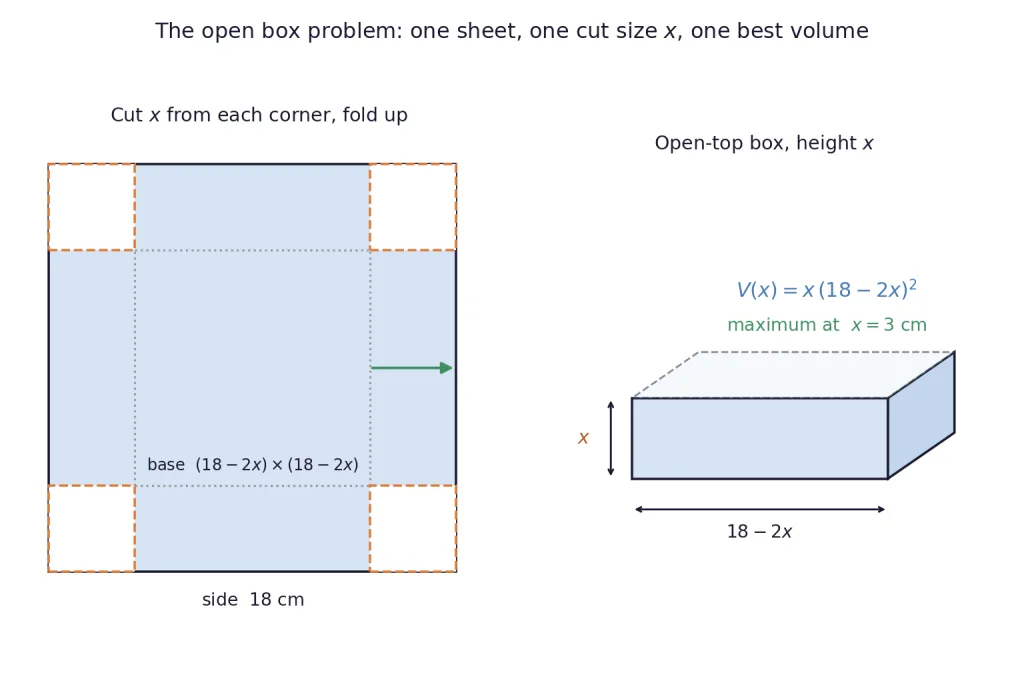
, which vanishes at (rejected — no box) and . Since , the volume is maximum when cm, giving cm³.
Key Point: Always state the physical domain of the variable (here ) and reject roots outside it with a reason — examiners award a mark for it.
[JEE Tip] In MCQs, once you get the optimal , sanity-check with a nearby value (?) rather than re-deriving — faster and error-proof.
The Geometry Toolbox — Results Worth Knowing
A small set of inscribed-figure results appears again and again in Boards and JEE. Learn the setups, remember the punchlines:
- Rectangle in a circle: of all rectangles inscribed in a fixed circle, the square has maximum area.
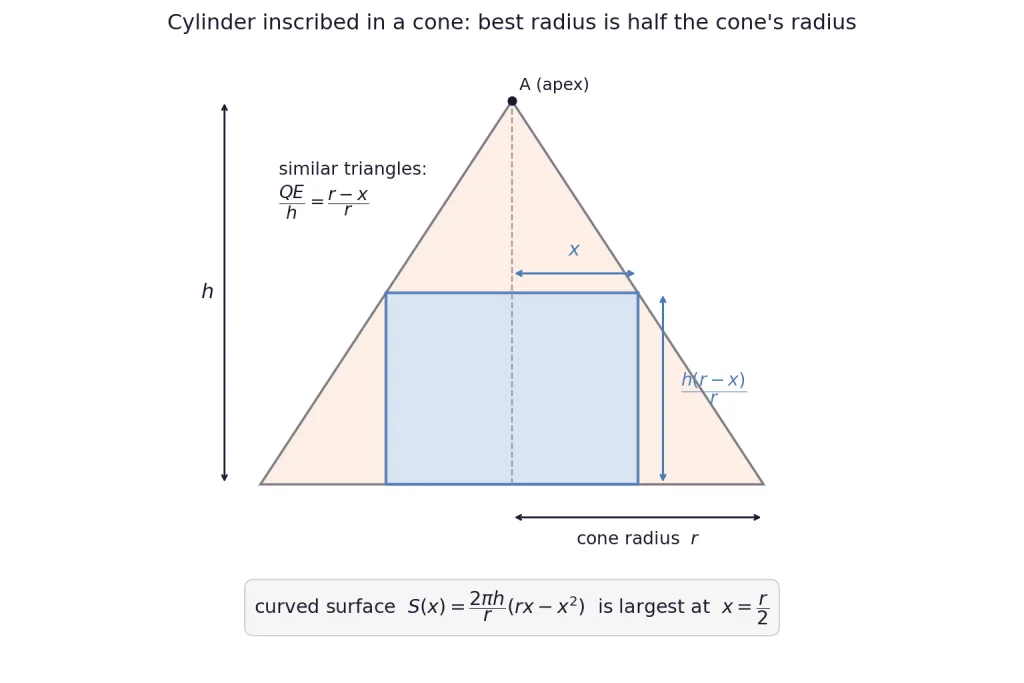
- Cylinder in a cone (cone radius , height ): the cylinder of greatest curved surface area has radius . Setup: similar triangles give cylinder height for cylinder radius , so — a downward parabola peaking at .
- Cone in a sphere (radius ): the largest cone has volume of the sphere's volume.
- Cylinder of given surface area: maximum volume when height = diameter ().
- Cone of given slant height: maximum volume at semi-vertical angle .
- Cone of given surface area: maximum volume at semi-vertical angle .
- Wire of length cut into a square and a circle: combined area is minimum when the square piece is and the circle piece is .
Key Point: In every proof, the flow is identical: similar triangles or Pythagoras for the constraint → one-variable target function → derivative test. Master the flow, not just the answers.
[JEE Important] JEE loves the distance variant: minimise the distance from a point to a curve. Trick: minimise the squared distance instead of — same minimiser, no square roots in the algebra. Example: the point on nearest to is .
Solved Examples
Example 1: The closed-interval method, start to finish
Find the absolute maximum and minimum values of on .
Solution:
- Critical points: (both inside ).
- Candidates: .
- Evaluate: ; ; ; .
- Compare: largest 56, smallest 24.
Final Answer: Absolute maximum 56 at ; absolute minimum 24 at .
Takeaway: Both winners were endpoints — always include them in the table.
Example 2: Fractional powers and a non-differentiable point
Find the absolute maximum and minimum of , .
Solution:
- Differentiate: .
- Critical points: at ; undefined at (but is defined there) — BOTH are critical points.
- Evaluate at : ; ; ; .
Final Answer: Absolute maximum 18 at ; absolute minimum at .
Takeaway: Missing the critical point is harmless here, but missing (from the zero of ) would lose the minimum. List every candidate mechanically.
Example 3: The nearest helicopter (distance minimisation)
A helicopter flies along the curve . A soldier is placed at the point . Find the nearest distance between them.
Solution:
- Set up the squared distance: the helicopter is at , so . Call this .
- Differentiate: .
- Solve: is the only real root ( has discriminant ).
- Value: , and comparison (e.g. ) confirms a minimum.
Final Answer: The nearest distance is .
Takeaway: Minimise , not — the square root would only clutter the derivative. Convert back with a square root at the very end.
Example 4: Two numbers, minimum sum of squares
Find two positive numbers whose sum is 15 and the sum of whose squares is minimum.
Solution:
- Variables and constraint: numbers and , with .
- Target: .
- Optimise: ; : minimum.
Final Answer: The numbers are and .
Takeaway: General fact: for a fixed sum , the sum of squares is minimised by equal halves — symmetry wins.
Example 5: Maximum product
Find two numbers whose sum is 24 and whose product is as large as possible.
Solution:
- Setup: numbers and ; product .
- Optimise: ; : maximum.
- Value: the numbers are 12 and 12, product .
Final Answer: 12 and 12 (maximum product 144).
Takeaway: Fixed sum product maximised at equality. Pair this with Example 4: symmetric answers are the norm for symmetric constraints.
Example 6: Unequal powers — no symmetry now
Find two positive numbers and such that and is maximum.
Solution:
- Eliminate: , so maximise for .
- Differentiate: (reject ).
- Confirm: changes from positive to negative through — maximum.
- Then .
Final Answer: , .
Takeaway: With , the "heavier" factor takes the proportionally larger share: gets of 60. In general for with , the split is — a superb JEE shortcut.
Example 7: The two poles
Let AP and BQ be two vertical poles at points A and B. If AP = 16 m, BQ = 22 m and AB = 20 m, find the distance of a point R on AB from A such that is minimum.
Solution:
- Variable: let m, so .
- Pythagoras twice: and .
- Target: .
- Optimise: ; : minimum.
Final Answer: is at distance 10 m from (the midpoint of AB).
Takeaway: The pole heights only shift by constants — they never affect where the minimum sits. Expect the midpoint whenever the -part is symmetric.
Example 8: Maximum area of a trapezium
Three sides of a trapezium, other than the base, are each 10 cm. Find the area of the trapezium when it is maximum.
Solution:
- Set up: let the equal slanted sides make foot-lengths on each side, so the parallel sides are 10 and , and the height is .
- Target: .
- Differentiate: ; setting the numerator to zero: (reject ).
- Confirm and evaluate: (maximum), and cm².
Final Answer: Maximum area cm².
Takeaway: When the target has a , only the numerator of matters for critical points — don't differentiate the square root twice unnecessarily.
Example 9: The open box (a Board perennial)
A square piece of tin of side 18 cm is to be made into an open-top box by cutting a square from each corner and folding up the flaps. What side of the cut square maximises the volume?
Solution:
- Variable: cut side ; base becomes , height ; domain .
- Target: .
- Differentiate: .
- Solve: (rejected — base vanishes) or .
- Confirm: , : maximum. cm³.
Final Answer: Cut squares of side 3 cm (maximum volume 432 cm³).
Takeaway: For an sheet the answer is always . For the rectangular 45 cm × 24 cm sheet, the same method gives cm.
Example 10: Minimum surface area of a can
Of all closed right circular cylindrical cans of volume 100 cm³, find the dimensions that minimise the surface area.
Solution:
- Constraint: .
- Target: .
- Differentiate: .
- Confirm: : minimum.
- Height: (using ).
Final Answer: cm and cm.
Takeaway: "Most economical can" always ends with height = diameter. Real tins aren't far from this shape!
Example 11: Cutting a wire into a square and a circle
A wire of length 28 m is cut into two pieces — one bent into a square, the other into a circle. What lengths minimise the combined area?
Solution:
- Variables: square piece (side ), circle piece (radius ).
- Target: .
- Differentiate: .
- Confirm: : minimum.
Final Answer: Square piece m; circle piece m.
Takeaway: For total length : square gets , circle gets . (For maximum combined area, no interior maximum exists — you'd use the whole wire for the circle.)
Example 12: Cylinder of greatest curved surface inside a cone (proof)
Prove that the radius of the right circular cylinder of greatest curved surface area which can be inscribed in a given cone is half the radius of the cone.
Solution:
- Set up with similar triangles: cone radius , height ; cylinder radius . The similar triangles give cylinder height .
- Target: .
- Differentiate: .
- Confirm: for all : maximum.
Final Answer: The cylinder of greatest curved surface area has radius — half the cone's radius. ∎
Takeaway: is just a downward parabola — its vertex at could even be quoted directly. Recognising hidden parabolas saves minutes in JEE.