
Welcome to Applications of Derivatives
In Chapter 5 you built a powerful machine — the derivative. You can now differentiate composite functions, implicit functions, exponentials, logarithms and inverse trigonometric functions. This chapter is where that machine gets put to work.
Here is the roadmap for the chapter:
- Rate of change of quantities (this section) — using to measure how fast things change: areas, volumes, costs, revenues.
- Increasing and decreasing functions — using the sign of to decide where a graph rises and falls.
- Maxima and minima — finding the turning points of a function with the first and second derivative tests.
- Optimisation — the famous word problems: largest area, maximum volume, minimum cost.
Key Point: One single idea powers this entire chapter — the derivative measures the instantaneous rate of change of at . Everything else is this idea applied in different costumes.
[JEE Tip] JEE also tests tangents and normals and Mean Value Theorem applications from this topic area. They are no longer in the NCERT chapter, so we cover them separately in the JEE Corner section of this chapter — don't skip it if you're preparing for JEE.
The Derivative as a Rate of Change
Recall from motion in a straight line: if is distance and is time, then is the speed — the rate of change of distance with respect to time. This idea generalises beautifully.
If a quantity varies with a quantity by a rule , then:
- (or ) represents the rate of change of with respect to
- (or ) is the rate of change of with respect to at the specific point
Geometrically, this is the slope of the tangent to the graph of at that point — a steep tangent means is changing fast, a flat tangent means it is barely changing.
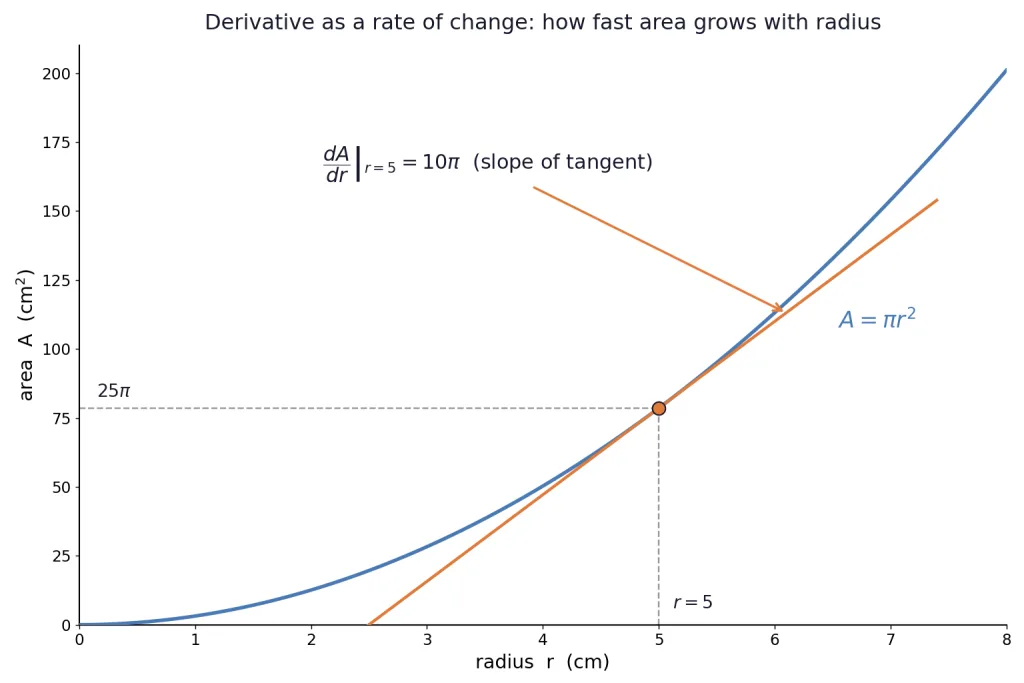
For example, the area of a circle is , so
At cm, — the area is growing at cm²/cm of radius. Notice the units: a rate of change of with respect to always carries units of (units of )/(units of ).
Key Point: is positive if increases as increases, and negative if decreases as increases. A negative rate simply means the quantity is shrinking.
[Board Important] When a question says "the length is decreasing at 3 cm/min", you must write cm/min. Forgetting the minus sign is the single most common mistake in this section.
Related Rates — the Chain Rule at Work
Often two quantities and both change with time , and we know one rate but want the other. If and , then by the Chain Rule:
So the rate of change of with respect to can be computed from the rates of both with respect to . In practice, you will usually differentiate a relation between the quantities directly with respect to .
The 4-step method for rate-of-change problems
- Name the variables and write down the given rates (with signs!) and the instant of interest.
- Find an equation connecting the quantities — an area, volume, perimeter or geometry formula.
- Differentiate both sides with respect to using the Chain Rule.
- Substitute the values at the required instant and solve for the unknown rate.
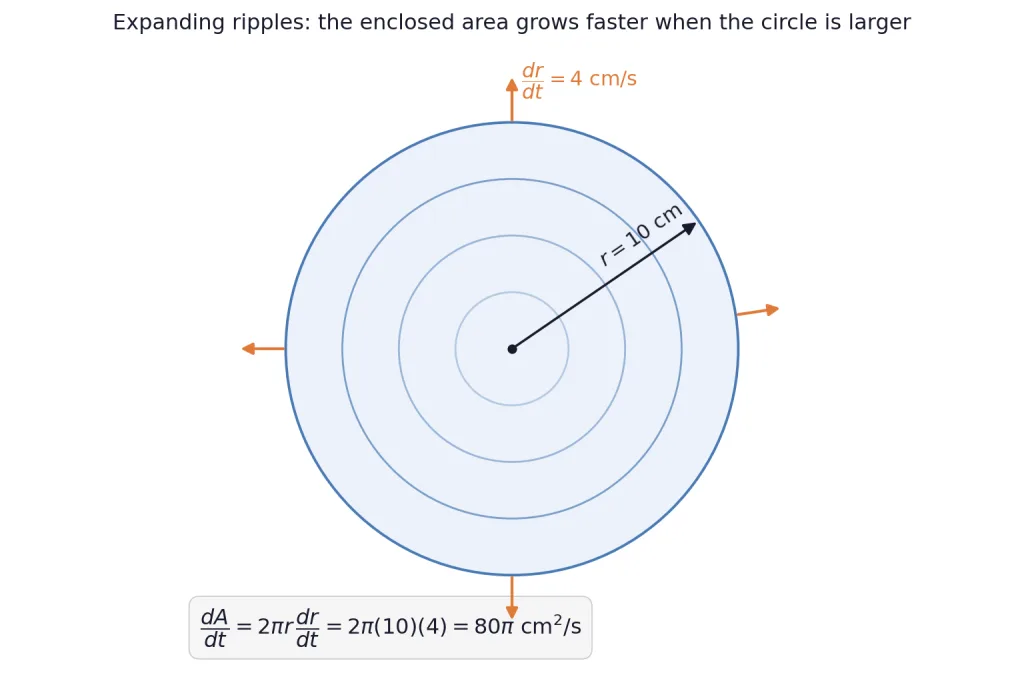
A classic picture: a stone dropped in a lake sends out circular ripples. The radius grows at a known speed , and we ask how fast the enclosed area grows:
The answer depends on — the same ripple speed sweeps out area faster when the circle is already large. That is exactly why we substitute values only after differentiating.
[JEE Tip] Substitute the specific values only at the very end, after differentiating. Substituting before differentiating turns a variable into a constant and gives — a guaranteed wrong answer and a favourite trap in MCQs.
When Quantities Are Linked by a Constraint — the Sliding Ladder
Some of the best rate problems link variables through a geometric constraint rather than an explicit formula. The classic example: a ladder of fixed length leaning against a wall, with its foot being pulled away.
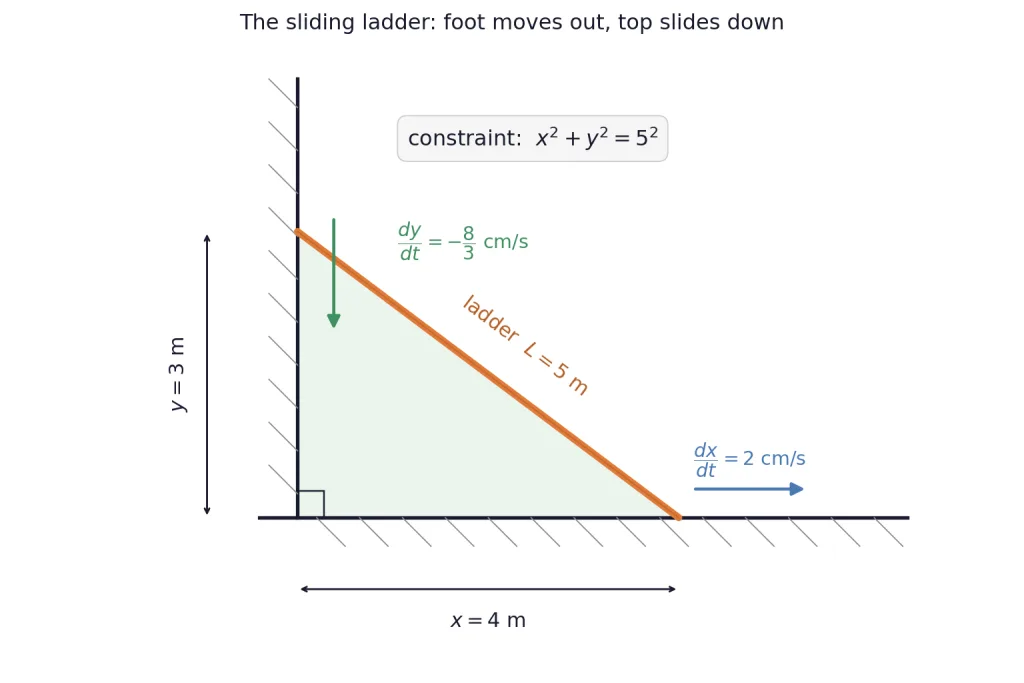
If the foot is metres from the wall and the top is metres up the wall, Pythagoras gives the constraint:
Since (the ladder length) is constant, differentiating both sides with respect to :
The minus sign tells the story: as the foot slides out (), the top slides down ().
Key Point: Constraints (Pythagoras, similar triangles, fixed volumes) are differentiated implicitly with respect to . Every variable gets a — that's implicit differentiation from Chapter 5 in action.
[JEE Important] In cone/cylinder problems, one variable is often proportional to another (e.g. "height is always one-sixth of the radius"). Use the proportion to eliminate a variable before differentiating — the solution becomes a two-line calculation.
Marginal Cost and Marginal Revenue
Derivatives are not just for geometry — economics uses them daily.
- Total cost : the cost of producing units of an item.
- Marginal cost (MC): the instantaneous rate of change of total cost with respect to output:
- Total revenue : the money received from selling units.
- Marginal revenue (MR): the rate of change of revenue with respect to the number of units sold:
Intuitively, marginal cost at answers: "roughly how much extra does the next unit cost to produce, when we are already producing 3?"
Key Point: Marginal = derivative. Differentiate the total cost or total revenue function, then substitute the given number of units.
[Board Important] Marginal cost/revenue questions are frequent 2-mark questions. They need only differentiation and substitution — free marks if you know the definition. Answers in rupees are usually rounded to two decimal places.
Solved Examples
Example 1: Rate of change of a circle's area with respect to radius
Find the rate of change of the area of a circle with respect to its radius when cm.
Solution:
- Formula: The area of a circle is .
- Differentiate with respect to : .
- Substitute : .
Final Answer: The area is changing at the rate of cm²/cm.
Takeaway: "Rate of change of with respect to " simply means — differentiate and substitute.
Example 2: Rate of change of circumference
The radius of a circle is increasing at the rate of 0.7 cm/s. What is the rate of increase of its circumference?
Solution:
- Given: cm/s. Formula: .
- Differentiate with respect to : .
- Substitute: cm/s.
Final Answer: The circumference increases at cm/s.
Takeaway: Because is linear in , this rate is the same for every radius — no instant needed.
Example 3: Cube — volume rate given, surface area rate wanted
The volume of a cube is increasing at a rate of 9 cm³/s. How fast is the surface area increasing when the length of an edge is 10 cm?
Solution:
- Name variables: Let = edge, , ; given cm³/s.
- Differentiate : , so , giving .
- Differentiate : .
- Substitute : cm²/s.
Final Answer: The surface area is increasing at 3.6 cm²/s.
Takeaway: Use the given rate to extract first, then feed it into the quantity you actually want.
Example 4: Expanding ripples on a lake
A stone is dropped into a quiet lake and waves move in circles at a speed of 4 cm/s. At the instant when the radius of the circular wave is 10 cm, how fast is the enclosed area increasing?
Solution:
- Given: cm/s; want at cm, where .
- Differentiate: .
- Substitute: .
Final Answer: The enclosed area is increasing at cm²/s.
Takeaway: Differentiate first, substitute last — the answer depends on the instant because appears in the derivative.
Example 5: Rectangle with one side growing and one shrinking
The length of a rectangle is decreasing at the rate of 3 cm/min and the width is increasing at the rate of 2 cm/min. When cm and cm, find the rates of change of (a) the perimeter and (b) the area of the rectangle.
Solution:
- Given (watch the signs): cm/min (decreasing), cm/min.
- (a) Perimeter: , so cm/min.
- (b) Area: , so by the Product Rule cm²/min.
Final Answer: The perimeter is decreasing at 2 cm/min; the area is increasing at 2 cm²/min.
Takeaway: A decreasing quantity gets a negative rate. The perimeter shrinks here, yet the area grows — signs carry real information.
Example 6: Volume rate of a growing cube
An edge of a variable cube is increasing at the rate of 3 cm/s. How fast is the volume of the cube increasing when the edge is 10 cm long?
Solution:
- Given: cm/s, .
- Differentiate: .
- Substitute : cm³/s.
Final Answer: The volume is increasing at 900 cm³/s.
Takeaway: Notice how fast volume grows compared to the edge — the factor amplifies the rate.
Example 7: Inflating a spherical balloon
A balloon, which always remains spherical on inflation, is being inflated by pumping in 900 cm³ of gas per second. Find the rate at which the radius of the balloon increases when the radius is 15 cm.
Solution:
- Given: cm³/s, .
- Differentiate: .
- Substitute : .
- Solve: cm/s.
Final Answer: The radius increases at cm/s.
Takeaway: The same inflow makes the radius grow slower as the balloon gets bigger — the gas spreads over a larger surface ( is exactly the surface area!).
Example 8: The sliding ladder
A ladder 5 m long is leaning against a wall. The bottom of the ladder is pulled along the ground, away from the wall, at the rate of 2 cm/s. How fast is its height on the wall decreasing when the foot of the ladder is 4 m away from the wall?
Solution:
- Constraint: With foot at distance and top at height : . Given cm/s.
- Find at the instant: When , m.
- Differentiate the constraint: , so .
- Substitute: cm/s.
Final Answer: The height on the wall is decreasing at the rate of cm/s.
Takeaway: Keep units consistent — since was given in cm/s, the answer comes out in cm/s even though lengths are in metres (the ratio is dimensionless).
Example 9: A particle on a curve
A particle moves along the curve . Find the points on the curve at which the -coordinate is changing 8 times as fast as the -coordinate.
Solution:
- Translate the condition: .
- Differentiate the curve with respect to : .
- Substitute the condition: .
- Find : At : . At : .
Final Answer: The points are and .
Takeaway: " changes times as fast as " always translates to . Don't forget the negative root of — dropping it loses half the marks.
Example 10: The sand cone
Sand is pouring from a pipe at the rate of 12 cm³/s. The falling sand forms a cone on the ground in such a way that the height of the cone is always one-sixth of the radius of the base. How fast is the height of the sand cone increasing when the height is 4 cm?
Solution:
- Given: cm³/s, , i.e. .
- Eliminate before differentiating: .
- Differentiate: .
- Substitute : , so cm/s.
Final Answer: The height is increasing at cm/s.
Takeaway: When two variables are proportional, eliminate one first — the problem collapses to a single-variable rate calculation.
Example 11: Marginal cost
The total cost in rupees, associated with the production of units of an item is given by . Find the marginal cost when 3 units are produced.
Solution:
- Definition: Marginal cost MC .
- Differentiate: .
- Substitute : MC .
Final Answer: The marginal cost is ₹30.02 (nearly).
Takeaway: The constant 5000 (fixed cost) vanishes on differentiation — marginal cost never depends on fixed costs.
Example 12: Marginal revenue
The total revenue in rupees received from the sale of units of a product is given by . Find the marginal revenue when .
Solution:
- Definition: Marginal revenue MR .
- Differentiate: .
- Substitute : MR .
Final Answer: The marginal revenue is ₹66.
Takeaway: Marginal = derivative, then substitute. These are among the quickest full-mark questions in the chapter.