
What JEE Actually Asks From This Chapter
Here is the current, official picture — worth knowing precisely, because it changed recently:
- JEE Main (per the official NTA syllabus): the Applications of Derivatives portion reads "Rate of change of quantities, monotonic — increasing and decreasing functions, maxima and minima of functions of one variable." That's it. Tangents & normals and Rolle's/Lagrange's Mean Value Theorems were dropped from the JEE Main syllabus in the 2024 rationalisation — they no longer appear in Main papers.
- JEE Advanced: the Differential Calculus syllabus still explicitly includes tangents and normals, increasing and decreasing functions, maxima and minima, Rolle's theorem and Lagrange's mean value theorem with their geometric interpretation.
So your strategy depends on your target:
- JEE Main aspirants: go deep on monotonicity (especially with parameters) and maxima-minima (especially of non-polynomial functions). Expect 1-2 questions almost every session, frequently MCQ-style versions of optimisation and monotonic-interval problems.
- JEE Advanced aspirants: everything in this section is testable, including tangents/normals, orthogonal curves, and MVT-based reasoning.
This section covers the full superset, with each topic labelled. Even pure Main aspirants should skim the tangent/normal ideas — they quietly power "minimum distance" and "common point of two curves" problems that ARE in the Main syllabus.
[JEE Tip] In recent Main papers, this chapter's questions increasingly hybridise with other units — monotonicity of , extrema of functions defined with logs and exponentials, and root-counting via shape-of-graph arguments. The last notes block here covers that root-counting technique.
Tangents and Normals (JEE Advanced syllabus; tools useful everywhere)
The derivative at a point IS the slope of the tangent there. For a curve and a point on it:
- Tangent at : slope , equation
- Normal at : perpendicular to the tangent, slope (when ), equation
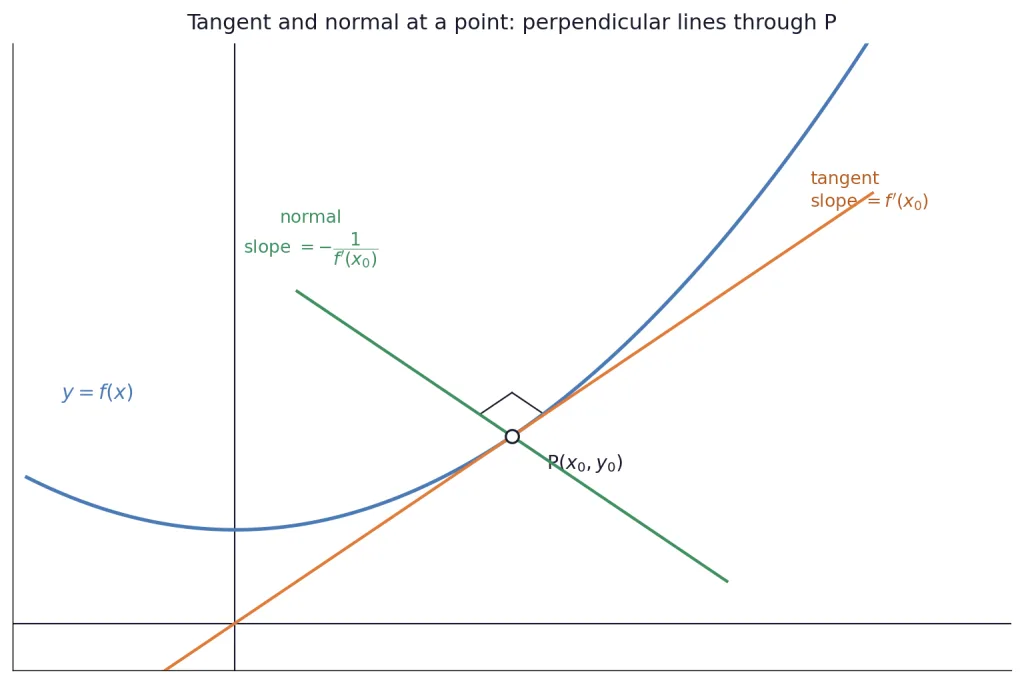
Special slopes to recognise instantly: tangent parallel to the -axis ; tangent parallel to the -axis is undefined/infinite (for implicit curves, ); tangent parallel to a line of slope ; tangent perpendicular to a line of slope .
Angle of intersection of two curves
At a common point, if the tangent slopes are and :
- Orthogonal curves: at every intersection point.
- Touching curves: (common tangent at the point).
Key Point: For implicit curves like or , differentiate implicitly and evaluate at the actual intersection point — find that point first by solving the two equations together.
[JEE Advanced] Classic result worth caching: the curves and cut at right angles if and only if — proved in Example 5 below. Variants of this appear repeatedly.
Rolle's and Lagrange's Mean Value Theorems (JEE Advanced syllabus)
Rolle's Theorem. If is continuous on , differentiable on , and , then there exists at least one with .
Geometrically: equal endpoint heights force at least one horizontal tangent in between.
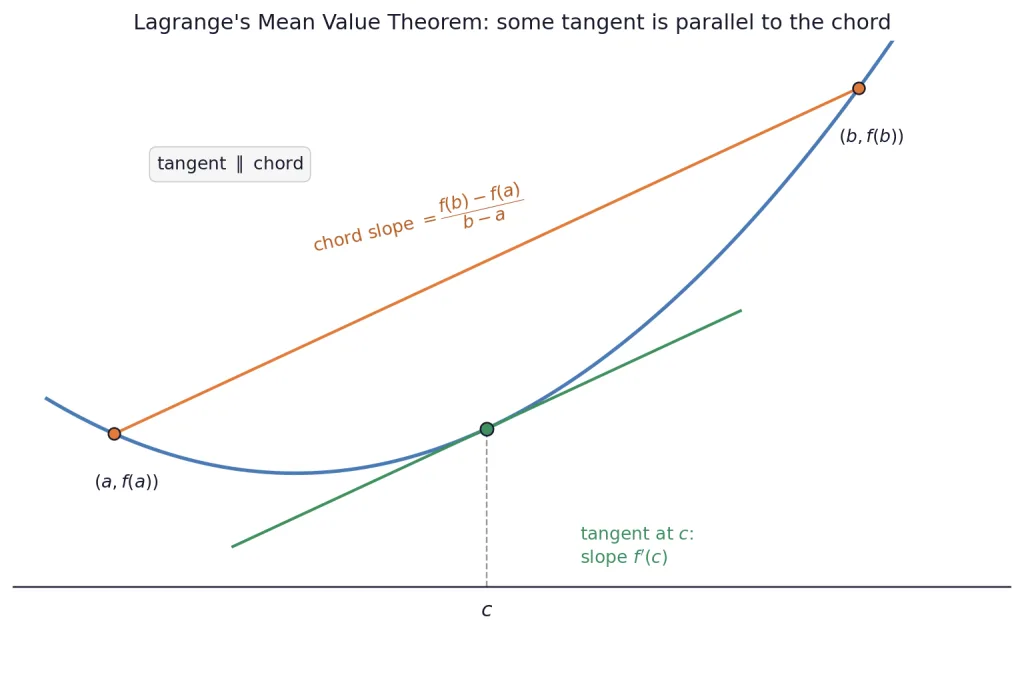
Lagrange's Mean Value Theorem (LMVT). If is continuous on and differentiable on , then there exists with
Geometrically: some tangent is parallel to the chord joining the endpoints. (Rolle's is the special case where the chord is horizontal.)
The three JEE application patterns
- Find the : verify hypotheses, set equal to the average slope, solve. (Answers must lie strictly inside — check!)
- Root existence: if a differentiable has two zeros, Rolle's gives a zero of between them. Contrapositive: if never vanishes on an interval, has at most one root there — the standard "exactly one real root" argument when combined with a sign change.
- Inequalities: LMVT bounds a difference by a derivative bound: where . Example: since .
Key Point: MVT questions are about existence, not computation. The theorem never tells you what is in general — only that it exists. When a question asks for explicitly, the function is deliberately chosen so the equation solves cleanly.
[JEE Advanced] Watch the hypotheses. on has but NO horizontal tangent — Rolle's does not apply because is not differentiable at 0. Options that ignore a hypothesis are planted traps.
Monotonicity, JEE Style (core JEE Main syllabus)
Board questions ask "find the intervals". JEE questions hide monotonicity inside something else:
1. Parameter ranges
For what is increasing on all of ? Need for all : a positive-leading-coefficient quadratic is non-negative everywhere iff its discriminant :
Memorise the template: and (allowing equality at isolated points).
2. Proving inequalities
To prove for : form , show and for . Classics every JEE aspirant should have done once:
- for
- for
- for
3. Root counting
A strictly monotonic continuous function has at most one real root; a sign change gives exactly one. For cubics with two turning points, compare the local max and local min values with 0: three distinct real roots iff ; a repeated root iff one of them is exactly 0.
Key Point: "Number of real solutions" questions in JEE are graph-shape questions. Find the turning values, sketch mentally, count crossings — no root formulas needed.
[JEE Main] When has a squared factor — e.g. — the function does NOT change monotonicity at the squared root. Monotonic-interval options that split at are the trap.
Maxima–Minima, JEE Style (core JEE Main syllabus)
Beyond the Board-style optimisation of Section 4, JEE adds these recurring shapes:
1. Standard bounds — quote, don't derive
- for (AM-GM; equality at )
- peaks at (value ); peaks at (value ); bottoms out at (value )
2. Minimum distance from a point to a curve
Minimise the squared distance; at the optimum, the join is normal to the curve — a fact that can shortcut MCQs entirely.
3. Extrema of rational functions
For -type functions, two clean methods: differentiate, or treat it as the range problem — cross-multiply to a quadratic in and force its discriminant for real ; the resulting inequality in gives the max and min directly.
4. Critical-point bookkeeping
From a factorised derivative like , count sign changes only at odd-multiplicity roots. Number of local extrema = number of sign changes of , not the number of roots of .
Key Point: JEE MCQs rarely need the full second-derivative ritual. Sign-of- reasoning plus the standard bounds above answer most questions in under two minutes.
[JEE Main] A favourite twist: extrema of or . Remember has possible extra minima where , and even functions automatically have a critical point at — check corners separately, the derivative machinery alone misses them.
Solved Examples (JEE Pattern)
Example 1: Where the slope equals the height [JEE Main pattern]
Find the points on the curve at which the slope of the tangent equals the -coordinate of the point.
Solution:
- Slope ; condition: .
- or .
- Points: and .
Final Answer: and .
Example 2: Tangent parallel to a given line [JEE Main pattern]
Find the equation of the tangent to that is parallel to the line .
Solution:
- Implicit differentiation: .
- Match slopes: , then .
- Tangent at : , i.e. .
Final Answer: (i.e. ).
Takeaway: For , the tangent of slope is always — here gives instantly. Knowing the conic shortcut converts a 3-minute problem into a 15-second one.
Example 3: Equation of a normal [JEE Advanced pattern]
Find the equation of the normal to at the point where the curve crosses the -axis with the smaller abscissa.
Solution:
- Crossing points: ; the smaller is .
- Tangent slope: , so at : .
- Normal slope: ; equation: .
Final Answer: .
Example 4: Angle between two parabolas [JEE Advanced pattern]
Find the angle of intersection of the curves and at their intersection point other than the origin.
Solution:
- Intersection: and give ; the non-origin point is .
- Slopes at : for : . For : .
- Angle: .
Final Answer: .
Takeaway: At the origin these two curves meet at right angles (tangents along the axes) — a two-intersection curve pair can meet at different angles at different points.
Example 5: Orthogonality condition (a classic) [JEE Advanced pattern]
Show that the curves and cut at right angles if .
Solution:
- Intersection point: substituting into : , .
- Slopes: from : . From : .
- Orthogonality: .
- Convert to : . ∎
Takeaway: Orthogonal-curves problems always reduce to at the intersection point — never at a general point.
Example 6: Rolle's theorem, then a root count [JEE Advanced pattern]
(a) Verify Rolle's theorem for on . (b) Show that has exactly one real root.
Solution:
- (a) Hypotheses: is a polynomial (continuous, differentiable everywhere) and . ✓
- Find : . Rolle's verified.
- (b) At most one root: always, so is strictly increasing — it can cross zero at most once. (Equivalently: two roots would force somewhere by Rolle's — impossible.)
- At least one root: and , so a root lies in by continuity.
Final Answer: (a) ; (b) exactly one real root (it lies in ). ∎
Example 7: LMVT — find the point, prove the bound [JEE Advanced pattern]
(a) Find the value of guaranteed by Lagrange's MVT for on . (b) Using LMVT, prove for all reals .
Solution:
- (a) Average slope . Setting gives .
- Check: . ✓
- (b) For , LMVT applied to on gives with .
- Taking absolute values: , so . ∎
Takeaway: Pattern (b) is the single most reused MVT argument in JEE Advanced — any function with a bounded derivative is Lipschitz: .
Example 8: The log sandwich inequality [JEE Main pattern]
Prove that for all .
Solution:
- Right half: let . Then and for , so : .
- Left half: let . Then and for , so .
Final Answer: Both inequalities hold for every . ∎
Takeaway: The template — difference function, value 0 at the endpoint, positive derivative — proves nearly every JEE inequality of this type. Practise until it is automatic.
Example 9: Parameter range for monotonicity [JEE Main pattern]
Find all values of for which is increasing on .
Solution:
- — an upward parabola in .
- Need for all : discriminant .
- .
Final Answer: .
Takeaway: At , vanishes at one isolated point only — monotonicity survives, so the endpoints are included.
Example 10: Extrema of a rational function, two ways [JEE Main pattern]
Find the local maximum and minimum values of .
Solution:
- Derivative method: .
- Critical points ; goes through (local min) and through (local max).
- Values: ; .
- Range cross-check: ; real needs — matching extremes.
Final Answer: Local maximum at ; local minimum at .
Takeaway: The discriminant/range method both verifies the answer and shows these are in fact global extremes — a free upgrade in an MCQ.
Example 11: Minimum distance to a parabola [JEE Main pattern]
Find the point(s) on nearest to the point , and the minimum distance.
Solution:
- Squared distance to : .
- Differentiate: .
- Candidates: . Values: ; .
- Compare: minimum at , i.e. the points , distance .
Final Answer: Nearest points and ; minimum distance .
Takeaway: By symmetry there are TWO nearest points here — is a local maximum of closeness (a critical point that is not the answer). Evaluate all candidates.
Example 12: Root counting via turning values [JEE Main pattern]
Find the number of distinct real roots of .
Solution:
- Turning points: : local max at , local min at .
- Turning values: ; .
- Read the shape: the local maximum value is exactly 0, so the graph touches the axis at (double root) and, since with , crosses once beyond .
- Confirm by factoring: — roots (double) and .
Final Answer: 2 distinct real roots ( and ).
Takeaway: local max value or local min value signals a repeated root — the graph kisses the axis at a turning point. This shape-reading is exactly what JEE root-counting questions test.