
What Does "Increasing" Mean?
Look at the graph of . To the right of the origin, as you move from left to right, the height of the graph continuously rises — the function is increasing for . To the left of the origin, moving left to right, the height continuously falls — the function is decreasing for .
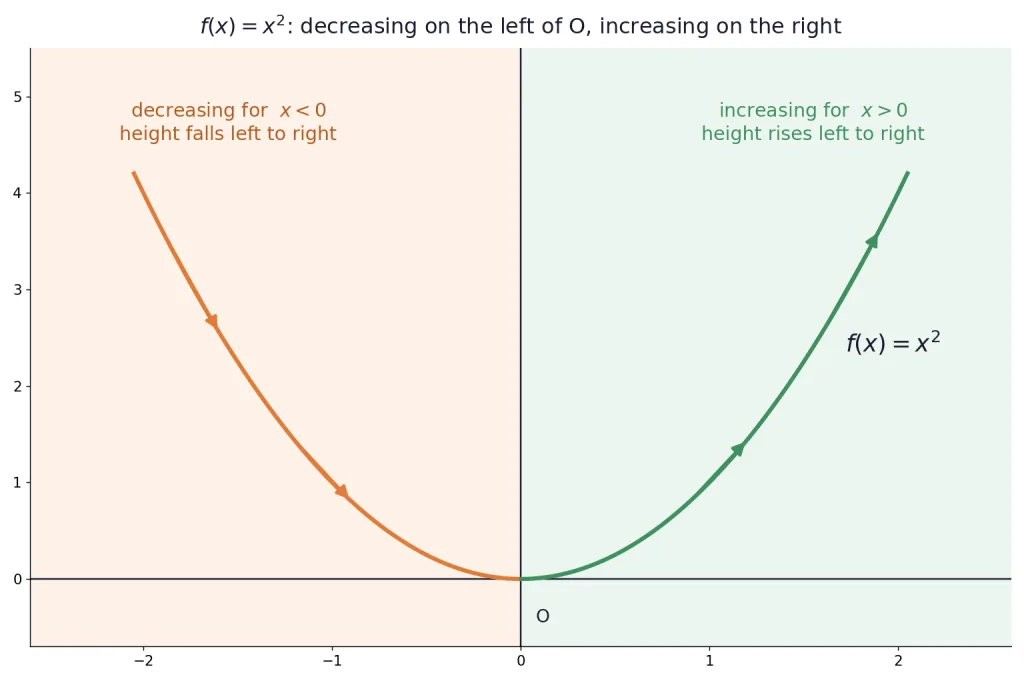
Let's make this precise. Let be an interval contained in the domain of a real valued function . Then is said to be:
- Increasing on if in for all
- Decreasing on if in for all
- Constant on if for all , where is a constant
- Strictly increasing on if in
- Strictly decreasing on if in
A function can also be increasing or decreasing at a point : this means there is some open interval containing on which the function is increasing (or decreasing).
Key Point: Bigger input bigger output means increasing. Bigger input smaller output means decreasing. And a function like can be decreasing on one interval and increasing on another — always name the interval.
[JEE Tip] Some books (and older NCERT editions) define "increasing" with (non-decreasing) and reserve for "strictly increasing". In JEE, "monotonically increasing" usually allows flat stretches. Read the question's convention carefully — but for Board answers, follow the current NCERT definitions above.
The First Derivative Test for Monotonicity
Checking for every pair of points is impractical. The derivative gives a far better tool.
Theorem 1. Let be continuous on and differentiable on the open interval . Then:
- (a) is increasing in if for each
- (b) is decreasing in if for each
- (c) is a constant function in if for each
Why it works (proof sketch): Take any in . By the Mean Value Theorem there is a point between them with
If , the right side is positive, so — that is exactly "increasing". The tangent-slope sign controls the function's direction.
Key Point: Positive slope everywhere graph climbs. Negative slope everywhere graph falls. The test needs the sign of on the open interval; continuity extends the conclusion to the closed interval's endpoints.
[JEE Important] vanishing at isolated points does no harm: has , yet is strictly increasing on all of because everywhere else. " with equality only at isolated points" still gives strict increase — a favourite JEE conceptual trap.
The Working Method: Sign Analysis on the Number Line
Most exam questions say: "Find the intervals in which is increasing or decreasing." Here is the standard recipe:
- Differentiate: compute .
- Solve : these critical values split the real line (or the given domain) into disjoint intervals.
- Factorise and test the sign of each factor in each interval (a quick sign table).
- Conclude: increasing on that interval; decreasing.
Take :
So at and , giving three intervals:
| Interval | Sign of | Nature of |
|---|---|---|
| increasing | ||
| decreasing | ||
| increasing |
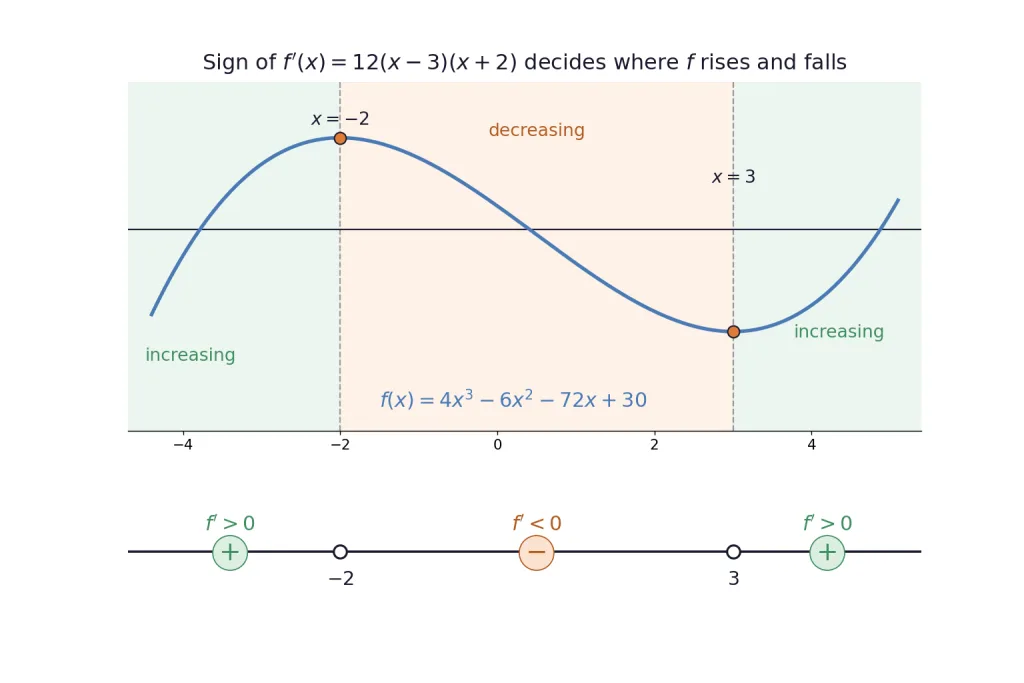
Note that is increasing on and on , decreasing on — but it is neither increasing nor decreasing on as a whole.
Key Point: Never write "increasing on " as one monotonic claim. Monotonicity is interval-by-interval; the union statement is false (compare with here). State the intervals separately.
[Board Important] Present the sign table in your Board answer — it earns method marks even if an interval slips.
Trigonometric Functions Need Extra Care
For trig functions the critical values come from solving equations like within the given domain.
Example pattern 1: has . On , , so : cosine is decreasing on . On , , so : cosine is increasing there. Over the whole of it is neither.
Example pattern 2: on . Then , which vanishes where , i.e. at and . Sign analysis gives: increasing on and , decreasing on .
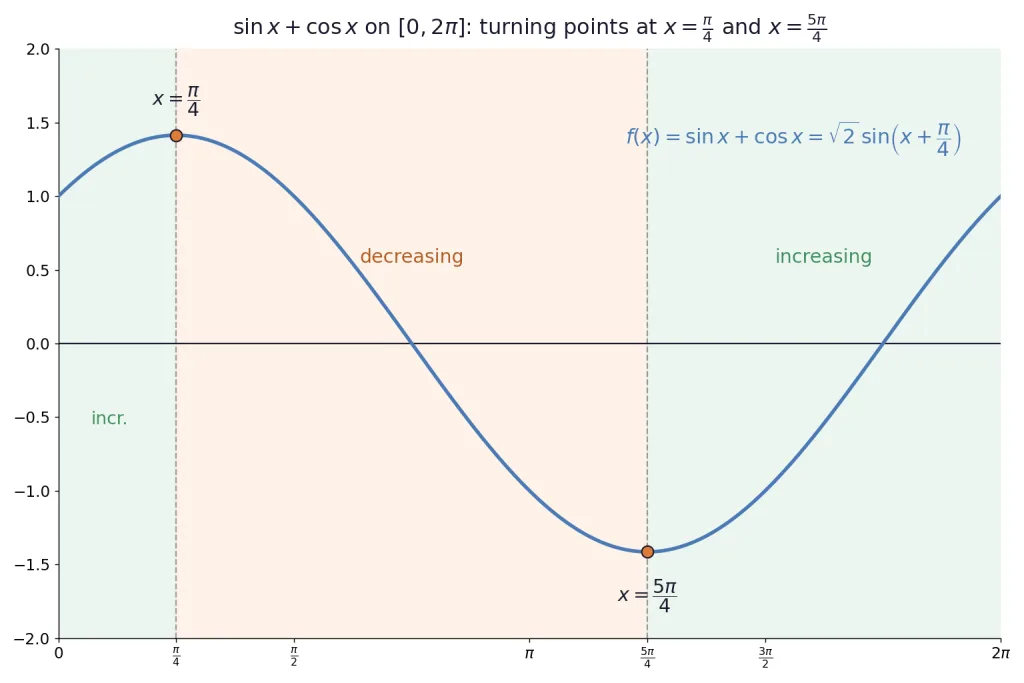
Key Point: Always solve within the stated domain — on gives , i.e. and , because ranges over .
[JEE Tip] A quick alternative for : write it as . It increases exactly where the shifted sine increases — the same intervals appear with almost no computation.
Parameters and Clever Algebraic Forms
Two patterns that Boards and JEE both love:
1. Finding parameter values
For what values of is increasing on ?
Here . We need for all . Since is smallest as , the condition is , i.e. . (At , for every in the open interval , so it qualifies.)
2. Showing a function is increasing via a perfect square
Show is increasing for .
For the denominator is positive and , so (zero only at the isolated point ) — increasing throughout the domain.
3. The family
For , . So exactly when : the function is increasing on any interval disjoint from , and decreasing on and .
[JEE Important] When can be written as or factored into simple linear factors, monotonicity questions become sign-reading exercises. Practise forcing into such forms — it is the single most useful algebraic skill for this topic.
Solved Examples
Example 1: A linear function, straight from the definition
Show that the function given by is increasing on .
Solution:
- Take any two reals with .
- Multiply by 7 (positive, so inequality keeps direction): .
- Subtract 3: , i.e. .
Final Answer: By the definition, is (strictly) increasing on .
Takeaway: For simple functions the definition itself is the fastest route — no derivative needed.
Example 2: Exponential growth is always increasing
Show that the function given by is increasing on .
Solution:
- Differentiate: .
- Sign: for every real , so on all of .
- Apply Theorem 1: everywhere is increasing on .
Final Answer: is increasing on .
Takeaway: Exponentials with positive coefficients in the exponent are always increasing — their derivative is a positive multiple of themselves.
Example 3: When the derivative hides a perfect square
Show that , , is increasing on .
Solution:
- Differentiate: .
- Complete the square: .
- Sign: , so for every .
Final Answer: in every interval of , so is increasing on .
Takeaway: When is a quadratic with negative discriminant (here ), it never changes sign — completing the square shows this instantly.
Example 4: Cosine on different intervals
Prove that is (a) decreasing in , (b) increasing in , (c) neither increasing nor decreasing in .
Solution:
- Differentiate: .
- (a) For : is decreasing in .
- (b) For : is increasing in .
- (c) Since decreases on part of and increases on another part, it is neither increasing nor decreasing on .
Final Answer: As proved above.
Takeaway: A function's behaviour is interval-specific — one interval where it rises and one where it falls means no overall monotonicity.
Example 5: A quadratic — one critical point
Find the intervals in which is (a) increasing (b) decreasing.
Solution:
- Differentiate: .
- Critical value: , splitting into and .
- Signs: On : (decreasing). On : (increasing).
Final Answer: is decreasing on and increasing on .
Takeaway: A parabola opening upwards always decreases to the left of its vertex and increases to the right.
Example 6: A cubic — two critical points
Find the intervals in which is (a) increasing (b) decreasing.
Solution:
- Differentiate and factorise: .
- Critical values: and , giving intervals , , .
- Sign table: On : . On : . On : .
Final Answer: is increasing on and ; decreasing on .
Takeaway: Factorise completely, then read signs interval by interval. This is the model answer format for a 3-mark Board question.
Example 7: A trig function with a compressed argument
Find the intervals in which , , is (a) increasing (b) decreasing.
Solution:
- Differentiate: .
- Solve in the domain: As runs over , runs over . So gives , i.e. .
- Signs: For : , so , . For : , so , .
- Include endpoints by continuity.
Final Answer: Increasing on , decreasing on .
Takeaway: Track the range of the inner argument ( here), not just — that's where students most often lose a critical point.
Example 8: on a full period
Find the intervals in which , , is increasing or decreasing.
Solution:
- Differentiate: .
- Solve : in .
- Sign analysis over the three intervals: on (e.g. at , ); on (e.g. at , ); on (e.g. at , ).
Final Answer: Increasing on and ; decreasing on .
Takeaway: Test one convenient point inside each interval to fix the sign of — quicker and safer than reasoning abstractly.
Example 9: Standard Board cubic
Find the intervals in which is (a) increasing (b) decreasing.
Solution:
- Differentiate and factorise: .
- Critical values: .
- Signs: Positive on , negative on , positive on .
Final Answer: Increasing on and ; decreasing on .
Takeaway: This exact structure — cubic with two critical points — is the most repeated monotonicity question in Board papers.
Example 10: A product needing careful factoring
Find the values of for which is an increasing function.
Solution:
- Rewrite: .
- Differentiate (Chain Rule): .
- Critical values: — four intervals.
- Sign table: On : . On : . On : . On : .
Final Answer: is increasing for and (i.e. on and ).
Takeaway: With three critical points you get four intervals — a sign table keeps the bookkeeping error-free.
Example 11: Increasing via a perfect square (a classic proof)
Show that , , is an increasing function of throughout its domain.
Solution:
- Differentiate: .
- Combine over a common denominator: .
- Sign: For : numerator and denominator , so , vanishing only at the single point .
Final Answer: is increasing throughout .
Takeaway: The whole battle is algebraic simplification of . When the numerator collapses to a perfect square, the sign question answers itself.
Example 12: Finding parameter values
For what values of is increasing on ?
Solution:
- Differentiate: .
- Condition: We need for all .
- Worst case: is smallest near , so we need , i.e. . (Check : for every in the open interval — it works.)
Final Answer: .
Takeaway: For parameter problems, force the inequality at the worst point of the interval. Check boundary parameter values against the open interval before accepting or rejecting them.
Example 13: Increasing away from — a JEE favourite
Let be any interval disjoint from . Prove that is increasing on .
Solution:
- Differentiate: .
- Sign on : If is disjoint from , then every has , so ; also .
- Conclude: for all , so is increasing on .
Final Answer: Proved — is increasing on every interval disjoint from .
Takeaway: decreases on and and increases outside . Remember its shape — it appears constantly in JEE maxima-minima and inequality problems.