
The Idea of Maximum and Minimum
This is the heart of the chapter: finding the turning points of a graph — the peaks and the valleys. Real problems lead here naturally: how many trees per acre maximise an orchard's profit? What is the maximum height a thrown ball reaches? What is the nearest a helicopter on the curve comes to a soldier on the ground?
Let be a function defined on an interval . Then:
- has a maximum value in if there is a point with for all . The number is the maximum value, and is a point of maximum value.
- has a minimum value in if there is a with for all .
- An extreme value is either of these; is then an extreme point.
Three instructive quick cases:
- on : minimum value 0 at , but no maximum — the parabola climbs forever.
- on : minimum value 0 at — even though is not differentiable there. Extrema can live at corners!
- on the open interval : neither a maximum nor a minimum — any candidate point has another point beyond it, and the endpoints are not included.
Key Point: Two facts worth memorising: every monotonic function attains its max/min at the endpoints of its domain, and every continuous function on a closed interval has both an absolute maximum and an absolute minimum (Theorem 5).
[JEE Tip] Open vs closed intervals is exactly where MCQ setters lay traps. On the function has no extrema; on it has both. Check the brackets before answering.
Local Maxima, Local Minima and Critical Points
Most graphs are not monotonic — they rise, fall, rise again. At each turning point the graph has a little hill (local maximum) or a little valley (local minimum).
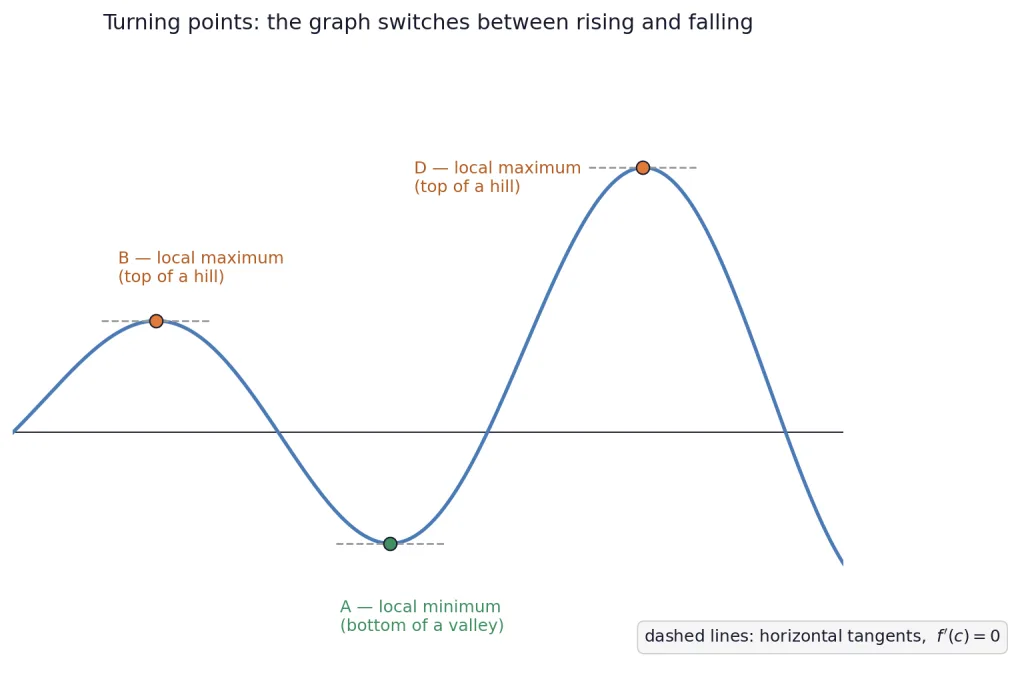
Definition. Let be an interior point of the domain of . Then:
- is a point of local maxima if there is an such that for all . The value is the local maximum value.
- is a point of local minima if there is an such that for all .
"Local" means: compared only with nearby points, not the whole domain.
Theorem 2. If has a local maximum or local minimum at , then either or is not differentiable at .
This motivates the key definition: a point where either or is not differentiable is called a critical point of . Critical points are the only candidates for local extrema.
Key Point: The converse of Theorem 2 is FALSE. For , , yet is neither a local max nor a local min — the curve just flattens momentarily and keeps climbing. makes a candidate, not a winner.
[JEE Important] "Number of critical points" questions must count BOTH kinds: zeros of AND points of non-differentiability (corners, cusps). Forgetting the second kind is a classic JEE error.
The First Derivative Test
How do we decide whether a critical point is a hill, a valley, or neither? Watch the sign of as passes through .
Theorem 3 (First Derivative Test). Let be continuous at a critical point in an open interval . Then:
- If changes sign from positive to negative as increases through , then is a point of local maxima. (Rising, then falling — a hilltop.)
- If changes sign from negative to positive as increases through , then is a point of local minima. (Falling, then rising — a valley floor.)
- If does not change sign through , then is neither — it is a point of inflection.
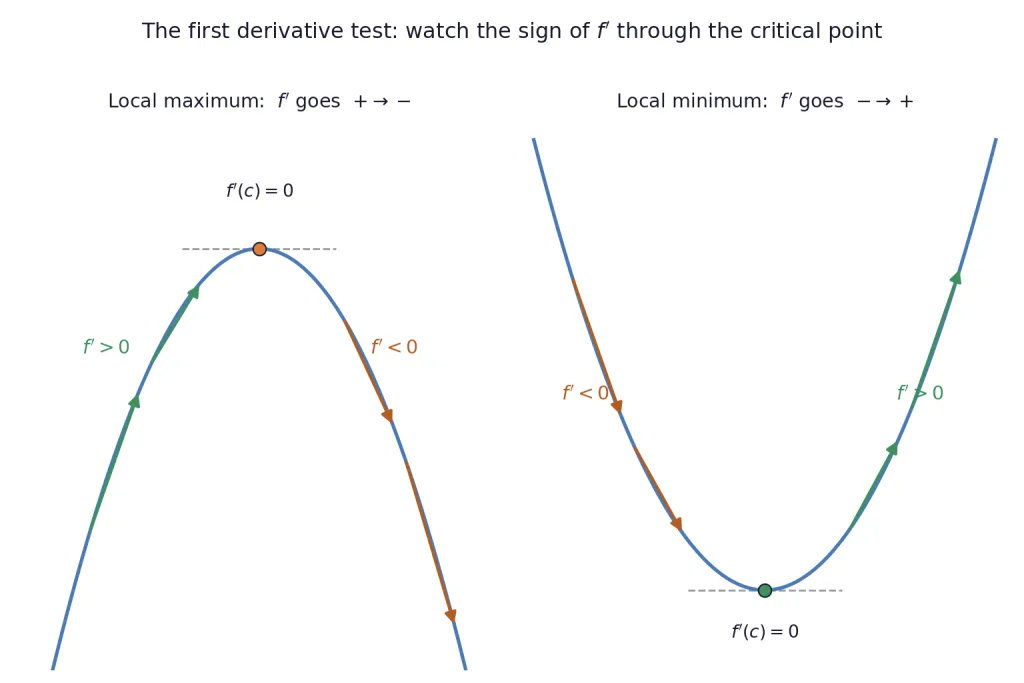
Worked pattern: gives , so the critical points are .
- Through : goes — local maximum, value .
- Through : goes — local minimum, value .
Key Point: Test the sign of at convenient points just left and just right of each critical point (e.g. at and for ). A tiny sign table earns full method marks.
[Board Important] Always report both the point () and the value () — questions ask for "local maximum value", and stopping at loses a mark.
The Second Derivative Test
Often quicker: differentiate twice and check concavity at the critical point.
Theorem 4 (Second Derivative Test). Let be twice differentiable at with . Then:
- If : is a point of local maxima (curve bends downwards — a dome).
- If : is a point of local minima (curve bends upwards — a cup).
- If : the test fails. Go back to the first derivative test and check the sign change.
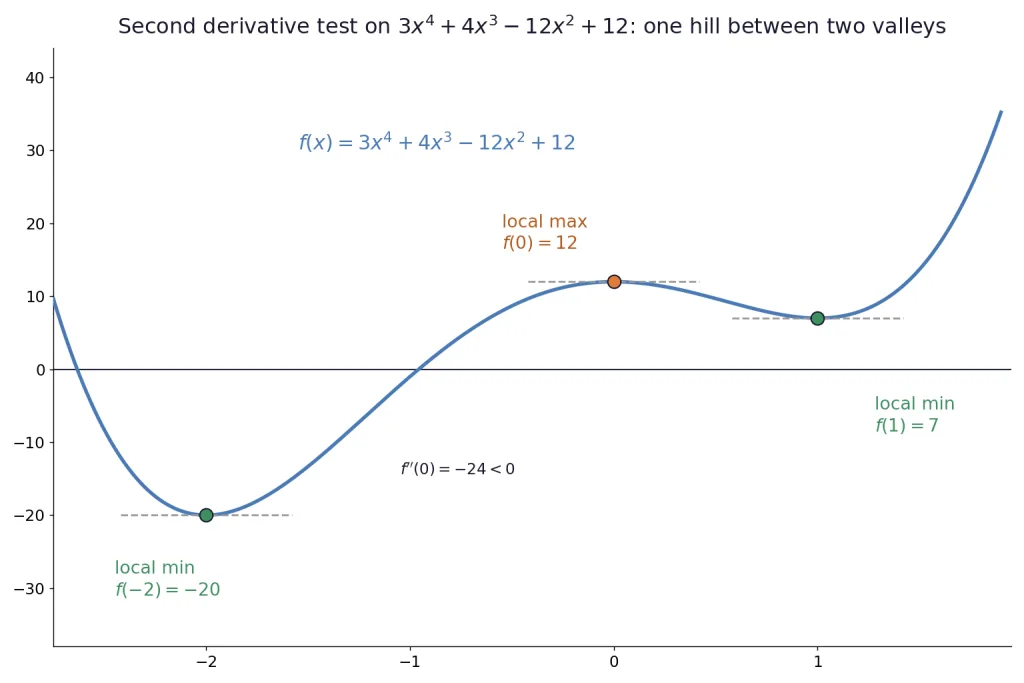
Worked pattern: .
Critical points: . Now , , . So is a local maximum with , while and are local minima with and .
When the test fails: has and , so AND — no verdict. First derivative test: on both sides (no sign change), so is a point of inflexion.
Key Point: Second derivative test = fast but can fail. First derivative test = always works (for continuous ). When , fall back — never conclude "no extremum" just because the second test is silent.
[JEE Tip] For functions with corners (like ), the second derivative test is unusable at the corner — only the first derivative test applies there. Sign of : negative left of 0, positive right of 0 local minimum value at .
Solved Examples
Example 1: A parabola's extremes
Find the maximum and the minimum values, if any, of , .
Solution:
- for all , and .
- So the minimum value is 0, attained at the point of minimum value .
- As , : no maximum value exists on .
Final Answer: Minimum value 0 at ; no maximum value.
Takeaway: If the domain were restricted to , a maximum WOULD appear: . Domains decide extrema.
Example 2: A corner can hold a minimum
Find the maximum and minimum values, if any, of , .
Solution:
- for all and : minimum value 0 at .
- The graph rises without bound on both sides: no maximum value.
- Note is NOT differentiable at — yet the minimum lives exactly there.
Final Answer: Minimum value 0 at ; no maximum.
Takeaway: Extreme values can occur at points of non-differentiability. Critical points include corners, not just flat tangents.
Example 3: An open interval with no extremes
Find the maximum and minimum values, if any, of , .
Solution:
- is strictly increasing on , so extremes could only be near the ends.
- But for any , the point is smaller still, and exceeds any candidate : no smallest or largest value is ever attained.
Final Answer: Neither a maximum nor a minimum value exists on .
Takeaway: On the closed interval the same function has minimum 0 and maximum 1 — endpoints matter. A continuous function on a closed interval always attains both extremes.
Example 4: First derivative test in action
Find all points of local maxima and local minima of .
Solution:
- Differentiate and factorise: ; critical points .
- Through : left of 1 (say 0.9): ; right of 1 (say 1.1): . Sign change local minimum, value .
- Through : left (say ): ; right (say ): . Sign change local maximum, value .
Final Answer: Local maximum value 5 at ; local minimum value 1 at .
Takeaway: For a cubic with positive leading coefficient, the left critical point is always the local max and the right one the local min.
Example 5: A point of inflexion
Find all the points of local maxima and local minima of .
Solution:
- Differentiate: ; the only critical point is .
- Check the sign change: on BOTH sides of 1 — no sign change.
- Conclude: by the first derivative test, is neither a local max nor a local min: it is a point of inflexion.
- Cross-check with the second derivative: gives — the second derivative test fails here, as expected.
Final Answer: No local maxima or minima; is a point of inflexion.
Takeaway: A perfect-square derivative never changes sign — the graph pauses (horizontal tangent) but keeps climbing.
Example 6: A corner minimum
Find the local minimum value of , .
Solution:
- is not differentiable at , so the second derivative test is unusable; is still a critical point.
- Left of 0: , . Right of 0: , .
- Sign change local minimum at .
Final Answer: Local minimum value .
Takeaway: The first derivative test handles corners gracefully — it only needs signs on either side, not a derivative at the point itself.
Example 7: Second derivative test on a quartic
Find the local maximum and local minimum values of .
Solution:
- Differentiate and factorise: ; critical points .
- Second derivative: .
- Evaluate: local max at 0; local min at 1; local min at .
- Values: ; ; .
Final Answer: Local maximum value 12 at ; local minimum values 7 at and at .
Takeaway: With three critical points, the second derivative test is much faster than three sign tables — that's exactly when to prefer it.
Example 8: The standard cubic
Find the local maxima and minima of , and the corresponding values.
Solution:
- : critical points .
- : local max at ; local min at .
- Values: ; .
Final Answer: Local maximum value 2 at ; local minimum value at .
Takeaway: Notice the local max value (2) is smaller than values of far away (e.g. ) — "local" really does mean local.
Example 9: A trigonometric local maximum
Find the local maximum of , .
Solution:
- (the only solution in the domain).
- , so : local maximum.
- Value: .
Final Answer: Local maximum value at .
Takeaway: is also the global maximum of over all reals — remember .
Example 10: A cubic with two turning points
Find the local maxima and minima of .
Solution:
- : critical points .
- : (local max); (local min).
- Values: ; .
Final Answer: Local maximum value 19 at ; local minimum value 15 at .
Takeaway: This is the single most common Board format for a 3-mark maxima-minima question. Practise it until it takes under three minutes.
Example 11: A rational function minimum
Find the local minimum of , .
Solution:
- (taking ).
- , so : local minimum.
- Value: .
Final Answer: Local minimum value 2 at .
Takeaway: This matches the AM-GM inequality: — a great way to verify derivative answers instantly.
Example 12: A square-root product
Find the local maximum of , .
Solution:
- Differentiate (product + chain rule): .
- Critical point: (inside the domain).
- Sign change: for and for : local maximum.
- Value: .
Final Answer: Local maximum value at .
Takeaway: Combine the fraction before hunting for zeros — a single tidy numerator makes both the roots and the sign analysis obvious.
Example 13: Functions with no extrema at all
Prove that , and have no maxima or minima.
Solution:
- : for every — never zero, always differentiable, so no critical points and hence no extrema.
- : on the domain — same conclusion.
- : has discriminant , so for all — no real critical points, no extrema.
Final Answer: All three functions are strictly increasing with no critical points, hence no maxima or minima.
Takeaway: No critical points no local extrema. A negative discriminant of a quadratic derivative settles it in one line.