Addition of Vectors

Vectors cannot be added by ordinary numerical addition alone because each vector has both magnitude and direction. Their addition is defined geometrically.

Triangle Law of Vector Addition

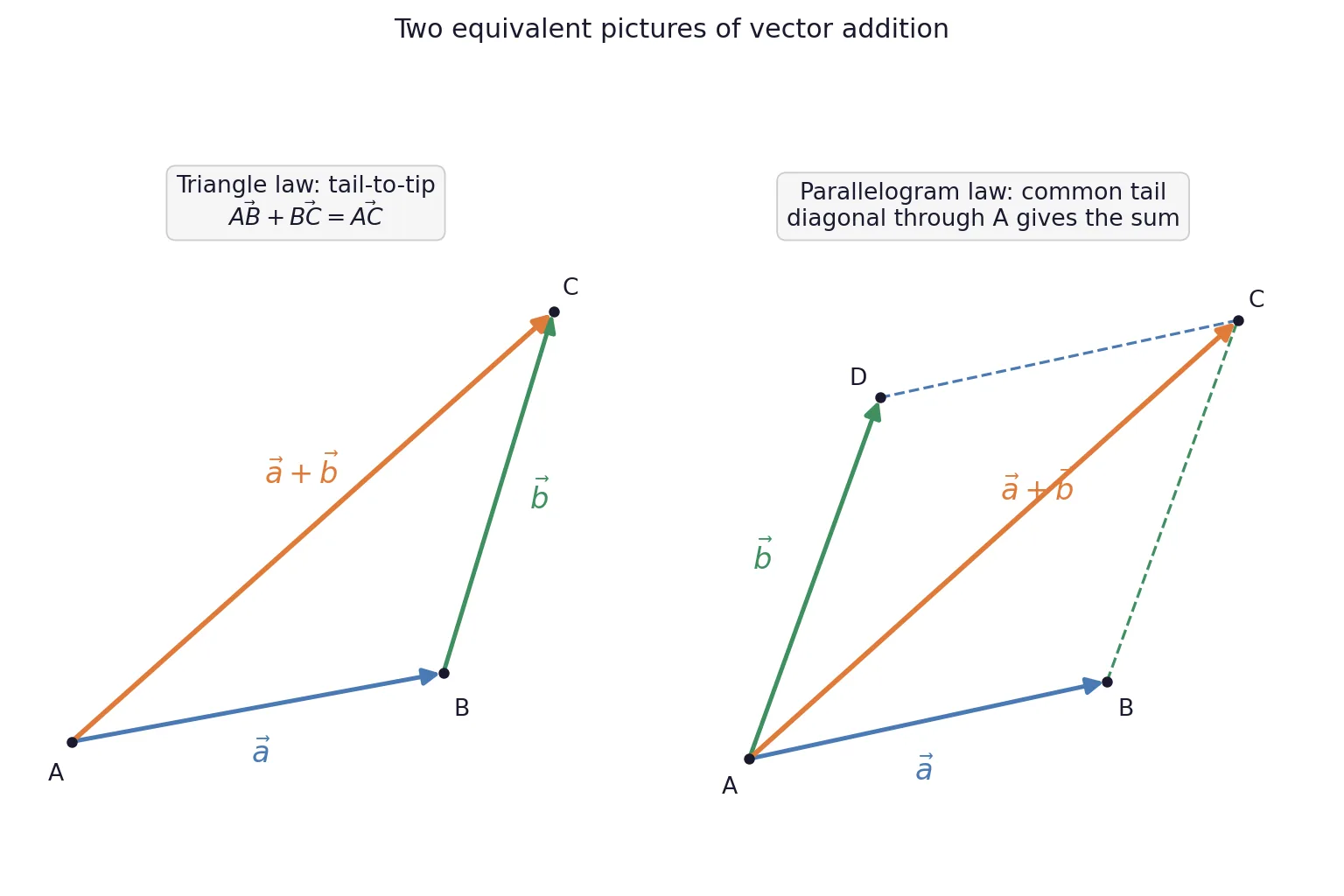
If two vectors are represented by two sides of a triangle taken in order (head-to-tail), then their sum is represented by the third side of the triangle taken from the tail of the first vector to the head of the second vector.

If AB=a\vec{AB} = \vec{a} and BC=b\vec{BC} = \vec{b}, then AC=a+b.\vec{AC} = \vec{a} + \vec{b}.

Parallelogram Law of Vector Addition

If two vectors acting at the same point are represented by the adjacent sides of a parallelogram, then their sum is represented by the diagonal of the parallelogram through the common initial point.

These two laws are equivalent ways of visualizing vector addition.

Properties of Vector Addition

  1. Commutative Law: a+b=b+a\vec{a} + \vec{b} = \vec{b} + \vec{a}
  2. Associative Law: (a+b)+c=a+(b+c)(\vec{a} + \vec{b}) + \vec{c} = \vec{a} + (\vec{b} + \vec{c})
  3. Additive Identity: a+0=a\vec{a} + \vec{0} = \vec{a}
  4. Additive Inverse: For every vector a\vec{a}, there exists a vector a-\vec{a} such that a+(a)=0.\vec{a} + (-\vec{a}) = \vec{0}.

These algebraic properties make vector addition behave similarly to ordinary algebra, while still preserving direction.

Multiplication of a Vector by a Scalar

When a vector a\vec{a} is multiplied by a scalar λ\lambda, the result is another vector written as λa\lambda\vec{a}.

  • Its magnitude becomes λa=λa|\lambda\vec{a}| = |\lambda|\,|\vec{a}|
  • Its direction remains the same as a\vec{a} if λ>0\lambda > 0.
  • Its direction becomes opposite to a\vec{a} if λ<0\lambda < 0.
  • If λ=0\lambda = 0, then λa=0.\lambda\vec{a} = \vec{0}.

So scalar multiplication changes the size of a vector and may reverse its direction, but it does not create any new direction unrelated to the original vector.

Properties of Scalar Multiplication

Let a\vec{a} and b\vec{b} be vectors, and k,mk, m be scalars.

  1. k(a+b)=ka+kbk(\vec{a} + \vec{b}) = k\vec{a} + k\vec{b}
  2. (k+m)a=ka+ma(k + m)\vec{a} = k\vec{a} + m\vec{a}
  3. k(ma)=(km)ak(m\vec{a}) = (km)\vec{a}
  4. 1a=a1\vec{a} = \vec{a}
  5. (1)a=a(-1)\vec{a} = -\vec{a}

These rules are fundamental in simplifying vector expressions.

Components of a Vector and Algebraic Operations

Let a=a1i^+a2j^+a3k^,b=b1i^+b2j^+b3k^\vec{a} = a_1\hat{i} + a_2\hat{j} + a_3\hat{k}, \qquad \vec{b} = b_1\hat{i} + b_2\hat{j} + b_3\hat{k} and let λ\lambda be a scalar.

Then operations are performed component-wise:

  • Addition: a+b=(a1+b1)i^+(a2+b2)j^+(a3+b3)k^\vec{a} + \vec{b} = (a_1 + b_1)\hat{i} + (a_2 + b_2)\hat{j} + (a_3 + b_3)\hat{k}
  • Subtraction: ab=(a1b1)i^+(a2b2)j^+(a3b3)k^\vec{a} - \vec{b} = (a_1 - b_1)\hat{i} + (a_2 - b_2)\hat{j} + (a_3 - b_3)\hat{k}
  • Scalar Multiplication: λa=(λa1)i^+(λa2)j^+(λa3)k^\lambda\vec{a} = (\lambda a_1)\hat{i} + (\lambda a_2)\hat{j} + (\lambda a_3)\hat{k}
  • Equality of Vectors: a=b    a1=b1, a2=b2, a3=b3\vec{a} = \vec{b} \iff a_1=b_1,\ a_2=b_2,\ a_3=b_3

This component form makes vector algebra very convenient because it reduces geometric operations to ordinary algebra on numbers.

Vector Joining Two Points: If P1(x1,y1,z1),P2(x2,y2,z2),P_1(x_1, y_1, z_1), \qquad P_2(x_2, y_2, z_2), then the vector from P1P_1 to P2P_2 is P1P2=(x2x1)i^+(y2y1)j^+(z2z1)k^.\vec{P_1P_2} = (x_2 - x_1)\hat{i} + (y_2 - y_1)\hat{j} + (z_2 - z_1)\hat{k}.

This formula is used constantly in coordinate geometry and 3D vector problems.

4. Section Formula

Let AA and BB be two points with position vectors a\vec{a} and b\vec{b} respectively.

  • Internal Division: If a point RR divides the line segment ABAB internally in the ratio m:nm:n, that is, AR:RB=m:n,AR : RB = m:n, then the position vector of RR is r=na+mbm+n.\vec{r} = \frac{n\vec{a} + m\vec{b}}{m+n}. This is often also written as r=mb+nam+n,\vec{r} = \frac{m\vec{b} + n\vec{a}}{m+n}, which is the same formula written in a reordered way.

  • External Division: If RR divides ABAB externally in the ratio m:nm:n, then r=mbnamn.\vec{r} = \frac{m\vec{b} - n\vec{a}}{m-n}.

  • Midpoint Formula: If RR is the midpoint of ABAB, then it divides the segment in the ratio 1:11:1, so r=a+b2.\vec{r} = \frac{\vec{a} + \vec{b}}{2}.

These formulas are extremely useful in coordinate geometry, especially when finding points dividing line segments in given ratios.

Example 1: Addition of Vectors in Component Form

Find the sum of the vectors a=i^2j^+k^\vec{a} = \hat{i} - 2\hat{j} + \hat{k}, b=2i^+4j^+5k^\vec{b} = -2\hat{i} + 4\hat{j} + 5\hat{k}, and c=i^6j^7k^\vec{c} = \hat{i} - 6\hat{j} - 7\hat{k}.

Solution: Step 1: Add corresponding components. a+b+c=(12+1)i^+(2+46)j^+(1+57)k^\vec{a} + \vec{b} + \vec{c} = (1-2+1)\hat{i} + (-2+4-6)\hat{j} + (1+5-7)\hat{k}

Step 2: Simplify each component. =0i^4j^k^= 0\hat{i} - 4\hat{j} - \hat{k}

Since the coefficient of i^\hat{i} is zero, it may be omitted.

Answer: 4j^k^-4\hat{j} - \hat{k}

Example 2: Magnitude of a Resultant Vector

If a=2i^+2j^5k^\vec{a} = 2\hat{i} + 2\hat{j} - 5\hat{k} and b=2i^+j^+3k^\vec{b} = 2\hat{i} + \hat{j} + 3\hat{k}, find the magnitude of the vector a+b\vec{a} + \vec{b}.

Solution: Step 1: First add the vectors component-wise. a+b=(2+2)i^+(2+1)j^+(5+3)k^=4i^+3j^2k^\vec{a} + \vec{b} = (2+2)\hat{i} + (2+1)\hat{j} + (-5+3)\hat{k} = 4\hat{i} + 3\hat{j} - 2\hat{k}

Step 2: Use the magnitude formula. a+b=42+32+(2)2|\vec{a} + \vec{b}| = \sqrt{4^2 + 3^2 + (-2)^2}

Step 3: Simplify. a+b=16+9+4=29|\vec{a} + \vec{b}| = \sqrt{16+9+4} = \sqrt{29}

Answer: 29\sqrt{29}

Example 3: Unit Vector in the Direction of a Sum

Find the unit vector in the direction of the sum of the vectors a=2i^+2j^5k^\vec{a} = 2\hat{i} + 2\hat{j} - 5\hat{k} and b=2i^+j^+3k^\vec{b} = 2\hat{i} + \hat{j} + 3\hat{k}.

Solution: Step 1: First find the sum. c=a+b=4i^+3j^2k^\vec{c} = \vec{a} + \vec{b} = 4\hat{i} + 3\hat{j} - 2\hat{k}

Step 2: Find its magnitude. c=42+32+(2)2=29|\vec{c}| = \sqrt{4^2 + 3^2 + (-2)^2} = \sqrt{29}

Step 3: Divide the vector by its magnitude to get the unit vector. c^=cc=4i^+3j^2k^29\hat{c} = \frac{\vec{c}}{|\vec{c}|} = \frac{4\hat{i} + 3\hat{j} - 2\hat{k}}{\sqrt{29}}

Hence, c^=429i^+329j^229k^\hat{c} = \frac{4}{\sqrt{29}}\hat{i} + \frac{3}{\sqrt{29}}\hat{j} - \frac{2}{\sqrt{29}}\hat{k}

Answer: 429i^+329j^229k^\frac{4}{\sqrt{29}}\hat{i} + \frac{3}{\sqrt{29}}\hat{j} - \frac{2}{\sqrt{29}}\hat{k}

Example 4: Vector Joining Two Points

Find the vector joining the points P(2,3,0)P(2, 3, 0) and Q(1,2,4)Q(-1, -2, -4) directed from PP to QQ.

Solution: Step 1: Use the formula PQ=(x2x1)i^+(y2y1)j^+(z2z1)k^\vec{PQ} = (x_2-x_1)\hat{i} + (y_2-y_1)\hat{j} + (z_2-z_1)\hat{k}

Step 2: Substitute the coordinates of P(2,3,0)P(2,3,0) and Q(1,2,4)Q(-1,-2,-4). PQ=(12)i^+(23)j^+(40)k^\vec{PQ} = (-1-2)\hat{i} + (-2-3)\hat{j} + (-4-0)\hat{k}

Step 3: Simplify. PQ=3i^5j^4k^\vec{PQ} = -3\hat{i} - 5\hat{j} - 4\hat{k}

Answer: 3i^5j^4k^-3\hat{i} - 5\hat{j} - 4\hat{k}

Example 5: Solving Vector Equations

Find a vector x\vec{x} such that 2ab+x=02\vec{a} - \vec{b} + \vec{x} = 0, where a=3i^j^+2k^\vec{a} = 3\hat{i} - \hat{j} + 2\hat{k} and b=i^+2j^k^\vec{b} = \hat{i} + 2\hat{j} - \hat{k}.

Solution: Step 1: Rearrange the equation. x=2a+b=b2a\vec{x} = -2\vec{a} + \vec{b} = \vec{b} - 2\vec{a}

Step 2: Substitute the given vectors. x=(i^+2j^k^)2(3i^j^+2k^)\vec{x} = (\hat{i} + 2\hat{j} - \hat{k}) - 2(3\hat{i} - \hat{j} + 2\hat{k})

Step 3: Multiply out the scalar. x=(i^+2j^k^)(6i^2j^+4k^)\vec{x} = (\hat{i} + 2\hat{j} - \hat{k}) - (6\hat{i} - 2\hat{j} + 4\hat{k})

Step 4: Combine like terms. x=(16)i^+(2(2?))\vec{x} = (1-6)\hat{i} + (2-(-2?)) We should carefully subtract component-wise: x=(16)i^+(2(2?))j^+(14)k^\vec{x} = (1-6)\hat{i} + (2-(-2?))\hat{j} + (-1-4)\hat{k} Since subtracting (2j^)( -2\hat{j}) is equivalent to adding 2j^2\hat{j}, the j^\hat{j}-component is 2(2)=42 - (-2) = 4 Thus, x=5i^+4j^5k^\vec{x} = -5\hat{i} + 4\hat{j} - 5\hat{k}

Answer: 5i^+4j^5k^-5\hat{i} + 4\hat{j} - 5\hat{k}

Example 6: Internal Division (Section Formula)

Find the position vector of a point RR which divides the line joining two points PP and QQ whose position vectors are i^+2j^k^\hat{i} + 2\hat{j} - \hat{k} and i^+j^+k^-\hat{i} + \hat{j} + \hat{k} respectively, in the ratio 2:1 internally.

Solution: Step 1: Let p=i^+2j^k^,q=i^+j^+k^\vec{p} = \hat{i} + 2\hat{j} - \hat{k}, \qquad \vec{q} = -\hat{i} + \hat{j} + \hat{k} and the ratio be 2:12:1.

Step 2: Use the internal division formula: r=2q+1p2+1\vec{r} = \frac{2\vec{q} + 1\vec{p}}{2+1}

Step 3: Substitute the vectors. r=2(i^+j^+k^)+(i^+2j^k^)3\vec{r} = \frac{2(-\hat{i}+\hat{j}+\hat{k}) + (\hat{i}+2\hat{j}-\hat{k})}{3}

Step 4: Expand and simplify. r=2i^+2j^+2k^+i^+2j^k^3\vec{r} = \frac{-2\hat{i}+2\hat{j}+2\hat{k}+\hat{i}+2\hat{j}-\hat{k}}{3} r=i^+4j^+k^3\vec{r} = \frac{-\hat{i}+4\hat{j}+\hat{k}}{3}

Step 5: Write in simplified form. r=13i^+43j^+13k^\vec{r} = -\frac{1}{3}\hat{i} + \frac{4}{3}\hat{j} + \frac{1}{3}\hat{k}

Answer: 13i^+43j^+13k^-\frac{1}{3}\hat{i} + \frac{4}{3}\hat{j} + \frac{1}{3}\hat{k}

Example 7: External Division (Section Formula)

Find the position vector of a point RR which divides the line joining points with position vectors i^+2j^k^\hat{i} + 2\hat{j} - \hat{k} and i^+j^+k^-\hat{i} + \hat{j} + \hat{k} in the ratio 2:1 externally.

Solution: Step 1: Let p=i^+2j^k^,q=i^+j^+k^\vec{p} = \hat{i} + 2\hat{j} - \hat{k}, \qquad \vec{q} = -\hat{i} + \hat{j} + \hat{k}

Step 2: Use the external division formula: r=2q1p21\vec{r} = \frac{2\vec{q} - 1\vec{p}}{2-1}

Step 3: Substitute and simplify. r=2(i^+j^+k^)(i^+2j^k^)\vec{r} = 2(-\hat{i}+\hat{j}+\hat{k}) - (\hat{i}+2\hat{j}-\hat{k}) r=2i^+2j^+2k^i^2j^+k^\vec{r} = -2\hat{i}+2\hat{j}+2\hat{k} - \hat{i} - 2\hat{j} + \hat{k} r=3i^+3k^\vec{r} = -3\hat{i} + 3\hat{k}

Answer: 3i^+3k^-3\hat{i} + 3\hat{k}

Example 8: Midpoint Formula

Find the position vector of the midpoint of the line segment joining the points P(2,3,4)P(2, 3, 4) and Q(4,1,2)Q(4, 1, -2).

Solution: Step 1: Write the position vectors of the two points. p=2i^+3j^+4k^\vec{p} = 2\hat{i} + 3\hat{j} + 4\hat{k} q=4i^+j^2k^\vec{q} = 4\hat{i} + \hat{j} - 2\hat{k}

Step 2: Apply the midpoint formula. r=p+q2\vec{r} = \frac{\vec{p}+\vec{q}}{2}

Step 3: Add the vectors. r=(2i^+3j^+4k^)+(4i^+j^2k^)2\vec{r} = \frac{(2\hat{i}+3\hat{j}+4\hat{k}) + (4\hat{i}+\hat{j}-2\hat{k})}{2} r=6i^+4j^+2k^2\vec{r} = \frac{6\hat{i}+4\hat{j}+2\hat{k}}{2}

Step 4: Divide by 2. r=3i^+2j^+k^\vec{r} = 3\hat{i} + 2\hat{j} + \hat{k}

Answer: 3i^+2j^+k^3\hat{i} + 2\hat{j} + \hat{k}

Example 9: Proving a Triangle is Right-Angled

Show that the points AA, BB, and CC with position vectors a=3i^4j^4k^\vec{a} = 3\hat{i} - 4\hat{j} - 4\hat{k}, b=2i^j^+k^\vec{b} = 2\hat{i} - \hat{j} + \hat{k}, and c=i^3j^5k^\vec{c} = \hat{i} - 3\hat{j} - 5\hat{k}, respectively, form the vertices of a right-angled triangle.

Solution: Step 1: Find the side vectors. AB=ba=(23)i^+(1(4))j^+(1(4))k^=i^+3j^+5k^\vec{AB} = \vec{b} - \vec{a} = (2-3)\hat{i} + (-1-(-4))\hat{j} + (1-(-4))\hat{k} = -\hat{i} + 3\hat{j} + 5\hat{k} BC=cb=(12)i^+(3(1))j^+(51)k^=i^2j^6k^\vec{BC} = \vec{c} - \vec{b} = (1-2)\hat{i} + (-3-(-1))\hat{j} + (-5-1)\hat{k} = -\hat{i} - 2\hat{j} - 6\hat{k} CA=ac=(31)i^+(4(3))j^+(4(5))k^=2i^j^+k^\vec{CA} = \vec{a} - \vec{c} = (3-1)\hat{i} + (-4-(-3))\hat{j} + (-4-(-5))\hat{k} = 2\hat{i} - \hat{j} + \hat{k}

Step 2: Find the squares of the side lengths. AB2=(1)2+32+52=1+9+25=35|\vec{AB}|^2 = (-1)^2 + 3^2 + 5^2 = 1+9+25 = 35 BC2=(1)2+(2)2+(6)2=1+4+36=41|\vec{BC}|^2 = (-1)^2 + (-2)^2 + (-6)^2 = 1+4+36 = 41 CA2=22+(1)2+12=4+1+1=6|\vec{CA}|^2 = 2^2 + (-1)^2 + 1^2 = 4+1+1 = 6

Step 3: Check the Pythagorean relation. AB2+CA2=35+6=41=BC2|\vec{AB}|^2 + |\vec{CA}|^2 = 35 + 6 = 41 = |\vec{BC}|^2

Since the square of one side equals the sum of the squares of the other two sides, the triangle is right-angled.

To identify the right angle: ABAB and ACAC meet at point AA, so the angle at AA is the right angle.

Answer: Proved. The triangle is right-angled at AA.

Example 10: Collinear Points using Vectors

Show that the points A(2,6,3)A(2, 6, 3), B(1,2,7)B(1, 2, 7), and C(3,10,1)C(3, 10, -1) are collinear.

Solution: Step 1: Find the vectors AB\vec{AB} and BC\vec{BC}. AB=(12)i^+(26)j^+(73)k^=i^4j^+4k^\vec{AB} = (1-2)\hat{i} + (2-6)\hat{j} + (7-3)\hat{k} = -\hat{i} - 4\hat{j} + 4\hat{k} BC=(31)i^+(102)j^+(17)k^=2i^+8j^8k^\vec{BC} = (3-1)\hat{i} + (10-2)\hat{j} + (-1-7)\hat{k} = 2\hat{i} + 8\hat{j} - 8\hat{k}

Step 2: Compare the two vectors. BC=2(i^4j^+4k^)=2AB\vec{BC} = -2(-\hat{i} - 4\hat{j} + 4\hat{k}) = -2\vec{AB}

Step 3: Since one vector is a scalar multiple of the other, they are parallel. Because these vectors share the common point BB, the three points must lie on the same straight line.

Answer: Proved.