
Scalars, Vectors, and the Position Vector
Some physical quantities are fully described by a single number with a unit — time, mass, temperature, distance, speed, volume, density, work. These are scalars. Others need a direction as well — displacement, velocity, force, acceleration. These are vectors.
Definition: a quantity that has magnitude as well as direction is called a vector.
Geometrically, a vector is a directed line segment: an arrow from an initial point to a terminal point . The distance between and is the magnitude (or length), written or — and since a length is never negative, a statement like has no meaning.
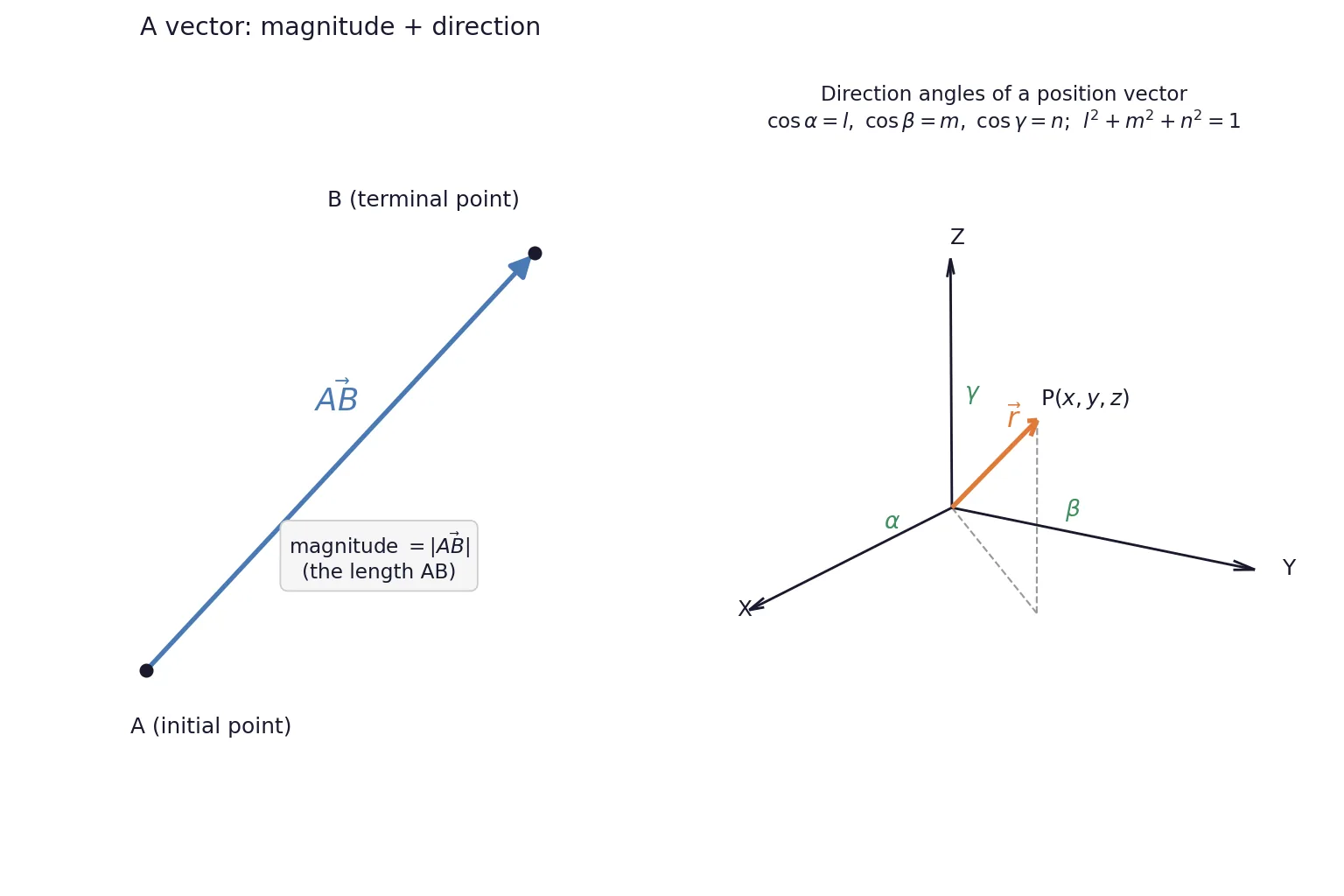
Position vector
Fix the origin of a right-handed coordinate system. For any point , the vector is called the position vector of with respect to . By the distance formula,
In practice the position vectors of points are written .
Direction cosines and direction ratios
Let make angles with the positive -, - and -axes. These are the direction angles, and their cosines
are the direction cosines of . The coordinates of can then be written .
Key Point: direction cosines always satisfy . Any triple of numbers proportional to (that is, , etc.) are called direction ratios — and in general . Cosines are the normalised, unique-up-to-sign version; ratios are any convenient scaling.
A quick test: can be direction angles of some vector? Check — yes. But gives — impossible.
Types of Vectors
Zero (null) vector : initial and terminal points coincide. Its magnitude is and it has no definite direction (or, equivalently, any direction). , all represent .
Unit vector: magnitude exactly . The unit vector in the direction of is written .
Coinitial vectors: two or more vectors with the same initial point.
Collinear vectors: vectors parallel to the same line, irrespective of their magnitudes and directions (same or opposite directions both count).
Equal vectors: when they have the same magnitude AND the same direction — regardless of where their initial points sit.
Negative of a vector: has the same magnitude as but the opposite direction; .
Key Point (free vectors): throughout this chapter a vector may be slid parallel to itself — displaced without changing magnitude or direction — and it remains the same vector. Such vectors are called free vectors. This is what lets us redraw vectors tail-to-tip when adding them in the next section.
The true/false traps, settled once
- and are collinear (they are parallel to the same line). ✓
- Two collinear vectors need not be equal in magnitude. ✗ as a claim of "always".
- Two vectors of the same magnitude need not be collinear — direction is unconstrained. ✗
- Even collinear vectors with the same magnitude need not be equal: they can point opposite ways. ✗
The only combination that forces equality is same magnitude and same direction.
Solved Examples
Example 1: Classifying quantities
Classify as scalar or vector: (i) seconds, (ii) , (iii) newton, (iv) km/hr, (v) , (vi) m/s towards north.
Solution:
- Ask one question per item: does a direction come attached?
- Classify: (i) time — scalar; (ii) volume — scalar; (iii) force — vector; (iv) speed — scalar (no direction stated); (v) density — scalar; (vi) velocity — vector (direction "towards north" attached).
Answer: vectors: (iii) and (vi); the rest are scalars. Speed vs velocity is exactly the scalar/vector split of the same physical idea.
Example 2: A displacement, described precisely
Describe the vector representing a displacement of km, east of north.
Solution:
- Direction first: start facing north, rotate towards the east — that ray fixes the direction.
- Magnitude: the arrow has length representing km on the chosen scale.
Answer: an arrow of length km (to scale) from the starting point, inclined from the north direction towards the east.
Example 3: Direction cosines from components
Find the magnitude and direction cosines of the position vector of .
Solution:
- Magnitude: .
- Divide each coordinate by : , , .
- Check: . ✓
Answer: magnitude ; direction cosines .
Example 4: Equal direction angles
A vector makes equal angles with the positive -, - and -axes. Find .
Solution:
- Use the identity: with .
- Solve: , so .
Answer: (about for the positive value — not , a common guess).
Example 5: Vectors on a square
is a square with vectors drawn as , , and . Identify which pairs are (i) equal, (ii) collinear but not equal.
Solution:
- Equal needs same magnitude and same direction: and are opposite sides traversed the same way — same length, same direction: . ✓
- Collinear but not equal: and are parallel to the same line but point opposite ways: collinear, not equal ().
Answer: (i) ; (ii) and — parallel line, opposite direction.
Example 6: True or false, with reasons
Decide: (i) and are collinear. (ii) Two collinear vectors are always equal in magnitude. (iii) Two vectors having the same magnitude are collinear. (iv) Two collinear vectors of the same magnitude are equal.
Solution:
- (i) True — opposite directions along the same line still count as collinear.
- (ii) False — collinearity says nothing about lengths: and are collinear.
- (iii) False — equal lengths with unrelated directions (say and ) are not collinear.
- (iv) False — and have equal magnitude and are collinear, yet are unequal (opposite directions).
Answer: T, F, F, F — only "same magnitude and same direction" forces equality.