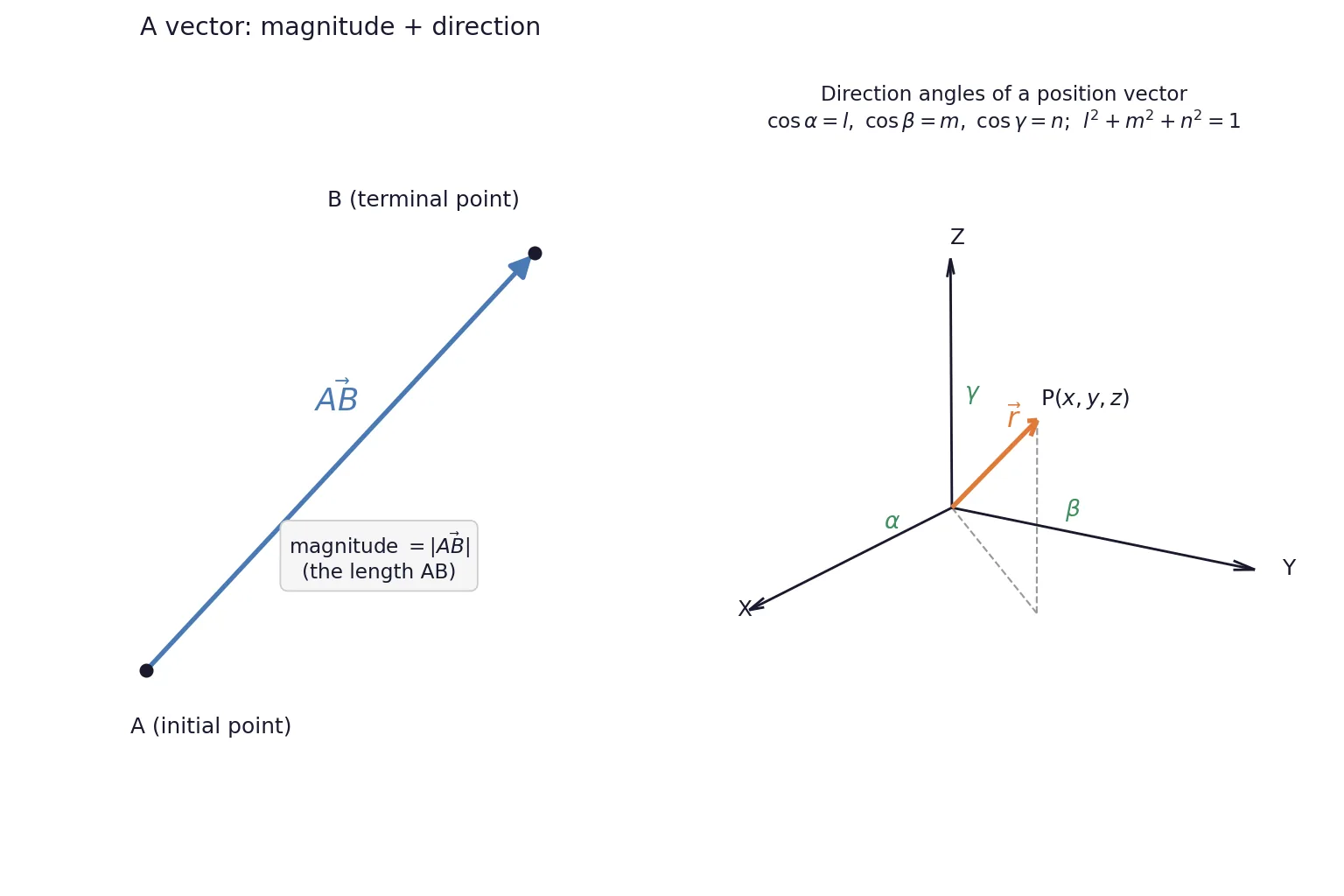
A vector has magnitude and direction; a directed segment AB pictures it, and sliding it parallel to itself changes nothing (free vectors).
The vocabulary
Position vector OP=xi^+yj^+zk^ with OP=x2+y2+z2. Direction cosines l=cosα,m=cosβ,n=cosγ satisfy l2+m2+n2=1; any proportional triple gives direction ratios — for a component-form vector, the components are direction ratios. Types: zero, unit (a^=a/∣a∣), coinitial, collinear (b=λa, proportional components), equal (same magnitude and direction), negative.
Addition and scalar multiplication
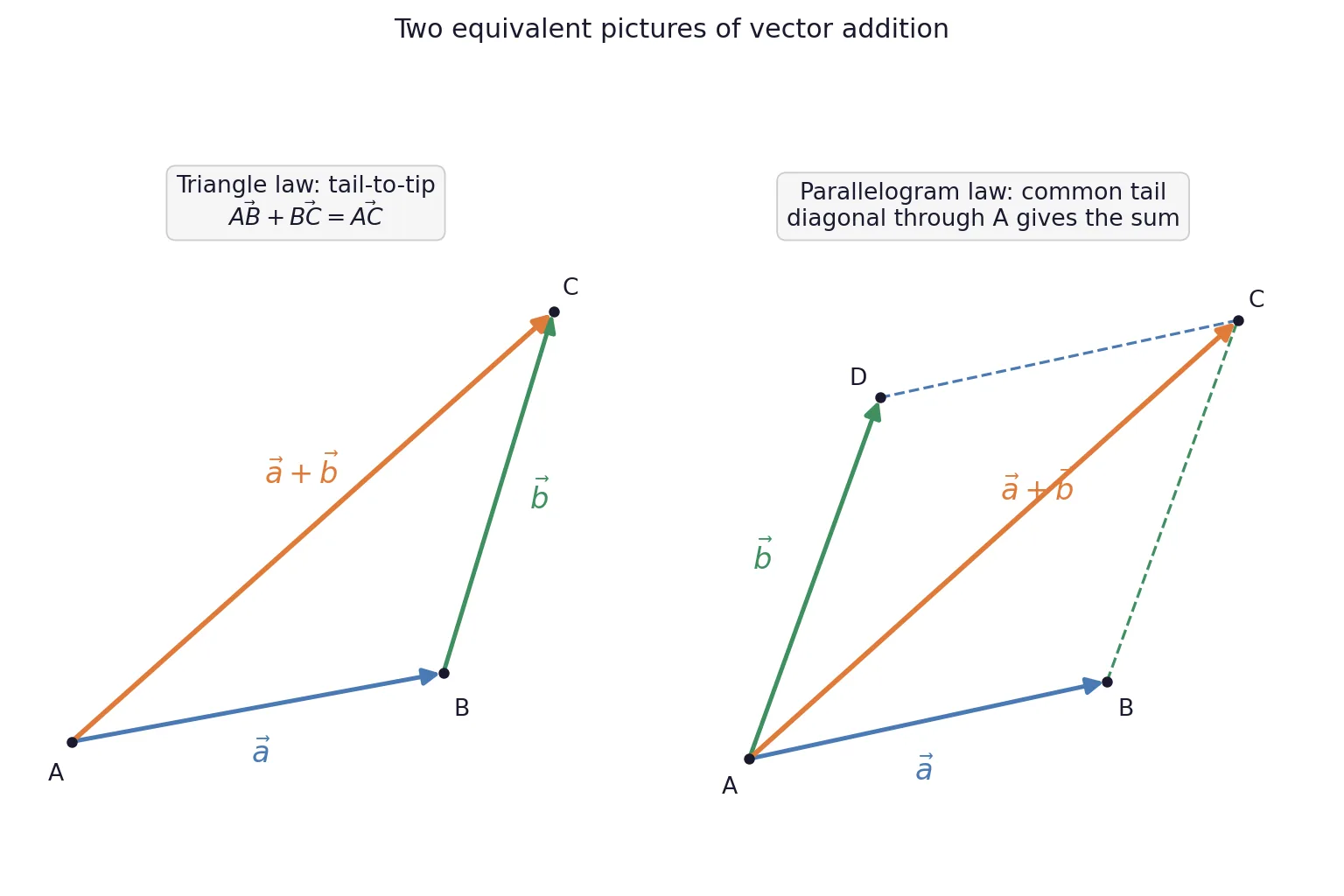
Triangle law (tail-to-tip) and parallelogram law (common tail, diagonal) are the same fact; sides of a closed polygon taken in order sum to 0; a−b=a+(−b); ∣λa∣=∣λ∣∣a∣ with direction kept (λ>0) or flipped (λ<0).
Joining points, dividing segments
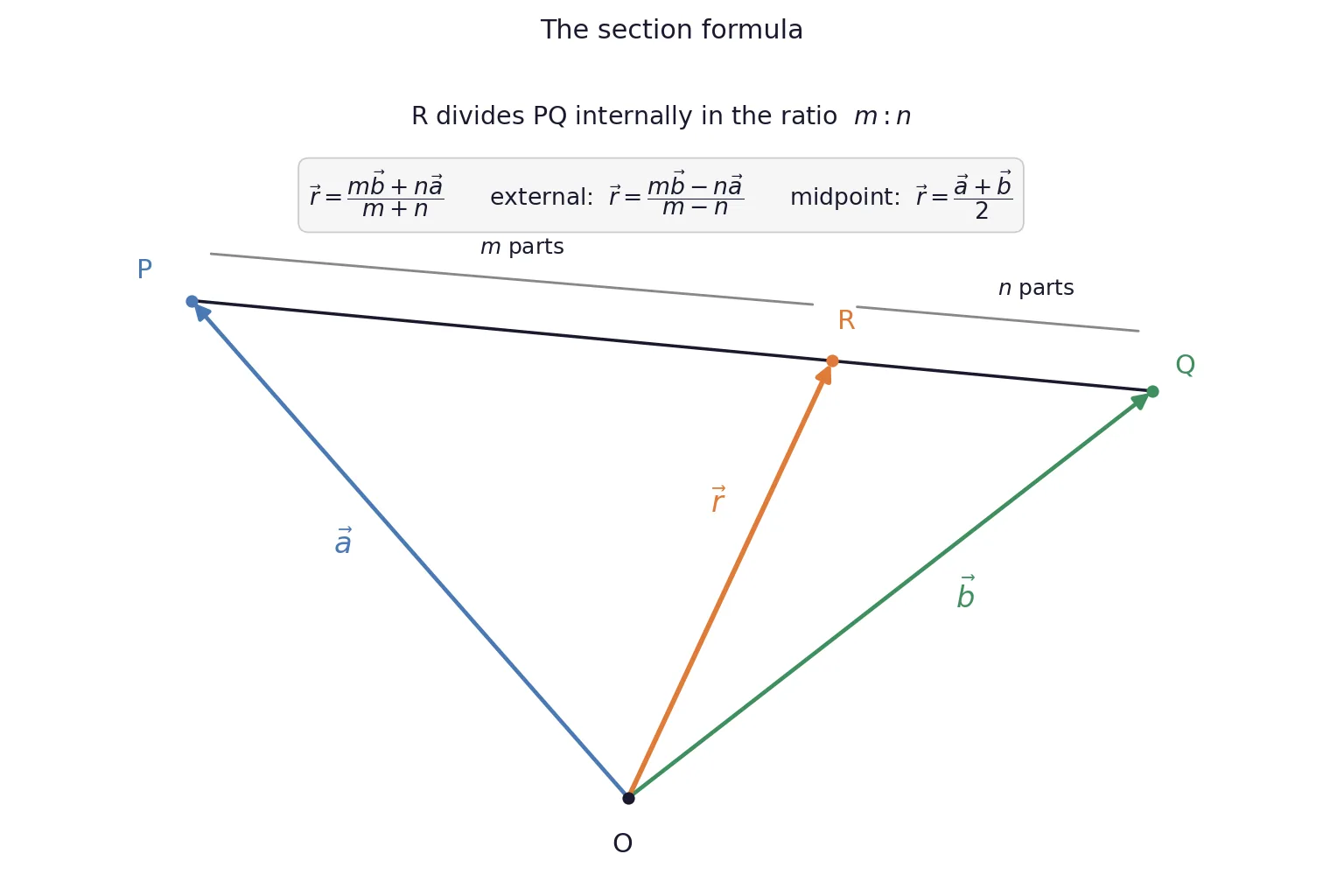
P1P2= terminal minus initial, componentwise. R dividing PQ in m:n: internally r=m+nmb+na; externally r=m−nmb−na; midpoint 2a+b; centroid of a triangle 3a+b+c.
The two products
Dot (scalar)
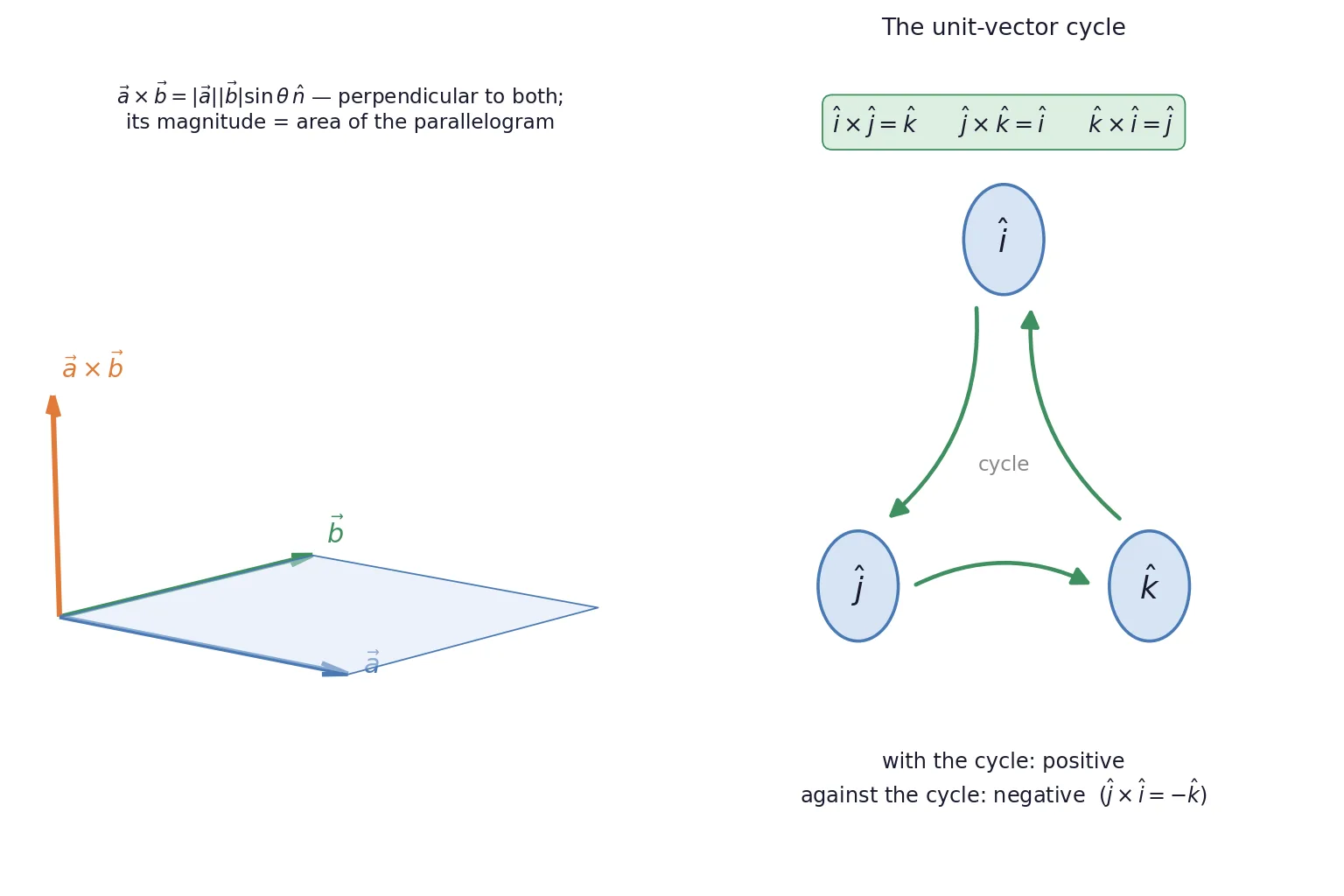
Cross (vector)
Definition
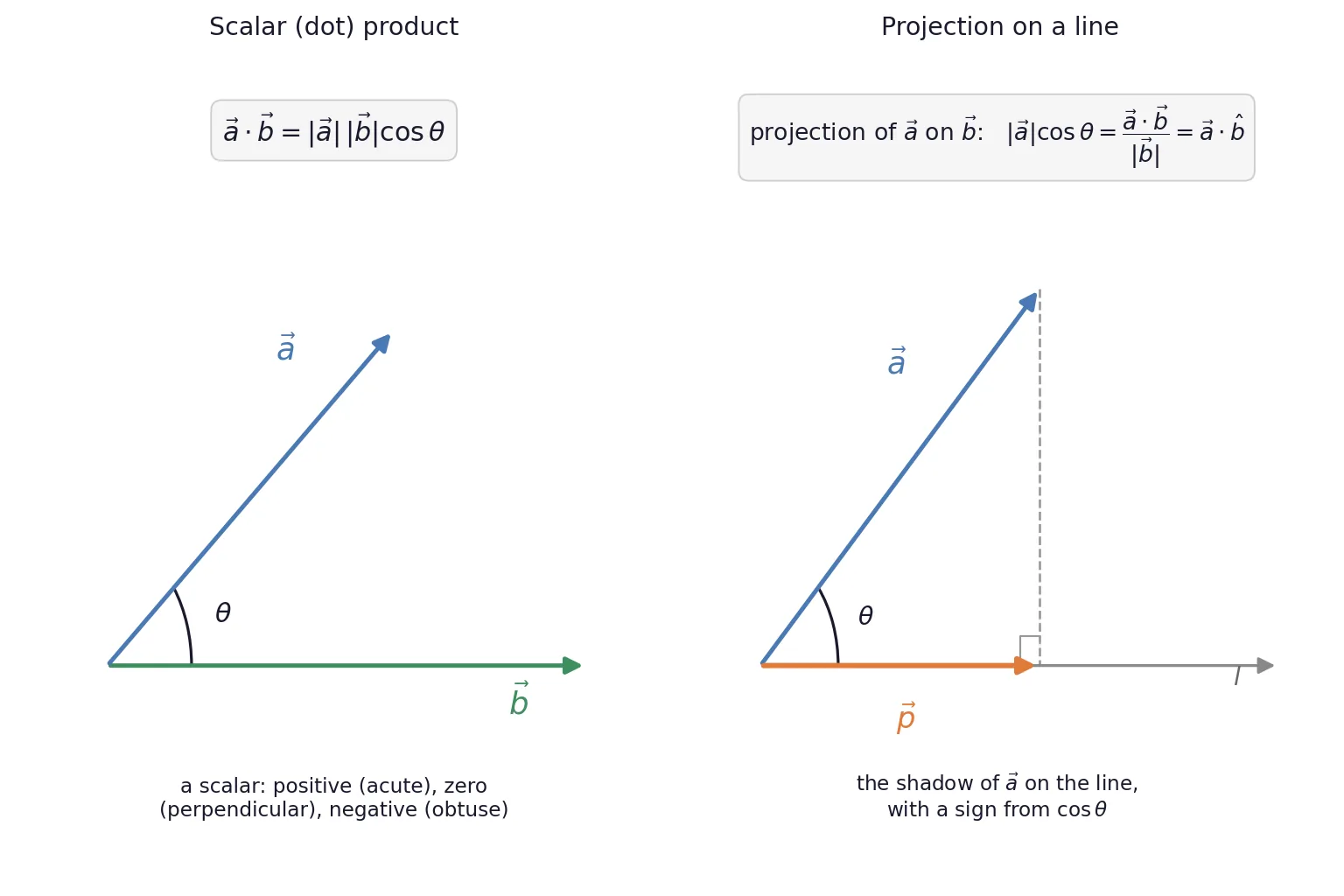
a⋅b=∣a∣∣b∣cosθ
a×b=∣a∣∣b∣sinθn^
Output
number
vector ⊥ both (right-hand rule)
Components
a1b1+a2b2+a3b3
3×3 determinant with i^,j^,k^ on top
Zero means
perpendicular
parallel
Order
commutative
anticommutative: b×a=−a×b
Geometry
projection =∣b∣a⋅b
area: parallelogram ∣a×b∣, triangle half of it
Identities and the Mistake Checklist
The identity kit
a⋅a=∣a∣2; a±b2=∣a∣2±2a⋅b+∣b∣2 — the workhorse conversions between lengths and dots.