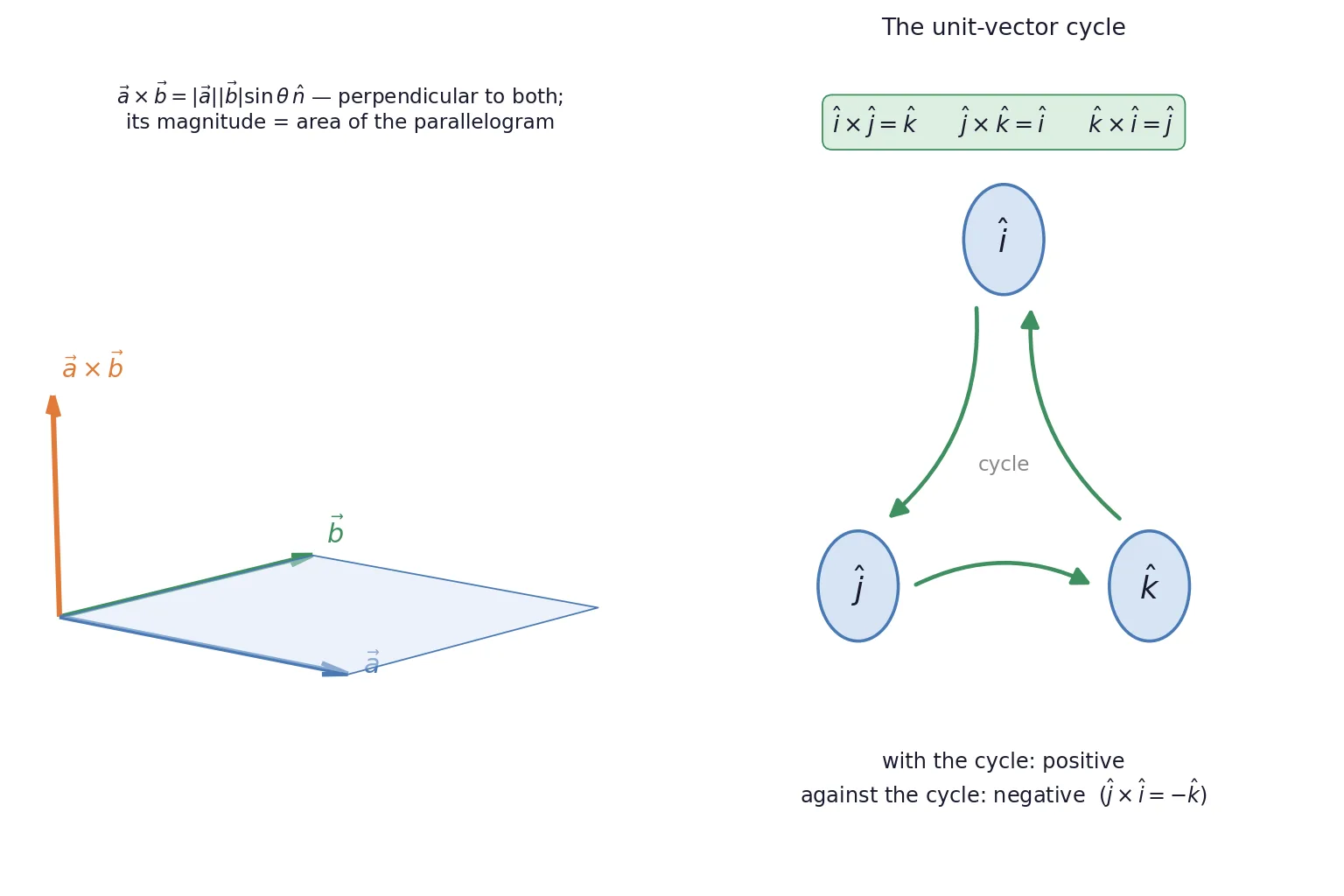
The Vector (Cross) Product
The second way to multiply vectors outputs a vector :
a ⃗ × b ⃗ = ∣ a ⃗ ∣ ∣ b ⃗ ∣ sin θ n ^ \vec{a} \times \vec{b} = |\vec{a}|\,|\vec{b}|\sin\theta\;\hat{n} a × b = ∣ a ∣ ∣ b ∣ sin θ n ^
where θ \theta θ 0 ≤ θ ≤ π 0 \leq \theta \leq \pi 0 ≤ θ ≤ π n ^ \hat{n} n ^ perpendicular to both a ⃗ \vec{a} a b ⃗ \vec{b} b a ⃗ , b ⃗ , n ^ \vec{a}, \vec{b}, \hat{n} a , b , n ^ right-handed system : curl the right hand's fingers from a ⃗ \vec{a} a b ⃗ \vec{b} b n ^ \hat{n} n ^ 0 ⃗ \vec{0} 0 a ⃗ × b ⃗ = 0 ⃗ \vec{a} \times \vec{b} = \vec{0} a × b = 0
Observations
a ⃗ × b ⃗ \vec{a} \times \vec{b} a × b vector (the dot product was a scalar).Parallel test: for nonzero vectors, a ⃗ × b ⃗ = 0 ⃗ ⟺ a ⃗ ∥ b ⃗ \vec{a} \times \vec{b} = \vec{0} \iff \vec{a} \parallel \vec{b} a × b = 0 ⟺ a ∥ b sin θ = 0 \sin\theta = 0 sin θ = 0 a ⃗ × a ⃗ = 0 ⃗ \vec{a} \times \vec{a} = \vec{0} a × a = 0 θ = π 2 \theta = \dfrac{\pi}{2} θ = 2 π ∣ a ⃗ ∣ ∣ b ⃗ ∣ |\vec{a}||\vec{b}| ∣ a ∣∣ b ∣ The cycle: i ^ × j ^ = k ^ \hat{i} \times \hat{j} = \hat{k} i ^ × j ^ = k ^ j ^ × k ^ = i ^ \hat{j} \times \hat{k} = \hat{i} j ^ × k ^ = i ^ k ^ × i ^ = j ^ \hat{k} \times \hat{i} = \hat{j} k ^ × i ^ = j ^ 0 ⃗ \vec{0} 0 against the cycle the sign flips: j ^ × i ^ = − k ^ \hat{j} \times \hat{i} = -\hat{k} j ^ × i ^ = − k ^ k ^ × j ^ = − i ^ \hat{k} \times \hat{j} = -\hat{i} k ^ × j ^ = − i ^ i ^ × k ^ = − j ^ \hat{i} \times \hat{k} = -\hat{j} i ^ × k ^ = − j ^ Angle via sine: sin θ = ∣ a ⃗ × b ⃗ ∣ ∣ a ⃗ ∣ ∣ b ⃗ ∣ \sin\theta = \dfrac{\left|\vec{a} \times \vec{b}\right|}{|\vec{a}||\vec{b}|} sin θ = ∣ a ∣∣ b ∣ a × b NOT commutative: a ⃗ × b ⃗ = − ( b ⃗ × a ⃗ ) \vec{a} \times \vec{b} = -\left(\vec{b} \times \vec{a}\right) a × b = − ( b × a ) is distributive over addition, and scalars slide through: λ ( a ⃗ × b ⃗ ) = ( λ a ⃗ ) × b ⃗ = a ⃗ × ( λ b ⃗ ) \lambda\left(\vec{a} \times \vec{b}\right) = (\lambda\vec{a}) \times \vec{b} = \vec{a} \times (\lambda\vec{b}) λ ( a × b ) = ( λ a ) × b = a × ( λ b )
Key Point (dot vs cross in one line): cos \cos cos sin \sin sin
Areas
Triangle with adjacent sides a ⃗ \vec{a} a b ⃗ \vec{b} b
Area = 1 2 ∣ a ⃗ × b ⃗ ∣ \text{Area} = \frac{1}{2}\left|\vec{a} \times \vec{b}\right| Area = 2 1 a × b
(base ∣ a ⃗ ∣ |\vec{a}| ∣ a ∣ ∣ b ⃗ ∣ sin θ |\vec{b}|\sin\theta ∣ b ∣ sin θ
Parallelogram with adjacent sides a ⃗ \vec{a} a b ⃗ \vec{b} b
Area = ∣ a ⃗ × b ⃗ ∣ \text{Area} = \left|\vec{a} \times \vec{b}\right| Area = a × b
For a triangle given by vertices A , B , C A, B, C A , B , C A B → \overrightarrow{AB} A B A C → \overrightarrow{AC} A C
Expanding ( a 1 i ^ + a 2 j ^ + a 3 k ^ ) × ( b 1 i ^ + b 2 j ^ + b 3 k ^ ) \left(a_1\hat{i} + a_2\hat{j} + a_3\hat{k}\right) \times \left(b_1\hat{i} + b_2\hat{j} + b_3\hat{k}\right) ( a 1 i ^ + a 2 j ^ + a 3 k ^ ) × ( b 1 i ^ + b 2 j ^ + b 3 k ^ )
a ⃗ × b ⃗ = ∣ i ^ j ^ k ^ a 1 a 2 a 3 b 1 b 2 b 3 ∣ = ( a 2 b 3 − a 3 b 2 ) i ^ − ( a 1 b 3 − a 3 b 1 ) j ^ + ( a 1 b 2 − a 2 b 1 ) k ^ \vec{a} \times \vec{b} = \begin{vmatrix} \hat{i} & \hat{j} & \hat{k} \\ a_1 & a_2 & a_3 \\ b_1 & b_2 & b_3 \end{vmatrix} = \left(a_2b_3 - a_3b_2\right)\hat{i} - \left(a_1b_3 - a_3b_1\right)\hat{j} + \left(a_1b_2 - a_2b_1\right)\hat{k} a × b = i ^ a 1 b 1 j ^ a 2 b 2 k ^ a 3 b 3 = ( a 2 b 3 − a 3 b 2 ) i ^ − ( a 1 b 3 − a 3 b 1 ) j ^ + ( a 1 b 2 − a 2 b 1 ) k ^
Key Point (the sign everyone forgets): the j ^ \hat{j} j ^ minus sign from the cofactor expansion. Compute all three 2 × 2 2 \times 2 2 × 2
A useful identity
Squaring the definition and using sin 2 θ = 1 − cos 2 θ \sin^2\theta = 1 - \cos^2\theta sin 2 θ = 1 − cos 2 θ
∣ a ⃗ × b ⃗ ∣ 2 + ( a ⃗ ⋅ b ⃗ ) 2 = ∣ a ⃗ ∣ 2 ∣ b ⃗ ∣ 2 \left|\vec{a} \times \vec{b}\right|^2 + \left(\vec{a} \cdot \vec{b}\right)^2 = |\vec{a}|^2\,|\vec{b}|^2 a × b 2 + ( a ⋅ b ) 2 = ∣ a ∣ 2 ∣ b ∣ 2
(Lagrange's identity) — it converts between dot and cross data without ever finding θ \theta θ
Solved Examples
Example 1: A straight determinant computation
Find a ⃗ × b ⃗ \vec{a} \times \vec{b} a × b a ⃗ = 2 i ^ + j ^ + 3 k ^ \vec{a} = 2\hat{i} + \hat{j} + 3\hat{k} a = 2 i ^ + j ^ + 3 k ^ b ⃗ = 3 i ^ + 5 j ^ − 2 k ^ \vec{b} = 3\hat{i} + 5\hat{j} - 2\hat{k} b = 3 i ^ + 5 j ^ − 2 k ^
Solution:
Determinant: a ⃗ × b ⃗ = ∣ i ^ j ^ k ^ 2 1 3 3 5 − 2 ∣ = ( − 2 − 15 ) i ^ − ( − 4 − 9 ) j ^ + ( 10 − 3 ) k ^ \vec{a} \times \vec{b} = \begin{vmatrix} \hat{i} & \hat{j} & \hat{k} \\ 2 & 1 & 3 \\ 3 & 5 & -2 \end{vmatrix} = (-2 - 15)\hat{i} - (-4 - 9)\hat{j} + (10 - 3)\hat{k} a × b = i ^ 2 3 j ^ 1 5 k ^ 3 − 2 = ( − 2 − 15 ) i ^ − ( − 4 − 9 ) j ^ + ( 10 − 3 ) k ^ Simplify: − 17 i ^ + 13 j ^ + 7 k ^ -17\hat{i} + 13\hat{j} + 7\hat{k} − 17 i ^ + 13 j ^ + 7 k ^ Magnitude: 289 + 169 + 49 = 507 \sqrt{289 + 169 + 49} = \sqrt{507} 289 + 169 + 49 = 507
Answer: a ⃗ × b ⃗ = − 17 i ^ + 13 j ^ + 7 k ^ \vec{a} \times \vec{b} = -17\hat{i} + 13\hat{j} + 7\hat{k} a × b = − 17 i ^ + 13 j ^ + 7 k ^ ∣ a ⃗ × b ⃗ ∣ = 507 \left|\vec{a} \times \vec{b}\right| = \sqrt{507} a × b = 507 j ^ \hat{j} j ^ ( − 4 − 9 ) (-4 - 9) ( − 4 − 9 ) + 13 +13 + 13
Example 2: A unit vector perpendicular to two vectors
Find a unit vector perpendicular to each of a ⃗ + b ⃗ \vec{a} + \vec{b} a + b a ⃗ − b ⃗ \vec{a} - \vec{b} a − b a ⃗ = i ^ + j ^ + k ^ \vec{a} = \hat{i} + \hat{j} + \hat{k} a = i ^ + j ^ + k ^ b ⃗ = i ^ + 2 j ^ + 3 k ^ \vec{b} = \hat{i} + 2\hat{j} + 3\hat{k} b = i ^ + 2 j ^ + 3 k ^
Solution:
Build the two vectors: a ⃗ + b ⃗ = 2 i ^ + 3 j ^ + 4 k ^ \vec{a} + \vec{b} = 2\hat{i} + 3\hat{j} + 4\hat{k} a + b = 2 i ^ + 3 j ^ + 4 k ^ a ⃗ − b ⃗ = − j ^ − 2 k ^ \vec{a} - \vec{b} = -\hat{j} - 2\hat{k} a − b = − j ^ − 2 k ^ Cross them: ∣ i ^ j ^ k ^ 2 3 4 0 − 1 − 2 ∣ = − 2 i ^ + 4 j ^ − 2 k ^ \begin{vmatrix} \hat{i} & \hat{j} & \hat{k} \\ 2 & 3 & 4 \\ 0 & -1 & -2 \end{vmatrix} = -2\hat{i} + 4\hat{j} - 2\hat{k} i ^ 2 0 j ^ 3 − 1 k ^ 4 − 2 = − 2 i ^ + 4 j ^ − 2 k ^ Normalise: magnitude = 4 + 16 + 4 = 2 6 = \sqrt{4 + 16 + 4} = 2\sqrt{6} = 4 + 16 + 4 = 2 6 − 1 6 i ^ + 2 6 j ^ − 1 6 k ^ \dfrac{-1}{\sqrt{6}}\hat{i} + \dfrac{2}{\sqrt{6}}\hat{j} - \dfrac{1}{\sqrt{6}}\hat{k} 6 − 1 i ^ + 6 2 j ^ − 6 1 k ^
Answer: ± 1 6 ( − i ^ + 2 j ^ − k ^ ) \pm\dfrac{1}{\sqrt{6}}\left(-\hat{i} + 2\hat{j} - \hat{k}\right) ± 6 1 ( − i ^ + 2 j ^ − k ^ ) two perpendicular directions; the second comes from crossing in the opposite order.
Example 3: Area of a triangle from vertices
Find the area of the triangle with vertices A ( 1 , 1 , 1 ) A(1, 1, 1) A ( 1 , 1 , 1 ) B ( 1 , 2 , 3 ) B(1, 2, 3) B ( 1 , 2 , 3 ) C ( 2 , 3 , 1 ) C(2, 3, 1) C ( 2 , 3 , 1 )
Solution:
Side vectors from one vertex: A B → = j ^ + 2 k ^ \overrightarrow{AB} = \hat{j} + 2\hat{k} A B = j ^ + 2 k ^ A C → = i ^ + 2 j ^ \overrightarrow{AC} = \hat{i} + 2\hat{j} A C = i ^ + 2 j ^ Cross: ∣ i ^ j ^ k ^ 0 1 2 1 2 0 ∣ = − 4 i ^ + 2 j ^ − k ^ \begin{vmatrix} \hat{i} & \hat{j} & \hat{k} \\ 0 & 1 & 2 \\ 1 & 2 & 0 \end{vmatrix} = -4\hat{i} + 2\hat{j} - \hat{k} i ^ 0 1 j ^ 1 2 k ^ 2 0 = − 4 i ^ + 2 j ^ − k ^ Halve the magnitude: ∣ A B → × A C → ∣ = 16 + 4 + 1 = 21 \left|\overrightarrow{AB} \times \overrightarrow{AC}\right| = \sqrt{16 + 4 + 1} = \sqrt{21} A B × A C = 16 + 4 + 1 = 21
Answer: area = 21 2 = \dfrac{\sqrt{21}}{2} = 2 21
Example 4: Area of a parallelogram
Find the area of the parallelogram whose adjacent sides are a ⃗ = 3 i ^ + j ^ + 4 k ^ \vec{a} = 3\hat{i} + \hat{j} + 4\hat{k} a = 3 i ^ + j ^ + 4 k ^ b ⃗ = i ^ − j ^ + k ^ \vec{b} = \hat{i} - \hat{j} + \hat{k} b = i ^ − j ^ + k ^
Solution:
Cross: ∣ i ^ j ^ k ^ 3 1 4 1 − 1 1 ∣ = ( 1 + 4 ) i ^ − ( 3 − 4 ) j ^ + ( − 3 − 1 ) k ^ = 5 i ^ + j ^ − 4 k ^ \begin{vmatrix} \hat{i} & \hat{j} & \hat{k} \\ 3 & 1 & 4 \\ 1 & -1 & 1 \end{vmatrix} = (1 + 4)\hat{i} - (3 - 4)\hat{j} + (-3 - 1)\hat{k} = 5\hat{i} + \hat{j} - 4\hat{k} i ^ 3 1 j ^ 1 − 1 k ^ 4 1 = ( 1 + 4 ) i ^ − ( 3 − 4 ) j ^ + ( − 3 − 1 ) k ^ = 5 i ^ + j ^ − 4 k ^ Magnitude: 25 + 1 + 16 = 42 \sqrt{25 + 1 + 16} = \sqrt{42} 25 + 1 + 16 = 42
Answer: area = 42 = \sqrt{42} = 42
Example 5: Completing a unit vector from two angles
A unit vector a ⃗ \vec{a} a π 3 \dfrac{\pi}{3} 3 π i ^ \hat{i} i ^ π 4 \dfrac{\pi}{4} 4 π j ^ \hat{j} j ^ θ \theta θ k ^ \hat{k} k ^ θ \theta θ a ⃗ \vec{a} a
Solution:
Direction cosines of a unit vector are its components: a 1 = cos π 3 = 1 2 a_1 = \cos\dfrac{\pi}{3} = \dfrac{1}{2} a 1 = cos 3 π = 2 1 a 2 = cos π 4 = 1 2 a_2 = \cos\dfrac{\pi}{4} = \dfrac{1}{\sqrt{2}} a 2 = cos 4 π = 2 1 Use l 2 + m 2 + n 2 = 1 l^2 + m^2 + n^2 = 1 l 2 + m 2 + n 2 = 1 1 4 + 1 2 + cos 2 θ = 1 \dfrac{1}{4} + \dfrac{1}{2} + \cos^2\theta = 1 4 1 + 2 1 + cos 2 θ = 1 cos 2 θ = 1 4 \cos^2\theta = \dfrac{1}{4} cos 2 θ = 4 1 cos θ = 1 2 \cos\theta = \dfrac{1}{2} cos θ = 2 1
Answer: θ = π 3 \theta = \dfrac{\pi}{3} θ = 3 π a ⃗ = 1 2 i ^ + 1 2 j ^ + 1 2 k ^ \vec{a} = \dfrac{1}{2}\hat{i} + \dfrac{1}{\sqrt{2}}\hat{j} + \dfrac{1}{2}\hat{k} a = 2 1 i ^ + 2 1 j ^ + 2 1 k ^
Example 6: Parallel vectors fix the unknowns
Find λ \lambda λ μ \mu μ ( 2 i ^ + 6 j ^ + 27 k ^ ) × ( i ^ + λ j ^ + μ k ^ ) = 0 ⃗ \left(2\hat{i} + 6\hat{j} + 27\hat{k}\right) \times \left(\hat{i} + \lambda\hat{j} + \mu\hat{k}\right) = \vec{0} ( 2 i ^ + 6 j ^ + 27 k ^ ) × ( i ^ + λ j ^ + μ k ^ ) = 0
Solution:
Zero cross means parallel: the components must be proportional: 1 2 = λ 6 = μ 27 \dfrac{1}{2} = \dfrac{\lambda}{6} = \dfrac{\mu}{27} 2 1 = 6 λ = 27 μ Solve: λ = 3 \lambda = 3 λ = 3 μ = 27 2 \mu = \dfrac{27}{2} μ = 2 27
Answer: λ = 3 , μ = 27 2 \lambda = 3, \ \mu = \dfrac{27}{2} λ = 3 , μ = 2 27
Example 7: Another triangle area
Find the area of the triangle with vertices A ( 1 , 1 , 2 ) A(1, 1, 2) A ( 1 , 1 , 2 ) B ( 2 , 3 , 5 ) B(2, 3, 5) B ( 2 , 3 , 5 ) C ( 1 , 5 , 5 ) C(1, 5, 5) C ( 1 , 5 , 5 )
Solution:
Side vectors: A B → = i ^ + 2 j ^ + 3 k ^ \overrightarrow{AB} = \hat{i} + 2\hat{j} + 3\hat{k} A B = i ^ + 2 j ^ + 3 k ^ A C → = 4 j ^ + 3 k ^ \overrightarrow{AC} = 4\hat{j} + 3\hat{k} A C = 4 j ^ + 3 k ^ Cross: ∣ i ^ j ^ k ^ 1 2 3 0 4 3 ∣ = ( 6 − 12 ) i ^ − ( 3 − 0 ) j ^ + ( 4 − 0 ) k ^ = − 6 i ^ − 3 j ^ + 4 k ^ \begin{vmatrix} \hat{i} & \hat{j} & \hat{k} \\ 1 & 2 & 3 \\ 0 & 4 & 3 \end{vmatrix} = (6 - 12)\hat{i} - (3 - 0)\hat{j} + (4 - 0)\hat{k} = -6\hat{i} - 3\hat{j} + 4\hat{k} i ^ 1 0 j ^ 2 4 k ^ 3 3 = ( 6 − 12 ) i ^ − ( 3 − 0 ) j ^ + ( 4 − 0 ) k ^ = − 6 i ^ − 3 j ^ + 4 k ^ Halve the magnitude: 36 + 9 + 16 = 61 \sqrt{36 + 9 + 16} = \sqrt{61} 36 + 9 + 16 = 61
Answer: area = 61 2 = \dfrac{\sqrt{61}}{2} = 2 61
Example 8: Parallelogram with messier sides
Find the area of the parallelogram whose adjacent sides are i ^ − j ^ + 3 k ^ \hat{i} - \hat{j} + 3\hat{k} i ^ − j ^ + 3 k ^ 2 i ^ − 7 j ^ + k ^ 2\hat{i} - 7\hat{j} + \hat{k} 2 i ^ − 7 j ^ + k ^
Solution:
Cross: ∣ i ^ j ^ k ^ 1 − 1 3 2 − 7 1 ∣ = ( − 1 + 21 ) i ^ − ( 1 − 6 ) j ^ + ( − 7 + 2 ) k ^ = 20 i ^ + 5 j ^ − 5 k ^ \begin{vmatrix} \hat{i} & \hat{j} & \hat{k} \\ 1 & -1 & 3 \\ 2 & -7 & 1 \end{vmatrix} = (-1 + 21)\hat{i} - (1 - 6)\hat{j} + (-7 + 2)\hat{k} = 20\hat{i} + 5\hat{j} - 5\hat{k} i ^ 1 2 j ^ − 1 − 7 k ^ 3 1 = ( − 1 + 21 ) i ^ − ( 1 − 6 ) j ^ + ( − 7 + 2 ) k ^ = 20 i ^ + 5 j ^ − 5 k ^ Magnitude: 400 + 25 + 25 = 450 = 15 2 \sqrt{400 + 25 + 25} = \sqrt{450} = 15\sqrt{2} 400 + 25 + 25 = 450 = 15 2
Answer: area = 15 2 = 15\sqrt{2} = 15 2