Components, Vector Joining Two Points, and Section Formula
Component Form: Vectors as Triples
Along the three axes sit the standard unit vectorsi^,j^,k^ — each of magnitude 1, along OX,OY,OZ respectively. Dropping perpendiculars from a point P(x,y,z) shows that its position vector decomposes as
r=OP=xi^+yj^+zk^
This is the component form. The numbers x,y,z are the scalar components and xi^,yj^,zk^ the vector components. Applying Pythagoras twice gives the magnitude:
∣r∣=x2+y2+z2
Algebra becomes arithmetic
For a=a1i^+a2j^+a3k^ and b=b1i^+b2j^+b3k^:
Equality:a=b⟺a1=b1,a2=b2,a3=b3 — all three components, no exceptions.
Scalar multiple:λa=(λa1)i^+(λa2)j^+(λa3)k^
with the distributive laws ka+ma=(k+m)a, k(ma)=(km)a, and k(a+b)=ka+kb.
Collinearity, in components
a and b are collinear if and only ifb=λa for some nonzero scalar λ — equivalently
a1b1=a2b2=a3b3=λ
(the components are proportional). The sign of λ tells same direction (λ>0) or opposite (λ<0).
Key Point: the components a1,a2,a3 of aare its direction ratios. And if l,m,n are direction cosines, then li^+mj^+nk^ is the unit vector in that direction — cosines are the components of the unit vector.
Vector Joining Two Points, and the Section Formula
The joining vector
For points P1(x1,y1,z1) and P2(x2,y2,z2), the triangle law in triangle OP1P2 gives P1P2=OP2−OP1:
P1P2=(x2−x1)i^+(y2−y1)j^+(z2−z1)k^
Terminal minus initial — always. Its magnitude is (x2−x1)2+(y2−y1)2+(z2−z1)2, the distance formula.
Section formula
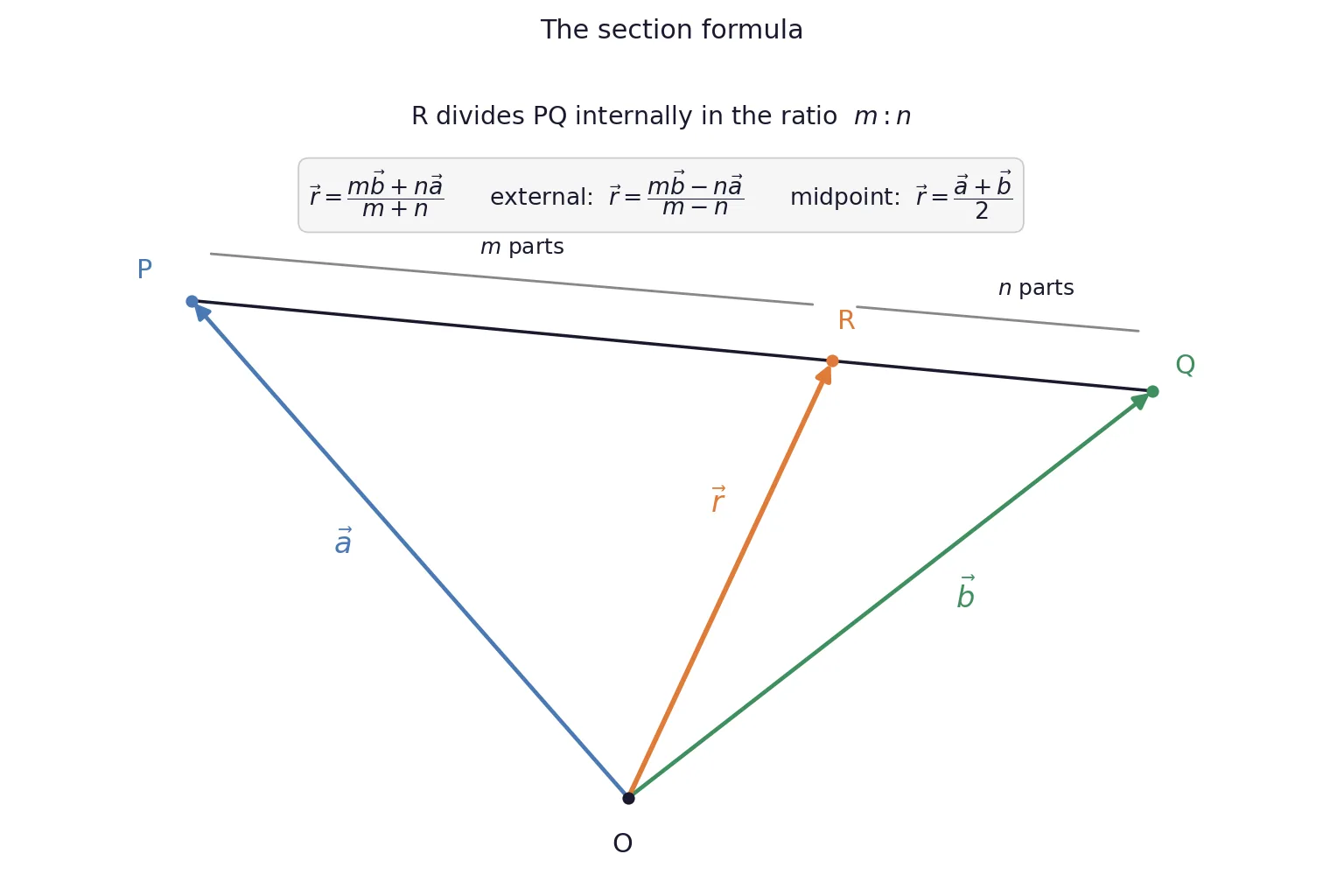
Let P and Q have position vectors a and b, and let R divide PQ in the ratio m:n.
Internal division (R between P and Q with RQPR=nm):
r=m+nmb+na
External division (R outside the segment with QRPR=nm):
r=m−nmb−na
Midpoint (m=n):
r=2a+b
Key Point (memory hook): in the internal formula the coefficient m (the first number of the ratio) multiplies b (the far point Q) — the ratio counts fromP, so m parts lie on the P-side and the weight m lands on the opposite end. Cross-pairing ma+nb is the single most common section-formula error.
The external formula is the internal one with n→−n — one formula to remember, one sign to flip.
Solved Examples
Example 1: Forcing equality
Find x,y,z so that the vectors xi^+2j^+zk^ and 2i^+yj^+k^ are equal.
Solution:
Componentwise matching: equality of vectors means equality of all corresponding components.
Read off:x=2, y=2, z=1.
Answer:x=2,y=2,z=1 — one vector equation is three scalar equations.
Example 2: Same magnitude, unequal vectors
Let a=i^+2j^ and b=2i^+j^. Is ∣a∣=∣b∣? Are the vectors equal?
Solution:
Magnitudes:∣a∣=1+4=5 and ∣b∣=4+1=5 — equal. ✓
Components:a1=1=2=b1 — the vectors are not equal.
Answer:∣a∣=∣b∣ but a=b: equal length says nothing about direction.
Example 3: Unit vector from components
Find the unit vector in the direction of a=2i^+3j^+k^.
Example 4: Prescribed magnitude in a given direction
Find a vector of magnitude 7 units in the direction of i^−2j^.
Solution:
Normalise:∣i^−2j^∣=5, so the unit vector is 51i^−52j^.
Scale by 7: the required vector is 57i^−514j^.
Answer:57i^−514j^ — normalise first, then stretch.
Example 5: Unit vector of a sum
Find the unit vector in the direction of the sum of 2i^+2j^−5k^ and 2i^+j^+3k^.
Solution:
Add first: the sum is 4i^+3j^−2k^.
Magnitude:16+9+4=29.
Divide:294i^+293j^−292k^.
Answer:291(4i^+3j^−2k^). Never normalise the two vectors separately and then add — unit vectors of parts do not sum to the unit vector of the whole.
Example 6: Direction ratios to direction cosines
Write the direction ratios of a=i^+j^−2k^ and hence its direction cosines.
Solution:
Ratios = components:a=1, b=1, c=−2.
Normalise:∣a∣=1+1+4=6, so l=61, m=61, n=−62.
Answer: direction ratios (1,1,−2); direction cosines (61,61,−62).
Example 7: Joining vector and the section formula
(i) Find the vector from P(2,3,0) to Q(−1,−2,−4). (ii) Find the point R dividing the join of A(i^+2j^−k^) and B(−i^+j^+k^) in the ratio 2:1 internally and externally.
Solution:
(i) Terminal minus initial:PQ=(−1−2)i^+(−2−3)j^+(−4−0)k^=−3i^−5j^−4k^.
(ii) Internal, m:n=2:1:r=32b+1a=32(−i^+j^+k^)+(i^+2j^−k^)=3−i^+4j^+k^.