
Complex Permanent Tissues - Xylem & Phloem
A complex tissue is made of more than one type of cell that work together as a unit. The two complex tissues are xylem and phloem; together they are the vascular (conducting) tissues.
Xylem - conducts water & minerals (upward, unidirectional)
Four elements:
- Tracheids - dead, elongated, tapering, lignified cells with no protoplast; the chief water-conducting element of gymnosperms and pteridophytes.
- Vessels (tracheae) - dead, long tube-like structures made of many cells (vessel members) joined end to end, with perforated common walls; a characteristic feature of angiosperms (highly efficient conduction).
- Xylem fibres - dead, sclerenchymatous, mainly mechanical support.
- Xylem parenchyma - the only living cells of xylem; store food and help in short-distance (radial) conduction of water.
The first-formed xylem is protoxylem (smaller vessels); the later, larger xylem is metaxylem. Position: in stems the protoxylem lies towards the centre and metaxylem outwards = endarch; in roots the protoxylem lies towards the periphery = exarch.
Phloem - conducts food/sugars (bidirectional)
Four elements:
- Sieve tube elements - living but enucleate at maturity (no nucleus); joined end to end through sieve plates; conduct food. Their function is controlled by the companion cell.
- Companion cells - living, specialised parenchyma closely associated with sieve tubes (connected by pits); they maintain the pressure gradient and control the enucleate sieve tube.
- Phloem parenchyma - living; store food and resins/latex; absent in most monocots.
- Phloem fibres (bast fibres) - the only dead, sclerenchymatous element of phloem; provide support (commercially valuable, e.g. jute, hemp).
High-yield traps: Vessels = angiosperm feature; tracheids = gymnosperm/pteridophyte. Xylem parenchyma is the ONLY living xylem cell; sieve tube is living-but-enucleate; companion cell controls it; phloem fibre is the ONLY dead phloem cell. Gymnosperm phloem has albuminous cells instead of companion cells and lacks sieve tubes & companion cells.
Visual - Xylem & Phloem Elements
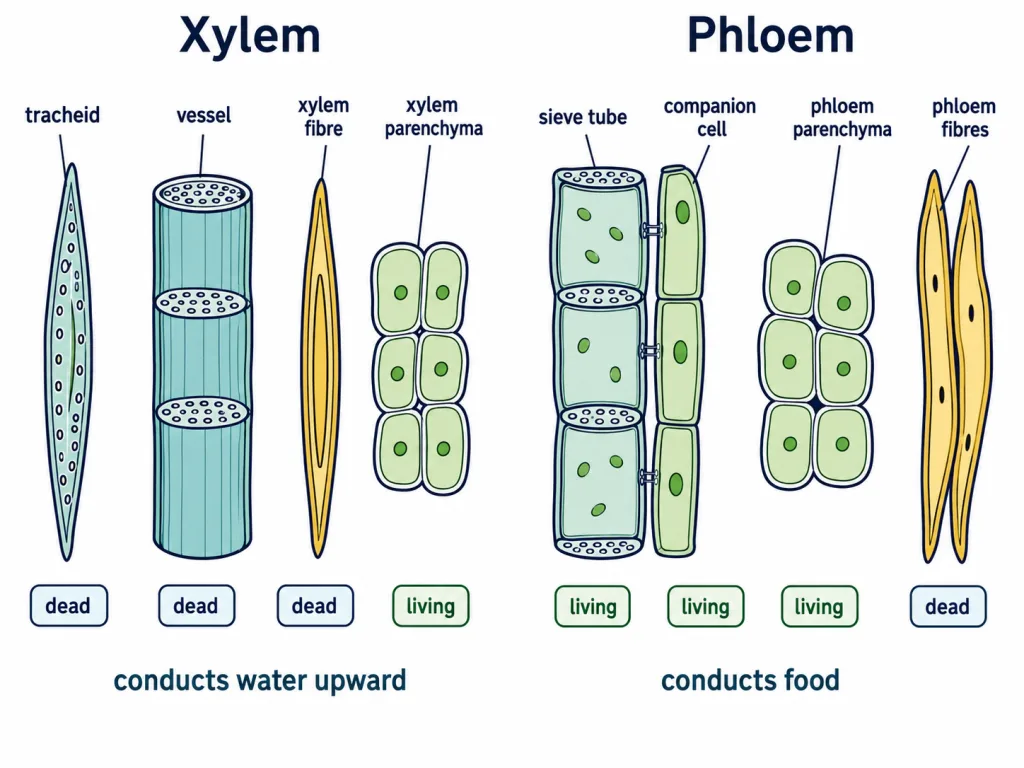
Xylem - tracheids, vessels (perforated end walls), xylem fibres, xylem parenchyma; Phloem - sieve tube elements with sieve plates, companion cells, phloem parenchyma, phloem fibres.
The Tissue Systems (Sachs)
On the basis of structure and location, all tissues are grouped into three tissue systems:
1. Epidermal tissue system
- The outermost covering; includes the epidermis, stomata and epidermal appendages.
- Epidermis - usually a single layer of parenchyma-like cells, covered on the outside by a waxy cuticle (thick in aerial parts, absent in roots).
- Stomata - pores in the epidermis (mostly of leaves) that regulate transpiration and gas exchange. Each stoma is bounded by two guard cells - bean/kidney-shaped in dicots, dumb-bell shaped in grasses (monocots). Guard cells (and sometimes subsidiary cells) contain chloroplasts.
- Epidermal appendages: root hairs (unicellular elongations of root epidermal cells, for absorption) and trichomes (usually multicellular hairs on the stem/shoot; may be branched; help reduce water loss).
2. Ground tissue system
- All tissues except the epidermis and the vascular bundles.
- Made mostly of parenchyma (with collenchyma/sclerenchyma); includes the cortex, pericycle, pith and medullary rays (in stems/roots) and the mesophyll (in leaves).
3. Vascular tissue system
- The xylem and phloem together, organised into vascular bundles.
- Radial bundle - xylem and phloem lie on different radii, alternating (seen in roots).
- Conjoint bundle - xylem and phloem lie together on the same radius (seen in stems & leaves); usually the phloem lies only on the outer side (collateral).
- Open bundle - has cambium between xylem and phloem → capable of secondary growth (dicot stem).
- Closed bundle - no cambium → no secondary growth (monocot stem).
One-liner recap: Roots = radial bundles; stems/leaves = conjoint collateral bundles. Dicot stem bundles = open (cambium present); monocot stem bundles = closed. Ground tissue = everything except epidermis + vascular bundles.