
Anatomy of the Leaf (Transverse Section)
Dorsiventral (dicot) leaf
- Epidermis on both surfaces with a cuticle; more stomata on the lower (abaxial) surface.
- Mesophyll (the ground tissue, made of chlorenchyma) is differentiated into:
- Palisade parenchyma - elongated cells, packed vertically below the upper epidermis, rich in chloroplasts (most photosynthesis).
- Spongy parenchyma - loosely arranged, irregular cells with large air spaces towards the lower epidermis (gas exchange).
- Vascular system - veins with vascular bundles; each bundle has a bundle sheath of parenchyma. Xylem is towards the upper side.
Isobilateral (monocot) leaf
- Stomata present on both surfaces in roughly equal numbers.
- Mesophyll is NOT differentiated into palisade and spongy - it is uniform.
- Bulliform cells - large, empty, thin-walled colourless cells in the upper epidermis of grasses; when they lose water (turgor) the leaf rolls/folds inward to minimise water loss.
- Veins are parallel and of similar size (except the larger midrib).
Dorsiventral vs Isobilateral leaf
| Feature | Dorsiventral (dicot) | Isobilateral (monocot) |
|---|---|---|
| Mesophyll | palisade + spongy (differentiated) | undifferentiated |
| Stomata | more on lower surface | equal on both surfaces |
| Bulliform cells | absent | present |
Trap: Kranz anatomy (a wreath of bundle-sheath cells around the vascular bundle) is the special leaf anatomy of C4 plants (e.g. maize, sugarcane) - a favourite link to the Photosynthesis chapter.
Visual - Dorsiventral vs Isobilateral Leaf (T.S.)
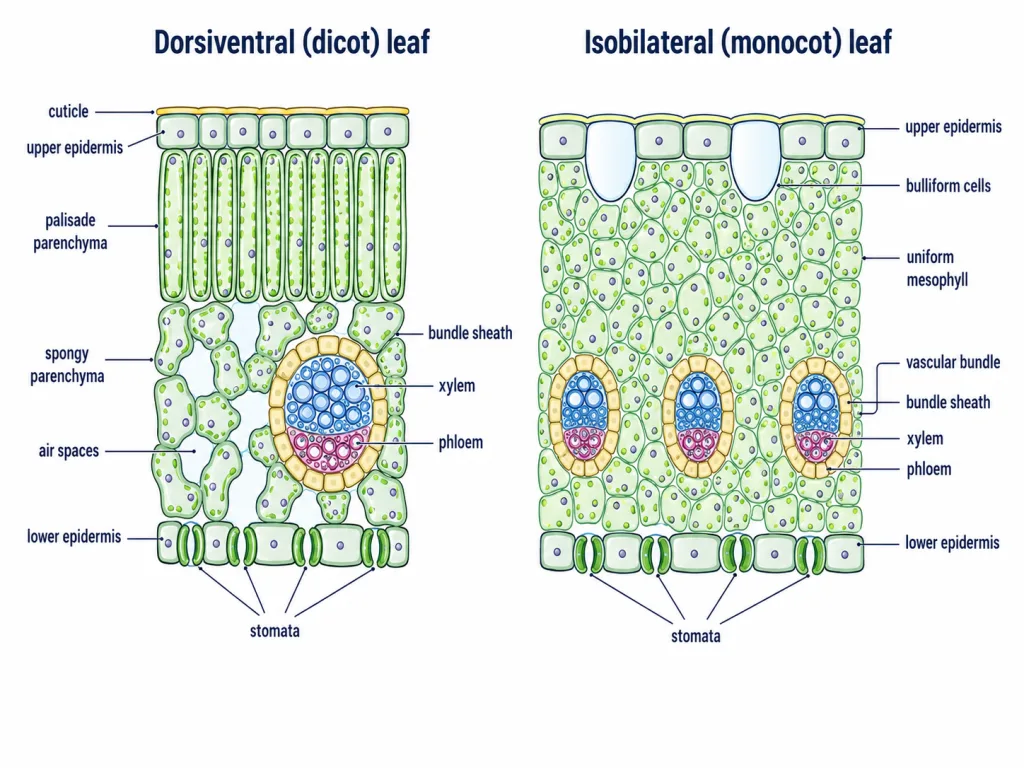
Dorsiventral leaf (palisade above, spongy below, stomata mainly lower) vs isobilateral leaf (uniform mesophyll, stomata both sides, bulliform cells).
Secondary Growth
Secondary growth is the increase in girth (thickness) produced by the lateral meristems - the vascular cambium and the cork cambium. It occurs in dicot stems and roots (and gymnosperms); monocots generally show no secondary growth.
1. Activity of the vascular cambium
- In the dicot stem, the cambium is at first present only within the bundles (fascicular/intrafascicular cambium). Cells of the medullary rays become meristematic to form the interfascicular cambium; the two join into a complete cambial ring.
- The cambium cuts off new cells: secondary xylem (wood) towards the inside and secondary phloem towards the outside. Much more xylem is formed than phloem, so wood accumulates.
2. Spring wood, autumn wood & annual rings
- Spring/early wood - formed when the cambium is very active (spring); vessels are wider, walls thinner, appears lighter.
- Autumn/late wood - formed in autumn; vessels narrower, walls thicker, appears darker.
- One ring of spring wood + one of autumn wood = one annual ring; counting annual rings estimates the plant's age (dendrochronology).
3. Heartwood & sapwood
- Heartwood (duramen) - the central, older, dark, dead secondary xylem; plugged with tannins/resins and tyloses; does not conduct water but gives mechanical support and is durable (commercial timber).
- Sapwood (alburnum) - the outer, lighter, living/functional secondary xylem that conducts water.
4. Cork cambium (phellogen) & periderm
As the stem thickens, the outer cortex/epidermis is torn, so a second lateral meristem, the cork cambium (phellogen), forms in the cortex. It cuts off:
- Cork (phellem) on the outside - dead, walls suberised, impervious to water and gases (protective).
- Secondary cortex (phelloderm) on the inside - living parenchyma.
Together phellem + phellogen + phelloderm = periderm. Aerating pores called lenticels develop in the cork for gas exchange.
5. Bark
- Bark = all the tissues outside the vascular cambium = secondary phloem + periderm. Early (soft) bark and late (hard) bark; when the cork cambium forms a continuous ring the bark peels in sheets (ring bark), or in scales (scaly bark).
Sequence to memorise: fascicular + interfascicular cambium → cambial ring → secondary xylem (in) + secondary phloem (out) → cork cambium → cork + secondary cortex (periderm) → lenticels → bark.
Visual - Secondary Growth in a Dicot Stem
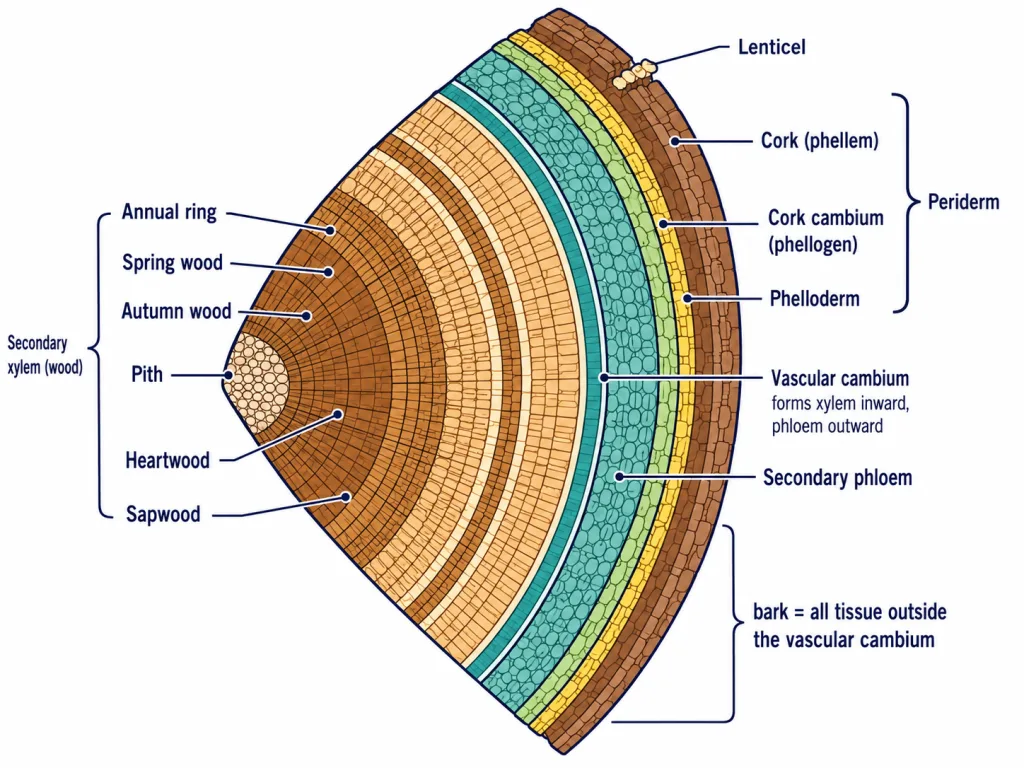
The cambial ring cuts off secondary xylem (wood) inward and secondary phloem outward; the cork cambium forms the periderm (cork + phelloderm) with lenticels; annual rings and heart/sapwood in the wood.