
Anatomy of the Root (Transverse Section)
From outside inward, both dicot and monocot roots show: epidermis (epiblema) → cortex → endodermis → pericycle → vascular bundles → pith.
- Epiblema (root epidermis / rhizodermis) - single layer, many cells bear root hairs; no cuticle, no stomata.
- Cortex - several layers of thin-walled parenchyma with intercellular spaces; stores food.
- Endodermis - the innermost cortex layer; a single layer of barrel-shaped cells with Casparian strips (bands of suberin/lignin on the radial and transverse walls) that regulate water flow. Thin-walled passage cells opposite the protoxylem allow water into the xylem.
- Pericycle - a layer just inside the endodermis; the site of origin of lateral roots and (in dicots) part of the vascular cambium during secondary growth.
- Vascular bundles - radial (xylem and phloem alternate). Xylem is exarch (protoxylem outer).
- Conjunctive tissue - parenchyma between the xylem and phloem strands.
- Pith - small or absent in dicot roots.
Dicot root vs Monocot root
| Feature | Dicot root | Monocot root |
|---|---|---|
| Number of xylem groups | few - 2 to 4 (di-, tri-, tetrarch) | many - usually more than six (polyarch) |
| Pith | small or absent | large, well developed |
| Secondary growth | present | absent |
| Xylem | exarch, radial | exarch, radial |
Trap: the reliable dicot-vs-monocot root discriminators are the number of xylem arches (2-4 vs >6/polyarch) and the pith (small/absent vs large). Example: bean/gram root = dicot (tetrarch); maize root = monocot (polyarch).
Anatomy of the Stem (Transverse Section)
Dicot stem (e.g. sunflower)
From outside inward: epidermis (with cuticle & multicellular trichomes) → hypodermis (collenchyma) → cortex (parenchyma) → endodermis (starch sheath - stores starch) → pericycle (semilunar patches of sclerenchyma above the phloem = the bundle caps) → vascular bundles → pith + medullary rays.
- Vascular bundles are conjoint, collateral, open (cambium present) and endarch, arranged in a ring.
- Medullary (pith) rays - parenchyma between the vascular bundles.
Monocot stem (e.g. maize)
- Epidermis with cuticle; hypodermis of sclerenchyma (not collenchyma).
- Ground tissue is not differentiated into cortex/endodermis/pericycle/pith - it is one continuous mass of parenchyma.
- Vascular bundles are scattered throughout the ground tissue, each surrounded by a sclerenchymatous bundle sheath.
- Bundles are conjoint, collateral and closed (no cambium) → no secondary growth.
- Each bundle has a characteristic 'Y'-shaped xylem with two large metaxylem vessels and one or two protoxylem vessels; below the protoxylem is a water-containing cavity - the protoxylem lacuna.
- Phloem parenchyma is absent; peripheral bundles are smaller than central ones.
Dicot stem vs Monocot stem
| Feature | Dicot stem | Monocot stem |
|---|---|---|
| Vascular bundles | in a ring | scattered |
| Bundle type | conjoint, collateral, open | conjoint, collateral, closed |
| Bundle sheath | absent | sclerenchymatous, present |
| Hypodermis | collenchyma | sclerenchyma |
| Ground tissue | differentiated (cortex/pith) | undifferentiated |
| Secondary growth | present | absent |
| Protoxylem lacuna | absent | present |
The single most-tested fact: dicot stem = vascular bundles in a ring, open; monocot stem = bundles scattered, closed, with a bundle sheath and a protoxylem lacuna.
Visual - Dicot vs Monocot Root & Stem (T.S.)
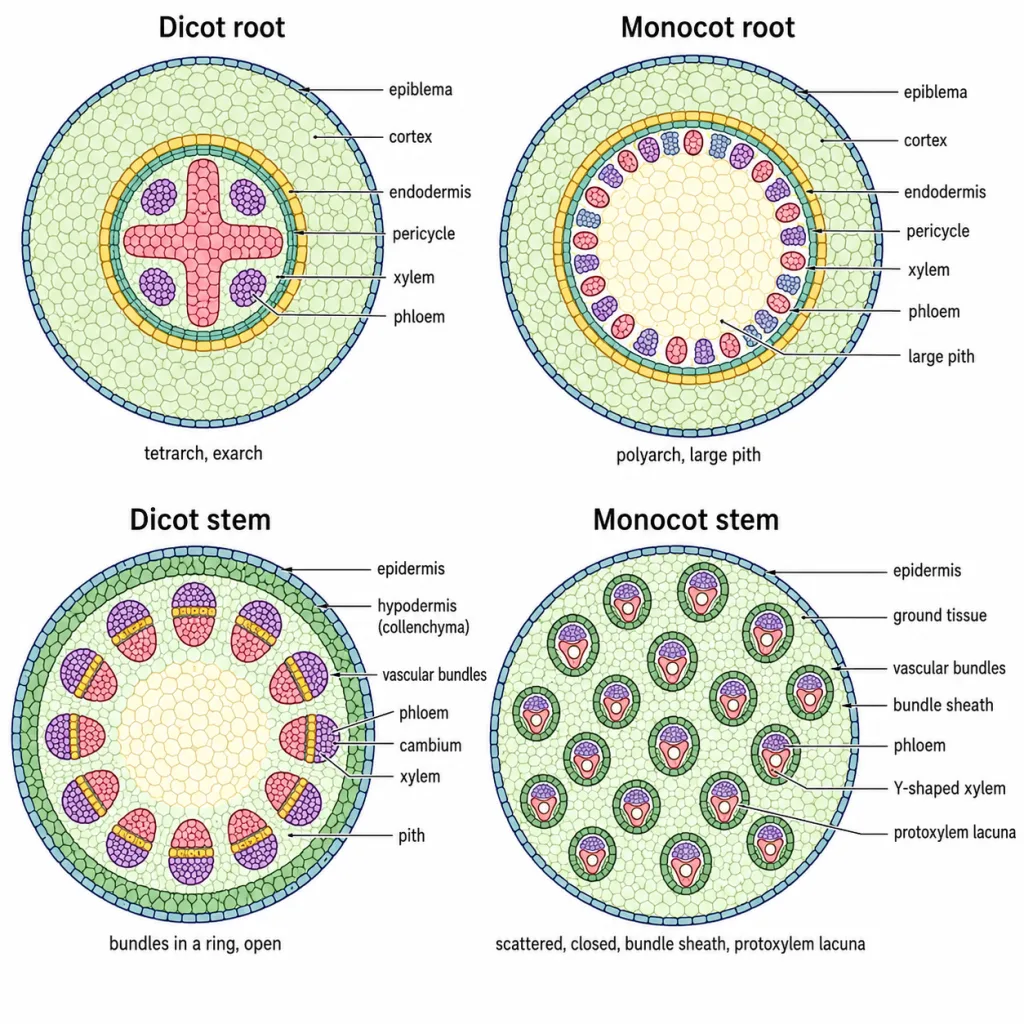
T.S. of dicot root (2-4 xylem, exarch, small pith) vs monocot root (polyarch, large pith); dicot stem (bundles in a ring, open, endarch) vs monocot stem (scattered closed bundles with sclerenchyma sheath and protoxylem lacuna).