
Systems of Classification - From Two Kingdoms to Five
Since the earliest times, humans have tried to classify living organisms. Aristotle attempted the first scientific classification, dividing plants into herbs, shrubs and trees, and animals into those with red blood and those without.
The Two-Kingdom System
Linnaeus developed a two-kingdom system with kingdoms Plantae and Animalia. It served for a long time but had serious limitations - it did not distinguish between:
- eukaryotes and prokaryotes,
- unicellular and multicellular organisms, and
- photosynthetic (green algae) and non-photosynthetic (fungi) organisms.
Grouping such different organisms together (e.g., placing bacteria, fungi and green algae all under 'plants' because they have cell walls) made the system unnatural. A large number of organisms did not fall into either kingdom. Classification systems therefore kept changing as understanding improved.
Whittaker's Five Kingdom Classification (1969)
R. H. Whittaker (1969) proposed the Five Kingdom Classification with the kingdoms Monera, Protista, Fungi, Plantae and Animalia.
Criteria used by Whittaker
- Cell structure - prokaryotic or eukaryotic
- Body organisation - unicellular or multicellular
- Mode of nutrition - autotrophic (photosynthetic or chemosynthetic) or heterotrophic (saprophytic, parasitic or holozoic)
- Reproduction, and
- Phylogenetic relationships.
The five kingdoms at a glance
| Character | Monera | Protista | Fungi | Plantae | Animalia |
|---|---|---|---|---|---|
| Cell type | Prokaryotic | Eukaryotic | Eukaryotic | Eukaryotic | Eukaryotic |
| Cell wall | Non-cellulosic (with amino acids) | Present in some | Present (chitin) | Present (cellulose) | Absent |
| Body organisation | Cellular | Cellular | Multicellular / loose tissue | Tissue/organ | Tissue/organ/organ-system |
| Nutrition | Autotrophic + Heterotrophic | Autotrophic + Heterotrophic | Heterotrophic (saprophytic/parasitic) | Autotrophic (photosynthetic) | Heterotrophic (holozoic) |
What changed: blue-green algae (cyanobacteria) were placed with bacteria in Monera; fungi were separated from plants into their own kingdom; and single-celled eukaryotes were grouped in Protista. Placing organisms is still not perfect - e.g., members of Protista have fuzzy boundaries, and some organisms (viruses, viroids, prions, lichens) are not placed in any kingdom.
Visual - Whittaker's Five Kingdoms
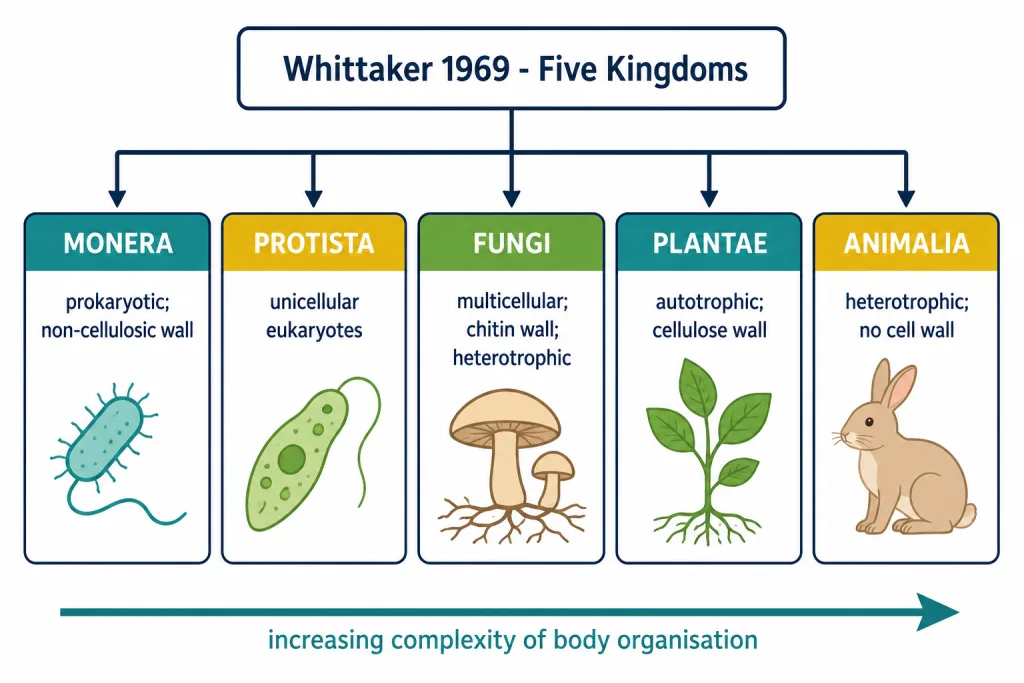
Increasing complexity of body organisation runs left to right: Monera < Protista < Fungi < Plantae < Animalia.
Kingdom Plantae and Kingdom Animalia (one-liner layer)
The five-kingdom system is completed by Plantae and Animalia. These are studied in detail in later chapters, but NEET tests a few one-liners from here:
Kingdom Plantae - eukaryotic, chlorophyll-containing (autotrophic) organisms with a cellulose cell wall; includes algae, bryophytes, pteridophytes, gymnosperms and angiosperms. A few are partially heterotrophic:
- Insectivorous plants - Venus flytrap, Bladderwort (Utricularia), Pitcher plant (Nepenthes).
- Parasites - Cuscuta (dodder), a rootless stem parasite.
- Plant cells have chloroplasts and a large central vacuole; the life cycle shows alternation of generations (a sporophyte and a gametophyte phase).
Kingdom Animalia - eukaryotic, multicellular, heterotrophic (holozoic - they ingest food) organisms that lack a cell wall. They store food as glycogen or fat, mostly reproduce sexually, and higher forms show elaborate sensory/neuromotor coordination and locomotion; development may be direct or indirect.