
Kingdom Fungi
Fungi are heterotrophic eukaryotes, cosmopolitan in distribution. Their cell wall is made of chitin and polysaccharides. The fungal body is a mycelium - a network of thread-like hyphae. Hyphae may be coenocytic (continuous tubes, multinucleate, without cross-walls) or septate (with cross-walls). Nutrition is saprophytic (on dead organic matter), parasitic, or symbiotic (as in lichens and mycorrhiza).
Reproduction in fungi
- Vegetative - fragmentation, fission, budding.
- Asexual - spores called conidia, sporangiospores or zoospores.
- Sexual - oospores, ascospores and basidiospores.
The sexual cycle runs: plasmogamy (fusion of two protoplasms) -> karyogamy (fusion of the two nuclei) -> meiosis in the zygote. In some fungi the two haploid nuclei do not fuse at once but pair up, giving a dikaryotic (n+n) stage before karyogamy.
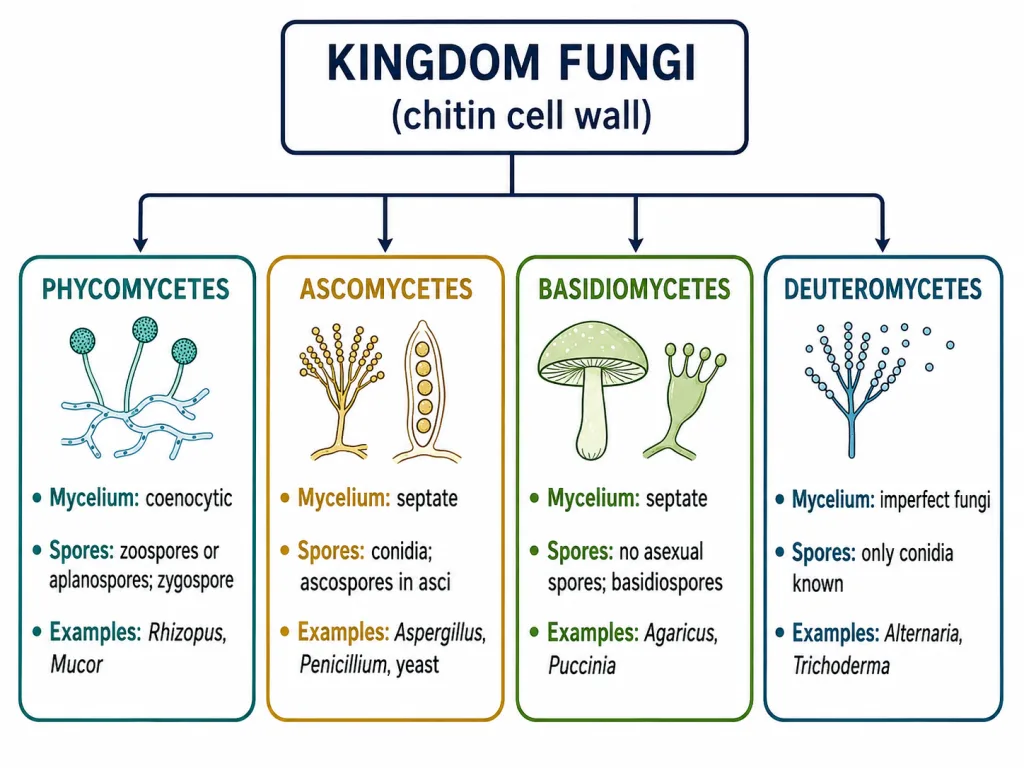
The four classes of fungi
| Class | Mycelium | Asexual spores | Sexual spore | Examples |
|---|---|---|---|---|
| Phycomycetes | Coenocytic (aseptate) | Zoospores / aplanospores (in sporangium) | Zygospore | Mucor, Rhizopus (bread mould), Albugo |
| Ascomycetes (sac-fungi) | Septate, branched | Conidia (exogenous, on conidiophores) | Ascospores (in asci, in ascocarps) | Aspergillus, Penicillium, Claviceps, Neurospora, yeast |
| Basidiomycetes | Septate, branched | Absent (vegetative by fragmentation) | Basidiospores (exogenous, on basidium, in basidiocarps) | Agaricus (mushroom), Ustilago (smut), Puccinia (rust) |
| Deuteromycetes (imperfect fungi) | Septate | Conidia | Only asexual/vegetative stages known | Alternaria, Colletotrichum, Trichoderma |
Deuteromycetes are called 'imperfect fungi' because only their asexual or vegetative phase is known; once a sexual (perfect) stage is discovered, they are moved to Ascomycetes or Basidiomycetes. Many are decomposers that help in mineral cycling.
Viruses, Viroids, Prions and Lichens
These do not fit into the five-kingdom system.
Viruses
Viruses are non-cellular, inert crystalline structures outside the living cell. D. Ivanowsky (1892) discovered them (from tobacco mosaic disease). M.W. Beijerinck (1898) called the extract Contagium vivum fluidum (infectious living fluid). W.M. Stanley (1935) showed viruses could be crystallised and are largely proteins.
A virus is a nucleoprotein - genetic material enclosed in a protein coat called a capsid made of subunits called capsomeres. A virus has either DNA or RNA, never both:
- Plant viruses - usually single-stranded RNA;
- Animal viruses - single- or double-stranded RNA or double-stranded DNA;
- Bacteriophages - usually double-stranded DNA.
Viral diseases include mumps, smallpox, herpes, influenza and AIDS (humans), and mosaic, leaf rolling and curling, yellowing, vein-clearing and dwarfing (plants).
Viroids
Discovered by T. O. Diener (1971). A viroid is a free RNA of low molecular weight with no protein coat (smaller than viruses). It causes potato spindle tuber disease.
Prions
Prions are infectious agents made of abnormally folded protein. They cause bovine spongiform encephalopathy (BSE, 'mad cow disease') in cattle and the analogous Creutzfeldt-Jakob disease (CJD) in humans.
Lichens
Lichens are symbiotic associations of an alga and a fungus. The algal component (phycobiont) is autotrophic and prepares food; the fungal component (mycobiont) is heterotrophic and provides shelter and absorbs mineral nutrients and water - a case of mutualism. Lichens are excellent pollution indicators - they do not grow in polluted areas.
Visual - Structure of a Bacteriophage
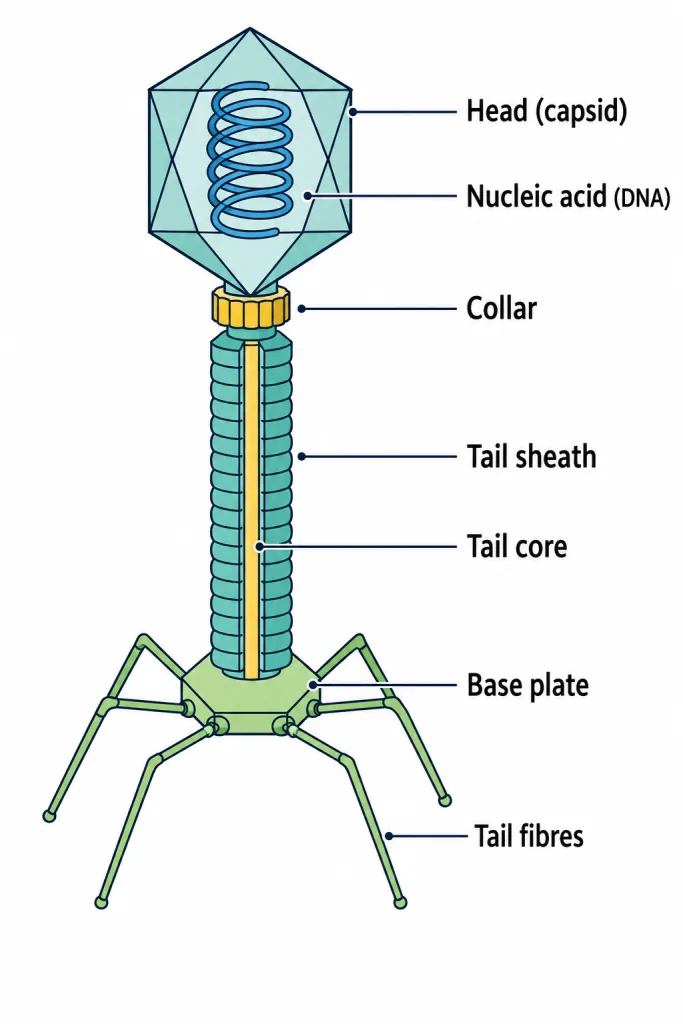
A bacteriophage is a nucleoprotein - a polyhedral head (capsid) enclosing the nucleic acid (dsDNA in most phages), connected by a tail (sheath + core) to a base plate with tail fibres for attachment.
Visual - Sexual Cycle in Fungi
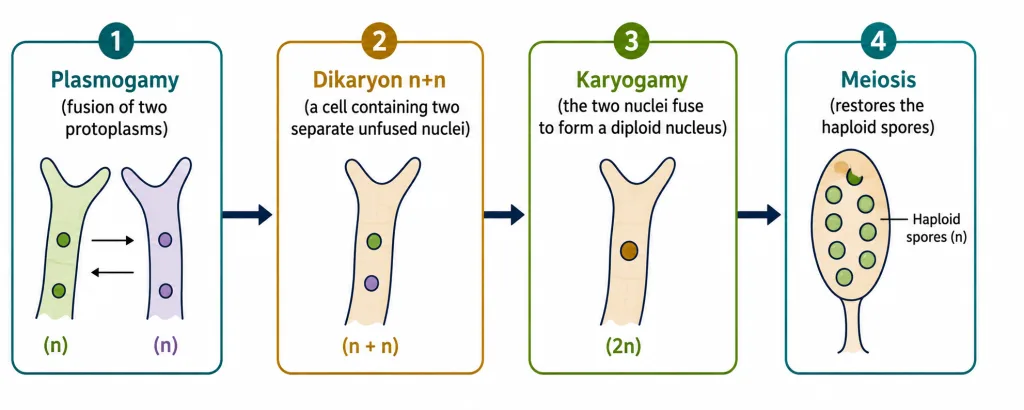
Order to remember: Plasmogamy -> Karyogamy -> Meiosis (with a dikaryotic n+n stage in Ascomycetes and Basidiomycetes).
Visual - The Four Classes of Fungi
Economic Importance of Fungi (one-liner layer)
NEET regularly tests fungal uses and harms, so memorise these:
Useful fungi
- Yeast (Saccharomyces cerevisiae) - used in baking and in brewing (fermentation of beer and wine).
- Penicillium - source of the antibiotic penicillin.
- Edible fungi - mushrooms (Agaricus), and morels and truffles are prized edible delicacies.
- Neurospora - used extensively in genetic and biochemical research.
Harmful fungi
- Puccinia - causes wheat rust; Ustilago - causes smut.
- Claviceps (ergot) - source of many alkaloids and LSD; ergot poisoning of grain.
- Many cause plant, animal and human diseases (e.g., ringworm, and food spoilage).