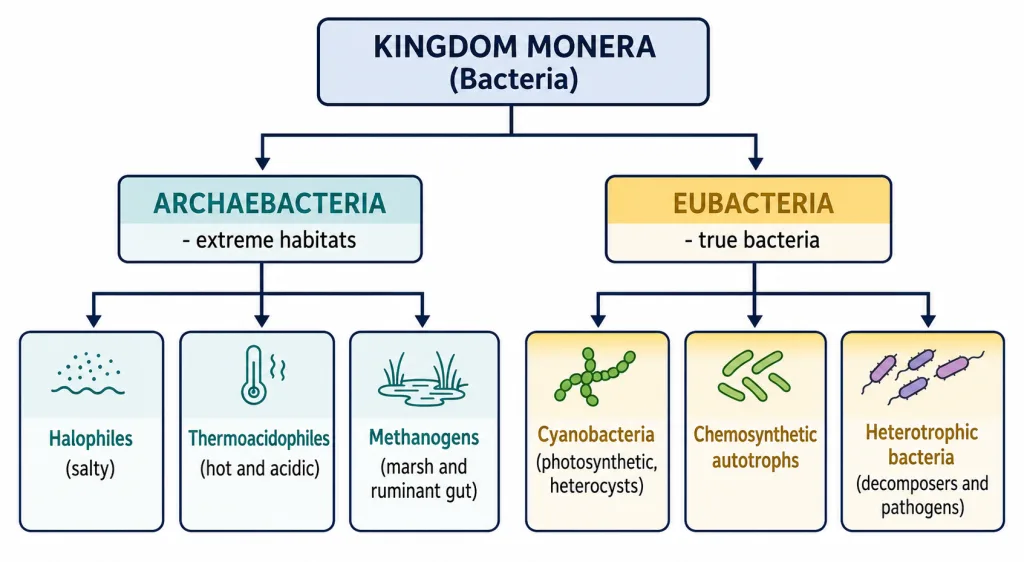
Kingdom Monera - The Bacteria
Bacteria are the sole members of Kingdom Monera. They are prokaryotic, the most abundant micro-organisms, and occur almost everywhere. Most have a cell wall.
Bacterial shapes
- Coccus (pl. cocci) - spherical
- Bacillus (pl. bacilli) - rod-shaped
- Vibrio - comma-shaped
- Spirillum - spiral
Nutrition
Though structurally simple, bacteria are the most complex group in behaviour. Some are autotrophic (photosynthetic or chemosynthetic); the vast majority are heterotrophic.
Archaebacteria
Archaebacteria live in some of the most extreme habitats and differ from other bacteria in cell-wall structure, which lets them survive extreme conditions. They include:
- Halophiles - in extremely salty areas,
- Thermoacidophiles - in hot springs / acidic conditions,
- Methanogens - in marshy areas and the gut of ruminant animals (cows, buffaloes); they produce methane (biogas) from dung.
Eubacteria, Cyanobacteria and Mycoplasma
Eubacteria ('true bacteria')
Characterised by a rigid cell wall and, if motile, a flagellum.
- Cyanobacteria (blue-green algae, BGA): photosynthetic autotrophs with chlorophyll a; unicellular, colonial or filamentous; often surrounded by a gelatinous sheath. Some fix atmospheric nitrogen in specialised cells called heterocysts (e.g., Nostoc, Anabaena). They can form blooms in polluted water.
- Chemosynthetic autotrophic bacteria: oxidise inorganic substances (nitrogen, sulphur, iron, etc.) and use the released energy for ATP; they play a great role in recycling nutrients (N, P, Fe, S).
- Heterotrophic bacteria: the most abundant; they are important decomposers. Useful ones help make curd from milk, produce antibiotics and fix nitrogen in legume roots; some are pathogens causing cholera, typhoid, tetanus and citrus canker.
Reproduction in bacteria
Mainly by binary fission. Under unfavourable conditions they form spores. They also show a primitive type of DNA transfer (a primitive sexual reproduction).
Mycoplasma
Mycoplasma are the smallest living cells. They completely lack a cell wall, can survive without oxygen (many are anaerobic), and many are pathogenic in animals and plants.
Visual - Bacterial Shapes
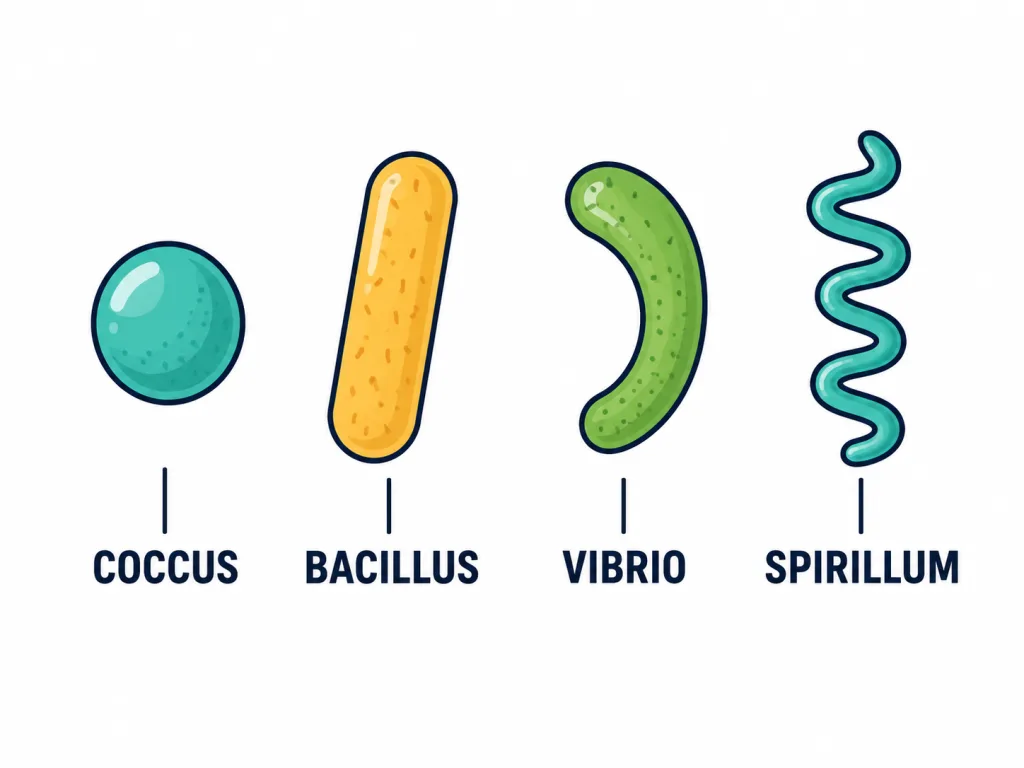
The four basic shapes: Coccus (spherical), Bacillus (rod), Vibrio (comma) and Spirillum (spiral).
Visual - Kingdom Monera at a Glance