
Kingdom Protista - The Single-celled Eukaryotes
Kingdom Protista includes all single-celled eukaryotes. Being eukaryotic, they have membrane-bound organelles and a well-defined nucleus; some bear flagella or cilia. They reproduce asexually and sexually (by cell fusion and zygote formation). Protista is a link with the plants, animals and fungi. Its boundaries are not well defined. It includes Chrysophytes, Dinoflagellates, Euglenoids, Slime moulds and Protozoans.
Chrysophytes
Include diatoms and golden algae (desmids). Microscopic and float passively in water currents (plankton); mostly photosynthetic. Diatoms have cell walls of silica forming two thin overlapping shells that fit together like a soap-box. The walls are indestructible and accumulate over billions of years as 'diatomaceous earth' (used in polishing and in filtration of oils and syrups). Diatoms are the chief producers in the oceans.
Dinoflagellates
Mostly marine and photosynthetic; appear yellow, green, brown, blue or red depending on their pigments. The cell wall has stiff cellulose plates; they usually have two flagella (one longitudinal, one transverse). Red dinoflagellates (e.g., Gonyaulax) may multiply so rapidly that the sea appears red - a 'red tide' - and their toxins can kill fishes and other marine animals.
Euglenoids, Slime Moulds and Protozoans
Euglenoids
Mostly freshwater organisms of stagnant water. They lack a cell wall; instead they have a protein-rich pellicle which is flexible. They have two flagella (a short and a long one). They are photosynthetic in sunlight but behave as heterotrophs (predatory) when deprived of sunlight - i.e., they are mixotrophic. Their pigments are identical to those of higher plants. Example: Euglena.
Slime moulds
Saprophytic protists. The body moves along decaying twigs and leaves, engulfing organic material. Under suitable conditions the bodies aggregate to form a plasmodium which may grow and spread. During unfavourable conditions the plasmodium differentiates and forms fruiting bodies bearing spores at their tips. The spores have true walls, are extremely resistant, and are dispersed by air currents.
Protozoans
All protozoans are heterotrophs - predators or parasites. Four groups:
- Amoeboid protozoans - move and capture prey by pseudopodia (e.g., Amoeba); some are parasites (e.g., Entamoeba); marine forms have silica shells.
- Flagellated protozoans - free-living or parasitic; move by flagella; parasitic forms cause diseases such as sleeping sickness (e.g., Trypanosoma).
- Ciliated protozoans - aquatic, actively moving using thousands of cilia; have a gullet opening to the cell surface (e.g., Paramoecium).
- Sporozoans - have an infectious spore-like stage; e.g., Plasmodium (the malarial parasite).
Visual - The Major Groups of Protista
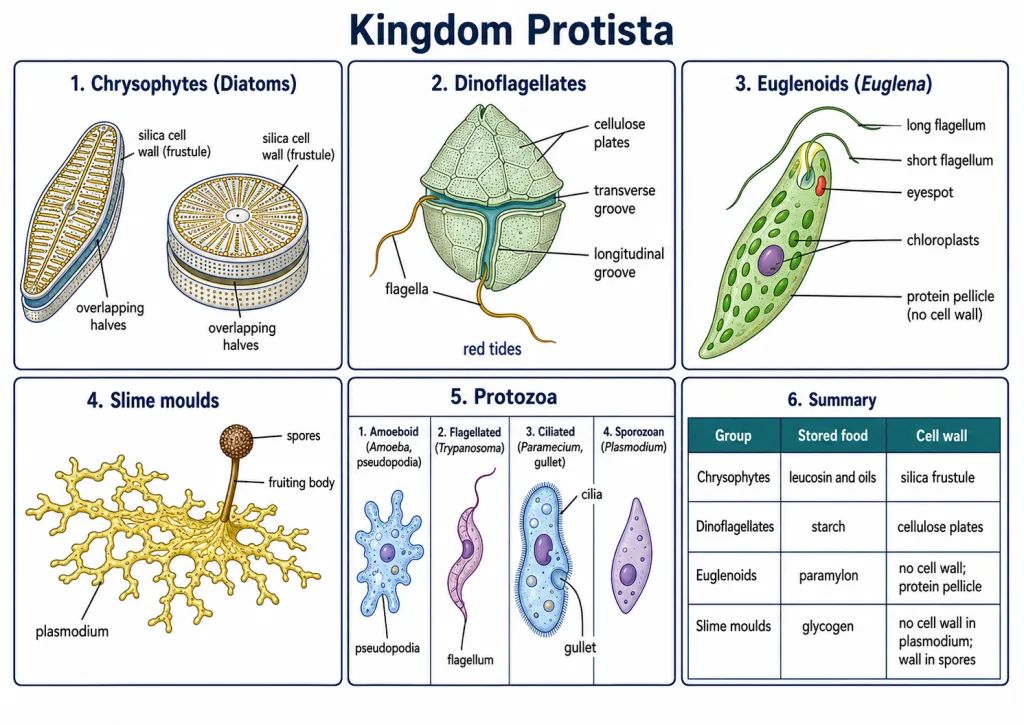
Chrysophytes (diatoms with silica walls), dinoflagellates (cause red tides), euglenoids (flexible protein pellicle with two unequal flagella), slime moulds (a plasmodium) and the four protozoan types - amoeboid, flagellated, ciliated and sporozoan.