
The Cell Cycle
The cell cycle is the sequence of events by which a cell duplicates its DNA and divides into two daughter cells. A typical human cell cycle takes about 24 hours (a yeast cell completes it in only about 90 minutes). It has two broad phases: the long interphase and the short M phase (mitotic phase).
In a 24-hour human cell cycle, interphase lasts ~23 hours and the M phase only ~1 hour - so interphase is the longest phase (it is NOT a 'resting' phase; the cell is metabolically very active).
Interphase - the phase of preparation ('between two M phases')
Interphase has three sub-phases:
- G1 phase (Gap 1) - follows cell division; the cell grows and is metabolically active, but does NOT replicate its DNA.
- S phase (Synthesis) - DNA replication occurs; the amount of DNA per cell doubles (e.g. from 2C to 4C). The number of chromosomes does NOT change - each chromosome now consists of two sister chromatids. In an animal cell, the centriole also duplicates in the cytoplasm.
- G2 phase (Gap 2) - the cell continues to grow and synthesises proteins (e.g. tubulin) and organelles in preparation for mitosis.
The G0 (quiescent) stage
Some cells (e.g. heart muscle, nerve cells) that do not divide again exit the cycle at G1 and enter an inactive stage called G0. Such cells are metabolically active but do not proliferate unless called upon.
High-yield one-liners: DNA replicates only in the S phase; DNA content doubles in S but chromosome number stays the same; G1 → S → G2 → M is the order; G0 = quiescent/exit stage; interphase is the longest and most active part of the cycle.
Visual - The Cell Cycle
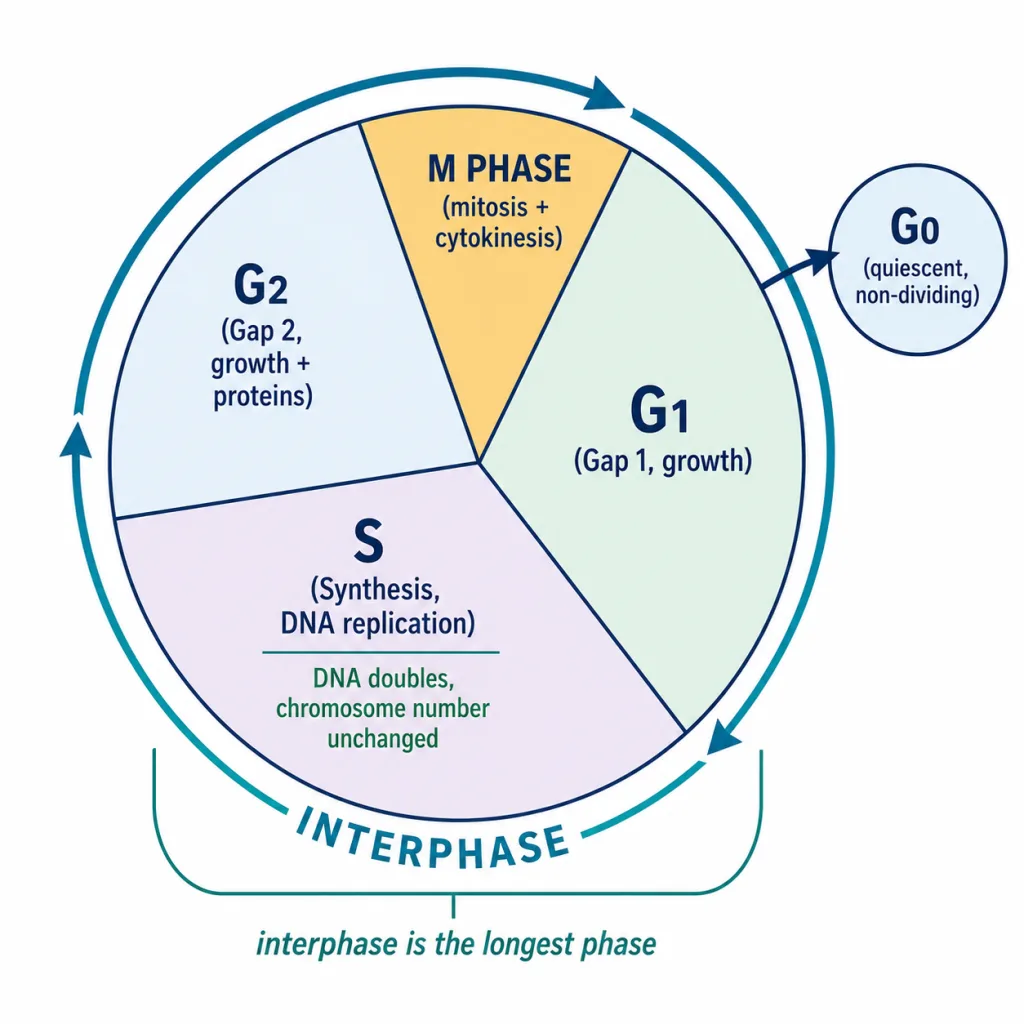
The cell cycle: interphase (G1 → S → G2) occupies most of the cycle, followed by the short M phase (mitosis + cytokinesis); non-dividing cells exit into G0 from G1.