
Meiosis II & the Significance of Meiosis
Meiosis II - the equational division (resembles mitosis)
After a short interkinesis (with no DNA replication), the two haploid cells undergo Meiosis II:
- Prophase II - chromosomes condense again; the nuclear envelope breaks down.
- Metaphase II - the chromosomes align at the equator; spindle fibres attach to the kinetochores of the sister chromatids.
- Anaphase II - the centromeres finally split and the sister chromatids separate and move to opposite poles (as in mitosis).
- Telophase II - four haploid nuclei form; after cytokinesis there are four haploid daughter cells in all.
Significance of meiosis
- Halves the chromosome number, so that when two gametes fuse at fertilisation the diploid number is restored and kept constant across generations.
- Generates genetic variation through (i) crossing over (in pachytene) and (ii) the independent (random) assortment of homologous chromosomes in metaphase I - the raw material for evolution.
Mitosis vs Meiosis - the master comparison
| Feature | Mitosis | Meiosis |
|---|---|---|
| Where | somatic (body) cells | reproductive cells |
| Divisions | one | two (I and II) |
| DNA replication | once, before the one division | once, before the two divisions |
| Daughter cells | two, diploid | four, haploid |
| Chromosome number | maintained (equational) | halved (reductional) |
| Pairing / crossing over | absent | present (synapsis, chiasmata) |
| Daughter cells genetically | identical to parent | different (variation) |
Traps: meiosis = one DNA replication but two divisions; the centromere splits in anaphase II (not anaphase I); variation comes from crossing over + independent assortment; four haploid cells result.
Visual - Meiosis I & II Overview
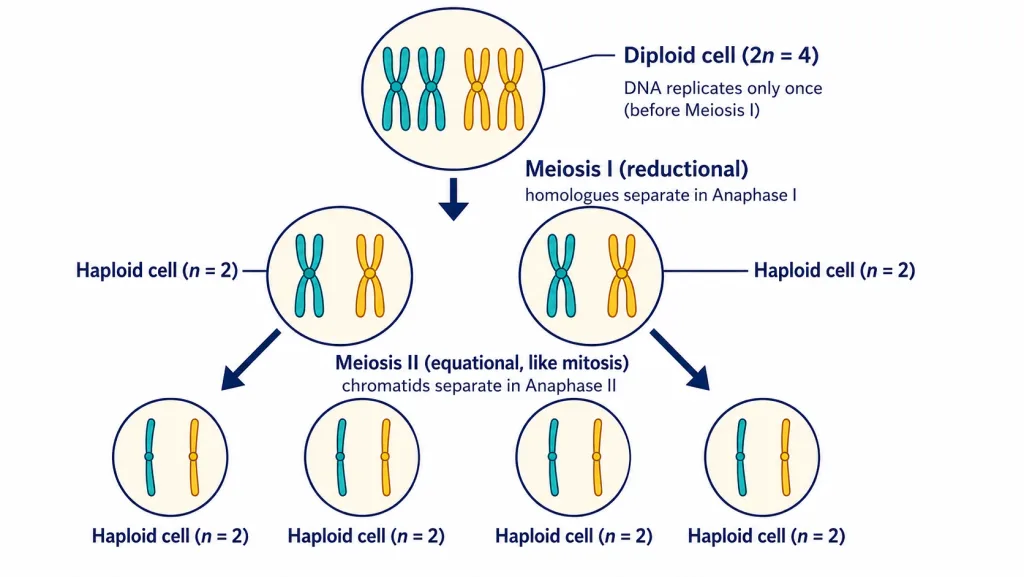
One diploid cell → Meiosis I (homologues separate, reductional) → two cells → Meiosis II (chromatids separate, equational) → four haploid cells.